Turning Heat On for the First Time in Winter: A Safe Start Checklist
- What to Do Before Turning Heat On for the First Time: 8 Quick Checks
- Turning On the Heat for the First Time: The Test Run
- Before the First Storm: Will Your Gas Furnace Run During a Winter Power Outage? (EcoFlow TITAN 5000 Classic)
- First Time Turning On Heat After Summer: What's Normal and What's a Warning
- Turning On a Heater After a Long Time: Space Heaters and Heat Pumps
- When to Call an HVAC Technician Before the First Cold Snap
- Conclusion
- FAQs
You wake up on the first chilly morning of late fall. You bump the thermostat up to call for heat. Within minutes, a dry, dusty, burning smell drifts out of your supply vents. Naturally, you stop and wonder if something inside your furnace is burning up.
This guide gives you a quick pre-start checklist and a step-by-step test run. We will break down which sounds and smells are harmless and which need a professional. We also cover one critical check most checklists overlook: will your gas furnace keep running if a winter freeze takes out the power grid?
What to Do Before Turning Heat On for the First Time: 8 Quick Checks
Most heating troubles on the first freezing night start with very basic oversights. A clogged filter, a blocked register, or a dead alarm battery can shut everything down. These eight checks take only a few minutes and require nothing more than a flashlight. Make sure to complete them before you switch your thermostat from cool to heat.
# | Check | What to do | Why it matters (source) |
1 | Air filter | Pull the filter and hold it to the light; replace it if it looks dirty. | ENERGY STAR (Heat & Cool Efficiently): Check your filter every month, especially during high-use seasons, and change it at least every 3 months. |
2 | Filter rating | If you upgrade, check the MERV number against what your furnace can handle. | The EPA notes you should choose at least a MERV 13 rating, or as high as your system fan and filter slot can handle. An HVAC tech can confirm what works for your unit. |
3 | Supply vents and return grilles | Open closed registers; move rugs, furniture, and curtains off them. | Restricted airflow forces your blower fan to work harder, straining the motor and driving up your utility bill. |
4 | Space around the furnace | Clear boxes, paint cans, laundry, and anything flammable that collected in the utility area over summer. | Flammables sitting right next to the burner cabinet pose an immediate fire hazard. Keep the area wide open. |
5 | CO and smoke alarms | Press the test button; replace batteries; check the date on the back. | The CPSC urges alarms on every level and near bedrooms. The CDC recommends battery checks each spring and fall, plus replacing units every 5 years. |
6 | Thermostat | Replace batteries if it uses them; confirm the mode is set to heat, not cool or off. | A dead thermostat display stops the furnace from getting the call to fire up. |
7 | Outdoor vent and intake pipes | On high-efficiency furnaces with plastic pipes through the wall or roof, look for leaves, nests, or debris at the openings. Don't take anything apart. | A blocked exhaust pipe forces dangerous fumes back inside. It can also trip safety switches that lock down the burner. |
8 | Fuel supply | Confirm the gas valve to the furnace is on; if you heat with propane, check the tank gauge before the first cold snap. | If the gas valve is shut off, your furnace will fail ignition and enter safety lockout mode. |
Both the Consumer Product Safety Commission (CPSC) and the Centers for Disease Control and Prevention (CDC) stress keeping carbon monoxide monitors active. CO is completely odorless, invisible, and lethal. Always test every sensor before your heating season kicks off.
Swapping your filter and clearing return grilles also ties straight into a larger pre-winter home energy efficiency checkup that targets hidden window drafts, duct leaks, and attic insulation gaps before sub-zero temperatures arrive.
Once your filters are clean, vents are clear, alarms work, and fuel is on, you are ready for the first live heating cycle.
Turning On the Heat for the First Time: The Test Run
A test run on a mild fall day is much less stressful than discovering a problem in the middle of a freezing night. Watch for three things: the furnace starts, warm air reaches the rooms, and the system shuts off when the thermostat reaches its target.
If any of these steps fails, stop the test and contact a qualified HVAC technician.
Step-by-step test sequence
Adjust the thermostat: Set the thermostat mode switch to "Heat." Raise the target temperature a few degrees above the current indoor reading so the system receives a clear call for heat.
Listen at the furnace: Stand near the cabinet and listen closely. You should hear the small draft inducer fan start first, followed by ignition, and then the main blower fan pushing air.
Walk your living areas: Check the supply vents in every room. Place your hand near the registers to confirm steady, warm airflow is actually reaching the living space.
Verify automatic shutdown: Let the heat run until the room matches your set temperature. Make sure the burners turn off and the blower shuts down cleanly. ENERGY STAR highlights verifying that equipment starts and shuts off properly as an essential safety step.
Program your heating schedule: Set your day and night temperatures. According to ENERGY STAR, an ENERGY STAR certified smart thermostat offers better convenience, energy insights, and daily control than standard manual units.

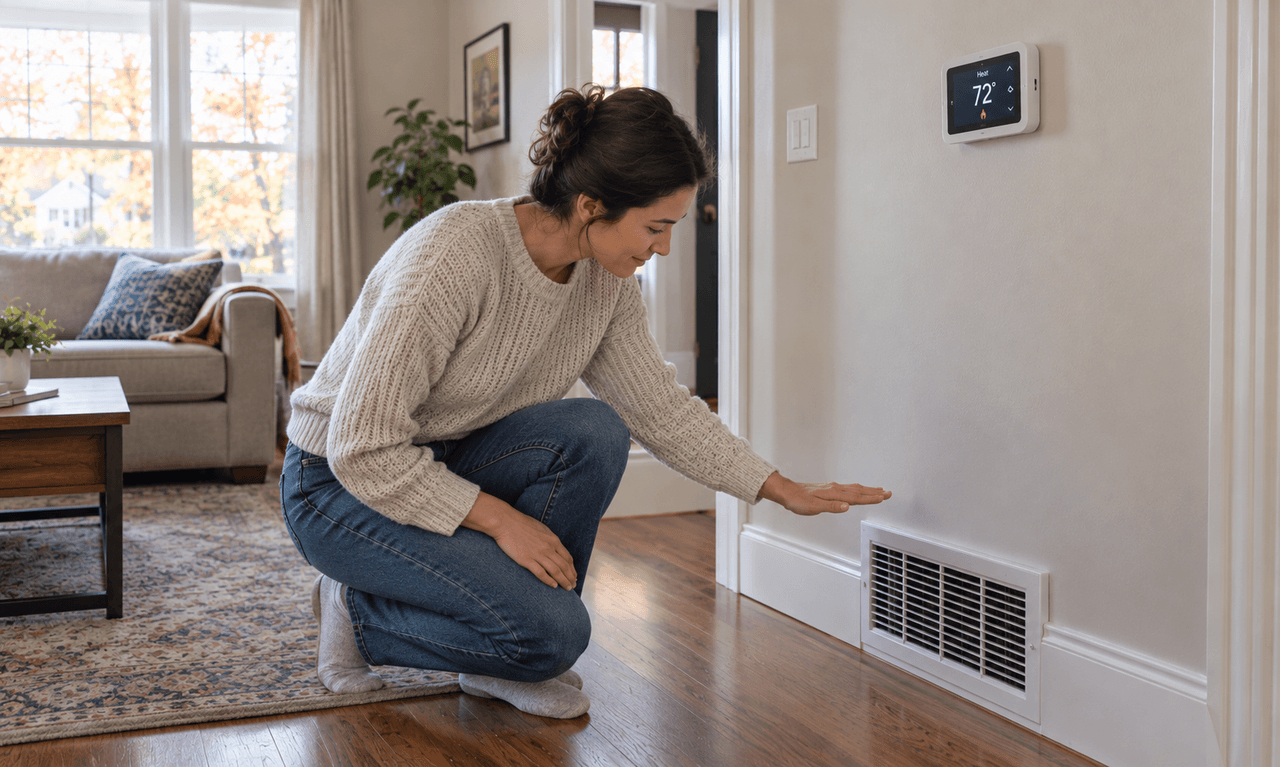
This is a check, not a repair. If the furnace won't light, keeps restarting, or trips a breaker, turn it off at the thermostat. Call a licensed HVAC technician. Don't keep resetting it.
If you use a smart thermostat with geofencing, you may also be able to adjust the temperature when everyone leaves and bring it back up before they return.
A furnace that passes the test run still has one weak point most first-time checklists ignore: its fan, igniter, and controls all need electricity, which is the first thing a winter storm can take away.
Before the First Storm: Will Your Gas Furnace Run During a Winter Power Outage? (EcoFlow TITAN 5000 Classic)
A gas furnace burns fuel to produce heat, but it still needs electricity to operate. The blower, igniter, and control board rely on household power. When an outage hits, most modern gas furnaces stop working even if the gas supply remains available.
Planning backup power before winter gives you time to check compatibility and arrange a safe connection.
Check your furnace's electrical requirements first
Carrier's product data for its Comfort 80 gas furnace, models 58SC0A and 58SC1A, specifies a nominal 115-volt, 60 Hz, single-phase electrical supply. Depending on the model size, the published maximum unit current ranges from 5.6 to 13.4 amps.
These figures are one manufacturer's example, not a specification for every furnace. Check your own unit's rating plate, usually inside the furnace door, or consult its installation manual.
Before choosing any backup:
Before picking out a home battery backup system, review these important setup points:
Verify voltage specs: Check your furnace rating plate to confirm it runs on a standard 120V (115V nominal) circuit rather than a 240V hookup.
Account for motor startup: Ask a licensed electrician or HVAC technician to evaluate starting inrush current, which spikes higher than continuous running watts.
Verify your fuel source: Make sure your municipal gas line is active, or ensure your propane storage tank has enough fuel for extended winter outages.
Inspect the circuit wiring: Most central furnaces are hardwired to an individual dedicated circuit controlled by an emergency service switch, requiring dedicated transfer equipment.
Fix mechanical problems first: A battery setup keeps an operational furnace running; it cannot fix mechanical faults. Never power damaged equipment with backup batteries.
EcoFlow TITAN 5000 Classic is one way to plan this ahead of time. It provides 120V output for essential loads. That can cover a compatible 120V gas furnace's blower, igniter, and controls, plus lights and your Wi-Fi router. Connecting it to home circuits requires the Smart Home Panel 10 (120V version), installed by a licensed electrician. It's not designed for 240V equipment, so it won't run a heat pump's outdoor unit, electric furnace, baseboard heat, or central AC.
EcoFlow TITAN 5000 Classic fits a home with a working, compatible 120V gas furnace that wants the furnace circuit, lights, and the router covered in a winter outage. It doesn't fit homes heated by a heat pump, an electric furnace, or baseboard heat at 240V, and it doesn't replace the first-start checks or repairs.
How long could the EcoFlow TITAN 5000 Classic run a furnace?
Runtime depends on actual electrical demand, startup surges, battery condition, conversion losses, and which other appliances you power.
For illustration, Carrier's published maximum unit currents can be used to estimate a conservative continuous-load scenario. At 115 volts:
115V × 5.6A is approximately 644W.
115V × 13.4A is approximately 1,541W.
Assuming 5,000Wh of battery capacity and an illustrative 85% usable-energy factor, the available energy would be about 4,250Wh. Dividing that figure by the two example loads gives approximately 6.6 hours and 2.8 hours, respectively.
These figures assume the blower fan runs nonstop. In normal use, a gas furnace cycles on and off throughout the day to hold your set temperature, so actual runtime is typically longer.
However, running extra loads like kitchen refrigerators, lamps, and modems will reduce battery reserve time. Always check the amp rating on your specific furnace plate to calculate your home's setup accurately.
Understanding why a gas furnace stops without electricity makes it much easier to select the right circuits to back up before winter storms hit.
Now that your backup power plan is covered, let us look at the smells and sounds you might notice during that very first heating cycle.
First Time Turning On Heat After Summer: What's Normal and What's a Warning
Nearly every homeowner notices an unusual smell the first time their heating unit turns on. In most cases, it is just dust burning off the heat exchanger. However, certain odors and noises signal mechanical wear, an electrical issue, or an active gas leak.


Use this quick-reference table to identify common heating system sounds and smells:
What You Notice | Likely Cause | What to Do (Source) |
Dusty, burning smell for the first few minutes | Dust and debris that settled on the burners and heat exchanger over summer burning off. | American Standard: This smell is normal and should clear within a few minutes. Open a window briefly to help clear the air. |
Acrid, burning odor lasting over an hour | Electrical problem, hot blower motor, or damaged part | American Standard: If the burning odor persists for more than an hour, switch off the heat and call an HVAC pro. |
Strong chemical smell from a brand-new furnace | Protective coatings curing during initial operation | American Standard: The smell should fade within an hour of your first run. If it lingers, call your installation team. |
Distinct rotten egg or sulfur odor | Escaping natural gas from a supply line, pipe fitting, or unlit burner. | California Public Utilities Commission (CPUC): Leave immediately on foot. Do not flip switches, use phones, or strike flames inside. Call your gas provider once safe outside, and dial 911 if there is immediate danger. |
CO alarm sounds, or family feels nausea, dizziness, or headaches | Dangerous carbon monoxide accumulating inside living areas. | CPSC: Symptoms include headaches, dizziness, nausea, weakness, and confusion. Evacuate outdoors to fresh air immediately and call 911. |
Loud banging, screeching, grinding, or rapid rattling | Loose fan belt, worn blower bearings, cracked fan wheel, or delayed burner ignition. | Turn the thermostat off right away. Have an HVAC technician inspect the moving components. |
The CPSC and CPUC emphasize strict safety rules for gas and exhaust issues. Treat the CPUC guidelines as universal home safety steps: never operate electrical switches or indoor phones if you smell raw gas, and always follow your local utility company's emergency rules.
A reliable detector is critical in the winter. Closed storm windows and sealed doors increase the dangers of carbon monoxide inside a sealed home whenever combustion equipment is running.
While central gas furnaces handle most whole-home heating, many households also rely on portable space heaters or heat pumps as the seasons change.
Turning On a Heater After a Long Time: Space Heaters and Heat Pumps
Central furnaces are not the only heating systems that sit idle through humid summer months. Portable electric heaters get pulled down from closet shelves, and central heat pumps reverse their refrigerant flow from cooling to heating. Both need a fast inspection before running unattended.
Portable electric space heaters
Before plugging in a portable heater, inspect the cord, plug, and housing. Don't use the unit if the cord is frayed, the plug is cracked, or the housing appears damaged.
Keep these precautions in mind:
Plug the heater directly into a wall outlet, following the owner's manual.
Check the heater's label for its wattage instead of assuming every model uses the same amount of power.
Keep the unit away from combustible materials as specified by its manufacturer.
Don't leave a heater running unattended unless its instructions explicitly support the intended operation.
Stop using it if you notice unusual smells, damaged wiring, or repeated electrical problems.
If you plan to use a space heater during an outage, check its wattage against your backup power equipment's output and capacity. A heater's high setting can use substantial energy, reducing the time available for other essential loads.
Heat pumps switching to heat mode
Heat pumps need a few basic checks before the heating season begins.
Clean or replace the indoor filter according to the manufacturer's instructions.
Remove leaves and debris from around the outdoor unit without opening its cabinet.
Check that the outdoor unit has no visible damage or obstructions.
Switch the thermostat to heat mode and monitor the first operating cycle.
Before relying on a portable unit for a cold bedroom, it helps to know how much electricity a space heater uses on each setting, since the high setting adds up fast on a winter bill.
Some first-start problems aren't a do-it-yourself job, and knowing when to stop and book a technician keeps a small fault from becoming a no-heat call in January.
When to Call an HVAC Technician Before the First Cold Snap
Some problems aren't visible during a basic inspection. An annual service visit allows a qualified technician to check internal components and identify potential issues before the heating season gets busy.
The CDC recommends having your heating system serviced by a qualified technician every year. Scheduling the visit in early fall can also help you avoid delays during the first cold snap.


Warning signs that need professional attention
Arrange service if you notice any of the following:
The furnace won't ignite or shuts down shortly after starting.
The system repeatedly starts and stops without completing a normal cycle.
A burning smell persists for more than an hour.
A breaker trips when the furnace starts.
The system makes new banging, grinding, or rattling sounds.
The furnace doesn't distribute warm air as expected.
If you smell gas or your CO alarm sounds, follow the emergency instructions in the previous section instead of waiting for a routine appointment.
What should annual furnace maintenance include?
ENERGY STAR's heating maintenance checklist includes several important tasks:
Checking gas or oil connections and fuel pressure.
Inspecting burner combustion and the heat exchanger.
Tightening electrical connections.
Checking the system's controls.
Confirming that the equipment starts and shuts off properly.
If your technician discovers that your older furnace is nearing the end of its reliable operating life, comparing heat pumps versus furnaces for upfront costs and cold-climate efficiency is a great way to plan your next heating upgrade.
Conclusion
Turning your heat on for the first time in winter goes smoothly when you check your filter, clear your vents, and test your carbon monoxide detectors before starting a test run. A faint burning-dust smell for a few minutes is normal, but a lingering odor, gas smell, or CO alarm requires immediate action.
Complete these checks on a mild fall afternoon, schedule your yearly HVAC tune-up, and inspect your furnace rating plate to check its electrical needs before freezing weather hits. If you want your 120V gas furnace, lights, and router protected during winter outages, explore whether the EcoFlow TITAN 5000 Classic with the Smart Home Panel 10, installed by a licensed electrician, fits your home backup plan.
FAQs
Is it normal for the heat to smell like burning the first time you turn it on?
Yes. A dusty burning smell lasting a few minutes is common after a furnace sits unused over summer. If the smell persists for more than an hour, turn off the furnace and contact an HVAC professional. Leave immediately if you suspect a gas leak.
What should I do before turning on the heat for the first time?
Check or replace the air filter, open supply vents, clear the area around the furnace, test CO and smoke alarms, and check accessible outdoor vent openings. Then switch the thermostat to heat and monitor a complete heating cycle.
How often should I change my furnace filter in winter?
ENERGY STAR recommends checking your filter monthly during heavy-use periods and changing it at least every three months. Replace it sooner if it becomes dirty, and follow your furnace and filter manufacturers' instructions.
Will my gas furnace work during a power outage?
Most modern gas furnaces need electricity for their blower, igniter, and controls. They generally stop operating when household power fails, even if natural gas is still available. A compatible backup power system may help, but check the furnace's electrical requirements and arrange a safe connection.
Can a home battery run a broken furnace?
No. Backup power can supply electricity to compatible equipment, but it can't repair a faulty igniter, blower motor, control board, or other failed component. Have the furnace inspected and repaired before relying on it during an outage.
For press requests or interview opportunities, reach out to our media team
media.na@ecoflow.com