What Is the Ground for a Portable Generator? When the Frame Is Enough and When You Need a Rod
- What Is the Ground for a Portable Generator?
- How to Ground a Portable Generator, Step by Step
- Fuel Generator or Battery for Small Plug-In Loads: Where EcoFlow DELTA 3 Classic Fits
- Grounding Isn't the Only Rule: CO, Wet Weather, and Backfeeding
- Grounding a Portable Generator at Campsites, Job Sites, and on Vehicles
- Grounding Mistakes That Cause Shocks, Trips, and Failed Inspections
- Conclusion
- FAQs
After unboxing a portable generator, you might notice a green ground terminal. Does that mean you need to drive a copper rod into your yard before using it?
Not necessarily. For many plug-in setups, the generator's own frame can serve as the ground. OSHA allows this when the generator supplies equipment through its own outlets and the required metal parts and grounding terminals are bonded to the frame. Other setups, including certain connections to buildings, have different requirements.
Below, we break down your setup step by step. We look at direct OSHA and manufacturer guidance, explain how to ground a portable generator safely, and cover the critical life-safety rules for carbon monoxide, rain, and backfeeding.
What Is the Ground for a Portable Generator?
On many portable generators, the metal frame serves as the grounding reference for the electrical system. The engine, housing, and other exposed metal parts may be bonded to the frame. The grounding terminals on the generator's outlets must also have the required connection.
Bonding creates an electrical path between conductive parts. Grounding connects an electrical system to earth when the applicable design and code require it. These terms are related, but they aren't interchangeable.
Whether the frame alone is sufficient depends on how you use the generator.
The OSHA frame rule
Under federal workplace rules for construction sites, OSHA standard 29 CFR 1926.404(f)(3)(i) spells this out clearly. It notes that the frame does not need a separate earth ground, and may serve as the grounding electrode, when two conditions are met:
The unit supplies only equipment mounted on it, or cord-and-plug gear plugged directly into its panel outlets.
All noncurrent-carrying metal parts and the equipment ground terminals of the receptacles are bonded to the frame.
Homeowners frequently look to this federal standard because it offers the clearest plain-English baseline for portable power safety.
The National Electrical Code addresses portable-generator grounding in Section 250.34. The Minnesota Department of Labor and Industry's summary explains that qualifying generators don't need a separate grounding electrode system when their outlet grounding terminals are bonded to the frame.
Does your setup need more than the frame?
How you're using the generator | Is the frame enough as the ground? | Source |
Cord-and-plug tools or appliances plugged into the generator's own outlets, with frame bonding intact | Yes, the frame serves as the grounding electrode | OSHA 29 CFR 1926.404(f)(3)(i); NEC 250.34 (Minnesota DLI summary) |
Generator mounted on a truck or trailer, supplying equipment on the vehicle or plugged into its outlets | The vehicle frame may serve as the grounding electrode if the generator frame is bonded to it and the other listed conditions are met | OSHA 29 CFR 1926.404(f)(3)(ii) |
Generator feeding a home, office, shop, or trailer through a transfer switch | No. It must connect to an approved grounding electrode system, such as a ground rod | OSHA fact sheet, Grounding Requirements for Portable Generators (DSTM 10/2005) |
The two frame conditions aren't met | No. A grounding electrode, such as a driven ground rod, is mandatory. | OSHA fact sheet |
Your local code or inspector requires an earth ground | Follow the local rule | Generac and Champion support pages (Tier 2) |
Bonded Neutral vs. Floating Neutral
Understanding earthing of portable generators requires knowing how your unit handles its neutral wire.
Bonded neutral: The generator's neutral wire connects physically to the steel frame inside the chassis.
Floating neutral: The neutral wire is completely isolated from the frame and the outlet ground pins.
For instance, Honda's EU2200i manual states that its stator winding is isolated from the frame and receptacle ground pins. Champion's Technical Bulletin 2030001 explains that a floating neutral setup is created by removing the neutral-to-frame bond. That is often recommended when feeding a home breaker panel through a transfer switch that does not switch the neutral wire.
Generac points out that the NEC requires the electrical system neutral to be grounded at the first disconnect, but never twice. You must check your manual to confirm whether your machine is bonded or floating.
Manufacturer guidelines can differ across product lines. Caterpillar's documentation recommends using the earth ground terminal and consulting an electrician. Always let your model's owner manual and local electrical inspector serve as the ultimate authority.
If you are running a portable generator during outages just to run a refrigerator, floor lamps, and phone chargers, you stay safely in the frame-is-the-ground column.
Once you know which row of the table matches your setup, following the correct grounding sequence is straightforward.
How to Ground a Portable Generator, Step by Step
Grounding a portable generator starts with paperwork, not a hammer. Take time to read the documentation carefully. Decide exactly how you plan to use the machine before touching a ground rod. Any installation that ties into your home's breaker panel must be completed by a licensed electrician.
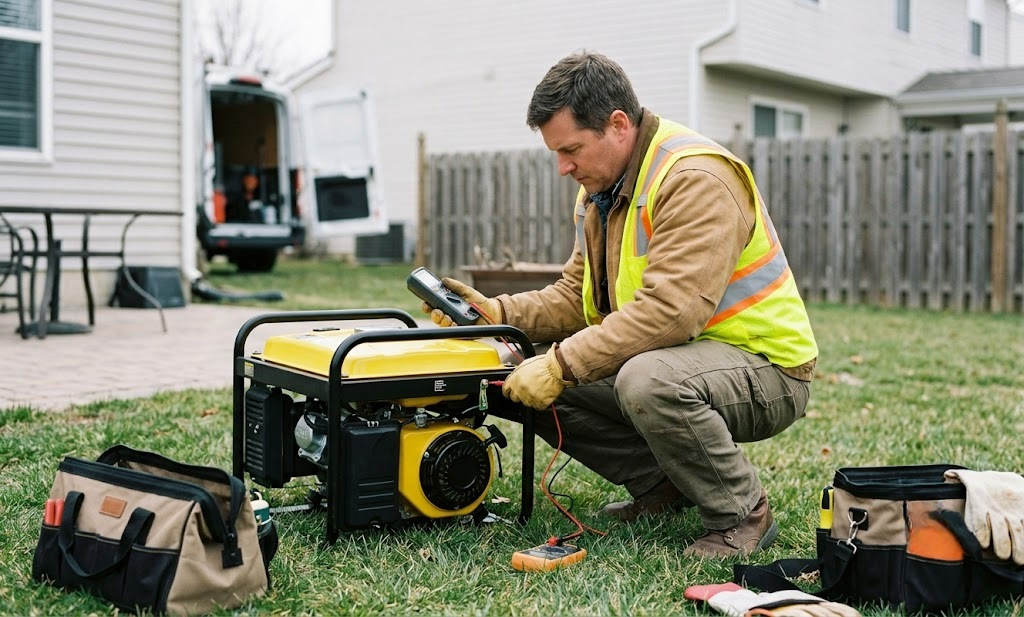
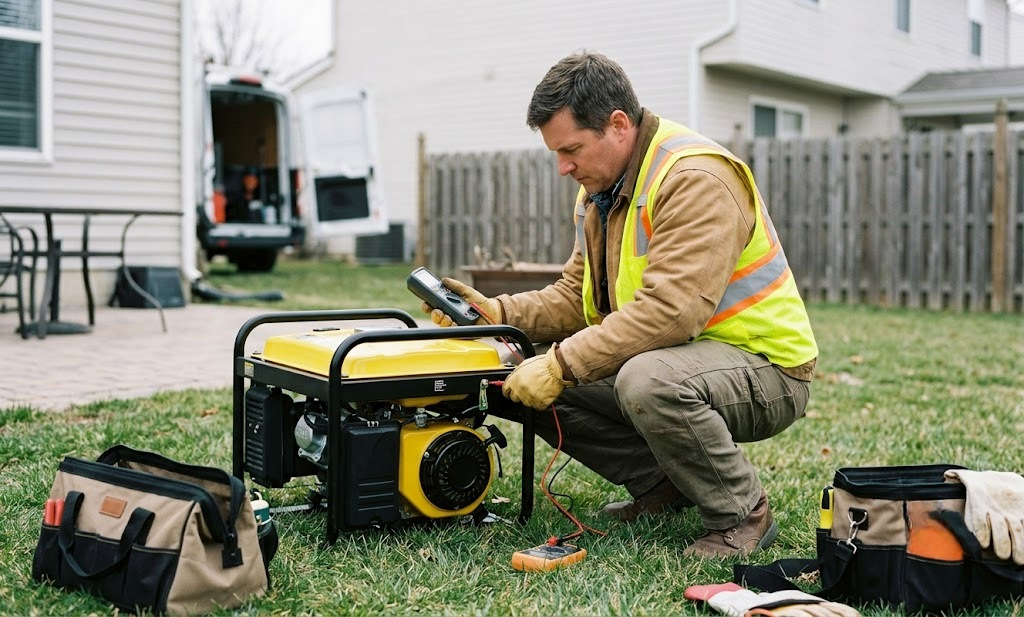
Step-by-step process:
Decide on your intended use
Are you running cord-and-plug tools outside, working from a truck bed, or powering house circuits? Your intended application determines whether OSHA requires an auxiliary ground rod.
Read the owner's manual
Locate the external ground terminal nut on the machine panel or tubular frame. Confirm whether the unit features a bonded or floating neutral. Honda explicitly instructs owners to consult a qualified electrician or inspector before attaching anything to that ground terminal.
Maintain frame bonding for direct plug-in loads
For equipment plugged directly into the generator, use cords rated for the load and designed for outdoor use when needed. OSHA recommends grounded three-prong cords with a grounding conductor.
Inspect cords, plugs, receptacles, and exposed wiring before use. Remove damaged equipment from service. Follow the generator's instructions for ground-fault circuit interrupter protection where applicable.
Don't modify the frame bonding or neutral configuration to accommodate a cord or appliance.
Drive a ground rod if required
If local codes or non-bonded setups require external earthing, connect your ground terminal to an earth electrode. Champion describes running a copper wire from the generator lug directly to a driven copper ground rod. Generac notes that where an earth rod is mandated, it should be driven at least eight feet into the soil. Always verify the proper wire gauge and rod dimensions with local electrical code authorities.
Hire a licensed electrician for home connections
Connecting a generator to a house panel requires professional installation. OSHA mandates connecting the generator to a grounding electrode system when powering structures through a transfer switch. The transfer switch must be listed for the application and installed by a certified electrician. That professional ensures you match neutral bonding correctly and avoid dangerous double-bonded faults.
Test the connections
OSHA fact sheets state that electrical resistance across grounding bonds must measure near zero ohms and remain steady. Intermittent readings reveal loose clamps or poor contact points. A qualified person should verify these connections with a calibrated meter.
Before wiring anything to your house, learn how an interlock kit versus a transfer switch manages neutral and ground wiring.
All of these steps assume you are running an engine that burns liquid fuel. If you only need to run a handful of small plug-in essentials, an indoor battery setup provides a cleaner path.
Fuel Generator or Battery for Small Plug-In Loads: Where EcoFlow DELTA 3 Classic Fits
A gas generator isn't always necessary for a few compatible plug-in devices. If you mainly need lights, phone chargers, and a Wi-Fi router, a portable power station may be another option.
A battery power station runs without an engine or fuel exhaust. However, it still has electrical ratings, operating instructions, and safety requirements. It doesn't eliminate every electrical hazard or replace the grounding and wiring requirements for a fuel generator.
Why does it fit small plug-in needs
A battery unit produces no carbon monoxide exhaust. That means you never have to set up 20 feet away in the rain or cold.
EcoFlow rates the DELTA 3 Classic at about 30dB under a 600W load. That is quiet enough to run inside a bedroom or home office without disturbance.
The US unit supports four distinct charging methods: standard AC wall power, gas generator pass-through, car socket charging, and up to 500W of solar input for multi-day outages.
Calculating runtime for essential devices
To estimate runtimes, take the 1,024Wh capacity and apply an 85% planning factor to account for inverter conversion:
Usable capacity = 1,024Wh × 0.85 ≈ 870Wh
If your lights, router, and phone chargers draw a combined 50W:
870Wh ÷ 50W = approximately 17.4 hours.
Always check the wattage labels on your specific household devices to calculate your actual running time.
If you are weighing a compact battery against a noisy gas generator for basic living room essentials, here are the specifications that matter most:
The EcoFlow DELTA 3 Classic shines for basic plug-in electronics when firing up an engine feels like overkill. But it does not replace a properly grounded generator tied to a manual transfer switch.
Large whole-home electrical loads still require a fuel generator or a professionally installed home backup system.
Weighing the balance between portable generators and portable power stations helps you choose the right gear for storm season.
Back to the fuel generator: a perfect ground doesn't help if the generator sits in the garage or runs in the rain, so the use rules from CPSC and OSHA come next.
Grounding Isn't the Only Rule: CO, Wet Weather, and Backfeeding
Grounding protects you from dangerous shocks, but carbon monoxide is by far the deadlier hazard. The CPSC warns that portable generators remain a leading cause of fatal post-storm poisonings.
Safe outdoor placement, dry operation, and proper wiring connections are just as critical as your ground path.
Carbon monoxide and placement
Carbon monoxide is an invisible, odorless killer that builds up quickly. Keep these safety requirements in mind:
Placement distance: The CPSC instructs owners to operate fuel generators outdoors only, at least 20 feet away from homes and neighboring buildings. Keep the exhaust pointed away from windows, doors, and intake vents.
Never run indoors: Never operate an engine inside a house, garage, basement, crawlspace, or storage shed. Opening windows or garage doors does not provide enough ventilation.
Annual fatalities: The CPSC reports that nearly 100 people die on average each year in the US from generator-related carbon monoxide poisoning.
CDC health statistics: The CDC reports over 400 Americans die annually from accidental CO poisoning unrelated to fires, resulting in over 100,000 emergency room visits.
Install battery-operated CO alarms or plug-in alarms with battery backup. Follow the alarm manufacturer's instructions and test the alarms regularly.
Rain and wet ground
Water increases the risk of electric shock. OSHA advises keeping generators dry and not operating them in rain or wet conditions.
Follow the owner's manual for weather protection and placement. Use only a cover or shelter that the manufacturer approves for the model and operating conditions. Never block ventilation or exhaust to protect the generator from rain.
Keep electrical connections protected as directed, and don't handle plugs or equipment with wet hands.
Never backfeed
Plugging a generator directly into an ordinary household wall outlet is called backfeeding. It is illegal, reckless, and extremely dangerous:
The backfeeding hazard: The CPSC explicitly warns never to power house circuits by plugging into a regular wall outlet.
Suicide cords: The CPSC issued urgent consumer warnings against male-to-male extension cords, which carry severe fire and electrocution risks.
Grid worker danger: Power pushed backward down your service lines steps up through neighborhood transformers, which can electrocute utility line crews working to restore power.
Transfer switch mandate: OSHA FS-3286 states a generator must never connect to a building's electrical system without an approved transfer switch installed by a qualified electrician.
Cool Before Refueling: Always shut the engine down and let it cool completely before adding fuel to prevent gas vapors from igniting.
If you spot downed power lines or suspect an immediate electrical hazard, call 911 immediately.
Engine exhaust is the reason so many families look into carbon monoxide risks and generator alternatives before the next storm season.
Home outages are the common case, but campsites, job sites, and trucks each change the grounding answer a little.
Grounding a Portable Generator at Campsites, Job Sites, and on Vehicles
The frame-as-ground rule was originally written for construction and jobsite use. That makes it a great fit for mobile outdoor work, tailgates, and camping.


Campsites and tailgates
Running small camp appliances straight from the panel outlets falls under OSHA 1926.404(f)(3)(i). As long as your factory frame bonding remains untouched, you do not need to pound a rod into the campsite dirt.
If you are plugging into an RV or travel trailer's shore power cord, read both the generator and RV manuals carefully. OSHA fact sheets list trailers among structures that require a grounding electrode when powered through transfer equipment.
Construction and commercial job sites
OSHA standard 29 CFR 1926.404 governs commercial construction job sites.
Inspectors verify that your cord-and-plug tools plug directly into the generator. They also confirm that internal ground pins bond securely to the structural metal frame.
Trucks, food trucks, and work trailers
Under 29 CFR 1926.404(f)(3)(ii), a vehicle frame can serve as the grounding electrode under specific conditions:
The generator frame is bonded directly to the vehicle chassis.
The unit powers only gear mounted on the vehicle or plugged straight into the generator.
Receptacle ground pins and equipment metal parts remain bonded to the generator frame.
All related provisions of the OSHA standard are fully met.
Temporary events and festivals
For public festivals and outdoor events, the Minnesota DLI electrical summary explains that systems not meeting standard exemptions require an engineered grounding electrode system.
For transient setups, three separate ground rods driven at least six feet apart can satisfy the requirement. This serves as an example of state-level code interpretation, so always check with your local Authority Having Jurisdiction (AHJ).
Before heading out, review whether portable generators belong at campgrounds to ensure you comply with campground quiet hours.
Even when you know the rules, simple grounding mistakes can still trip breakers and create hazards.
Grounding Mistakes That Cause Shocks, Trips, and Failed Inspections
Small mistakes can undermine an otherwise suitable setup. Avoid these common problems:


Adding a second neutral-to-ground bond: The correct bonding arrangement depends on the system. An unintended second bond can create hazardous current paths.
Changing the neutral bond yourself: Don't remove or add a bond without an electrician's assessment and the manufacturer's instructions.
Driving a ground rod without checking requirements: A rod isn't automatically necessary for every portable generator. Follow the manual and local code.
Connecting the generator through a wall outlet: This creates a dangerous backfeeding risk. Use an approved connection system installed by a qualified electrician.
Ignoring loose or damaged connections: Inspect the equipment before each use and remove damaged components from service.
Using unsuitable extension cords: Choose cords with the correct grounding conductor and ratings for the load and environment.
A home connection done right starts with a transfer switch for storm season, installed by a licensed electrician before the outage, not during it.
Conclusion
For plug-in loads, a portable generator’s steel frame serves as its ground under OSHA 1926.404(f)(3)(i) and NEC 250.34, provided all outlets and metal components remain bonded to it. You only need a separate ground rod if that factory bonding is missing, local building codes mandate one, or you connect the unit to a building via a transfer switch. Always check your owner's manual to confirm the neutral type. Use heavy-duty, grounded outdoor cords, and keep the engine running at least 20 feet away from any structure. Never attempt home panel connections without a licensed electrician.
If your main goal is simply keeping phones, LED lamps, and your Wi-Fi router running during an outage, consider the EcoFlow DELTA 3 Classic for quiet (about 30dB at a 600W load), clean, indoor-friendly, plug-and-play power.
FAQs
What is the ground for a portable generator?
For ordinary plug-in use, the ground is the generator's own steel frame. Under OSHA 29 CFR 1926.404(f)(3)(i), the frame serves as the grounding electrode as long as the receptacle ground pins and noncurrent-carrying metal parts bond securely to it.
Do portable generators need to be grounded with a ground rod?
No, portable generators do not need a ground rod when you only plug cords directly into their bonded outlets. However, OSHA states that an external ground rod is required if those frame-bonding conditions are not met, or when the unit powers a building through a transfer switch.
How deep does a generator ground rod need to go?
You must follow local building codes. Where an earth ground rod is required, Generac notes it should generally be driven at least 8 feet deep into the soil.
What's the difference between a bonded neutral and a floating neutral generator?
On a bonded-neutral unit, the neutral wire connects to the generator frame inside the chassis. On a floating-neutral unit, the neutral wire is completely isolated from the frame. The right choice depends on how your home's transfer switch routes the neutral wire.
Can I plug a generator into a wall outlet to power my house?
No. The CPSC warns never to power a house through a standard wall outlet. This illegal practice is called backfeeding. It can cause house fires and electrocute utility line workers down the street. Always use an approved transfer switch installed by a licensed electrician.
For press requests or interview opportunities, reach out to our media team
media.na@ecoflow.com