Heat Pump Thermostat Settings for Winter: Temperatures, Modes, and Outage Planning
- Best Heat Pump Thermostat Settings for Winter: Quick-Reference Table
- AUX Heat, EM Heat, and Defrost: Reading Your Thermostat in Winter
- Planning Backup Power by Operating Mode: EcoFlow TITAN 5000 Plus for Heat Pump Circuits
- How to Use a Heat Pump in Cold Weather: Below-Zero Nights, Snow, and Trips Away
- Heat Pump Winter Settings by System: Ductless, Ducted, and Dual-Fuel
- Conclusion
- FAQs
When you raise your thermostat on a freezing morning and see “AUX” appear, it can be tempting to wonder whether something is wrong. Usually, it means your heat pump needs extra heating power. Unlike a traditional furnace, a heat pump moves heat rather than generating it directly, so it works best with steady thermostat settings. Understanding the right heat pump thermostat settings for winter can help you stay comfortable, avoid unnecessary auxiliary heating, and prepare for outages. Here's how to choose temperatures, understand operating modes, and plan backup power.
Best Heat Pump Thermostat Settings for Winter: Quick-Reference Table
The best heat pump winter settings are straightforward: choose a comfortable temperature, use Heat mode, and leave the fan on Auto. ENERGY STAR recommends maintaining a steady temperature rather than turning a heat pump down while you sleep or leave home.
Table: Heat pump thermostat settings for winter at a glance
Thermostat setting | Recommended choice | Why it matters |
Mode | Heat | Prevents unwanted switching between heating and cooling. |
Temperature | 68°F as a starting point | Provides a common winter comfort setting. |
Night and away | Maintain a steady temperature; avoid deep setbacks | Reduces the chance of triggering AUX during recovery. |
Fan | Auto | Helps avoid unnecessary continuous fan operation. |
Emergency heat (EM) | Off during normal operation | Reserved for heat pump failure or malfunction. |
Separate backup furnace thermostat | 3–5°F below the heat pump setting | Helps the heat pump handle the load before backup heating starts. |
Best Temperature for a Heat Pump in Winter
A setting of 68°F is a reasonable starting point for many households, according to the New York State Energy Research and Development Authority (NYSERDA). The best temperature is ultimately one your household finds comfortable enough to maintain consistently. Adjust the thermostat to a degree at a time rather than making large changes. Infants, older adults, and people with certain medical needs may require warmer indoor temperatures.
Should You Turn a Heat Pump Down at Night?
NYSERDA recommends avoiding sudden thermostat changes of 3°F or more, as large setbacks can work against heat pump efficiency. Although some winter heating advice recommends lowering temperatures by 7–10 degrees overnight, that approach is often intended for furnaces. Before following general advice on cutting heating bills in cold weather, consider how your heat pump recovers, since in the morning temperature increase may trigger auxiliary heat. If you prefer a nighttime setback, keep it small and raise the temperature gradually in the morning; some smart thermostats can ramp up the temperature slowly to help limit unnecessary AUX operation.
AUX Heat, EM Heat, and Defrost: Reading Your Thermostat in Winter
AUX and EM both involve backup heating, but they work differently. AUX switches on automatically when additional heat is needed, while EM heat is a manually selected operating mode. Defrost is a normal process that removes frost from the outdoor coil.
AUX (Auxiliary) Heat: Automatic and Normal
Auxiliary heat commonly uses electric resistance strips inside the air handler. It can activate when outdoor temperatures are very low, the thermostat calls for a large temperature increase, or the system enters defrost. Seeing AUX on a cold morning does not automatically indicate a problem. The system is adding heat to help maintain your indoor temperature. However, if AUX runs frequently in mild weather, check the air filter and contact an HVAC technician. Carrier notes that auxiliary heating above roughly 40°F can sometimes indicate a dirty filter, refrigerant problem, or another system fault. Do not disable AUX to reduce electricity use.
EM (Emergency) Heat: Manual and Only for Breakdowns
Emergency heat is intended for situations where the heat pump has physically failed or malfunctioned. When selected, it typically locks out the compressor and relies on the backup heating system. Because electric resistance heat can consume substantially more electricity than normal heat pump operation, EM heat is generally more expensive to run. If your heat pump stops heating properly, contact an HVAC professional to determine whether emergency mode is appropriate.
Defrost: Steam, a Pause, and Sometimes AUX
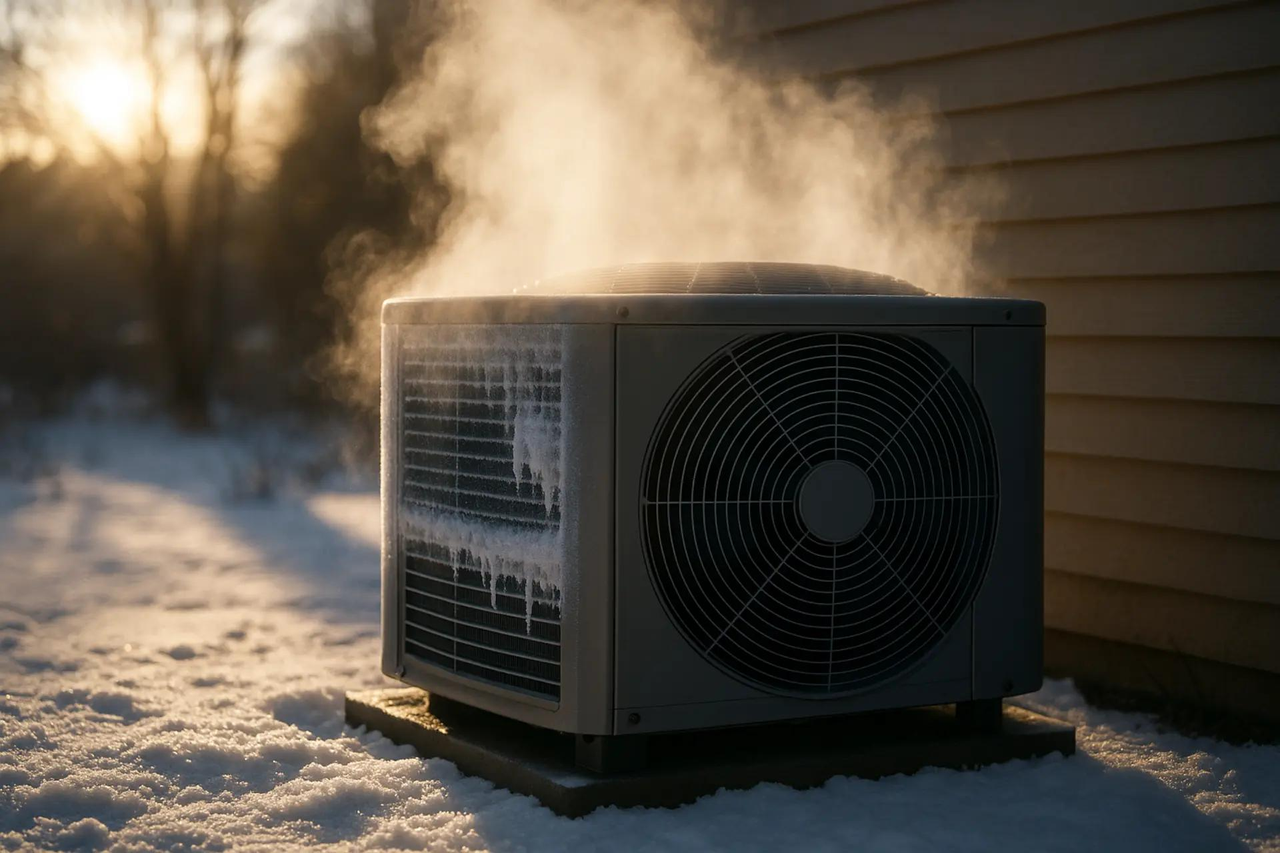
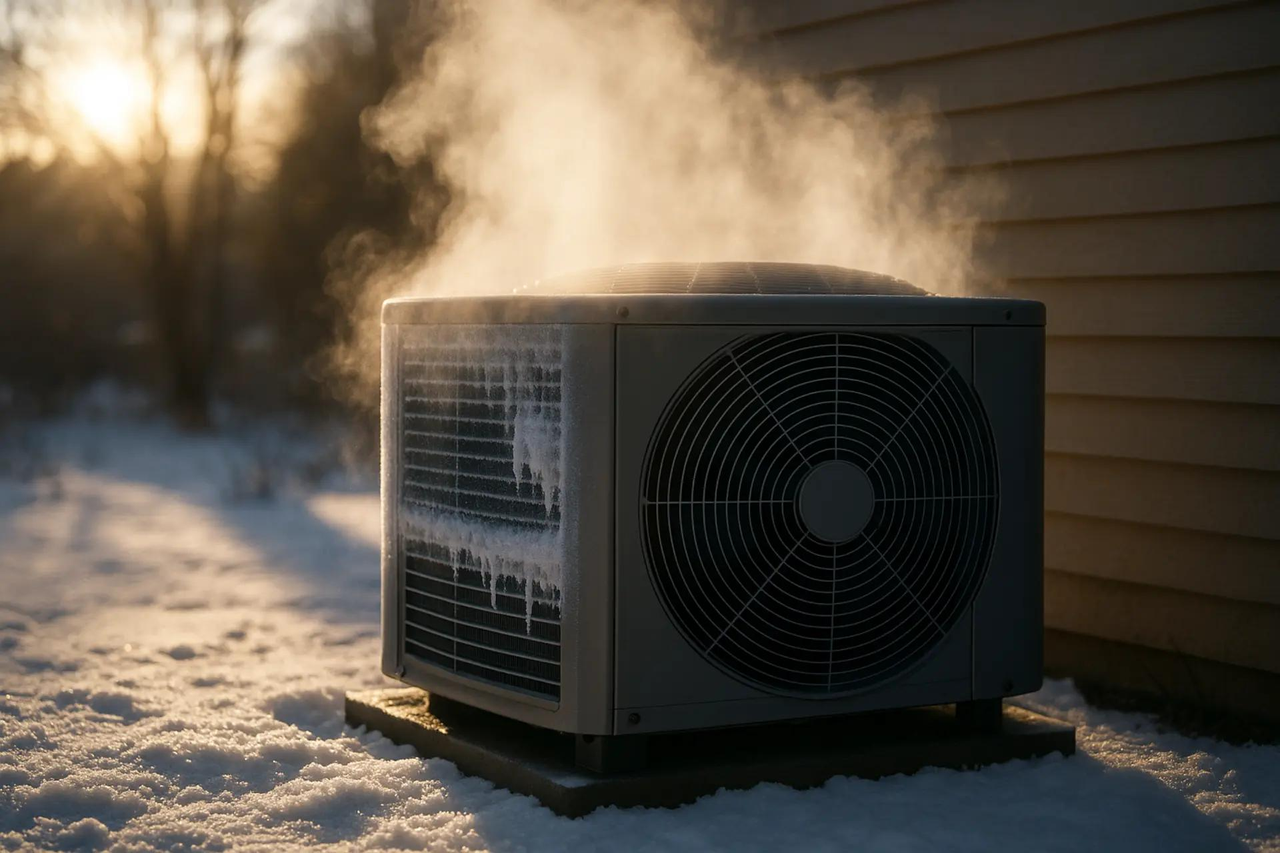
During defrost, a heat pump temporarily reverses refrigerant flow to warm the outdoor coil and remove frost. The outdoor fan may stop, steam may rise from the unit, and auxiliary heat may activate to maintain indoor comfort. Trane reports that its systems typically complete defrost in 3–5 minutes, while Lennox describes cycles lasting 5–15 minutes on its systems. Light frost that clears naturally is normal, but persistent thick ice may indicate an airflow, refrigerant, or defrost problem, so understanding how to fix heat pump freezing and ice buildup can help you recognize when the unit needs professional attention. These operating modes also affect electricity consumption, making it important to consider when planning backup power for a heat pump during an outage.
Planning Backup Power by Operating Mode: EcoFlow TITAN 5000 Plus for Heat Pump Circuits
A heat pump does not have one fixed power requirement. During ordinary heating, the compressor, outdoor fan, and indoor blower share the load. During a cold snap or defrost cycle, electric strip heat may add several kilowatts. Planning backup power therefore means checking every operating mode, not just the heat pump’s normal running load.
How Much Power Does a Heat Pump Need?
The following example uses a Trane 3-ton 5TWR7036A heat pump with a 5TEM7 air handler. These figures illustrate the types of equipment specifications to check; they are not a universal estimate for all heat pumps.
Operating mode | What is running | What to check |
Normal heating | Compressor, outdoor fan, indoor blower | Nameplate ratings, running input, and compressor startup behavior |
Defrost | Compressor operating in defrost, indoor blower, sometimes strip heat | Whether the controls activate backup heat |
Auxiliary heat | Heat pump plus electric resistance strips | Heater-kit rating in kilowatts and other simultaneous loads |
Emergency heat | Backup heating source and blower; compressor generally off | Full backup heater rating and blower consumption |
For this example, the outdoor unit's minimum circuit ampacity is 29 A, and its maximum breaker rating is 40 A. These are electrical circuit-sizing figures, not running-watt measurements. According to Trane's 5TEM7 air handler specifications, compatible electric heater kits vary by air-handler model. For example, the EH05 kit for the 5TEM7C04 is rated at 5.0 kW at 240 V, while the EH17 kit for the 5TEM7D06 and 5TEM7D07 is listed at 17.5 kW at 240 V, despite its nominal 17 kW name. A 5 kW resistance heater draws approximately 20.8 A at 240 V. These differences demonstrate why backup-power planning must account for the specific air handler, installed heater kit, and electrical load.
Can EcoFlow TITAN Plus Run a Heat Pump?
EcoFlow TITAN Plus offers 7.2 kW of battery-only output and up to 10 kW of output when compatible solar generation operates alongside the battery. It has a base battery capacity of 5 kWh, expandable to 30 kWh with additional EcoFlow TITAN batteries. It may be suitable for selected heating circuits, but compatibility depends on the specific equipment, startup surge, operating voltage, simultaneous loads, and backup heating requirements.
EcoFlow TITAN Plus provides 7.2kW of battery-only output, but whether it can support a heat pump depends on the compressor's startup demand and the loads running simultaneously. Understanding the difference between starting watts and running watts helps explain why an electrician must check both values, along with the auxiliary heater's rating, before selecting a backup configuration. During an outage, maintain a steady thermostat setting to avoid unnecessary AUX activation, but never disable backup heat when the system needs it.
How to Use a Heat Pump in Cold Weather: Below-Zero Nights, Snow, and Trips Away
Cold weather can make a heat pump work harder, but switching it off is rarely the best response. Keep the system operating, clear the outdoor unit, and let its controls manage backup heating.
Keep the Outdoor Unit Clear
Remove loose snow and debris gently with your hands or a soft broom. Keep leaves, ice, and roof runoff away from the unit, and never chip ice from the coil. A suitable rain and snow shelter may help when installed according to manufacturer requirements without restricting airflow.


Know Your Heat Pump's Cold-Weather Limit
There is no single temperature at which every heat pump stops working. Some traditional models struggle around 0°F, while certain cold-climate systems are designed to operate at much lower temperatures. Check the model's specifications rather than relying on a general temperature threshold. ENERGY STAR cold-climate certification evaluates performance at 5°F, but performance and efficiency still vary by model and outdoor conditions.
Maintain the System Before Winter
Clean or replace filters: Check your air filters regularly and clean or replace them according to the manufacturer's instructions, often monthly during heavy use.
Keep vents clear: Make sure supply and return vents are free from furniture, curtains, and other obstructions to maintain proper airflow.
Schedule professional maintenance: If your heat pump struggles to maintain the set temperature or heating performance declines, contact an HVAC technician for an inspection.
Leave installer settings unchanged: Avoid adjusting balance-point or compressor lockout settings yourself, as incorrect changes can affect heating performance and auxiliary heat operation.
What About Trips Away?
When leaving home during winter, avoid lowering your heat pump's temperature too much, as a steady setting helps protect indoor comfort and plumbing. Since a prolonged power outage can leave your heating system offline, consider preparing essential household power for a blackout before severe weather arrives, and choose an away temperature that follows your heat pump manufacturer's recommendations and any applicable insurance requirements.
Heat Pump Winter Settings by System: Ductless, Ducted, and Dual-Fuel
The best heat pump settings depend partly on your system design. Ductless mini-splits use individual indoor heads, ducted systems distribute air through an air handler, and dual-fuel setups combine a heat pump with a furnace.
System type | Winter setting to prioritize |
Ductless mini-split | Heat mode, steady setpoint, and an appropriate fan speed |
Ducted central heat pump | Steady setpoint, Auto fan, and gradual recovery after small setbacks |
Heat pump with a separate furnace or boiler | Set the backup thermostat around 3–5°F below the heat pump setting, where recommended |
Dual-fuel heat pump and gas furnace | Follow the installer's configured switchover settings |
Smart Thermostats and Zoned Homes
Smart thermostats can gradually increase the temperature to help reduce unnecessary AUX heat, but the installer must configure them correctly for the heat pump and its backup heating stages. In zoned homes, the older system's thermostat may need to be turned down or off in the zone served by the heat pump. The right controls also depend on the system design, so understanding the differences between ductless mini-splits and central heat pumps can help you identify which settings apply to your home. Leave balance-point and compressor lockout adjustments to a qualified HVAC professional.
Conclusion
The best heat pump thermostat settings for winter are a comfortable, steady temperature, Heat mode, and Auto fan. Around 68°F is a common starting point, while small, gradual adjustments help avoid unnecessary AUX activation. Remember that AUX and defrost are normal, and reserve EM heat for equipment failure. Before winter, record your outdoor unit and air handler specifications, including the strip-heater size. If you want backup power for heating circuits, explore EcoFlow TITAN Plus and have a licensed electrician verify every operating mode before selecting a configuration.
FAQs
What is the best thermostat setting for a heat pump in winter?
Start around 68°F and maintain a comfortable, consistent temperature. Adjust the temperature to suit your household's needs and follow your equipment manufacturer's guidance.
Should I turn my heat pump down at night?
Avoid large overnight reductions. A deep setback may create a high recovery demand and trigger auxiliary heat.
Should I use Auto or Heat mode in winter?
Heat mode is generally recommended because Auto may switch between heating and cooling under certain outdoor conditions.
When should I use emergency heat on a heat pump?
Generally, use EM heat when the heat pump has malfunctioned and your equipment instructions or HVAC technician indicate it is appropriate.
Can a home battery run my heat pump during a power outage?
Potentially, if its output, voltage, startup capability, and capacity match the heat pump and all simultaneous loads. Electric strip heat can exceed a battery system's output rating, so have a licensed electrician verify compatibility before selecting a system.
For press requests or interview opportunities, reach out to our media team
media.na@ecoflow.com