Alabama Power Solar Fee: What the Capacity Charge Costs, Why It Survived in Court, and What Solar Owners Can Do
- What Is the Alabama Power Solar Fee? The $5.41-per-kW Charge Explained
- Where the Solar Fee Stands in 2026: PSC, FERC, and Federal Court
- Where Home Storage Fits, and What It Can't Change: EcoFlow TITAN and EcoFlow TITAN Plus
- What Alabama Power Pays for Solar You Send Back
- Co-op, Municipal, and TVA-Area Customers Follow Different Rules
- Steps Before You Install Solar in Alabama Power Territory
- Conclusion
- FAQs
You switch on your new rooftop panels, and then the first bill shows up. It has a new line that grows with the size of your array, not with how much power your house uses. For a 6 kW system, that's $32.46 a month at the posted rate. You pay it even in a sunny month when the panels cover most of your needs. A federal judge left the charge in place in March 2026. Here's how the Alabama Power solar fee is figured, what exports earn, who isn't covered, and where home storage fits.
What Is the Alabama Power Solar Fee? The $5.41-per-kW Charge Explained
The so-called solar fee is the Capacity Reservation Charge in Alabama Power's Rate Rider RGB. It applies when you make some of your own power with on-site generation that runs in parallel with the grid. You pay it monthly based on system size, not on what you use or send back.
The posted Rate Rider RGB tariff sets it at $5.41 per kW for secondary service. Customers on primary service owe $4.87 per kW instead. Alabama Power also folds this amount into your minimum monthly bill.
Your bill uses the system’s rated size, which the tariff calls nameplate capacity. Solar panels carry both an AC and a DC rating, and the tariff never says which one counts, so get that answer from Alabama Power. The table below is simple math on the posted secondary rate.
System size (nameplate) | Monthly charge | Yearly total |
4 kW | $21.64 | $259.68 |
5 kW | $27.05 | $324.60 |
6 kW | $32.46 | $389.52 |
7.2 kW | $38.95 | $467.42 |
8 kW | $43.28 | $519.36 |
10 kW | $54.10 | $649.20 |
Two options inside the rider most articles skip
The first is a recount. If your nameplate seems higher than your real needs, you can ask Alabama Power to calculate your actual capacity requirement.
The second is a different way to pay. Qualifying customers may take Rate RTA instead. The catch is a 71¢ per kWh price on weekdays from 3 to 5 p.m., June through September. The rider doesn't define "qualifying," so ask if you're eligible.
How Alabama Power arrived at the number
Per the court's opinion, Alabama Power modeled a typical rooftop system's output across the state's three weather zones. Then it estimated how much of its fixed costs those customers stopped covering. It said it must keep back-up capacity ready for most of a solar unit's peak output. So it charged a share of those lost costs, adjusted for Rate FD, as a monthly per-kW charge.
It acts like a demand charge. Learning how electricity demand charges work explains why a sunny month doesn't shrink it.
That size-based design is what customers challenged in court. The history explains why it's still on bills in 2026.
Where the Solar Fee Stands in 2026: PSC, FERC, and Federal Court
Solar customers and an environmental group have fought the charge for years. Each time, it stayed. As of October 2026, it remains in the posted tariff.
2013: The Alabama PSC approved changes to Rate Rider RGB that set up the charge's current method.
PSC complaint: After a hearing, the PSC denied the customers' challenge and adopted Alabama Power's proposed changes.
FERC: FERC issued a "notice of intent not to act." Two commissioners wrote a joint concurrence raising PURPA concerns in June 2021.
Federal court: In the March 25, 2026 opinion in Bankston v. Alabama Public Service Commission, Judge Annemarie Carney Axon ruled in favor of the PSC and Alabama Power on the parties' summary-judgment motions. The case addressed three PURPA claims.
Later proceedings: The March 25 opinion establishes the court's reasoning at that stage of the case. Check the court docket for Case No. 2:21-cv-00469 for any subsequent motions, appeals, or decisions.
What the court decided, in plain words
The court read "back-up power" to cover partial outages, such as clouds cutting your output. So a working system that simply makes less power than usual still counts as having an outage. The judge also saw no proof that the cost figures were wrong or that PURPA was broken.
Net metering in Alabama
Alabama Power's posted tariffs don't credit exports at the retail rate. The company buys them under Rate PAE instead, at a much lower price. Compare that with how retail net metering works, where an exported kWh offsets one you buy.
So the fee stays and exports earn little. That leaves a fair question for anyone weighing Alabama solar power: can a battery help?
Where Home Storage Fits, and What It Can't Change: EcoFlow TITAN and EcoFlow TITAN Plus
Start with what a battery can't do. Since the bill is tied to the size of your panels, a battery or a no-export setting leaves the charge in place. Buying EcoFlow TITAN or EcoFlow TITAN Plus won't erase the Alabama Power solar fee either. The rider doesn't say if storage counts toward billed kW, so ask Alabama Power in writing first.

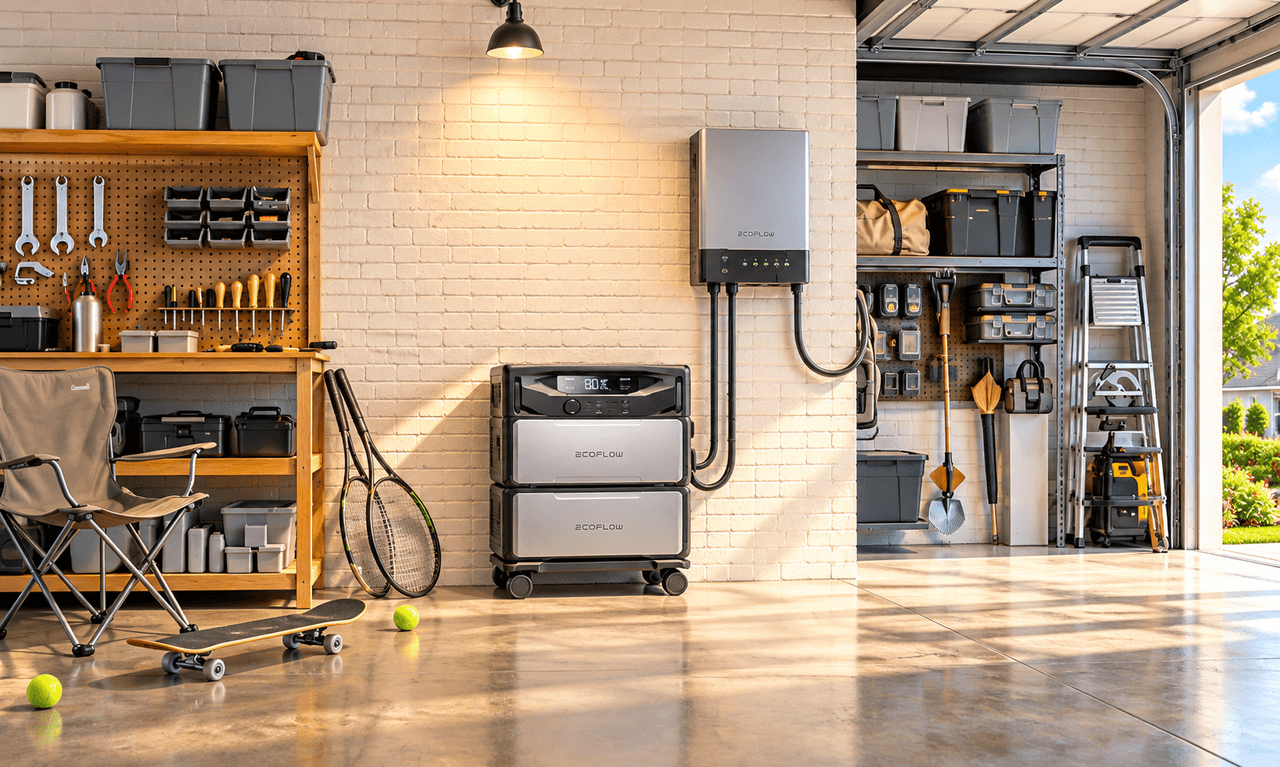
What storage can change is how much solar you keep. Exports earn roughly 3.5¢ to 5.5¢ per kWh. Standard Rate FD charges 13.4851¢ for the first 1,000 summer kWh, before add-ons.
With Smart Home Panel 10 installed by a qualified electrician, either unit can back up selected circuits. Through X-Fusion 2.0 AC coupling, both work with compatible third-party solar in no-export operation, which earns no export credits. Both are pre-launch, so confirm Alabama availability, installer support, and interconnection approval first.
Think about a home with a modest rooftop array. Most of its panels' output arrives at midday, but the family uses more power in the evening. Storing that midday solar for later is a smaller job, and the standard model is built for it.
Now picture a home with a bigger array, or one planning to add more panels later. A small battery can't take in all that solar, so more of it gets sold back at Rate PAE prices. A model with more solar input and PV Boost keeps more of that power at home.
Storage pays off only with a real price gap. Rate RTA customers pay more on summer weekdays from 1 to 7 p.m. Knowing how time-of-use pricing works helps you spot that gap.
What Alabama Power Pays for Solar You Send Back
Wondering what your extra solar earns? Alabama Power buys exports from systems of 100 kW or less under Rate PAE (Purchase of Alternate Energy). Prices vary by season and time of day. Enrolling also requires Rider RGB, so the charge and the buyback go together.
The prices below come from the current Rate PAE tariff, which Alabama Power began using on April 2026 bills. You'll also see a small fee for the extra metering each month: 91 cents on a single-phase line or $1.39 on a three-phase line. Times are Central, and weekdays exclude five major holidays.
PAE option | Season | Higher-price hours | Paid in those hours | All other hours |
Time of Day | June to September | Weekdays, 10 a.m. to 9 p.m. | 5.17¢/kWh | 3.85¢/kWh |
Time of Day | October to May | Weekdays, 7 a.m. to 9 p.m. | 3.84¢/kWh | 3.66¢/kWh |
Time Advantage | June 1 to September 30 | Weekdays, 1 to 7 p.m. | 5.47¢/kWh | 4.02¢/kWh |
Time Advantage | November 1 to March 31 | Weekdays, 5 to 9 a.m. | 4.37¢/kWh | 3.84¢/kWh |
Time Advantage | October, and April 1 to May 31 | None. | 3.45¢/kWh | 3.45¢/kWh |
Residential Demand | April 1 to October 31 | Weekdays, 1 to 5 p.m. | 4.64¢/kWh | 3.83¢/kWh |
Residential Demand | November 1 to March 31 | Weekdays, 6 to 9 a.m. | 4.38¢/kWh | 3.86¢/kWh |
The column that applies to you is set by the retail plan you're on, so check with Alabama Power. Unused credits roll over, and you can ask for them to be paid out.
Alabama Power's current residential plans (2026)
Open plans are Family Dwelling (FD), Family Dwelling Demand, Residential Time Advantage, and FlatBill. Two older plans are closed to new accounts. Alabama Power also says it has committed to steady rates through 2027.
Standard Rate FD has a $14.50 base charge. Energy costs 13.4851¢ per kWh for the first 1,000 kWh in summer or 750 in winter. Fuel (ECR), NDR, and tax add-ons come on top. With exports at 3.5¢ to 5.5¢, weighing self-consumption against selling power back helps put numbers on it.
Everything above applies only inside Alabama Power's territory. That leaves out much of the state.
Co-op, Municipal, and TVA-Area Customers Follow Different Rules
Not served by Alabama Power? Many Alabamians get power from co-ops or city-owned utilities. Much of north Alabama is served by local power companies that buy from the Tennessee Valley Authority. Rider RGB and Rate PAE cover only Alabama Power, so don't apply the $5.41 figure elsewhere.
In TVA areas, TVA's Dispersed Power Production program buys renewable output at a price that changes monthly. It needs a five-year commitment, and your local power company sets its own steps and fees. Co-ops and city utilities set their own rules, so ask yours for its written solar policy.
If you're with Alabama Power and still want to go ahead, a few steps prevent first-bill surprises. They work best in order.
Steps Before You Install Solar in Alabama Power Territory
Ready to move ahead? Talk to Alabama Power before anyone mounts a panel, because the size it signs off on is the size you'll be billed for.
Apply before you install. Alabama Power's DER Interconnection Process guide (November 2025) requires an application through PowerClerk first. Design approval lasts 365 days, and you need written permission to operate.
Know your tier. Tier I (up to 25 kW) has no study fee, and Tier II (over 25 to 100 kW) costs $500.
Ask what gets billed. Get in writing which rating (AC or DC) applies and whether a battery changes it.
Compare the RTA option. Ask if you qualify, then run both on your own usage.
Ask for a recount. Request an actual capacity calculation if your nameplate seems too high.
Don't count on 30% back. The IRS Residential Clean Energy Credit ended for property placed in service after December 31, 2025.
Size for self-use. Every kW of nameplate adds $5.41 a month at the posted secondary rate.
These steps keep the fee from surprising you. They also give you real numbers to compare before you sign.
Conclusion
Alabama Power's solar fee is a capacity reservation charge of $5.41 per kW of nameplate capacity each month for secondary service. A federal judge upheld it in March 2026, and exports earn only about 3.5¢ to 5.5¢ per kWh. Size solar for what you use. Ask Alabama Power in writing how nameplate and storage are billed, and compare the RTA option. If using more of your own solar makes sense, EcoFlow TITAN and EcoFlow TITAN Plus are worth a look as they launch. Neither removes the fee.
FAQs
How much is the Alabama Power solar fee?
It's $5.41 per kW of nameplate capacity each month for secondary service. Primary service pays $4.87 per kW. A 6 kW system pays $32.46 a month, no matter how much power you use or export.
Does a battery or zero-export setting get rid of the fee?
No. The charge is based on generating capacity that runs in parallel with the grid. The rider doesn't exempt storage or zero-export setups. Ask Alabama Power in writing how a battery would be billed.
Is the fee still legal after the 2026 lawsuit?
The March 25, 2026 federal district court opinion ruled in favor of the PSC and Alabama Power. That describes the March decision; consult the court docket for later proceedings rather than assuming the case's current procedural status.
Does Alabama Power offer net metering?
Not at the retail rate. Alabama Power buys exports under Rate PAE at about 3.5¢ to 5.5¢ per kWh, depending on season and time. That's far below what you pay for grid power.
Do Alabama co-op or TVA-area customers pay this fee?
Not under Rider RGB, which covers only Alabama Power's system. Co-ops, city utilities, and TVA local power companies set their own rules, so check with yours.
For press requests or interview opportunities, reach out to our media team
media.na@ecoflow.com