Advantages of a Whole Home Generator: 7 Benefits and How a Home Battery Compares
- 7 Advantages of a Whole Home Generator
- How Long US Power Outages Last, and Why Runtime Matters
- How a Home Battery Compares: EcoFlow TITAN Plus
- What a Standby Generator Asks of You: Installation, Fuel, and Upkeep
- Carbon Monoxide and Placement: Safety Rules That Still Apply
- Is a Whole Home Generator Worth It? A Quick Decision Checklist
- Conclusion
- FAQs
It's 9 p.m., a storm is rolling through, and the lights cut out. A few seconds later, the fridge hums back on and the Wi-Fi light blinks green, and nobody had to step outside. That's the moment a standby generator is built for. Below, you'll find seven advantages backed by what generator makers actually say, federal data on how long US outages last, and a look at how a home battery compares. Both options need a pro install, so the right pick depends on your outages, your fuel, and the circuits you need.
7 Advantages of a Whole Home Generator
A whole home generator, also called a home standby generator, sits outside your house. It's wired through a transfer switch and fed by a gas line or propane tank, and that setup drives most of the advantages of whole home generator ownership. Each point below sticks to what the makers state.
1. It Starts on Its Own Within Seconds
Generac says its units connect to your home through an automatic transfer switch and turn on within seconds to restore power. Cummins says its switch "instantly senses" an interruption from the utility, and the generator shuts itself off once grid power returns.
2. It Runs on Fuel You Already Have
Generac and Cummins both say standby units run on natural gas or propane. Gas comes through the utility line and propane from a tank on your property, so nobody hauls gas cans in the rain.
3. It Keeps Running Through Long Outages
Generac says a unit "can run for as long as fuel is available and the unit is properly maintained." Of all the benefits of a standby generator, this is the biggest edge over a battery, as long as both conditions hold.
4. It Can Cover Selected Circuits or the Whole House
Generac says a standby unit can power selected circuits or an entire home, depending on its size and setup. Cummins lists home models such as 13kW and 20kW, but a dealer's load calculation decides what your home needs.
5. It's a permanent, Outdoor Installation
The unit sits outside, usually near your fuel source, with clearances set by the installation guide. There's no dragging a portable unit across the yard or running cords through a cracked window.
6. You Can Check on It From Your Phone
Cummins says owners can "observe and control" a standby generator from a mobile device. Features vary by brand and model, so ask your dealer what the app shows.
7. It's About as Loud as a Central AC
Generac says its units average 65 to 67 decibels, which it compares to a central air conditioner. That's Generac's figure for its own lineup, not a universal number.
Knowing the portable and standby generator differences explains why a fixed unit costs more. It also asks far less of you in a storm.
Advantage #3 matters most when outages drag on. So how long do Americans actually go without power?
How Long US Power Outages Last, and Why Runtime Matters
Outage length decides how much a generator's long runtime is worth to you. Most years bring a couple of hours of routine interruptions, but big storms push some states into multi-day territory.
What the 2024 Outage Numbers Show
EIA's latest reliability data shows US customers averaged 11 hours of interruptions in 2024, the most in 10 years. Major events caused nearly nine of those hours, compared with nearly four a year from 2014 through 2023. EIA measures this with SAIDI, the total time an average customer spends without power in a year.
Hurricanes Beryl, Helene, and Milton left millions in the dark, and events like these made up 80% of 2024's outage hours. South Carolina was hit hardest, at nearly 53 hours, while Arizona, South Dakota, North Dakota, and Massachusetts averaged under two.
What This Means for Your Decision
Where outages run a couple of hours a year, a battery may cover most events. In hurricane or ice storm country, multi-day outages are where a fuel-fed generator stands out. Either way, start by deciding which circuits need backup, since essentials need far less capacity.
Short and mid-length outages are where a home battery competes most directly. Here's how the two compare.
How a Home Battery Compares: EcoFlow TITAN Plus
What if you don't have a gas line, or you'd rather not run an engine? A home battery stores power from the grid or compatible solar and switches over on its own through the right panel. But its runtime depends on stored energy and load, so it can't match a generator's open-ended run.


A battery also backs up selected circuits chosen through a load calculation, not the whole house by default. With compatible solar, it can store daytime solar for use at home. It needs Smart Home Panel 10 (240V version) and a licensed electrician.
Standby Generator vs. Home Battery at a Glance
Factor | Whole home standby generator | Home battery (EcoFlow TITAN Plus) |
Energy source | Natural gas or liquid propane (Generac; Cummins). | Stored electricity, recharged from the grid or compatible solar (8kW solar input). |
Runtime | "As long as fuel is available and the unit is properly maintained" (Generac). | Limited by stored energy and load. 5kWh base, up to 30kWh with more EcoFlow TITAN batteries. Solar recharges it only while panels produce. |
Switchover | Within seconds through an automatic transfer switch (Generac). | 20ms auto-switchover for up to 10 selected circuits with Smart Home Panel 10. |
Coverage | Selected circuits or an entire home, depending on size (Generac). | Selected circuits. 7.2kW from the battery alone, up to 10kW only while compatible solar produces. |
Noise | 65 to 67 dB on average for Generac models (Generac). | No engine. |
On-site emissions | Engine exhaust contains carbon monoxide (CPSC). Installed outdoors. | No fuel burned on site. IP20 rated for indoor installation. |
Routine upkeep | Service every 6 months by an authorized dealer (Generac). | No oil or fuel. Follow EcoFlow's manual and app. |
Installation | Authorized dealer or licensed contractor (Generac). | Smart Home Panel 10 installed by a qualified electrician. |
So what sets how many circuits a battery can carry, and for how long? These EcoFlow TITAN Plus specs answer that.
Where EcoFlow TITAN Plus Fits
It fits homes that want fuel-free backup for a set of circuits, like the fridge, lights, Wi-Fi, a sump pump, and possibly central AC in EcoFlow's test scenario. It suits outages measured in hours. Unless solar recharges it, it won't cover a multi-day outage, and it never backs up the whole house by default.
How Long a Home Battery Can Run
How long would it last? These are estimates, assuming 1,000W of essential loads running nonstop and 85% usable energy after conversion losses (a planning guess, not a spec).
Base 5kWh: 5,000Wh × 0.85 ÷ 1,000W ≈ 4.3 hours.
Expanded to 30kWh: 30,000Wh × 0.85 ÷ 1,000W ≈ 25.5 hours.
Refrigerator alone: A sample refrigerator EnergyGuide label from the DOE shows about 1.7 kWh a day. 4,250Wh ÷ 1,700Wh ≈ 2.5 days.
Compare that with the 11-hour national average and South Carolina's 53. More loads mean less runtime, and solar recharging depends on weather.
Whichever way you lean, a standby generator brings its own duties. Fuel, placement, and service all come with owning one.
What a Standby Generator Asks of You: Installation, Fuel, and Upkeep
Those advantages depend on a proper installation and regular service. A standby generator is a permanent appliance with a fuel line, an engine, and code rules on where it can sit.
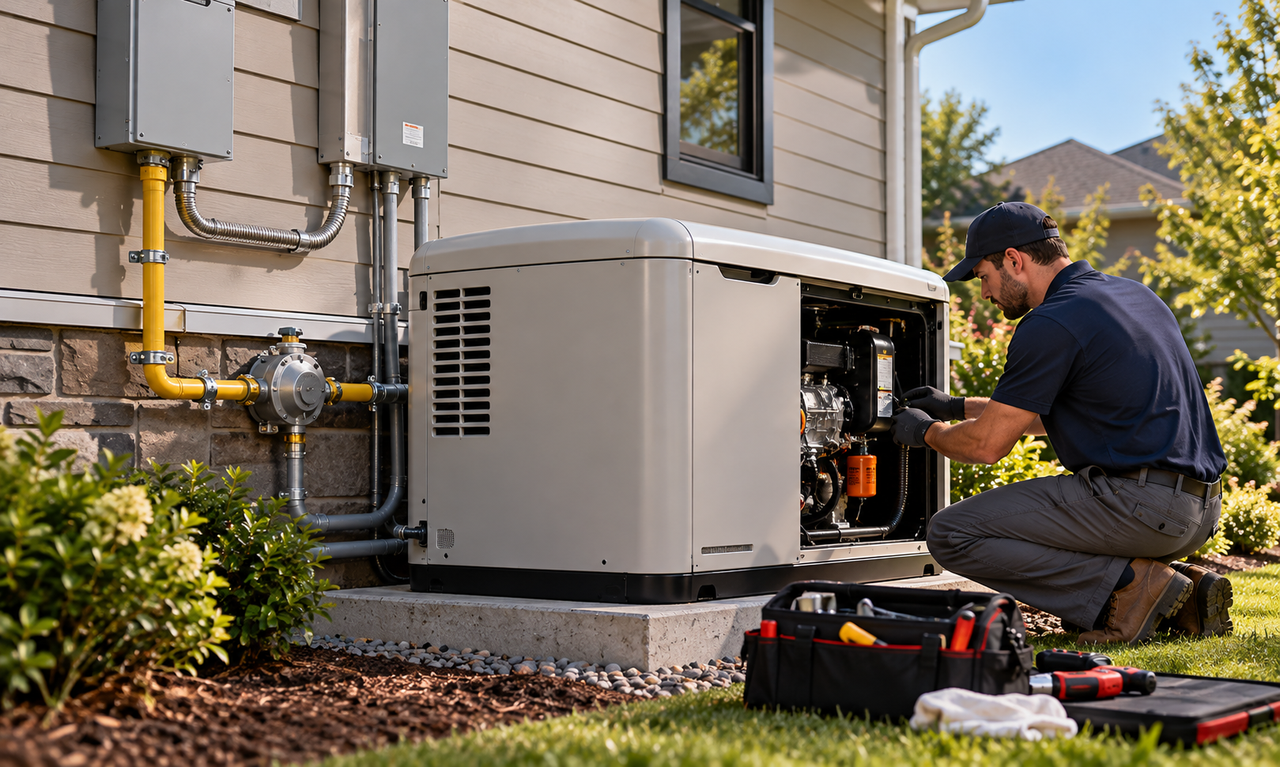
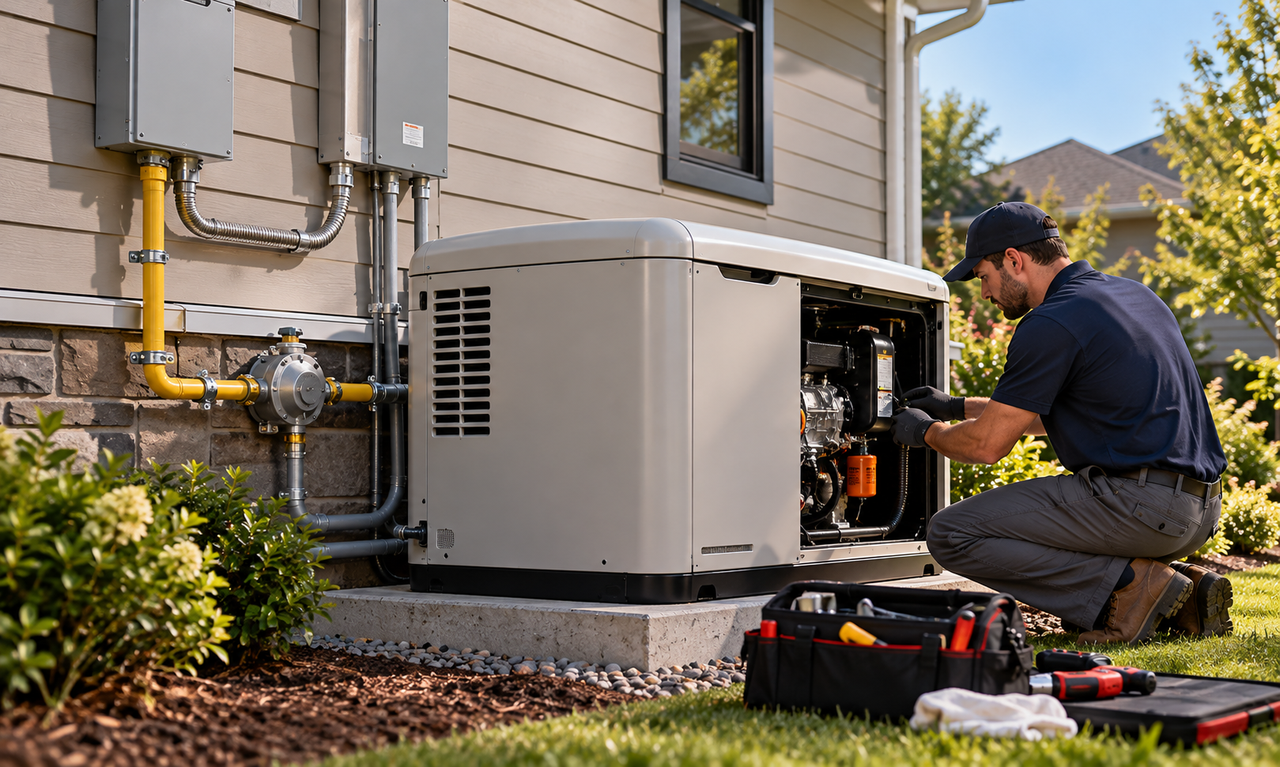
Installer: Generac recommends an authorized dealer or licensed contractor, and says the dealer sets the price.
Fuel: Natural gas needs a utility line with enough supply. Propane runtime depends on what's in the tank.
Placement: Clearances are in the installation guide. Many local authorities reference NFPA 37, the code for stationary combustion engines.
Service: Generac recommends service every 6 months and a shutdown and inspection after every 24 hours of continuous run time.
HOAs: Check HOA and local rules on placement and sound before you sign.
Keeping up with routine home generator maintenance tasks is what makes the "runs as long as fuel lasts" promise hold up. Skipped service lets that promise slip.
Placement isn't only about code and neighbors. An engine makes carbon monoxide, and that brings its own rules.
Carbon Monoxide and Placement: Safety Rules That Still Apply
A standby generator lives outdoors, but it still burns fuel and makes exhaust. Pair a pro install with CO alarms inside.
The CPSC's generator safety guide warns that exhaust contains carbon monoxide, "a poison you cannot see or smell" that "can kill in minutes." Signs include headache, dizziness, nausea, and confusion. If you suspect CO poisoning, "get outside immediately, then call 911."
CO Alarms and the 20-Foot Rule
In its 2026 hurricane season warning, CPSC says to put working CO and smoke alarms on every level. Interconnected alarms are best, and you should test them monthly. Its "at least 20 feet" rule is for portable units, so standby owners follow the installation guide and local code.
CPSC also says portable generators are a leading cause of post-storm CO deaths. A permanent unit removes the urge to run one in a garage, but it doesn't erase CO risk. A home battery burns no fuel and makes no exhaust, but it still needs an electrician.
With the trade-offs and safety rules laid out, one step is left. It's time to match all of it to your home.
Is a Whole Home Generator Worth It? A Quick Decision Checklist
Is it worth it? That depends on your home. Use this list to choose a generator, battery, or both.
Outage history: Check your state in EIA's data. Multi-day outages favor fuel-fed runtime.
Fuel access: No gas line or tank space? A battery with solar may fit better.
Loads: List must-run circuits and get a load calculation.
Upkeep: Weigh twice-a-year service and engine noise against no fuel at all.
Medical devices: Talk to your doctor and ask your utility about medical priority programs.
Comparing standby generator installation cost factors like permits and gas line work makes quotes easier to read. Get every quote in writing.
Conclusion
The main advantages of a whole home generator are automatic start within seconds, natural gas or propane fuel, runtime that lasts as long as fuel and maintenance hold up, and coverage from selected circuits to the whole house. Check your state's outage hours, confirm your fuel, get a load calculation, and use a licensed installer and CO alarms. If your outages usually last hours rather than days, EcoFlow TITAN Plus is worth comparing for selected circuits, installed by a licensed electrician.
FAQs
What are the main advantages of a whole home generator?
Most homeowners buy one for four reasons. It senses an outage and kicks on within seconds through its automatic transfer switch, so you don't have to lift a finger. It draws natural gas from your utility line or propane from a tank on your property, which means no refueling runs in the middle of a storm. And depending on its size, it can keep selected circuits or your entire home running for as long as fuel lasts and the unit is maintained.
How long can a standby generator run during an outage?
There's no fixed number of hours. Generac says a standby unit can run as long as fuel is available and it's properly maintained. Natural gas models can often run nonstop because they're tied to a utility line, though heavy strain on the gas grid can cut the supply reaching your unit. Propane models run only as long as the tank holds out, and Generac's support guidance calls for a shutdown and inspection after every 24 hours of continuous running.
Is a standby generator better than a home battery?
Neither one wins for every home. It comes down to how long your outages last and what fuel you can get. If storms in your area knock out power for days, a generator's open-ended runtime is hard to beat. If your outages usually last a few hours, a home battery can cover selected circuits with no engine, no fuel, and no exhaust at the house, but its runtime is limited by stored energy and load unless solar can recharge it.
Do standby generators need maintenance?
Yes, and regular service is what keeps the long-runtime promise real. Generac recommends having the unit serviced every 6 months by an authorized independent service dealer. Between visits, follow your owner's manual for oil and filter changes. During a long outage, plan for a shutdown and inspection after every 24 hours of continuous run time.
Can a standby generator cause carbon monoxide poisoning?
Yes, it can. Like any engine, a standby generator makes exhaust that contains carbon monoxide, a gas you can't see or smell. That's why it's installed outdoors, following the maker's clearance rules and local code. CPSC also recommends working CO alarms on every level of your home, with interconnected alarms being best and monthly tests, so you get a warning if exhaust ever finds its way inside.
For press requests or interview opportunities, reach out to our media team
media.na@ecoflow.com