How Many Amps Does a Water Heater Use?
The honest answer depends on the type of water heater in your house. The range is wider than most people expect. A small 120V unit can draw as little as 12 amps. A whole-house tankless system can pull well over 100. Unlike most major appliances, a water heater has no motor and no startup surge. Its running amps and starting amps are the same number. This article covers how to calculate a water heater's amp draw. It also shows the numbers for a standard tank model, how tankless and heat pump units compare, breaker sizing rules, and what backup power actually needs to cover.
How to Calculate a Water Heater's Amp Draw
Calculating an amperage starts with three simple electrical numbers. You need the heater's watts, volts, and amps.
The basic formula is simple.
Amps = Watts ÷ Volts
For example, consider a 4,500-watt electric water heater. Most standard models operate on a 240V circuit.
Amps = 4500 ÷ 240 = 18.75 amps
Check the label first. The wattage and voltage are printed right on the heating element. You'll also find them on the unit's data plate. A quick label check beats guessing from tank size alone.
Tank size doesn't actually change the amp draw. A larger tank just runs longer to heat more water. The amperage itself is set by the heating element's wattage. It has nothing to do with how many gallons the tank holds.
A lot of homeowners assume a bigger tank automatically means a bigger amp draw. That's not really how it works. Think of it like a stovetop burner. A big pot on low heat doesn't pull more power than a small pot on the same setting. The heating element is what matters, not the container around it. Two tanks with identical 4,500-watt elements will draw the exact same amps, whether one holds 40 gallons and the other holds 80.
That's why the label check matters more than eyeballing the tank. You can have a 30-gallon unit with a bigger element than a 50-gallon one down the street. Manufacturers size elements based on recovery time and expected household demand, not just tank volume.
The same amps-watts-volts formula applies to every appliance in the house. As this basic electrical math explains, you can use it anywhere.
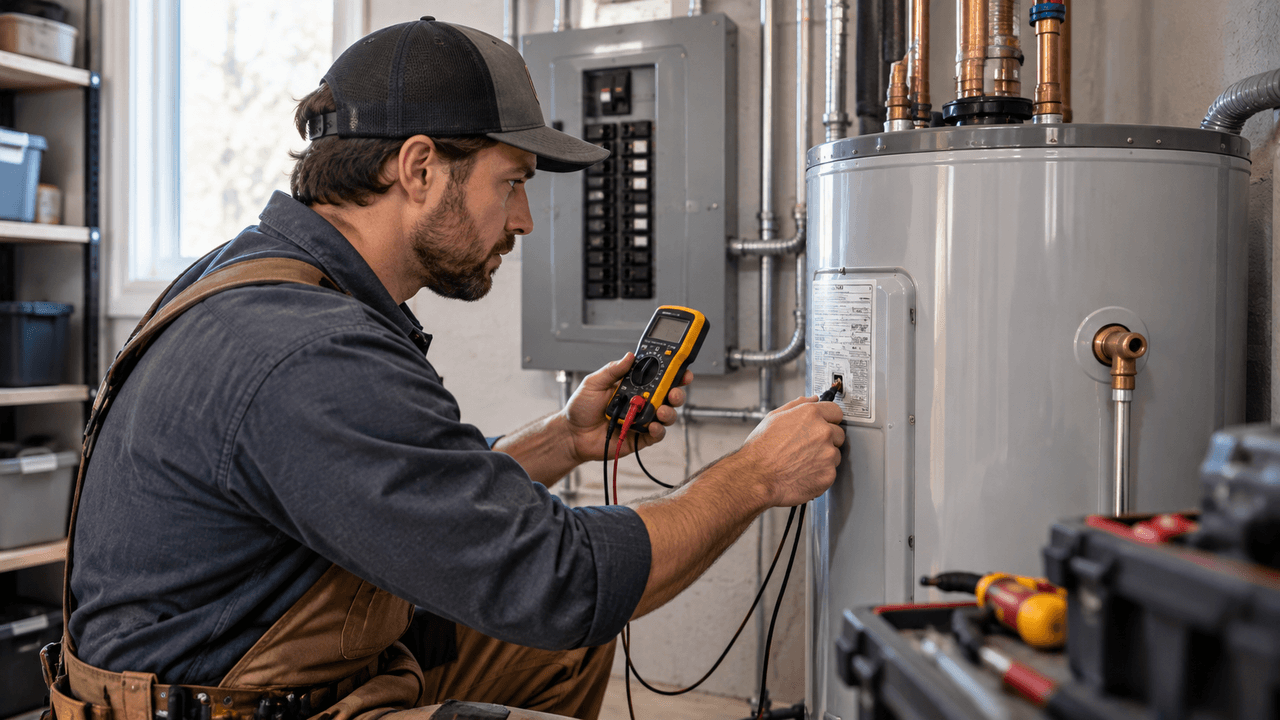

With the formula in hand, here's what that actually looks like for the most common type of water heater on the market.
Amps and Watts for a Standard Tank Water Heater
Standard storage tank water heaters are common across American homes. Most 40 to 50-gallon models use 4,500 to 5,500 watts. These setups pull between 18.8 and 22.9 amps at 240 volts.
Smaller 20-gallon utility tanks run on 120-volt circuits instead. They use 1,500 to 2,000 watts and draw 12.5 to 16.7 amps. Large 80-gallon tanks can reach 6,000 watts.
Standard residential tanks contain two separate heating elements. Upper and lower elements take turns heating your water supply. They run sequentially rather than operating at the same time. The tank never draws double wattage during normal use.
Tank Size | Typical Wattage | Voltage | Approx. Amps |
20-Gallon | 1,500 – 2,000W | 120V | 12.5 – 16.7A |
30-Gallon | 3,000 – 3,500W | 240V | 12.5 – 14.6A |
40-Gallon | 4,000 – 4,500W | 240V | 16.7 – 18.8A |
50-Gallon | 4,500 – 5,500W | 240V | 18.8 – 22.9A |
65–80 Gallon | 4,500 – 6,000W | 240V | 18.8 – 25.0A |
Knowing the heater's amp draw also helps you figure out what backup power can handle it. A standard electric tank heater can use several thousand watts while heating. So, if you're planning for outages, it's worth comparing your heater's demand with the output of a home backup system.
That's where options like the EcoFlow TITAN Plus, TITAN, and TITAN Classic come into the picture. Each offers a different level of power and capacity, making it easier to match your backup setup to your home's electrical needs. Before choosing one, though, check your water heater's actual wattage and voltage first.
For homeowners wanting to power a 240V tank water heater during outages, the EcoFlow TITAN Plus provides 7.2kW from battery alone, rising to 10kW with solar, backing up selected heavy loads through Smart Home Panel 10.
EcoFlow TITAN suits homes that want certified indoor backup for 240V loads like a tank water heater. It matches the 7.2kW split-phase output of EcoFlow TITAN Plus, but takes a single 4kW MPPT solar input instead.
If your home uses a compact 120V water heater or only requires backup for basic appliances, the EcoFlow TITAN Classic fits best. It provides 4kW of dedicated 120V power for essential circuits during blackouts.
Whether your setup runs on gas or electricity changes this math entirely, so it is worth understanding if gas water heaters need electricity before sizing your breaker panel.
Tank models are the baseline, but tankless systems pull in an entirely different range.
Tankless Water Heaters Draw Far More
Tankless units heat water instantly as it moves through pipes. That instant heating creates a dramatic jump in power demand.
Point-of-use units stay relatively easy to manage. A single under-sink heater uses 1,400 to 1,800 watts. It runs on a dedicated 120-volt line at 12 to 15 amps.
Whole-house electric tankless units demand massive amounts of energy. They pull between 18,000 and 36,000 watts on demand. That requires 75 to 150 amps across multiple 240-volt circuits.
You can weigh the pros and cons of tankless systems before making a final equipment upgrade. The extra electrical demand requires serious panel space.


Heat pump water heaters land at the opposite end of the range from whole-house tankless units.
Heat Pump Water Heaters Use the Least
Heat pump water heaters use less power during normal operation. Their compressor typically draws 300 to 1,000 watts. At 240V, that's roughly 1.25 to 4.17 amps.
The backup heating element can change that demand. When hot water demand exceeds the heat pump's capacity, the resistive element can turn on. A 4,500-watt element draws about 18.75 amps at 240V.
In heat-pump mode, most units draw only 2 to 5 amps. When the 4,500-watt backup element kicks in, draw rises to roughly 19 amps, or about 23 amps if both run together, which is why many models use a 30A circuit.
The electrical setup can also vary by model. Some units need a dedicated 240V circuit, while others can use different household wiring configurations. The 240V requirements depend on the specific heat pump water heater.
Across all three types, one thing stays consistent: none of them have a starting surge to plan around.
Why Water Heaters Don't Have a Starting Surge
A water heater's heating element is a simple resistive load. It doesn't have a motor that needs extra power to start.
Unlike a refrigerator or air conditioner, it doesn't create a startup spike. The heater draws the same amps when it turns on. It continues drawing those amps while running.
That makes backup power planning easier. You don't need extra capacity for a startup spike. Motor-driven appliances usually need that additional headroom.
Most major household appliances aren't this simple. Refrigerators, air conditioners, and pumps can draw more power when starting. That's why you should calculate a water heater's demand separately.
For appliances with motors, starting and running watts can change the amount of backup power you need.
That steady draw is exactly what determines the breaker a water heater needs.
Breaker Sizing and the NEC 125% Rule
The National Electrical Code requires breakers for continuous loads to be rated at 125% of the calculated amperage. Water heaters can fall under this requirement because they cycle on and off to maintain the tank's temperature.
Here's the math for a 4,500-watt water heater.
Calculate amps: 4,500W ÷ 240V = 18.75 amps
Apply the 125% rule: 18.75 × 1.25 = 23.44 amps
Select the breaker: 23.44 amps requires a 30-amp breaker under the applicable sizing rules.
The wire size matters just as much as the breaker. A standard 30-amp circuit typically uses 10 AWG copper wire, though installation conditions can affect the final choice. The same sizing considerations apply when working with a 30-amp breaker and wire.


Knowing the exact amp draw also determines what backup power can realistically handle.
What This Means for Backup Power
Backing up a standard tank water heater is entirely realistic. A typical 40 to 50-gallon unit draws 18 to 23 amps. That translates to roughly 4,500 to 5,500 watts of demand. Modern residential battery setups handle this load range with ease.
Whole-house electric tankless systems present a much bigger challenge. These units draw 75 to 150-plus amps across multiple lines. Most residential backup systems cannot sustain that massive power draw.
Choosing which circuits to back up comes down to your household's priorities. A backup circuit setup can help you decide which loads make the most sense during an outage.
For a water heater, the decision comes down to available output. You also need enough battery capacity for the desired runtime.
Conclusion
A standard electric tank water heater pulls roughly 18 to 23 amps. This steady electrical draw sits comfortably within standard home battery backup capabilities. In contrast, electric tankless systems demand far more amperage and careful planning.
Always check the voltage and wattage data plate on your unit. Relying on tank capacity alone will lead to incorrect electrical estimates. Multiply your calculated running amps by 1.25 to size breakers properly. This ensures your household wiring stays completely safe under continuous operation.
The same numbers also matter when choosing backup power. Once you know your heater's real demand, you can evaluate reliable power solutions like EcoFlow TITAN, EcoFlow TITAN Plus, and EcoFlow TITAN Classic. Each can fit different home backup needs depending on the power and capacity your home requires.
FAQs
How many amps does a water heater use?
A typical electric tank water heater uses 18 to 23 amps at 240 volts. Smaller 120-volt models pull 12 to 17 amps, while whole-house tankless systems can draw well over 100 amps.
How many watts does a water heater use?
A typical electric tank heater uses 4,500 to 5,500 watts. Compact 20-gallon units run lower, around 1,500 to 2,000 watts. Whole-house tankless systems need 18,000 to 36,000 watts to heat water instantly on demand.
What size breaker does a water heater need?
A common 4,500-watt water heater draws 18.75 amps at 240V. Applying the 125% continuous-load calculation gives 23.44 amps, which commonly calls for a 30-amp double-pole breaker.
Do tankless water heaters use more power than tank models?
Whole-house tankless water heaters generally use much more power than standard tank models. Some require 18,000 to 36,000 watts across multiple circuits, with combined amperage reaching 75 to 150 amps or more.
Can backup power run a water heater during an outage?
A standard 240V tank heater at 18 to 23 amps is realistic for split-phase home battery systems like EcoFlow TITAN and TITAN Plus on dedicated subpanels. Smaller 120V water heaters can be powered by EcoFlow TITAN Classic. Whole-house electric tankless units usually fall outside residential battery backup range.
For press requests or interview opportunities, reach out to our media team
media.na@ecoflow.com