Power Failure Emergency Light Guide: How Plug-In Night Lights Work and How to Keep the Lights On Longer
- Power Failure Emergency Lights You'll Find in Stores
- How a Plug-In Emergency Light Knows the Power Went Out
- When the Outage Outlasts the Night Light: Backup Power for Lamps, Phones, and Wi-Fi
- Where to Plug In Power Outage Night Lights
- Night Lights at Home vs. Emergency Lighting Required by Code
- How to Choose, Test, and Store Plug-In Emergency Lights
- Conclusion
- FAQs
When the power cuts out at 2 a.m., your hallway can go completely dark. A small light plugged into an outlet near the stairs can make all the difference. A power failure emergency light switches on automatically when electricity stops flowing, helping you find your way around safely.
This guide covers plug-in emergency lights sold by U.S. retailers, what their specifications mean, and where to place them. You'll also learn how they detect an outage, how to test them, and why they aren't a substitute for required building emergency lighting. For longer outages, we'll look at ways to keep lamps, phones, and Wi-Fi running.
Power Failure Emergency Lights You'll Find in Stores
Most plug-in emergency lights do three jobs. They provide a night light, switch on automatically during a power failure, and work as a small flashlight. Some models also serve as tabletop lights when removed from the outlet.
The options below are identified by their manufacturers' product information. Features and runtimes vary by model, so check the specifications before buying.
Light (maker) | Brightness stated by maker | Battery stated by maker | Runtime stated by maker | Auto-on in a power failure | Flashlight mode |
GE 4-in-1 Rechargeable Power Failure LED Night Light (Jasco) | 40 lumens as a flashlight; 5 lumens as a night light or tabletop light | 3 AA batteries included | Up to 250 hours on the low setting | Yes, "comes on instantly when power goes off" | Yes, unplug and fold the plug in |
GE 4-in-1 Rechargeable Power Failure Light Sensing LED Night Light (Jasco) | 10 lumens night light, 5 lumens power failure light, 20 lumens task light, 40 lumens flashlight | Built-in rechargeable battery | Not stated | Yes, "instantly activates during power outages" | Yes, plus tabletop use |
GE Rechargeable 3-in-1 LED Power Failure Night Light, model 11281 (Jasco) | 5 lumens as a night light; 20 lumens as a power failure light; 20 lumens as a flashlight | Built-in rechargeable battery (no replacement batteries needed) | Not stated | Yes, "turns on instantly when the power goes out" | Yes, foldable prongs with simple ON/OFF control |
Energizer 4-in-1 Rechargeable Power Failure Light Sensing LED Night Light (Jasco, product code 38511) | Not stated | Rechargeable battery | Not stated | Yes, "During a power outage, it promptly comes on" | Yes, plus tabletop light |
Energizer Rechargeable Compact Handheld LED Flashlight (Energizer, WeatheReady line) | 40 lumens on high | Built-in rechargeable AAA NiMH | 3 hours on high (spec table) | Yes, when plugged in and the power goes out | It is a flashlight that charges in the outlet |
Reading the package labels
Package numbers can get confusing fast. Lumens measure total visible light output. Watts measure electrical power consumption.
According to the Federal Trade Commission (FTC), an older 60-watt incandescent bulb puts out roughly 800 lumens. A modern LED produces that same brightness using only about 9 watts.
A power failure night light rated at 5 lumens provides just enough light to navigate a dark corridor. It is not meant for preparing meals or reading a book. A night light rated at 5 lumens and a kitchen bulb at 800 lumens do very different jobs, which is why comparing bulbs by lumens, not watts makes these labels easier to read.
Every light in that table promises to switch on by itself when the grid drops, so it helps to know what is happening inside that small plastic case.
How a Plug-In Emergency Light Knows the Power Went Out
A power failure light monitors electricity at its outlet. While power is available, a model with a built-in rechargeable battery charges it, and a model that runs on AA batteries leaves them unused. Many units also work as a dusk-to-dawn night light. When the outlet loses power, the light switches to battery power automatically.
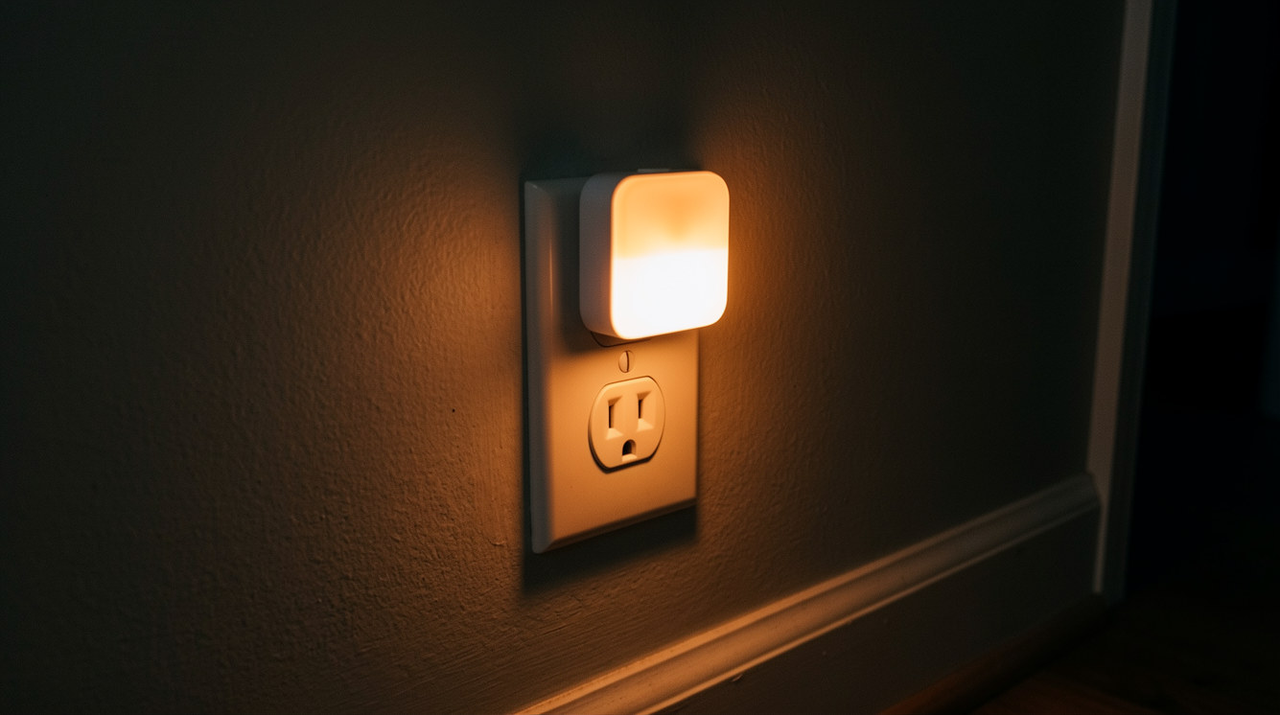
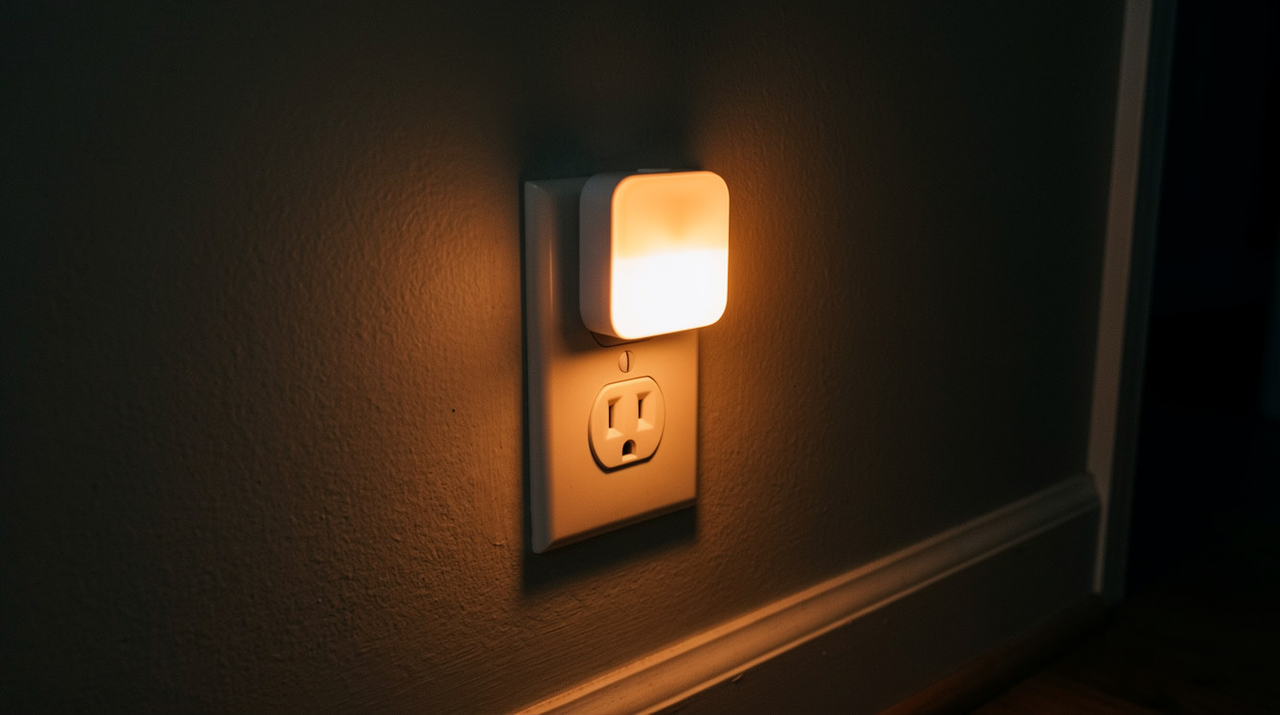
Most units operate across three simple states:
Normal standby mode: The light sits plugged into the wall. Rechargeable models charge their built-in battery while plugged in. AA-powered models, such as the GE 4-in-1 with 3 AA batteries, don't use their batteries while plugged in, so nothing is charging. A front-facing light sensor turns the low-level night light on at dusk and off at dawn on models that have one.
Power outage mode: The instant line current cuts out, the fixture switches on automatically. As Jasco notes for its GE lineup, the unit "comes on instantly when power goes off."
Handheld flashlight mode: You slide the light out from the wall plate and fold down the prongs. The unit then functions as a compact, portable flashlight.
Rechargeable vs. replaceable batteries
The hardware inside these fixtures varies quite a bit between models:
Built-in rechargeable cells: The GE 3-in-1 model 11281 has a built-in battery that charges while plugged in, so it does not need disposable replacement batteries. Follow the manufacturer's instructions for battery care and end-of-life handling.
Replaceable alkaline cells: Units like the GE 4-in-1 use 3 standard AA batteries. If a storm knocks out the power for multiple days, you can swap fresh AA batteries anytime.
Why some lights come on when you unplug them
A power outage night light monitors voltage at its own plug prongs. It cannot tell the difference between a neighborhood blackout and being pulled out of the wall.
It also turns on if you plug it into a wall outlet controlled by a wall switch that gets turned off. If your unit switches on whenever you pull it out to clean, check the casing for an AUTO or OFF switch.
What these lights can't do
These fixtures serve as short-term path lights. They cannot charge your phone, run household gear, or light an entire room. Their internal batteries are built strictly for temporary, low-lumen guidance.
A couple of auto-on night lights sit near the top of the list of essentials to have ready before outages, alongside flashlights and charged phones.
A 5-lumen glow gets you to the bathroom at 2 a.m., but if the outage stretches into the next evening, you'll want real lamps, a charged phone, and a working router.
When the Outage Outlasts the Night Light: Backup Power for Lamps, Phones, and Wi-Fi
Plug-in emergency lights help during the first minutes of darkness. They aren't designed to keep an entire household comfortable through a two-day outage. A portable power station offers another option. It can run compatible LED lamps, charge phones, and power a Wi-Fi router. Unlike an automatic night light, it supplies electricity to devices connected to its outlets.
If you want lamps and a router to keep going after the night lights fade, these two EcoFlow units cover a small setup and a larger one.
The EcoFlow DELTA 3 Classic suits homes needing to keep essential lights and devices running. With 1,024Wh capacity, it powers table lamps, phones, and your Wi-Fi router through short blackouts without complex setups. Check device wattage labels to plan runtime.
The EcoFlow DELTA 3 Max suits larger setups or longer outages. With 2,048Wh capacity and 2,400W output, it can run several LED lamps, a router, and phone chargers for a day or more, depending on the total load (see the estimate table below). It is a portable power source, not an automatic wall-mounted light.
The EcoFlow DELTA 3 Classic covers a small number of lighting and communication devices. The EcoFlow DELTA 3 Max covers more devices or a longer outage. A lamp plugged into either one stays on through an outage only if the unit was already plugged into the wall and the lamp was already on.
Estimated runtime for LED lamps (labeled estimate)
To estimate runtimes, use this standard planning formula:
Runtime = (Capacity (Wh) × 0.85) ÷ load (W)
The 0.85 is our planning assumption for conversion losses, not an EcoFlow figure.
A standard 800-lumen household LED bulb draws roughly 9 watts. The estimates below show how long each power station can keep household lights on during an extended blackout.
Setup | Usable energy (capacity × 0.85) | 1 LED bulb (9W) | 3 LED bulbs (27W) | 5 LED bulbs (45W) | 5 LED bulbs + 25W from your device labels (70W, hypothetical) |
EcoFlow DELTA 3 Classic (1,024Wh) | About 870Wh | About 97 hours | About 32 hours | About 19 hours | About 12 hours |
EcoFlow DELTA 3 Max (2,048Wh) | About 1,741Wh | About 193 hours | About 64 hours | About 39 hours | About 25 hours |
Note on runtime figures: The single-bulb hours represent theoretical maximum limits. When running very small loads like a single 9W bulb, the inverter's own baseline operating consumption uses up energy faster. Expect real-world runtimes for a single bulb to be lower than the mathematical maximums.
For routers and mobile gear, check the back panel label on each power brick. Look for the listed wattage or multiply the output volts by amps.
Before you add up a lamp setup, it helps to know how many watts household bulbs use, since an old incandescent lamp can draw several times what an LED does.
Whether the light comes from a 5-lumen night light or a lamp on a power station, where you put it decides whether anyone trips on the stairs.
Where to Plug In Power Outage Night Lights
Place your emergency light night light units along walking paths, not just inside living spaces. Think carefully about the path your family takes when walking through a dark house at night.
Primary hallway outlets: Place units midway between bedroom doors and the main bathroom.
Stairway approaches: Plug a night/emergency light at the top landing and bottom floor of every stair run.
Children's and elders' rooms: Keep floors lit for kids or family members using canes or walkers.
Basement or safe room paths: Keep walkways clear down into basements or interior storm shelters. A lit hallway matters most during tornado warnings that come after dark, when everyone has to move to the safe room fast.
Utility zones: Put a light right near your main breaker panel and your emergency supply shelf.
Kitchen counters: Keep one near the refrigerator so you can grab drinks without opening doors repeatedly.
Safety notes that matter in an outage
Skip open candle flames: The Consumer Product Safety Commission (CPSC) issued a safety warning urging consumers to avoid open flames during outages. Use flashlights or battery-powered lanterns instead of open wax candles. If you must use candles, never leave them unattended and extinguish them before going to bed.
Check safety recall lists: Plug-in night lights run warm. The CPSC previously recalled approximately 37,000 Luminescent Model 2017-G night lights because of severe overheating issues that posed fire hazards. Periodically check your home products at CPSC.gov/Recalls and keep devices away from drapes, bed skirts, or rugs.
Never run combustion engines indoors: The CPSC warns to never operate a portable generator inside a home, garage, basement, crawlspace, shed, or other enclosed space. Opening doors or windows does not provide enough ventilation. Run engine generators outside only, at least 20 feet from the house, and not on a porch or in a carport. Point the exhaust away from your home and other buildings, keep it clear of doors, windows, and vents, and follow the manufacturer's instructions. The CPSC reports that nearly 100 people die each year in the US from carbon monoxide poisoning caused by portable generators.
Emergency utility hazards: If you spot downed neighborhood utility lines or smell leaking gas after a storm, evacuate and dial 911 immediately.
A few night lights along the hallway work well at home, but they are a different thing from the lit exit signs and emergency fixtures you see in offices and apartment corridors.


Night Lights at Home vs. Emergency Lighting Required by Code
Consumer roundups often mix up residential night lights with commercial emergency lighting systems. However, business fixtures must meet strict building regulations and fire safety standards.
Plug-in units offer basic residential convenience. They do not fulfill legal safety requirements in commercial, industrial, or multifamily rental properties.
The Occupational Safety and Health Administration (OSHA) enforces specific workplace lighting standards under federal law:
29 CFR 1910.37(b)(1): "Each exit route must be adequately lighted so that an employee with normal vision can see along the exit route."
29 CFR 1910.37(b)(2): "Each exit must be clearly visible and marked by a sign reading 'Exit.'"
29 CFR 1910.37(b)(6): Each exit sign "must be illuminated to a surface value of at least five foot-candles (54 lux) by a reliable light source."
State and municipal governments enforce separate building and fire codes for commercial properties and apartment hallways. Property managers and business owners should always consult local municipal inspectors regarding commercial compliance.
Consumer products and portable stations like the EcoFlow DELTA 3 series are ideal for personal home convenience. However, neither unit satisfies mandated emergency lighting codes for workplaces or shared rental corridors.
At home, nobody inspects your setup, so lighting is one part of a wider list of step-by-step safety during a blackout, from unplugging electronics to checking on neighbors.
Once you know a night light is a home convenience and not a code device, picking one gets a lot simpler.
How to Choose, Test, and Store Plug-In Emergency Lights
The right power failure emergency light depends on where you'll use it. A dim light may be enough for a hallway. A brighter flashlight mode helps when you need to inspect a fuse box or find supplies.
Use this checklist before buying:
Brightness: Check the lumen rating for each mode. If the manufacturer doesn't list one, don't assume the light will illuminate a whole room.
Battery type: Decide whether you prefer replaceable AA batteries or a built-in rechargeable battery.
Runtime: Use the manufacturer's stated figure and check which mode it applies to. The GE 4-in-1's 250-hour claim, for example, applies to its low setting.
Light sensor: Check whether the model supports automatic dusk-to-dawn operation.
Switch settings: Look for ON, OFF, or AUTO controls that suit your needs.
Flashlight function: Folding prongs and a handheld design can make the light easier to use away from the outlet.
Safety certification: Look for a recognized testing laboratory mark on the packaging and follow the manufacturer's instructions.
Routine testing and storage habits
Test your emergency lights once every month. You can test them by pressing the circuit breaker test button or simply pulling the light out of the wall. Combine this check with your monthly safety routine. As the CPSC recommends, test your home smoke alarms and carbon monoxide detectors on a monthly schedule to ensure they work properly.
Keep dedicated high-output flashlights with fresh batteries in every bedroom nightstand. Plug-in night lights guide your footsteps, but dedicated flashlights help you tackle emergency repairs.
Plug-in lights belong next to water, food, and radios on a complete outage supply kit checklist that you review each spring and fall.
Conclusion
Power failure emergency lights are cheap, automatic, and dim on purpose. They guide your steps through sudden darkness along hallways and stairs. Place a few auto-on units between bedrooms, bathrooms, and steps. Test them monthly, and keep real flashlights handy for tasks.
When blackouts outlast small night light batteries, a portable power station bridges the gap. An EcoFlow DELTA 3 Classic keeps lamps and a router running, while an EcoFlow DELTA 3 Max powers more devices for longer, about 25 hours at a 70W example load (see the estimate table). Check your gear's running wattage to plan runtime. Remember, both are portable power sources, not automatic emergency lights.
FAQs
Do power failure night lights turn on automatically?
Yes. Quality units like the GE and Energizer models featured above constantly monitor incoming voltage. They switch over to their internal batteries the moment the electrical grid drops.
How long does a power outage night light last?
It depends on the model and operating mode. The Energizer handheld flashlight lists about three hours on high, while the AA-powered GE 4-in-1 lists up to 250 hours on low. Many manufacturers don't publish a runtime.
How bright is a plug-in emergency light?
Most models put out between 5 and 40 lumens, depending on whether you use them as a night light or a flashlight. That is plenty of light for walking down a hallway, but well below the roughly 800 lumens you get from a standard 9W household LED bulb.
Can a plug-in emergency light replace emergency lighting in a business or rental building?
No. Commercial buildings and workplaces must follow OSHA standard 29 CFR 1910.37, along with local building and life safety codes. Standard residential plug-in night lights do not meet these legal workplace requirements.
Can a portable power station work as an emergency light?
No, a power station is an electrical supply source rather than an automatic light fixture. An EcoFlow DELTA 3 Classic or EcoFlow DELTA 3 Max can power table lamps, network routers, and cell phones for hours, but it will not turn a lamp on by itself when the grid drops.
For press requests or interview opportunities, reach out to our media team
media.na@ecoflow.com