What the NEC Actually Says About 20 Amp Circuit Outlet Limits
If you've ever counted the outlets in a room and wondered whether you have too many on one circuit, you're asking a fair question, just not quite the right one. There's no single NEC maximum number of outlets for a residential 20-amp circuit. What actually determines whether a circuit is safe is the electrical load running through it at any given moment, not how many outlets are wired into it. Once that distinction clicks, figuring out how many outlets on a 20-amp circuit your room can safely handle gets a lot easier.
Is There a Limit to How Many Outlets Can Be on a 20-Amp Circuit?
The short answer is no, at least not in the way most homeowners expect. A lot of people assume there's a hard number somewhere in the code, some fixed count of receptacles a 20 amp circuit is allowed to carry. There isn't. The rules that do specify a receptacle count are built for commercial and non-residential load calculations, not homes. Residential branch circuits are governed by total connected load instead. So whether the question is how many 20 amp outlets on a 20 amp circuit is safe, or how many plugs on 20 amp circuit wiring can carry, the answer is the same: it depends on what's drawing power, not how many places there are to plug something in.
Residential vs. commercial: commercial spaces follow stricter, calculation-based receptacle rules; residential branch circuits are governed by total connected load instead
80% continuous load rule: a widely used safety margin that keeps circuits from running at their absolute maximum for extended periods
Why electricians recommend practical limits anyway: even without a hard NEC cap, experienced electricians suggest reasonable outlet counts based on real-world usage patterns, not just what the code technically allows
Understanding your panel's layout and reviewing a smart home backup power guide helps clarify where 20 amp circuits typically show up in a home. The NEC requires them for kitchen countertop receptacles, bathrooms, laundry areas, and garages—spaces where higher-draw appliances are common—while bedrooms and living rooms usually run on 15 amp circuits instead. A 20 amp breaker in most panels is labeled differently from standard 15 amp breakers, though labeling should always be confirmed against the directory. That's really what settles how many outlets a 20 amp circuit breaker can safely support in a given room, not the wall plate count.
Since the code doesn't set a hard outlet cap, the real question becomes how much load a circuit can actually carry, which starts with the math.
How Many Watts Can a 20-Amp Circuit Handle?
%20(2).PNG)
%20(2).PNG)
The formula behind this is straightforward: watts equals volts times amps. For a standard 120V, 20A circuit, that works out to 2,400 watts of maximum capacity. For anything running continuously, three hours or more, the recommended ceiling drops to 80 percent of that, or 1,920 watts. That's the number that actually matters day to day when you're figuring out how many watts on a 20 amp circuit you can safely run at once, since most households aren't running a circuit at its absolute limit, they're running it continuously somewhere below that.
Maximum capacity: 2,400W (20A x 120V)
Recommended continuous load: 1,920W (80% rule)
Intermittent vs. continuous: a device running for under 3 hours at a time (like a microwave) can briefly draw closer to the full 2,400W ceiling; anything running longer should stay under the 1,920W continuous limit
Here's what that looks like in a typical room. Say you have a TV, a Wi-Fi router, a laptop charging, a floor lamp, and a couple of phone chargers all plugged into the same 20 amp circuit.
Device | Typical Wattage | Running Total |
|---|---|---|
TV (50-inch LED) | ~100W | 100W |
Wi-Fi router | ~10W | 110W |
Laptop (charging) | ~65W | 175W |
Floor lamp (LED) | ~15W | 190W |
Two phone chargers | ~20W | 210W |
That combination lands around 210 watts, well under the 1,920 watt continuous ceiling, with plenty of headroom left. But headroom disappears fast once a higher-draw device joins the mix. Add a 1,500 watt space heater to that same circuit and the total jumps to around 1,710 watts, close to the continuous limit with almost nothing left over. Nothing about the outlet count changed, only what's plugged into them. Learning how to calculate amps makes this math far more reliable for planning than counting outlets, as two circuits with the same outlet count can have vastly different safety margins depending on what's running.
Understanding how many outlets a 20 amp circuit can support is only part of keeping your home powered safely. It is equally important to plan for unexpected outages, especially if you rely on essential electronics like refrigerators, Wi-Fi routers, home office equipment, or medical devices. While adding more outlets won't increase a circuit's capacity, having a reliable portable backup power source can help keep critical appliances running when grid power is unavailable. That's where EcoFlow's portable power solutions come in.
Offloading Your 20-Amp Circuit with EcoFlow Portable Power Stations
When a circuit is running close to its limit, the more practical fix is often not rewiring but offloading, moving some of that draw onto a separate power source instead of the wall circuit. A portable power station can take on part of the load directly, which reduces the risk of nuisance trips without any electrical work. Two EcoFlow options fit this role in different ways, depending on whether the priority is raw offloading capacity or protecting sensitive gear.
Because high-wattage kitchen appliances demand substantial power, understanding how many amps a microwave uses helps explain why microwaves are a common source of circuit trips. Always verify exact current draw and output figures from the live product page before finalizing specs. Knowing how to offload a circuit is key to prevention, while recognizing warning signs catches an active problem in progress.
Signs You're Overloading a 20-Amp Circuit
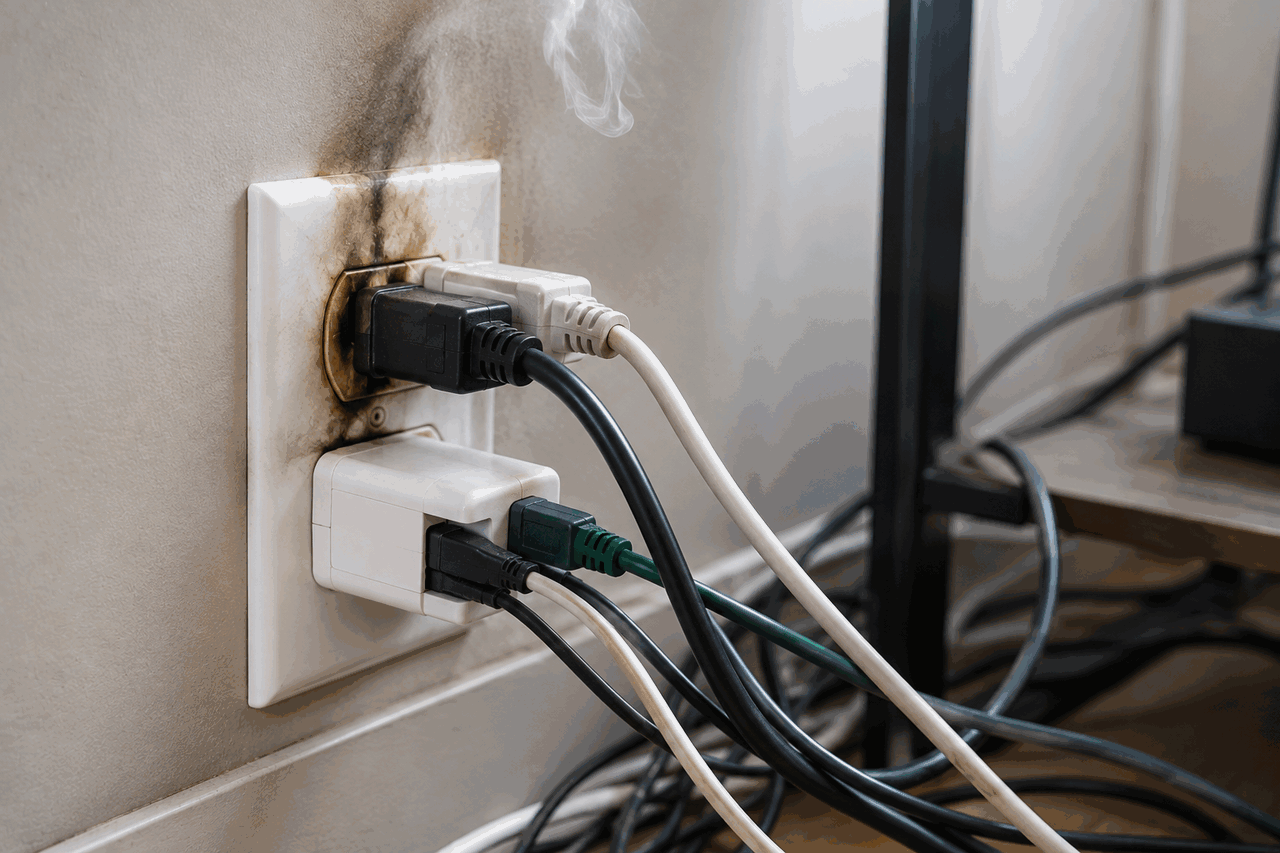
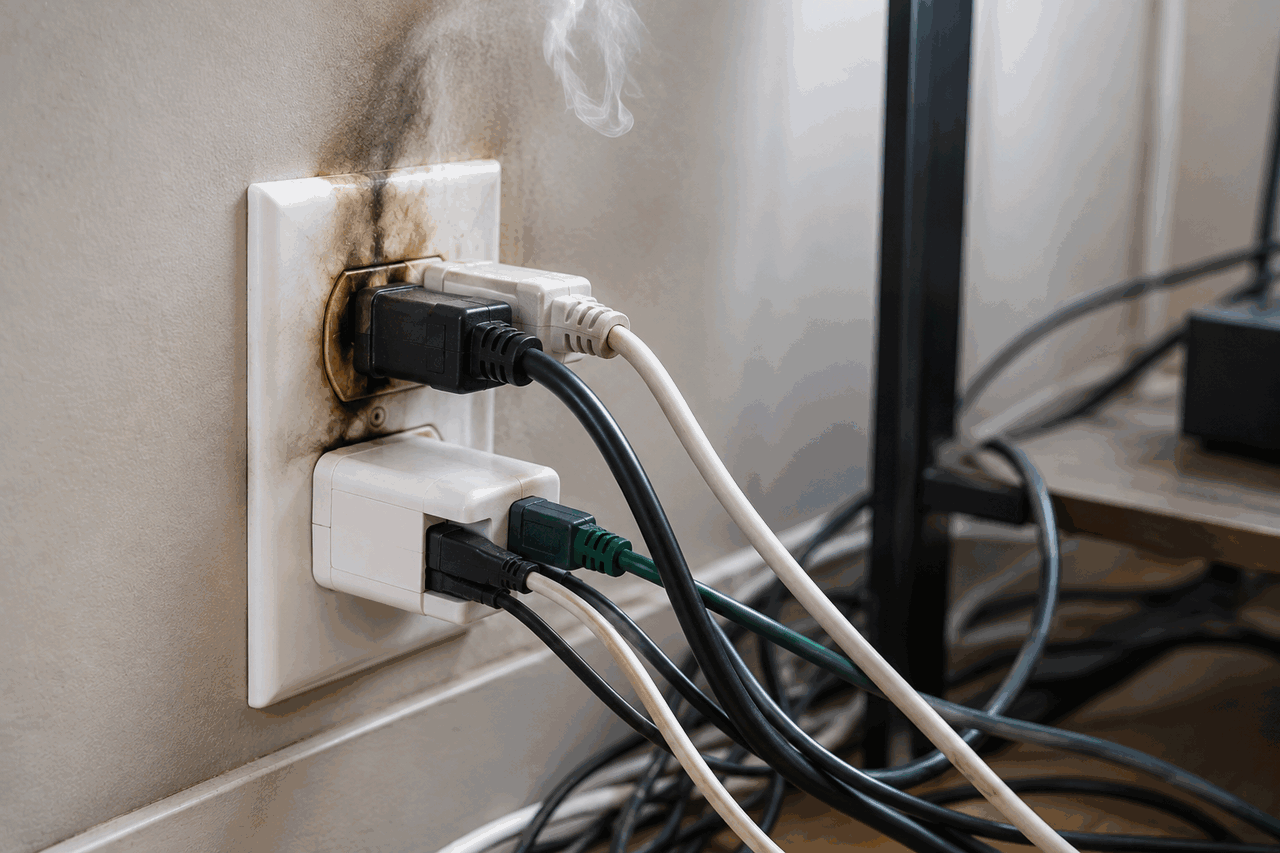
Frequently tripped breaker
Flickering or dimming lights
Warm outlet cover plates
A burning smell near an outlet or panel
Buzzing sounds from an outlet box
Extension cords that feel hot to the touch
While upgrading to smart electrical panels for an energy-efficient home gives you real-time visibility into circuit performance, physical warning signs still demand immediate attention. Experiencing more than one issue at once means it is time to call a licensed electrician. Flickering lights often stem from a large appliance's startup draw pulling voltage, which is a load issue. A burning smell or a hot extension cord is far more serious—it indicates heat buildup and should be addressed immediately.
Conclusion
Electrical load, not outlet count, is what determines safe circuit usage. A 20 amp circuit can technically support many outlets as long as the total wattage running through it at any given time stays within safe limits, and that's really the answer to how many outlets on a 20 amp circuit is safe for your home. Calculate expected wattage before adding new receptacles or plugging in high-power devices, rather than relying on outlet count alone.
When a circuit is running close to its limit, offloading with a portable power station is often the simplest fix. The EcoFlow DELTA 3 Max is built for heavy appliances that push a room circuit to its edge, while the EcoFlow DELTA 3 Max Plus is the better fit for protecting sensitive electronics on a circuit that is already near its continuous load limit.
FAQs
How many outlets can be on a 20 amp breaker?
There is no fixed NEC maximum for residential circuits. The real limit is total connected load, so the safe outlet count depends on what's plugged in and running at the same time, not a specific number of receptacles.
How many receptacles on a 20 amp circuit are recommended?
Electricians commonly suggest 10 to 13 receptacles as a practical guideline for general-use rooms, though this is a convention rather than a code requirement. Total wattage still matters more than the receptacle count itself.
How many watts can a 20 amp circuit safely handle?
A 20A, 120V circuit maxes out at 2,400 watts. For continuous loads (3 hours or more), keep usage under 1,920 watts, which is 80 percent of the circuit's total capacity.
Can I put 15-amp outlets on a 20-amp circuit?
Yes, on multi-receptacle circuits. When comparing 15-amp vs. 20-amp circuits, NEC 210.21(B)(3) explicitly allows standard 15-amp receptacles on a 20-amp branch circuit, provided there is more than one outlet on the circuit. Only a single-receptacle circuit requires a dedicated 20-amp receptacle.
What causes a 20-amp breaker to trip?
A breaker trips when the connected load exceeds the circuit's safe capacity, usually from running several high-draw appliances at once, a short circuit, or a ground fault. It's a safety response, not a malfunction.
For press requests or interview opportunities, reach out to our media team
media.na@ecoflow.com