Heat Pump Water Heater vs Tankless: Efficiency, Cost, Hot Water Flow, and Outage Power Needs
- Heat pump water heater vs tankless: how each works, side by side
- Efficiency and yearly operating cost: what the UEF ratings mean
- What each one needs in a power outage, and where EcoFlow TITAN Plus and EcoFlow TITAN Classic Fit
- Hot water delivery: flow rate, first-hour rating, and household size
- Installation requirements: space, venting, gas lines, and wiring
- Pros and cons, and which one fits your home
- Conclusion
- FAQs
When comparing water heaters, remember that tankless systems come in two types: gas and electric. Gas tankless heaters burn fuel but still need electricity to operate. Whole-house electric tankless models can draw more than 100 amps. Heat pump water heaters work differently. They store hot water and use heat from the surrounding air to warm it. This guide compares all three options by efficiency, running costs, hot water delivery, installation needs, and backup power during an outage.
Heat pump water heater vs tankless: how each works, side by side
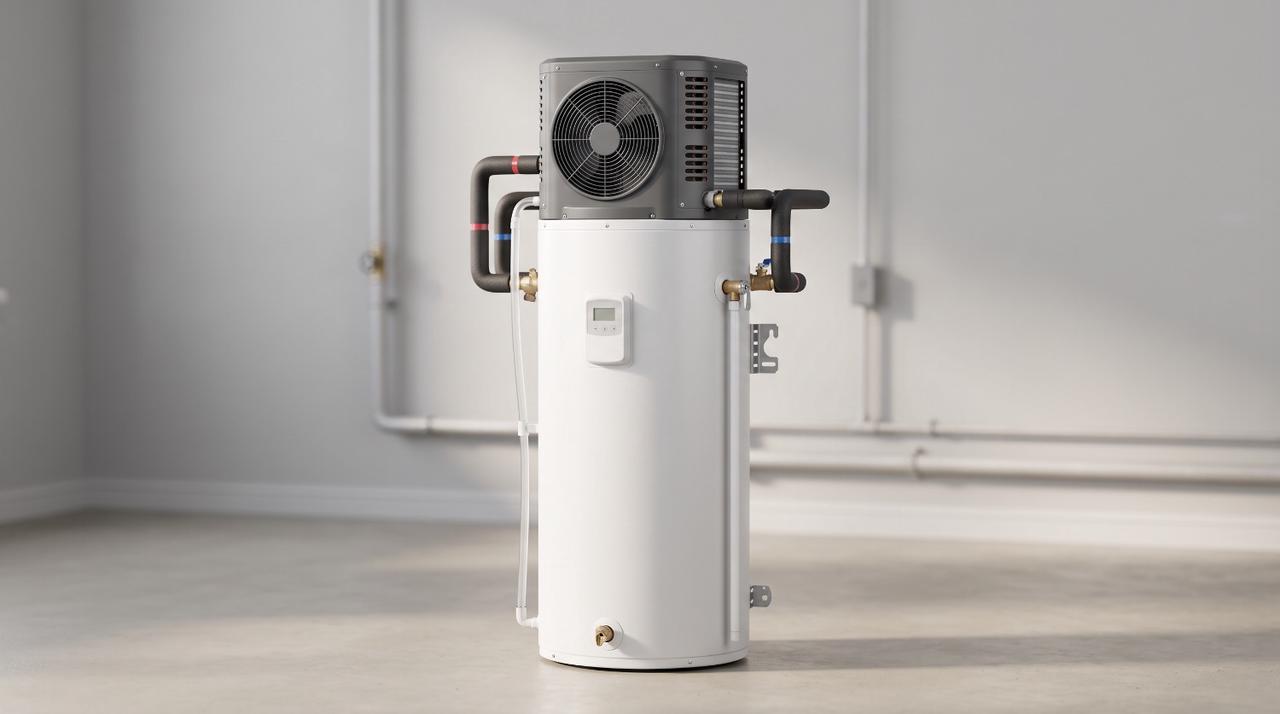
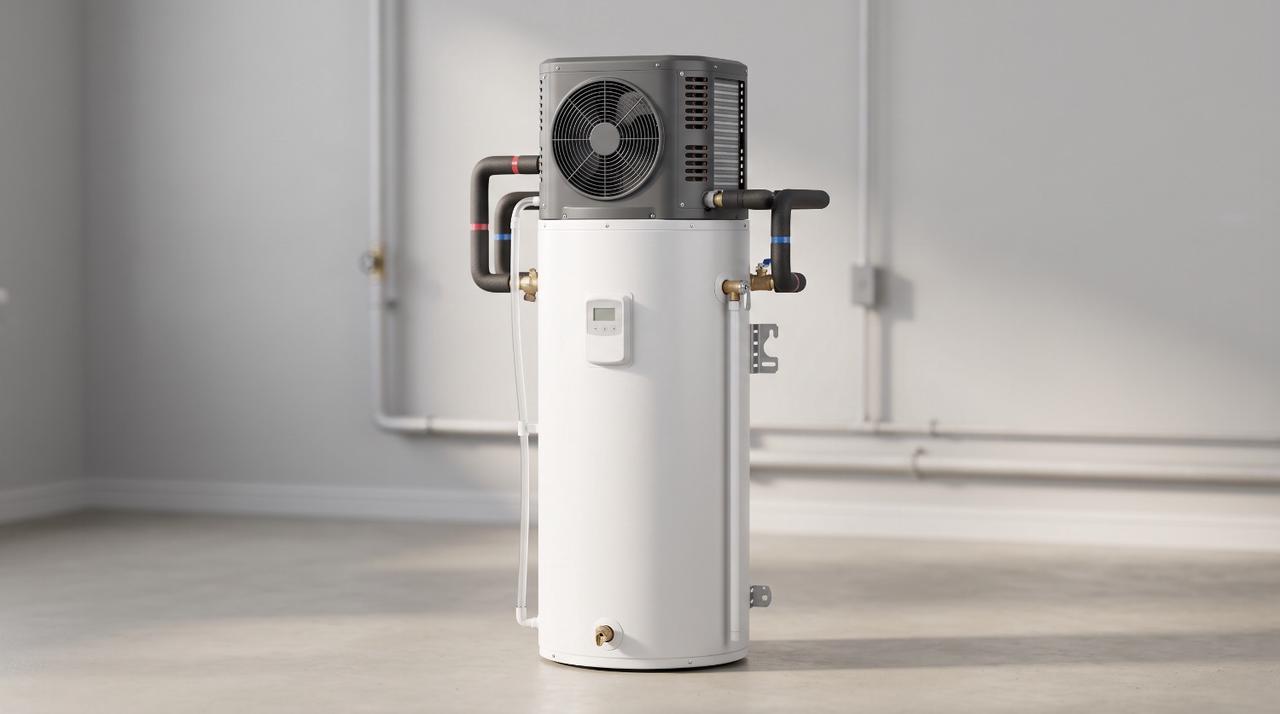
A heat pump water heater stores hot water in an insulated tank. It draws heat from the surrounding air and transfers it to the water. A tankless water heater has no storage tank. It heats water as it flows through the unit. It can use either a gas burner or electric heating elements.
How a heat pump water heater works
A heat pump water heater uses a compressor to move heat from the air into the water. The process uses less electricity than direct electric heating. According to the U.S. Department of Energy (DOE), these systems can be two to three times more energy-efficient than conventional electric resistance water heaters.
Many models also have backup resistance elements. These help meet high demand or heat water when conditions limit heat pump performance. However, using these elements increases electricity use. Some models offer heat pumps, hybrid, high-demand, and electric modes. The mode you choose affects both running costs and power needs.
How a tankless water heater works (gas and electric)
A tankless water heater heats water only when a tap or appliance needs it. Gas models use a burner, while electric models use heating elements. Both avoid standby heat loss associated with storing hot water.
Gas tankless heaters can usually deliver higher flow rates than electric tankless models. However, gas units still need electricity for controls, ignition, and fans. For example, Rinnai states that its gas tankless units require a 120V supply and less than three amps. They will not operate during a power outage without suitable backup power.
Heat pump water heater vs tankless at a glance
Feature | Heat pump water heater | Gas tankless | Electric tankless |
How it heats | Compressor moves heat from room air into a tank; resistance elements as backup | Gas burner heats water as it flows | Resistance elements heat water as it flows |
Stored hot water | Yes (tank) | No | No |
ENERGY STAR category | Yes: integrated UEF 3.30 or higher | Yes: UEF 0.95 or higher | No ENERGY STAR category on the criteria page |
Typical electrical supply | 240V/30A for many full-size models; some 120V plug-in models | 120V, under 3 amps (Rinnai example) | 240V, from one 30A breaker up to four 40A breakers (Rheem RTEX line) |
Works with no grid power? | No | No (Rinnai) | No |
Space needs | 1,000 cubic feet of air space (ENERGY STAR); room kept 40°F to 90°F year-round (DOE) | Wall-mounted; needs venting and an adequate gas line | Wall-mounted; needs heavy wiring and panel capacity |
Life expectancy | 13-year lifespan used in ENERGY STAR's savings math | "more than 20 years" (DOE, tankless in general) | Same DOE statement |
The right choice depends on your fuel supply, household demand, available space, and electrical service. Tankless systems offer continuous heating, but their flow and power requirements vary by type.
Gas and electric on-demand units share the endless-flow appeal, and the pros and cons of tankless water heaters look different once you factor in flow limits and installation cost.
The side-by-side table shows how each design heats water. The next section measures how much energy each one turns into hot water, using UEF ratings and a yearly cost example.
Efficiency and yearly operating cost: what the UEF ratings mean
Uniform Energy Factor (UEF) measures how efficiently a water heater converts energy into hot water under standard test conditions. A higher UEF means better efficiency. Heat pump water heaters can have a UEF above 3 because they move heat rather than create it through resistance heating. Tankless models generally have a UEF below 1.
Table: UEF yardsticks (checked October 14, 2026)
Water heater | UEF | Source |
ENERGY STAR integrated heat pump water heater (minimum) | 3.30 or higher | ENERGY STAR Key Product Criteria |
ENERGY STAR heat pump water heater on a 120V/15A circuit (minimum) | 2.20 or higher | ENERGY STAR Key Product Criteria |
Rheem ProTerra 50 gal, 30A model | 3.88 | Rheem spec sheet HP-400-NO SO Rev. 1 |
ENERGY STAR gas tankless (minimum) | 0.95 or higher | ENERGY STAR Key Product Criteria |
Rheem RTEX-18 electric tankless | "up to .94" | Rheem RTEX-18 product page |
ENERGY STAR lists a minimum UEF of 3.30 for integrated heat pump water heaters and 0.95 for qualifying gas tankless models. One manufacturer's electric tankless line reaches a UEF of up to 0.94. These figures help compare products, but they do not show your exact annual bill.
The DOE reports that tankless heaters can be 24% to 34% more energy-efficient than conventional storage-tank heaters in homes that use about 41 gallons of hot water per day. For homes using about 86 gallons daily, the improvement is around 8% to 14%. This comparison is against conventional tank heaters, not heat pump models.
Estimated yearly operating costs
The following example uses a daily hot water demand of 55 gallons, a 67°F temperature rise, and average U.S. energy prices for 2025. These figures are estimates, not guaranteed bills. Actual costs depend on your water use, local rates, and the model's performance.
Factor | Estimate |
Daily hot water demand | 55 gallons |
Annual heat needed | 11.2 million Btu |
Electricity price | $0.173 per kWh |
Natural gas price | About $1.48 per therm |
Using these assumptions, the estimated annual costs vary by water heater efficiency:
Water heater type | Example UEF | Estimated annual energy cost |
Heat pump water heater | 3.30 | $172 |
Gas tankless | 0.95 | $175 |
Electric tankless | 0.94 | $605 |
These estimates use the rated UEF to calculate energy input and assume the heater maintains that efficiency throughout the year. They exclude fixed utility charges and other costs. A heat pump operating in a cold space or using resistance backup will consume more energy than this example suggests.
The main takeaway is that a heat pump water heater can use roughly a third of the energy required by electric tankless heating. Its cost advantage over gas tankless depends on local electricity and gas prices. For a more accurate comparison, check each model's EnergyGuide label and use your own utility rates.
Your own rate decides the result here, and knowing what your electricity cost per kWh includes makes the comparison with a gas bill fairer.
Efficiency is only half the decision, because both a heat pump tank and a tankless unit stop making hot water the moment grid power goes out, and each needs very different backup.
What each one needs in a power outage, and where EcoFlow TITAN Plus and EcoFlow TITAN Classic Fit
Neither a heat pump water heater nor a tankless unit can heat water without electricity. However, their backup power needs differ sharply. A heat pump model may use a 240V circuit with a 30-amp rating and high-power resistance elements. A gas tankless heater needs much less electricity, while a whole-house electric tankless model requires far more power.
Heat pump water heater backup with EcoFlow TITAN Plus
EcoFlow TITAN Plus may support a compatible heat pump water heater circuit if the load stays within its output limits. In heat pump mode, the compressor uses much less power than the resistance elements. During high-demand or electric mode, a 4,500W element may switch on. Rheem lists a total draw of 5,000W for some 30A models.
That load uses a large share of TITAN Plus's 7.2kW output capacity. It also leaves less power for other appliances. A licensed electrician can assess the circuit and configure backup through the compatible 240V version of Smart Home Panel 10. During an outage, heat pump-only mode may help reduce the load if the water heater supports it.
Gas tankless backup with EcoFlow TITAN Classic
EcoFlow TITAN Classic may support the 120V controls, fan, and ignition circuit of a compatible gas tankless water heater. The gas supply must remain available, and the heater's manual must confirm that its electrical load is compatible.
Connection requires the matching 120V version of Smart Home Panel 10, installed by a licensed electrician. TITAN Classic cannot power a whole-house electric tankless heater or a 240V heat pump water heater.
Estimated backup runtime
The estimates below assume 85% usable energy after conversion losses. They are planning examples, not guarantees of real-world runtime.
Load | Battery capacity | Estimated runtime |
Gas tankless at 360W | 5kWh | About 11.8 hours |
Heat pump heater at 5,000W | 5kWh | About 0.85 hours |
Heat pump heater at 5,000W | 30kWh | About 5.1 hours |
120V heat pump at 1,100W | 5kWh | About 3.9 hours |
These figures represent operating time, not elapsed clock time. Water heaters cycle on and off, and other backed-up appliances reduce the available runtime. Actual consumption also depends on the unit's operating mode and electrical specifications.
TITAN Plus is the candidate for a compatible 120V or 240V heat pump circuit. TITAN Classic is limited to suitable 120V loads, such as the controls of a gas tankless heater. Neither system can run a whole-house electric tankless heater based on the power limits discussed here. Always confirm the load, wiring, and installation requirements with a licensed electrician.
Most full-size heat pump tanks sit on the 240V side of the panel, and a system that can support 120V/240V split-phase power is what makes those circuits possible to back up at all.
Backup planning covers the rare outage day. The next section covers every other day, when first-hour ratings and flow rates decide whether showers and laundry get enough hot water.
Hot water delivery: flow rate, first-hour rating, and household size
Heat pump water heaters and tankless units use different measures of hot water delivery. A tank's First Hour Rating (FHR) estimates how much hot water it can supply in the first hour of use. A tankless unit's flow rate measures how many gallons it can heat per minute at a specified temperature rise.
Heat pump water heater capacity
ENERGY STAR requires qualifying electric storage water heaters to have an FHR of at least 45 gallons per hour. Rheem lists FHR values of 60, 67, 76.6, and 87 gallons for its 40-, 50-, 65-, and 80-gallon 30A ProTerra models. A.O. Smith lists 52 gallons for its 120V Voltex HPTV-50.
Heat pump-only mode usually recovers hot water more slowly than resistance heating. Hybrid and high-demand modes help meet peak demand, but they can increase electricity use.
Tankless flow rate
ENERGY STAR's gas tankless criteria require a flow rate of at least 2.8 gallons per minute at a 67°F temperature rise. Actual flow depends on the model and the difference between incoming water temperature and the desired hot water temperature. Colder incoming water means a unit must work harder and may deliver less hot water per minute.
Consider your peak demand. One shower may use about 2 gallons per minute, so two showers can require around 4 gallons per minute before adding a dishwasher or another tap. If one unit cannot meet that demand, multiple tankless heaters may help, but they add equipment and installation costs.
How to size each type?
Sizing factor | Heat pump water heater | Tankless water heater |
Main rating | First Hour Rating | Gallons per minute at a set temperature rise |
Key question | How much stored hot water will you need? | How many fixtures may run at once? |
Main limitation | Tank capacity and recovery time | Flow rate and incoming water temperature |
Possible solution | Choose a suitable tank size and operating mode | Select a higher-capacity unit or install multiple units |
Choose based on actual household demand, not just the number of people in your home.
In northern homes, winter is also when water lines are most at risk, and preventing frozen pipes in winter protects the supply line feeding either type of heater.
Once you know which type can keep up, the practical question is what your house needs to install it: air space and a condensate drain, or venting, gas piping, and heavy wiring.


Installation requirements: space, venting, gas lines, and wiring
Installation needs differ by water heater type. A heat pump water heater needs enough air space and a way to drain condensate. A gas tankless unit needs proper venting and a correctly sized gas line. An electric tankless unit may need major electrical upgrades. Check these requirements before choosing a system.
Heat pump water heater installation
The DOE recommends installing heat pump water heaters in spaces that stay within a suitable temperature range, generally 40°F to 90°F. ENERGY STAR also recommends about 1,000 cubic feet of surrounding air space. These units can cool the room, take longer to install, and need regular maintenance, including air filter changes where applicable.
Some models have different requirements. For example, Rheem lists an operating range of 37°F to 145°F for its ProTerra models. Its installation guidance also covers ventilation for smaller rooms. Follow the specifications for your exact model rather than assuming all heat pump water heaters have the same needs.
Most units also need a condensate drain. Many full-size models use a dedicated 240V, 30A circuit, although 120V plug-in models are available. Check the electrical rating, room size, drainage, and service access before installation.
Tankless water heater installation
Gas tankless water heaters need suitable venting and a gas line that can supply enough fuel. Rinnai warns that an undersized gas line can affect performance and may reduce the unit's lifespan. Pipe sizing depends on the model, pipe length, and other gas appliances. Have a qualified installer assess the setup.
Electric tankless heaters can place a heavy load on a home's electrical panel. Rheem's RTEX range includes models using a single 30A breaker and larger units requiring up to four 40A breakers, with a total draw of 150 amps for the RTEX-36. Have an electrician check panel capacity before selecting a whole-house model.
Outdoor units also need protection in cold climates. Rinnai recommends suitable drain-down measures for certain installations and calls for heat-traced, insulated supply pipes where required. Always follow the manufacturer's installation instructions and local code.
A 30 amp circuit is common for full-size heat pump tanks, and the right wire size for a 30-amp breaker is something your electrician will confirm against local code.
Air space, venting, gas lines, and panel capacity now feed into the final pros and cons tables and a short guide to which type fits which home.
Pros and cons, and which one fits your home
Neither type is right for every household. Heat pump water heaters offer high efficiency among electric water heating options but need space and time to recover stored hot water. Gas tankless units save space and can provide continuous hot water within their flow limits. Your energy rates, climate, fuel supply, and peak demand should guide the decision.
Heat pump water heater: pros and cons
Pros | Cons |
Uses less electricity than resistance heating | Higher upfront cost in many cases |
Can lower annual energy use | Needs suitable air space and temperature |
Stores hot water for peak demand | Recovery may be slower in heat pump-only mode |
Some models support backup resistance heating | Resistance mode raises electricity use |
Tankless water heater: Pros and cons
Pros | Cons |
Heats water on demand | Output is limited by flow rate and temperature rise |
Saves space without a storage tank | Gas models need venting and gas supply |
Gas models can provide high flow rates | Electric models may need major panel upgrades |
Avoids storage tank standby losses | Most models still need power during outages |
Choose a heat pump water heater if you have enough room, suitable temperatures, and a need to reduce electric water heating costs. Choose gas tankless if you already have gas service, limited space, and demand that fits the unit's capacity. Be cautious with whole-house electric tankless models if your electrical panel has limited spare capacity.
Before buying, compare the EnergyGuide labels, installation costs, and local energy prices. If outage operation matters, confirm that your planned backup system can support the heater's voltage and actual operating load.
Many full-size heat pump models are wired on a dedicated circuit, but the answer to whether heat pump water heaters need 240 volts depends on the model, since 120V plug-in versions exist.
Conclusion
A heat pump water heater can use far less energy than an electric tankless unit. Compared with gas tankless, its running cost depends on local utility rates. Tankless models save space and can deliver continuous hot water, but their flow rates and power requirements vary. Heat pump tanks need room, drainage, and enough time to recover after heavy use.
Compare UEF ratings and EnergyGuide estimates using your own electricity or gas prices. Then check household demand, installation needs, and electrical capacity. If you want hot water during a power outage, ask a licensed electrician whether EcoFlow TITAN Plus can support a compatible heat pump water heater circuit or whether EcoFlow TITAN Classic can support the 120V controls of a compatible gas tankless unit. Confirm all loads and connection requirements before installation.
FAQs
Is a heat pump water heater more efficient than a tankless water heater?
Usually, yes, when compared with electric tankless heating. ENERGY STAR qualifying integrated heat pump models have a UEF 3.0 of at least 3.30 (minimum UEF for 120V/15A integrated models is 2.20). While qualifying gas tankless models start at 0.95. Actual energy use depends on the model and operating conditions.
Is a heat pump water heater cheaper to run than a tankless one?
It is generally cheaper to run than an electric tankless heater. Against gas tankless, the result depends on local electricity and gas prices. Use each model's EnergyGuide figures and your utility rates to estimate annual costs.
Does a tankless water heater work during a power outage?
No, not without a suitable backup power supply. Gas tankless models still need electricity for their controls, ignition, and fans. Rinnai states that its tankless heaters will not operate during a power outage.
Can a home battery run an electric tankless water heater?
A typical home battery may not support a whole-house electric tankless heater. Some models draw 75 to 150 amps at 240V, exceeding the 7.2kW output rating of EcoFlow TITAN Plus. Check the heater's electrical specifications before planning backup power.
How long does each type last?
The DOE says many tankless water heaters last more than 20 years. ENERGY STAR uses a 13-year lifespan assumption in its heat pump water heater savings calculations. Actual service life depends on water quality, maintenance, installation, and usage.
For press requests or interview opportunities, reach out to our media team
media.na@ecoflow.com