Swamp Cooler vs AC: How They Compare on Climate, Water, Power, and Outage Runtime
- Swamp Cooler vs AC at a Glance
- Swamp Cooler vs Air Conditioner in an Outage: Power Burden on EcoFlow DELTA 3 Max
- Humidity Decides It: Where Swamp Coolers Work
- Water Use and Upkeep: The Cost Most Comparisons Skip
- Swamp Cooler vs Portable Air Conditioner vs Window AC for One Room
- Are Swamp Coolers Worth It? A Quick Decision Check
- Conclusion
- FAQs
One simple physical fact settles most of the debate: a swamp cooler cools air by evaporating water. Because of that, its cooling performance depends entirely on how dry your outdoor air is.
This guide lays swamp coolers and air conditioners side by side. We explain how evaporative cooling gets weaker as humidity rises and how to read your local forecast for it. We also look at seasonal water consumption, a factor most comparisons skip completely. Finally, we answer a crucial emergency question: during a summer blackout, how long can a portable battery station run a swamp cooler versus a window AC?
Swamp Cooler vs AC at a Glance
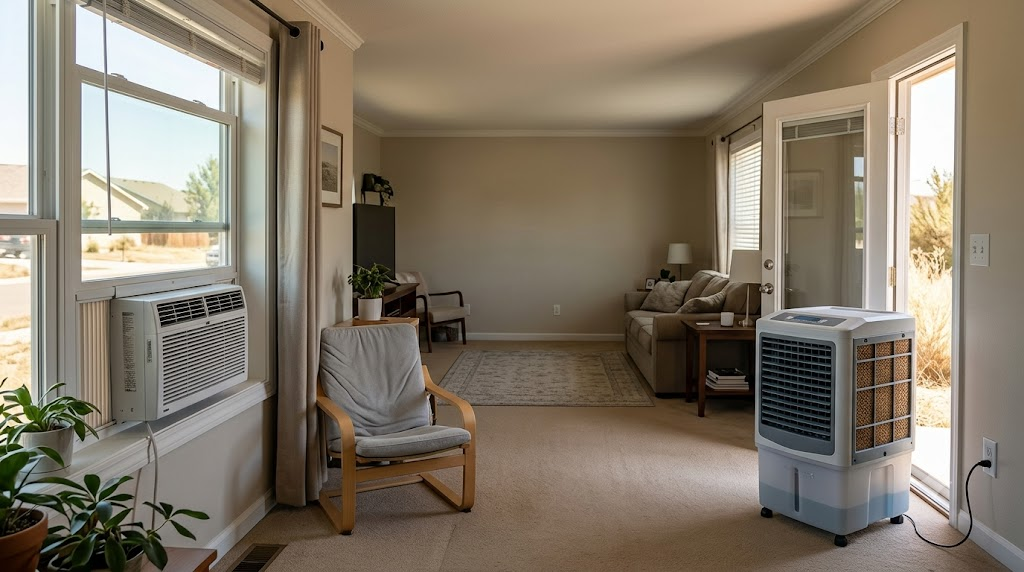
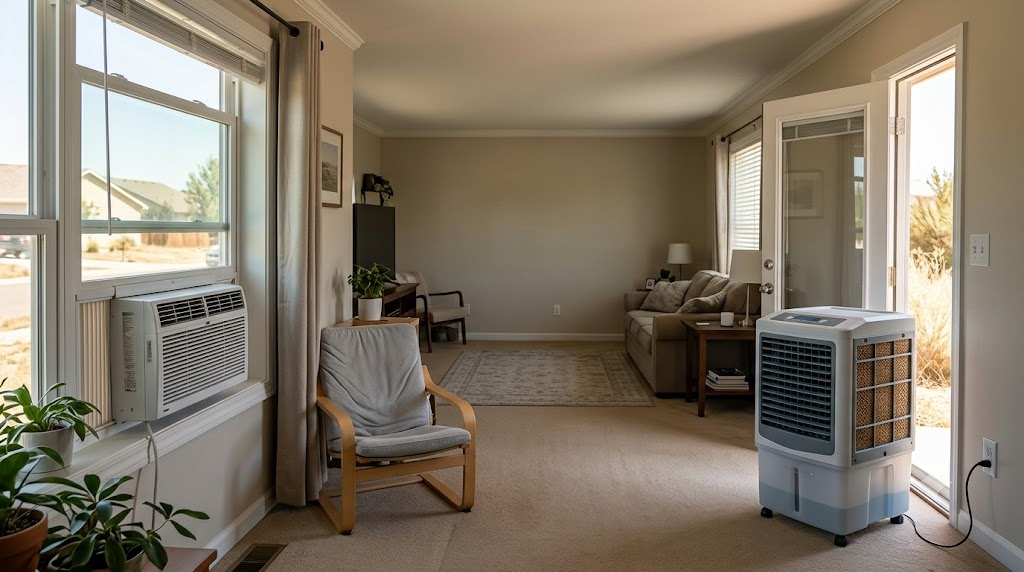
An air conditioner moves heat outdoors through a refrigerant cycle and removes moisture from indoor air. A swamp cooler pulls outdoor air through wet pads, cooling it through evaporation. That difference determines where each system works, how much water it needs, and whether it can keep a room comfortable.
Swamp (evaporative) cooler | Air conditioner | |
How it cools | Evaporation "can reduce the temperature of the air entering the home by 15°F to 40°F." | Circulates refrigerant to pull heat out of indoor air and actively dehumidifies the space. |
Best climate | Low-humidity regions. DOE states they should not be used in humid climates because they pump added moisture inside. | Any climate, whether humid, dry, coastal, or inland. |
Windows | Requires open windows. Provide 1 to 2 square feet of opening for each 1,000 CFM of capacity. | Requires tightly closed windows and sealed exterior doors to retain chilled air. |
Electricity | Whole-house models use about one-quarter as much energy as central AC, according to the DOE | Significantly higher power draw due to the energy-intensive mechanical compressor. |
Water | Uses water continuously. DOE notes this may be a concern in areas with limited water supplies. | Zero water consumed during normal cooling operations. |
Installed cost | Whole-house evaporative coolers cost roughly half as much to install as central AC systems (DOE). | Usually costs more than a comparable whole-house evaporative system |
Upkeep | Replace pads twice per season (or monthly with constant use); clean out mineral deposits (DOE). | Clean or replace air filters regularly; schedule seasonal checkups for refrigerant and coils. |
Room-size options | Window units and portable coolers on wheels, which DOE says "provide only a slight cooling effect and are limited by the humidity within your home" | Window units, portable units, and mini-splits sized specifically by room square footage. |
Note: DOE energy and installation-cost figures apply strictly to whole-house coolers compared with central air systems. They do not apply to small portable units.
A portable unit that blows cool air is not always an AC. Learning how a portable air cooler works helps explain why wet evaporative pads behave so differently from a mechanical compressor.
The table above shows how both systems perform on a typical grid-connected afternoon. The next section compares what each one asks of a battery when the power is out.
Swamp Cooler vs Air Conditioner in an Outage: Power Burden on EcoFlow DELTA 3 Max
During a severe summer outage, the central question changes fast. It is no longer about which machine cools better. The question becomes which device you can actually keep running on backup power. A plug-in evaporative cooler and a small window AC pull vastly different electrical loads. Because of that, their battery runtimes are not even close.
This section covers plug-in 120V units only. The EcoFlow DELTA 3 Max powers standard household plugs directly. It does not wire into breaker panels to run central AC or ducted rooftop coolers.
Start with your humidity, then the device
Check your local weather conditions before choosing what to plug in during a blackout:
Dry conditions: If outdoor air is dry, a small evaporative cooler can deliver quick relief near an open window.
Humid conditions: If it is sticky, raining, or stormy outside, an evaporative cooler simply dumps humidity into your room. In those conditions, it barely cools at all (DOE; New Mexico Office of the State Engineer).
The takeaway: When humidity spikes, a small window or portable AC is the device to plan around.
Rather than guessing with a generic humidity percentage, check your local National Weather Service (NWS) forecast for the current dew point.
Three numbers to check on any unit
Before connecting any cooling gear to a portable power station, verify three key numbers:
Running Watts: Read the continuous wattage listed on the manufacturer's spec label.
Startup load: An AC compressor may need extra power when starting. Check the manual or ask the manufacturer for its starting requirements.
Voltage: Make sure your device matches the battery's inverter specs. Standard room coolers and portable ACs run on standard 115V or 120V power. Keep the total continuous draw inside the rated output limit of your battery station. All four examples below are 120V-class plug-in units (LG lists 115V; EcoFlow DELTA 3 Max outputs 120V, 60Hz).
Example runtimes on EcoFlow DELTA 3 Max (labeled estimates)
The EcoFlow DELTA 3 Max has 2,048Wh of battery capacity, 2,400W of rated output, and a 4,800W surge rating. Its X-Boost feature can support some higher-wattage appliances up to 3,400W by lowering voltage, but results vary by device. X-Boost shouldn't be treated as additional rated output.
For planning, assume 85% of the battery's rated capacity is available after conversion losses:
2048 x 0.85 ≈ 1,741Wh
Divide that usable energy by each appliance's listed running watts to estimate continuous runtime.
Device (maker spec) | Type | Listed power | Estimated runtime |
Hessaire MC12V, 900 CFM, 2.8-gallon tank | Portable evaporative cooler | 55W | 1,741 ÷ 55 ≈ 31.7 hours |
Hessaire MC18, 1,300 CFM, 4.8-gallon tank, up to 500 sq ft | Portable evaporative cooler | 85W | 1,741 ÷ 85 ≈ 20.5 hours |
LG LW6017R, 6,000 BTU | Window AC | 520W | 1,741 ÷ 520 ≈ 3.3 hours |
LG LP0624WFR, 6,000 BTU, 250 sq ft | Portable AC | 865W | 1,741 ÷ 865 ≈ 2.0 hours |
These are estimates based on listed power and assumed conversion losses, not guaranteed runtimes.
Keep three limitations in mind:
Water matters: The Hessaire coolers need tank refills. Their listed specifications don't establish how long a full tank lasts, so monitor the water level.
AC cycling matters: Compressors switch on and off as needed. Actual runtime can exceed the continuous-draw estimate, although very hot conditions may keep the compressor running longer.
Cooling isn't equivalent: A cooler's performance drops as humidity rises. A longer runtime doesn't mean it delivers the same cooling as an AC.
Power ratings vary across brands and cooling capacities. Learning how many watts portable ACs use before a storm hits helps you calculate accurate runtimes for your exact setup.
These hardware specs highlight why the EcoFlow DELTA 3 Max pairs so well with emergency cooling appliances.
In a dry-climate outage, EcoFlow DELTA 3 Max can keep a small plug-in evaporative cooler going for many hours. With a small window or portable AC, expect a few hours instead. It powers plug-in units only. It won't run fixed central AC or a ducted whole-house cooler. And the battery doesn't change how efficient either device is.
EcoFlow lists 0 to 80% in 68 minutes from a wall outlet or generator. If you charge from a fuel-powered generator, the CPSC says to operate it outdoors only, at least 20 feet from homes and buildings, with the exhaust directed away from windows, doors, and vents. Never run one in a garage, shed, basement, or other enclosed space, even with doors or windows open. Follow the generator manufacturer's instructions to reduce shock hazards in wet weather.
The runtime table only helps if the cooler actually cools, and that depends on the humidity outside your window.
Humidity Decides It: Where Swamp Coolers Work
Water evaporation slows down significantly when surrounding air is already saturated with moisture. That basic physical rule explains why the Department of Energy limits its evaporative cooler recommendations to low-humidity areas. Even in dry states, humid stretches of summer can cut a cooler's output.
What DOE and New Mexico say
DOE: Evaporative cooling works in low-humidity areas. Don't use it in humid climates.
At 30% relative humidity: The New Mexico Office of the State Engineer says a cooler can take 90-degree air down to a comfortable 74 degrees.
Best timing: Coolers work best in the hottest part of the day, when relative humidity drops.
Rainy or humid days: They're much less efficient. Run only the fan.
How to read your local forecast
The National Weather Service gives you a simple way to judge humidity. Look at the dew point, not just the temperature.
Dew point | NWS description |
55°F or lower | Dry and comfortable |
55°F to 65°F | Sticky |
65°F or higher | Oppressive |
Use this as a way to read forecasts. It's not a swamp cooler cutoff. No government source sets one.
Southwest readers should watch the calendar too. NWS Tucson says the monsoon season runs from June 15 to September 30. During the monsoon, a shift in winds brings a significant increase in atmospheric moisture across the region, so expect weaker cooler performance during humid spells.
NWS also says the heat index isn't the best gauge of heat impacts in low-humidity areas. So in dry climates, watch NWS heat warnings as well.
Families across the Southwest should prepare for Northern Arizona monsoon season hazards well before July arrives. Sudden moisture surges strike right when summer cooling demand peaks.
Humidity sets where a swamp cooler can work. Water sets what it costs to keep it working. Most swamp cooler vs AC comparisons leave that part out.
Water Use and Upkeep: The Cost Most Comparisons Skip
A conventional air conditioner consumes no water while cooling your home. A swamp cooler, on the other hand, consumes continuous gallons of water all summer long.
In dry Western states where water supplies are tightly managed, daily water consumption is a major factor. In addition, mineral scale and damp pads demand steady physical maintenance.
How much water does a whole-house swamp cooler use?
The New Mexico Office of the State Engineer's evaporative cooler brochure published water consumption benchmarks for a 1,500-square-foot home during an average weather year:
City | Cooling hours | Gallons per season | With bleed-off |
Santa Fe | 696 | 2,980 | About 4,470 |
Albuquerque | 1,130 | 7,261 | About 10,892 |
Las Cruces | 1,718 | 12,457 | About 18,686 |
Continuous water bleed-off lines prevent heavy mineral buildup on cooling pads. However, the state report emphasizes that bleed-off lines increase total water use by 50% or more.
Installing an automated "dump pump" instead of an open bleed line dumps pan water periodically. This saves significant water over the season.
Practical tips to lower water use and maintenance
Follow these practical steps to keep a swamp cooler working efficiently:
Start cooling when outdoor temperatures reach around 85°F rather than 79°F, following the New Mexico guidance.
Run the pump briefly before switching on the fan.
Open windows slightly in rooms that need cooling so warm, moist air can escape.
Use fan-only mode when evaporative cooling isn't helping.
Check for leaks regularly and arrange a spring tune-up.
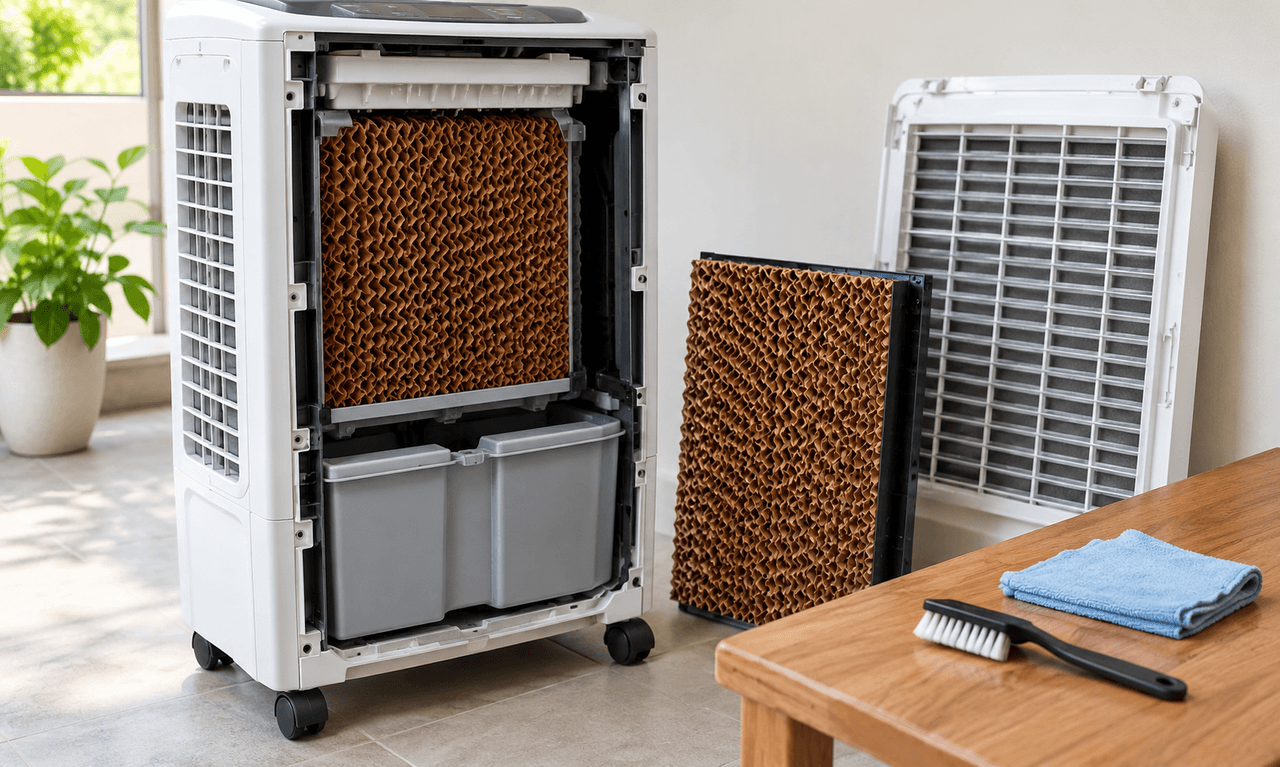
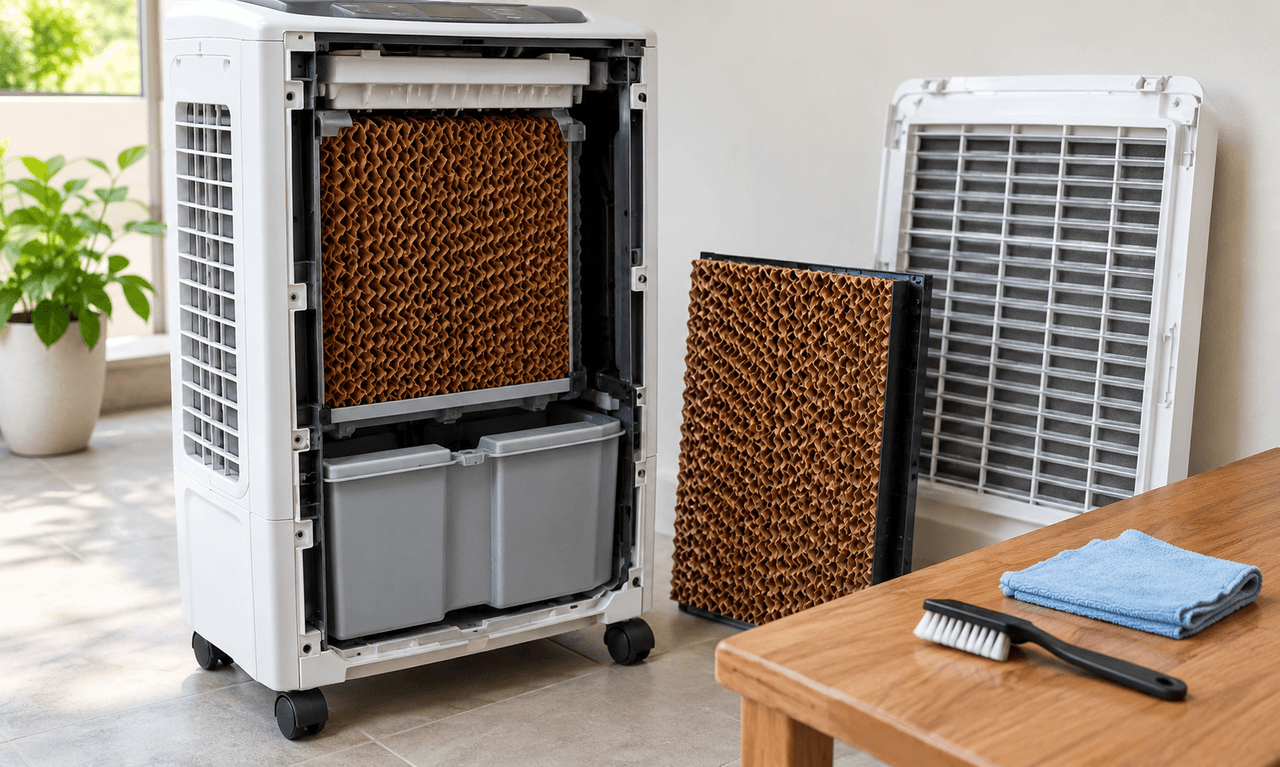
Replace cooling pads and clean the water trough, pan, and float valve as needed.
The DOE recommends replacing pads at least twice each season, or monthly with continuous use. Drain the unit and remove mineral deposits and sediment during maintenance.
Portable coolers use much less water than whole-house systems, but the amount varies by model and operating conditions. Don't assume a specific gallons-per-hour figure without a manufacturer's specification.
Stored drinking water is part of getting through a heat wave that brings outages, and a household with a swamp cooler needs extra for tank refills.
With climate and water covered, the last choice for most renters and single-room buyers is between three plug-in units: a portable swamp cooler, a portable AC, or a window AC.
Swamp Cooler vs Portable Air Conditioner vs Window AC for One Room
Renters and homeowners cooling a single room typically choose between three plug-in options: a portable evaporative cooler, a portable air conditioner, or a window-mounted AC.
These units differ sharply in cooling output, window requirements, and electrical draw. Sizing recommendations from ENERGY STAR help put their capabilities in perspective.
Portable evaporative cooler | Portable AC | Window AC | |
Example | Hessaire MC18 | LG LP0624WFR | LG LW6017R |
Listed power | 85W | 865W | 520W |
Rated cooling | No BTU rating; 1,300 CFM, up to 500 sq ft (Hessaire) | 6,000 BTU, 250 sq ft (LG) | 6,000 BTU, 13 by 20 ft room (LG) |
Humidity | Adds moisture; limited by indoor humidity (DOE) | Removes moisture (LG lists 2.2 pints per hour) | Removes moisture |
Setup | Fill the tank and open a window | Vent hose to a window | Mount securely in window opening; insulate and seal edges (ENERGY STAR) |
ENERGY STAR's room AC guidance suggests around 6,000 BTU for spaces measuring 150 to 250 square feet. Very sunny rooms may need about 10% more cooling capacity. Follow the manufacturer's installation instructions and seal gaps around the unit.
For the two LG examples above, the window AC draws 520W, compared with 865W for the portable model. That's a difference between these specific units, not a rule for every window and portable AC.
Available floor area, operating noise, and building rules all influence whether a portable AC or window unit makes sense for your space, particularly if local HOA rules prohibit exterior window brackets.
Factoring in climate, water access, and electrical specs makes it easy to answer whether an evaporative cooler is truly worth the investment.
Are Swamp Coolers Worth It? A Quick Decision Check
A swamp cooler can be a practical choice in dry climates where water is available and open windows are acceptable. An AC is generally more dependable in humid conditions or when indoor temperatures need to be controlled more consistently.
Use this quick checklist to pick the right system for your home.
Choose a swamp cooler if:
Your summer weather is usually dry.
You can provide adequate airflow through open windows.
Water use is acceptable in your area.
You're comfortable maintaining the pads and water system.
Choose an AC if:
Your summers are frequently humid.
You need to keep windows closed.
You need more reliable indoor temperature control during hot weather.
Someone in your household is especially vulnerable to heat.
Heat safety check
The CDC says fans help only when indoor temperatures are below 90°F. Above that, a fan can raise body temperature. If your home is too hot, use AC or dial 2-1-1 to find a place that has it.
And before a summer storm, compare running watts and the runtimes above. Do it before the outage, not during one.
In dry heat, the wet bulb temperature in extreme heat also shows why evaporation, from pads or from sweat, slows down as humidity rises.
Conclusion
In the swamp cooler vs AC choice, humidity comes first. Evaporative coolers draw far less power and suit dry climates, but they consume water and add indoor moisture. Air conditioners cool reliably in any climate, though at a higher electricity cost. Check your local summer dew points, water rates, and running wattage before deciding. If you are prepping for summer outages, check running watts first. At continuous draw, an EcoFlow DELTA 3 Max can run a 55 W portable evaporative cooler for about 32 hours or an 85 W unit for about 20 hours, based on 1,741 Wh of usable energy (an assumed 85% of the 2,048 Wh capacity). A 520 W window AC gets about 3 hours. These are estimates for one charge, not guarantees. Evaporative coolers also need tank refills, and AC compressors cycle, so real runtimes will differ.
FAQs
Is a swamp cooler better than an air conditioner?
A swamp cooler is only better in dry, arid climates where low humidity allows rapid water evaporation. The DOE advises against using evaporative coolers in humid regions because they cannot cool effectively and pump unwanted moisture inside.
Are swamp coolers worth it?
They can be in low-humidity areas, where DOE says whole-house units cost about half as much to install as central AC and use about one-quarter as much energy, as long as water use is acceptable.
How much water does a swamp cooler use?
The New Mexico Office of the State Engineer estimates that a whole-house cooler for a 1,500-square-foot home uses between 2,980 and 12,457 gallons per season depending on the local climate. Continuous bleed-off lines can increase that consumption by 50% or more.
Does a swamp cooler work with the windows closed?
No. An evaporative cooler needs fresh air movement to function. The DOE recommends providing 1 to 2 square feet of window opening for every 1,000 CFM of cooler airflow to push hot, humid air outside.
Can a portable power station run a swamp cooler or a window AC?
Yes, as long as the appliance's wattage requirements stay within the power station's output limits. For example, an EcoFlow DELTA 3 Max can run an 85W portable swamp cooler for about 20.5 hours or a 520W small window AC for about 3.3 hours at continuous draw.
For press requests or interview opportunities, reach out to our media team
media.na@ecoflow.com