Best Eco-Friendly Home Improvements to Save Energy and Reduce Costs
An energy-efficient home is not built around a single expensive upgrade. In many houses, the biggest losses begin with thin attic insulation, air leaks, old appliances, or heating equipment that runs longer than it should. A practical plan starts with the building itself, moves to the equipment that uses the most energy, and then considers renewable power. If you’re comparing eco- friendly home improvements, start with the upgrades most likely to address energy waste in your home.
Which Eco-Friendly Materials Can Make Your Home More Energy-Efficient?
Insulation, windows, and roofing form the boundary between indoor living space and outdoor weather. When that boundary performs poorly, heating and cooling equipment must compensate. Improving it first can reduce energy waste before a homeowner spends money on larger mechanical systems.
Materials matter, but installation matters just as much. Insulation must fill the intended space, windows need a tight fit, and a reflective roof should suit the climate and existing structure.
Improve Home Insulation With Eco-Friendly Options
When deciding how to improve home insulation, start by checking the attic and crawl spaces for gaps and uneven coverage. Compressed or uneven insulation forces the HVAC system to run longer, while leaks around wiring, plumbing, and attic hatches make the problem worse. Blown-in cellulose made from recycled newspaper is one alternative to fiberglass. Recycled denim and sheep’s wool can also fill irregular spaces around joists and wiring when installed correctly.
Insulation should be paired with air sealing. Adding material over an open gap does not necessarily stop moving air. For typical existing U.S. homes, EPA estimates an average savings of 15% on heating and cooling costs from sealing air leaks throughout the home and insulating attics, floors above crawl spaces, and accessible basement rim joists. Results vary with the home’s condition and climate, but the work can also reduce drafts and uneven temperatures.
Select Recycled Materials for Window Frames
Windows affect efficiency through the frame, the glass, and the quality of the installation. An old single-pane unit may lose heat through the glass, while gaps around the opening allow air to pass around it. Replacing only the visible sash will not solve every problem if the surrounding frame remains poorly sealed.
Composite frames made with fiberglass, reclaimed wood fibers, or recycled polymers offer alternatives to hollow aluminum. They resist warping and generally insulate better than highly conductive metal frames. Their durability can also help the window maintain a reliable seal through temperature changes.
Pairing an efficient frame with double-pane, low-emissivity (Low-E) glass helps limit unwanted heat transfer while preserving natural light. Before replacing every window, identify which units are actually failing; repairing seals or insulation around a frame may be the more sensible first project.
Use Cool Roofing Materials to Reduce Heat Absorption
A roof receives direct sun for hours at a time, so its color and surface properties influence how much heat reaches the attic. Dark asphalt shingles can approach 150°F on a hot summer day. That heat does not remain entirely outdoors; part of it moves into the roof assembly and increases the cooling load below.
Reflective metal panels, clay tiles, and solar-reflective shingles absorb less solar heat than a conventional dark roof. In hot, sunny parts of Texas, Florida, and Arizona, the change can lower attic temperatures by as much as 30°F under favorable conditions. The result may be a cooler upper floor and less strain on the air conditioner during the hottest part of the day.
Cool roofing makes the most financial sense when a roof is already due for replacement. At that point, compare reflectance, durability, local climate, and compatibility with the home rather than selecting by color alone.


Which Home Upgrades Can Reduce Your Environmental Impact?
After improving the building envelope, look at the equipment used every day. The strongest candidates for replacement are usually older units that run frequently or are approaching the end of their useful life.
Switch to Energy-Efficient Electric Appliances
An aging refrigerator can draw electricity day and night, while older clothes washers and dishwashers may use more water and energy with each cycle. The ENERGY STAR label provides a consistent way to identify products that meet federal efficiency requirements within their category. It is more useful than relying on a manufacturer’s broad claim that an appliance is “green” or “energy-saving.”
For example, a clothes washer that meets federal energy-efficiency certification criteria uses about 20% less energy and 30% less water than a standard model. Household savings still depend on how often the machine runs, local utility rates, and the model being replaced. A lightly used appliance will not produce the same return as equipment serving a large household every day.
Cooking equipment presents another opportunity. An induction cooktop transfers heat directly to compatible cookware and does not create indoor combustion fumes. It can boil water in roughly half the time required by gas, radiant, or coil cooking. That speed does not mean every kitchen needs an immediate replacement, but it is worth considering when an existing range is due for an upgrade.
Install a Heat Pump for Heating and Cooling
A furnace produces heat by burning fuel or, in the case of electric resistance equipment, converting electricity directly into heat. A heat pump works differently. In winter, it moves available heat from the outdoor air into the house. In summer, the refrigeration cycle reverses and carries indoor heat outside.
Because the system moves heat instead of creating all of it at the point of use, it can deliver two to four units of heat per unit of electricity consumed. Modern cold-climate models are designed to continue operating when outdoor temperatures fall well below freezing, although performance and capacity still vary by model and local conditions.
One system can provide both heating and air conditioning. Its performance still depends on correct sizing, suitable ductwork or indoor units, and the home’s heat loss.
Upgrade to a Heat Pump Water Heater
Water heating is a major source of household energy use. A conventional electric resistance tank creates heat with electric elements. A hybrid heat pump water heater instead draws warmth from the surrounding air and transfers it to the water in the tank.
Models that meet federal energy-efficiency certification criteria can use about 70% less energy than a standard electric water heater. The room also becomes somewhat cooler and less humid while the heat pump is operating, which may be useful in a basement or garage but should still be considered when choosing the installation location.
The savings are most meaningful when replacing an electric resistance unit in a household that uses hot water regularly. Available space, surrounding air temperature, purchase price, and estimated operating cost should all be part of the comparison.
Replace Traditional Lighting With LED Bulbs
Lighting is one of the few efficiency projects that can be completed room by room without construction. Replacing remaining incandescent or halogen bulbs with LEDs reduces electricity use immediately and also cuts the number of replacement bulbs a household buys over time.
A quality LED uses at least 75% less energy than a comparable incandescent bulb. Many models are rated for 15,000 to 25,000 hours, so a fixture used for only part of each day may continue operating for years. Choose the brightness in lumens and the color temperature that suits the room; wattage alone does not describe how the light will look. For fixtures you use most often, LEDs can be one of the best energy saving tips to put into practice before a larger renovation.
The table below summarizes the planning figures used throughout this guide. They are broad estimates rather than guaranteed savings for an individual house:
Home Upgrade | Typical Energy / Cost Impact | Best Fit Scenario |
Cellulose or Denim Insulation | ~15% savings on heating & cooling | Homes with unfinished attics or drafts |
Cool Roofing Materials | Cuts peak cooling demand by 10–15% | Hot, sun-heavy climates or roof replacements |
Heat Pump HVAC | Delivers 2x–4x more heat energy than the electricity it uses | Replacing aging AC and electric/oil heating systems |
Heat Pump Water Heater | ~60%–70% less electricity than standard electric tanks | Basements, garages, or utility closets |
Whole-Home LED Swap | ~75% less lighting energy use | Immediate DIY savings in any home |
How Can Renewable Energy Make Your Home More Sustainable?
Efficiency lowers the amount of energy a house needs. Renewable generation addresses where some of the remaining electricity comes from. Solar is the most familiar residential option, but battery storage, small wind systems, and geothermal equipment can also play a role when the property and climate support them. Sizing a solar battery starts with estimating how much surplus generation you can store and use after sunset.
A smaller, more efficient household load is easier to serve with renewable energy. Site conditions matter too: roof shade, turbulent wind, or unsuitable ground can substantially change the economics.
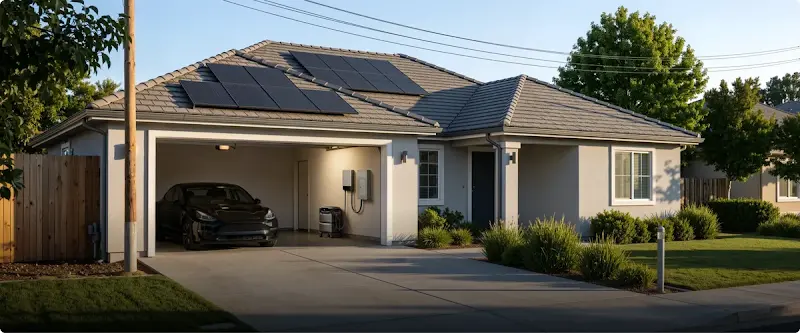
Pair Solar Panels With Home Battery Storage
Solar production and household consumption do not always occur at the same time. Panels may generate more electricity than the home needs around midday, especially when residents are away. Demand often rises again in the evening as lights, cooking equipment, laundry appliances, and electronics come into use.
A battery stores some of the midday surplus for use after solar production falls. This can increase the amount of solar electricity consumed within the home instead of limiting its value to the hours when sunlight and demand happen to overlap. The appropriate storage capacity depends on which loads the homeowner wants to support and how much surplus the solar array normally produces.
For households that want to begin by supplying selected essentials, the EcoFlow DELTA 3 Max Plus Portable Power Station offers an approachable starting point. Its 2,048Wh battery capacity and up to 1,000W solar input work with portable or rigid solar panels to store clean electricity for baseline loads such as a refrigerator, Wi-Fi router, and key lighting circuits. This allows a household to begin offsetting daily grid consumption with solar energy without rewiring the entire main electrical panel on the first day.
For a more complete whole-home energy setup, the size of the solar array should be matched to the household circuits it is intended to serve. The EcoFlow TITAN 5000 Plus supports up to 8kW of solar input for larger rooftop photovoltaic arrays. Through X-Fusion 2.0, the system sends solar power to active home loads first, reducing battery wear and reliance on grid electricity. When paired with the Smart Home Panel 10, it connects with designated household circuits so power can be managed across selected breakers. The Smart Home Panel 10 requires professional installation by a qualified electrician and must be wired into your home’s existing electrical panel. A compatible existing rooftop solar system may also be integrated through AC coupling.
Use Wind Energy to Supplement Household Electricity
Small residential wind systems are far more dependent on the site than solar panels. A turbine needs clear exposure to steady wind, enough land for proper placement, and local rules that permit the required structure. Rooftops and heavily obstructed lots can create turbulence that weakens performance.
For a property of an acre or more in the Great Plains, along a coastal bluff, or in an open rural valley, small wind may be worth investigating. A suitable site generally has average annual wind speeds of at least 10 to 12 mph at the relevant height. The turbine can produce electricity at night and during some periods when solar output is low, which may make it a useful companion to a solar system.
Review county zoning and height restrictions before buying equipment. A regional wind estimate is not the same as a measurement at the planned turbine location, so siting deserves careful attention.
Adopt Geothermal Heat Pumps for Home Heating
Ground temperatures below the surface remain comparatively stable through winter cold and summer heat. A few feet below the earth’s surface, temperatures are generally more consistent than outdoor air temperatures. A geothermal, or ground-source, heat pump uses buried loops filled with circulating fluid to exchange heat with this stable environment.
During winter, the system draws heat from the ground and transfers it into the home. In summer, it moves indoor heat into the ground. According to the U.S. Department of Energy, geothermal heat pumps can reduce energy consumption by 25% to 50% compared with air-source heat pumps.
The main obstacle is installation. Horizontal loops require sufficient land for trenching, while vertical systems involve drilling and can be more expensive to install. Although the initial investment is typically higher than for an air-source heat pump, the underground infrastructure has an estimated lifespan of 25 to 50 years. Geothermal is therefore most practical when the property’s soil conditions, available space, long-term ownership plans, and heating and cooling needs justify the upfront cost.

How Can You Prioritize Eco-Friendly Home Improvements on a Budget?
Sustainable home renovation starts with identifying where the house wastes the most energy. Correct the largest source of waste first, then time major purchases around equipment replacement. An audit and a review of past utility use can keep the plan grounded in the actual house.
Prioritize Upgrades Based on Your Home's Energy Needs
A professional home energy audit can reveal problems that are difficult to see during an ordinary walk-through. Blower-door testing helps locate uncontrolled air leakage, while infrared imaging can show temperature differences around insulation, walls, and ceilings. Some utilities offer free or low-cost home energy assessments, sometimes for less than $100, although availability and testing scope vary by location.
The findings can help prevent costly misdirected upgrades. For example, spending around $15,000 on replacement windows may not solve the main problem if most energy loss comes from an unsealed attic that could potentially be addressed with about $1,200 in targeted air sealing and insulation. Actual project costs vary by home size, materials, and labor. The purpose of an audit is not simply to produce a list of upgrades; it is to establish a sensible order of work based on measured conditions.
Begin with repairs that protect the house and reduce waste, then consider equipment that is failing, inefficient, or expensive to operate. This order also makes later equipment sizing more accurate. Reviewing utility bills and tracking when major appliances run can support energy optimization between professional assessments.
Compare Upfront Costs With Long-Term Energy Savings
Payback period is a useful screening tool, but it should not be the only measure. Comfort, equipment condition, maintenance, and the timing of a planned renovation also affect whether an upgrade makes sense. A project with a longer payback may still be reasonable if the existing system already needs replacement.
Low-cost changes such as LEDs, weatherstripping, and a properly used smart thermostat may recover their cost within a single year. A heat pump water heater may take three to five years to break even through lower utility bills. Both estimates depend on local energy prices, installation cost, household use, and the efficiency of the equipment being replaced.
Large projects are easier to justify at a natural replacement point. When a roof or HVAC system is already failing, compare the added cost of an efficient option with the standard replacement rather than removing serviceable equipment early. When comparing a home battery for backup, list the circuits you want to keep running and compare usable capacity, output, and installation costs.
Explore State and Local Utility Incentives
Incentives can reduce the upfront cost of efficiency and electrification projects, but eligibility is rarely automatic. Federal residential clean-energy tax rules have changed, so homeowners should not assume that a credit described in an older article or contractor proposal still applies.
Current opportunities may include state-level energy office programs, including state-administered efficiency and home-electrification rebates, as well as local utility cash-back rebates for qualifying insulation, heat pumps, or battery storage. Program availability, income requirements, approved products, and application timing vary by location.
Check the rules before ordering equipment or signing an installation contract. Some programs require an application, approved contractor, or qualifying product before work begins. Keep itemized receipts and any required manufacturer certification statements with the project records so the household can document the purchase if an incentive application calls for them.
Conclusion
The best eco-friendly home improvements address a real weakness in the house. Air sealing and insulation may provide more value than new windows, while an aging water heater or HVAC system may create an opportunity to adopt heat-pump technology. After reducing unnecessary demand, consider solar, storage, wind, or geothermal options that suit the property. Comparing upfront cost, expected savings, and available incentives turns a collection of “green” products into a practical home-improvement plan.
FAQ
Do Energy-Efficient Home Improvements Increase Property Value?
Yes, documented energy-efficient upgrades routinely boost home resale value and help properties sell faster. Buyers increasingly factor monthly utility bills into their housing budget, and homes with modern heat pumps, upgraded insulation, or owned solar-plus-storage systems stand out in competitive real estate markets.
How Do Energy-Efficient Home Improvements Reduce Your Carbon Footprint?
Energy-efficient upgrades lower your carbon footprint by reducing the total amount of electricity and fossil fuels your household consumes every day. Swapping gas-burning furnaces and water heaters for electric heat pumps—and powering them with rooftop solar and home batteries—cuts direct on-site emissions while easing demand on fossil-fuel power plants.
Do Energy-Efficient Upgrades Require Professional Installation?
Simple upgrades like swapping LED bulbs, adding weatherstripping, or setting up a portable solar-and-battery backup unit can easily be handled as DIY projects. However, HVAC heat pumps, hybrid water heaters, whole-home electrical panels, and roofing replacements require licensed contractors to ensure code compliance, safe refrigerant or high-voltage handling, and valid manufacturer warranties.
How Do You Maintain Energy-Efficient Home Upgrades?
Most eco-friendly upgrades need only basic seasonal upkeep to stay at peak efficiency. Change HVAC and heat pump air filters every one to three months, flush sediment from your heat pump water heater tank annually, keep outdoor heat pump coils and solar panels clear of leaves or heavy debris, and check window weatherstripping each fall before freezing weather arrives.
For press requests or interview opportunities, reach out to our media team
media.na@ecoflow.com