Electricity Market Reform: What It Means and How It Affects Consumers
When an electricity bill changes, household use is only part of the explanation. Fuel costs, transmission limits, weather, utility investments, and wholesale-market rules can also affect what customers pay. Electricity market reform covers the rule changes and infrastructure planning intended to address those pressures. Much of the work happens far from the household meter, but the results can still appear in retail rates, delivery charges, plan choices, and reliability.
What Is Electricity Market Reform in the U.S.?
No single national electricity market serves every American household under the same rules. States regulate retail service in different ways, while regional organizations coordinate much of the wholesale trade and high-voltage grid. Federal regulators oversee important parts of interstate transmission and wholesale commerce.
“Market reform” can therefore describe the process for connecting a new power project, regional transmission planning, battery participation, or residential rate design. Not every change applies in every state, and the household effect depends heavily on the local utility.
How the U.S. Electricity Market Works
Electricity reaches a home through three connected stages: generation, transmission, and distribution. A power plant, wind farm, solar facility, or another resource generates electricity. High-voltage transmission lines move large amounts of power across long distances. The local distribution system then carries it through substations, poles, and underground cables to homes and businesses.
The commercial side also has two layers. In wholesale markets, generators sell bulk electricity to utilities, competitive suppliers, or other entities serving customers. Regional grid operators coordinate supply and demand in much of the country and help determine which resources run at a given time. In the retail market, a utility or competitive supplier sells electricity to the end customer.
Although a household may receive only one bill, its charges can reflect energy supply, transmission, distribution, metering, and other approved costs handled by different organizations.
Regulated vs. Deregulated Electricity Markets
State policy largely determines how much retail choice a customer has. In a regulated market, a local utility generally supplies electricity and maintains the delivery network. Where retail choice is available, eligible customers can choose a competitive electricity supplier while the local utility continues to deliver power and maintain the lines. Rules can still vary within a state, so the table summarizes the general models:
Feature | Regulated Electricity Markets | Deregulated Electricity Markets |
Provider Choice | One local utility handles generation, transmission, and billing. | Customers can shop around and choose their retail electricity supply provider, while the local utility still delivers the power and maintains the lines. |
Rate Setting | State Public Utility Commissions (PUCs) review and approve rates. | Wholesale supply prices fluctuate based on market competition and demand. |
Common Examples | Florida, Georgia, North Carolina, Alabama, Tennessee, and Washington. | Texas (ERCOT), Pennsylvania, Ohio, Illinois, New York, New Jersey. |
Customer Experience | Predictable rate structures, though fewer plan options. | Wide variety of fixed-rate, variable, and time-of-use plans—requires active shopping. |
A competitive-market customer still remains tied to the local delivery utility. Selecting another supplier does not change which company maintains the neighborhood poles and wires.
Why Is the U.S. Electricity Market Undergoing Reform?
Much of the grid was developed around large, centralized plants whose output could be scheduled to follow predictable patterns. That system now has to accommodate a wider mix of resources, new concentrations of demand, and weather conditions capable of stressing several parts of the network at once.
Grid Congestion and Bottlenecks: Wind projects in the Great Plains and solar facilities in the Southwest may be ready to produce power, yet the available transmission system cannot always move all of that electricity to distant population centers. Congestion can delay projects, limit output, and increase costs in constrained areas.
Extreme Weather Events: Winter freezes in Texas, intense California heat, and hurricanes along the Gulf Coast have shown how fuel supply, generation, transmission, and local distribution can fail under severe conditions. Reform efforts increasingly consider how regions prepare for and recover from those events. A home battery can provide backup for selected household loads during a local outage.
Changing Generation Mix: As older fossil-fuel plants retire and wind, solar, and batteries enter the system, operators need rules that recognize how those resources behave. Solar and wind output changes with conditions, while storage can absorb electricity at one time and return it later.
The aim is not simply to add more generation. New resources must be able to connect, transmission must carry their output, and market rules must keep supply and demand balanced at every moment.
What Are the Key Changes in U.S. Electricity Market Reform?
Reform is occurring across several layers of the power system. Federal orders are changing interconnection and transmission planning, regional operators are revising market procedures, and state regulators are examining how large new loads should pay for service. These efforts move at different speeds, so implementation is an ongoing process rather than a single nationwide switch.
Reform Wholesale Electricity Market Rules
Wholesale rules help determine which resources can sell electricity, how they are scheduled, and how the grid secures enough capacity for periods of high demand. One major bottleneck is the interconnection queue, where proposed projects wait for grid studies. Wind, solar, battery, and conventional projects may wait through repeated studies before learning what network upgrades they need and how much those upgrades will cost.
FERC Order No. 2023 requires a first-ready, first-served cluster study process, which examines groups of proposed projects rather than reviewing every request in a strictly sequential line. It also strengthens site-control and financial-readiness requirements and imposes withdrawal penalties in specified circumstances, so speculative requests are less likely to occupy queue space.
The order also sets firmer study deadlines and potential financial penalties when transmission providers miss them. It addresses resources that share a site or point of interconnection, with the aim of moving viable projects through a more disciplined queue.
Improve Grid Infrastructure and Transmission Planning
Transmission projects often cross utility territories and state lines. Planning them requires agreement about future needs, potential benefits, route selection, and who should pay. If each region looks only at immediate problems, it may miss a line that could serve several needs over many years.
FERC Order No. 1920 requires covered transmission providers to assess at least three long-term regional transmission scenarios over a planning horizon of at least 20 years, using information about expected demand, generation retirements, new resources, public policies, and other known drivers of transmission need. The process also considers uncertainty, including the effects of extreme weather and wide-area outages.
The rule does not approve every proposed line. It changes how regions identify and compare long-term options that may improve reliability or reduce costly congestion over time.
Address Rising Electricity Demand from Data Centers
After years of relatively modest growth, electricity demand is increasing in many areas. AI data centers, new manufacturing facilities, and electric vehicles are among the contributors. Rising data center power demand can strain local grids when large campuses seek service faster than utilities can expand infrastructure.
Regulators and utilities are therefore revisiting connection rules and rate structures for exceptionally large customers. The central question is how to serve new economic activity without shifting an unreasonable share of the required grid investment to existing households and small businesses.
Regional approaches may include new tariff categories, construction contributions, or clearer service requirements. The objective is to align a large customer’s financial responsibility with the grid costs its demand creates.
Expand Renewable Energy and Battery Storage Integration
Wind and solar can supply substantial amounts of electricity, but their output follows weather and daylight rather than the timing of household demand. A grid with more variable generation needs resources that can respond quickly. Batteries can charge when supply is plentiful and discharge when the system is under greater pressure. At home, a solar battery can store surplus rooftop generation for later use.
Market reforms also create paths for smaller resources to participate together. A group of home batteries, rooftop solar systems, smart thermostats, or electric vehicles may be coordinated as a virtual power plant (VPP). By combining many devices, an aggregator can provide a service large enough to participate under regional market rules.
Availability still depends on regional implementation, state regulation, utility programs, equipment eligibility, and customer consent. The broader direction nevertheless gives distributed resources a more formal role in grid support.


How Will Electricity Market Reform Affect U.S. Consumers?
Households may notice reform indirectly through rate design, delivery charges, reliability, solar compensation, and new utility programs. The timing and scale will differ by service territory.
Change Electricity Plans and Pricing Options
Traditional flat rates charge the same cents per kilowatt-hour (kWh) at 3 a.m. and 6 p.m. That simplicity does not reflect the fact that supplying electricity can cost much more during a strained evening peak than during a period of low demand or strong solar output.
Utilities in California, Michigan, and Illinois are among those using or expanding Time-of-Use (TOU) rates, while other providers offer critical-peak pricing or rebate programs. Under a TOU plan, the price changes according to a published schedule. Overnight or midday electricity may be less expensive, while late-afternoon and evening use may cost more. The exact hours and price differences are set by the individual utility or supplier.
This structure can reward customers who move flexible loads, but it can also increase bills for households that cannot change when they use electricity. Before enrolling in an optional plan, compare the schedule with actual household routines rather than assuming that a TOU rate is automatically cheaper.
Affect Consumers' Electricity Supply and Reliability
Grid modernization requires capital. New transmission, substations, distribution equipment, and weather-resilience work may eventually appear in approved delivery rates. The amount and timing depend on the utility, regulatory decisions, and the way project costs are allocated.
Those investments may also produce benefits that are less visible on an ordinary bill. A stronger transmission network gives regions more ability to move power around a congested area or import electricity when local supply is tight. Better connections do not prevent every outage, especially one caused by damage to neighborhood lines, but they can reduce the risk that a shortage in one area becomes a broader reliability problem.
Regulators must weigh those potential benefits against the costs customers are asked to fund.
Expand Opportunities for Home Solar and Battery Storage
The value of residential solar depends partly on how a utility compensates exports. Traditional net-metering arrangements may credit excess solar electricity near the retail rate. Other net-billing structures use a lower export value or vary the credit according to time and grid conditions.
Where export compensation falls, storing midday solar power for evening use can become more attractive. The homeowner uses more of the electricity on-site instead of selling it at a lower rate and buying power later at a higher one. Battery value may increase further under a utility demand-response or VPP program that provides bill credits for approved grid support. Net metering and solar energy management affect how much value a household gets from exporting surplus power versus storing it for later use.
These opportunities are location-specific. A household should compare the retail rate, export credit, TOU schedule, program rules, and normal evening demand before deciding what solar or storage arrangement makes financial sense.
How Can Households Adapt to Changes in the Electricity Market?
Households cannot set wholesale prices or write utility tariffs, but they can understand the plan attached to their meter. The practical response is to identify when electricity costs more, determine which loads are flexible, and decide whether efficiency or storage would reduce purchases during expensive periods.
Understand Your Local Electricity Rates and Utility Policies
Begin with the rate section of the latest bill rather than the total alone. Determine whether the account uses a flat, tiered, variable, or TOU structure. If prices change by time, write down the weekday, weekend, seasonal, and peak-hour rules that apply to the plan.
Customers in deregulated markets such as Texas or Pennsylvania should also note the supplier contract’s end date, renewal terms, and the difference between the energy charge and utility delivery charges. Waiting until a contract has rolled into a variable rate can make plan comparison more urgent and less deliberate.
Solar customers should review export compensation separately from the price paid for imported electricity. The two values may not be equal, and that difference can shape whether daytime load shifting or battery storage offers more benefit.
Shift Electricity Use to Lower-Cost Hours
Understanding your time-of-use rate starts with checking your utility’s published peak and off-peak periods. The time windows below are illustrative examples rather than universal utility hours; always check your own bill or tariff for your utility’s exact schedule.
Delay-start major appliances: Run the dishwasher, washing machine or dryer after 9 p.m. or before 2 p.m., if those hours are off-peak on your plan.
Pre-cool or pre-heat your home: Use a smart thermostat to adjust the temperature in the early afternoon, then let it coast through the 4–9 p.m. peak window.
Time your EV charging: Set your Level 2 charger to start after midnight if your plan offers lower overnight rates.
The largest savings generally come from shifting the largest flexible loads. A dishwasher cycle may help at the margin, while air conditioning and EV charging can represent much more electricity. Comfort, appliance instructions, and household schedules still determine what is practical.
Store Excess Solar Energy for Evening Use
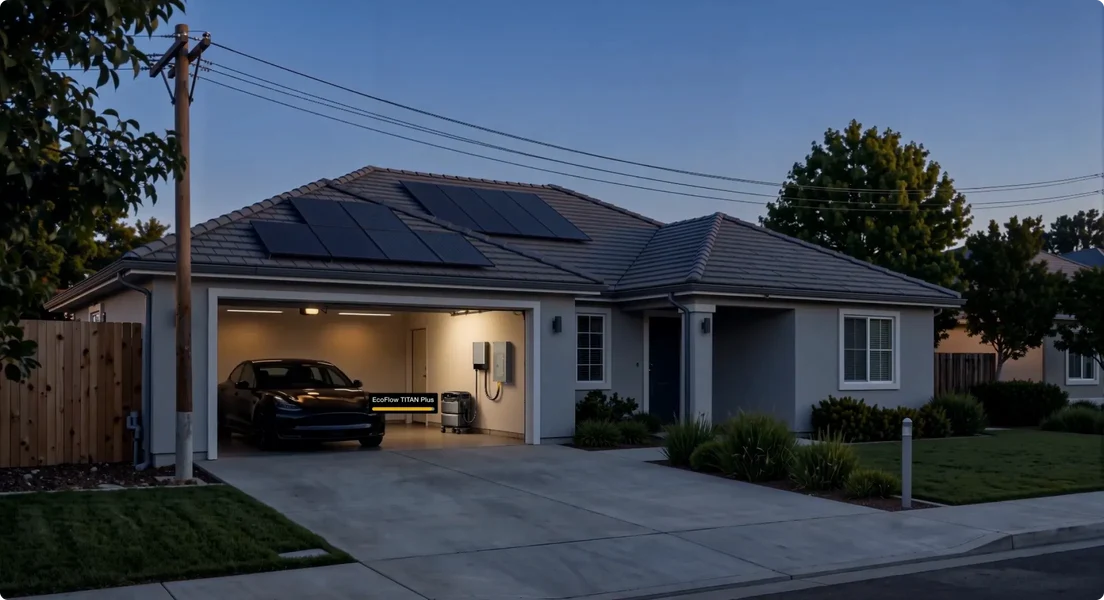
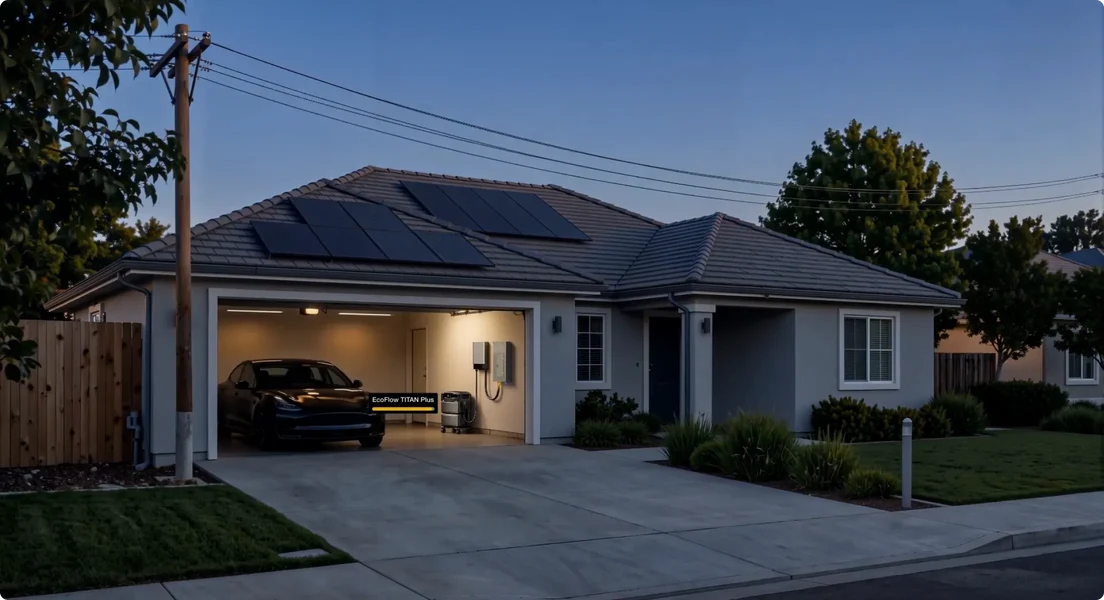
Solar panels often reach their strongest production during the day, while many homes use more power after residents return in the evening. Under a TOU plan with higher evening prices, a battery can save midday solar electricity and make it available when grid power costs more.
Storage can also give a homeowner greater control over which loads use solar energy and when. The useful capacity depends on the household’s evening consumption, the solar surplus available for charging, and the rate window the system is intended to cover.
Consider the EcoFlow TITAN 5000 and EcoFlow TITAN 5000 Plus. Both systems start at 5kWh and expand up to 30kWh, allowing households to scale storage capacity to their daily usage. The EcoFlow TITAN 5000 has a rated output of 7.2kW for everyday household loads. For homes with heavier power demands, the EcoFlow TITAN 5000 Plus uses X-Fusion 2.0 technology so the battery and a compatible solar PV system can supply power simultaneously, reaching up to 10kW of total output when solar input is active. Both models support the OASIS 3.0 smart energy management system, which shows solar generation, daily consumption, and battery status so homeowners can schedule energy use around changing rate windows.
Conclusion
Electricity market reform is changing how projects connect, how regions plan the grid, and how some utilities price power. The household impact will not be uniform. Read the local rate plan, understand its peak periods and export rules, and compare them with the home’s actual use. Shifting flexible demand or storing midday solar may reduce costs when the tariff rewards those choices. A clearer bill review also makes it easier to distinguish a change in household consumption from a change in the market itself.
FAQ
Does the Federal Government Control Electricity Prices?
No, the federal government does not set the retail electricity prices that appear on your monthly household bill. While the Federal Energy Regulatory Commission (FERC) oversees interstate transmission and wholesale power markets, retail rates for residential customers are regulated by state Public Utility Commissions (PUCs) or determined by market competition in deregulated states.
Which States Have Regulated Electricity Markets?
Roughly two-thirds of U.S. states operate traditional regulated electricity markets—or have suspended retail competition—including Florida, Georgia, North Carolina, Alabama, Tennessee, Colorado, and Washington. In these states, a single local utility owns or manages the power generation, transmission lines, and local distribution network, and state regulators approve the rates customers pay.
What Is the Wholesale Energy Market?
The wholesale energy market is where power generators sell bulk electricity to local utilities, retail energy suppliers, and large industrial buyers before that power reaches homes and businesses. Wholesale prices fluctuate constantly—sometimes every five minutes—based on fuel costs, weather conditions, transmission congestion, and real-time regional demand.
Is the Price of Electricity Expected to Go Up or Down?
In the near term, average U.S. residential electricity prices are expected to edge upward due to heavy utility spending on grid modernization, storm-hardening infrastructure, and rising power demand from data centers and electrification. Over the longer term, adding low-cost renewable energy and expanding transmission capacity should help stabilize wholesale power costs and reduce price spikes.
Does Renewable Energy Reduce Electricity Bills?
Yes, renewable energy helps lower electricity bills both at the grid level and for individual homeowners, though the exact savings depend on local utility policies. Because wind and solar have zero fuel costs, they frequently push down wholesale electricity prices when abundant, while installing rooftop solar paired with home battery storage allows households to offset peak retail utility rates directly.
For press requests or interview opportunities, reach out to our media team
media.na@ecoflow.com