Plug-and-Play Solar: How It Works and Is It Worth It?
- What Is Plug and Play Solar?
- How Does Plug-and-Play Solar Work?
- Is Plug and Play Solar Legal in the US?
- How Much Does a Plug-and-Play Solar System Cost?
- How Much Can You Save With Plug and Play Solar?
- How Does Plug and Play Solar Compare to Rooftop Solar?
- How Can a Power Station Improve a Plug-and-Play Solar Setup?
- Is Plug and Play Solar Worth It?
- Frequently Asked Questions
- Plug and Play Solar Gives Renters and Homeowners a Simple Way to Start Saving on Energy
Solar power doesn't have to mean a rooftop crew and a permit office visit. Plug-and-play solar lets you generate electricity from solar panels that connect to your home through a plug-in microinverter or portable power station.
Here's how the technology works, what it costs, and whether it really makes sense for your home.
What Is Plug and Play Solar?
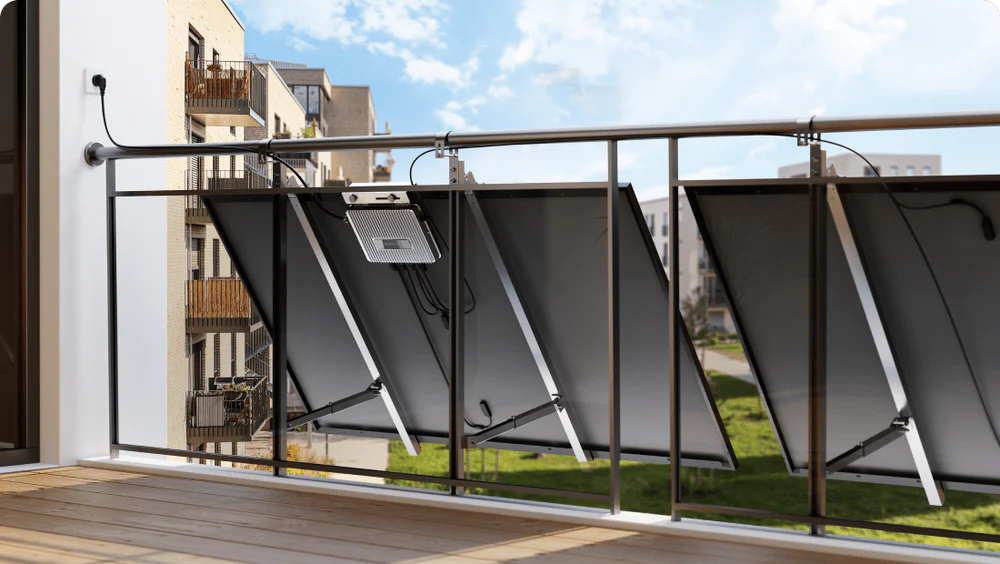
Plug-and-play solar, sometimes called balcony or plug-in solar, is a small-scale system you connect directly to a standard household outlet instead of wiring into your home's electrical panel. You can set up a system on a balcony, patio, or yard, plug it in, and start offsetting what you'd otherwise pull from the grid.
The appeal is accessibility. Renters who can't install rooftop panels, homeowners who want to test solar before committing to a full system, and anyone who wants a low-cost entry point into solar can get one running in an afternoon. If you're renting and want a system that comes with you when you move, plug-and-play solar kits for renters are worth a closer look.
How Does Plug-and-Play Solar Work?
A plug-and-play system has three main parts working together to turn sunlight into usable household power.
Solar Panels
The panel captures sunlight and converts it into direct current (DC) electricity. Portable plug-in panels are typically rated between 400W and 800W, small enough to mount on a railing or lean against a wall, but still enough to make a dent in daytime energy use.
Micro-Inverter
Since your home runs on alternating current (AC), the system needs a micro-inverter to convert the panel's DC output into usable AC power. The inverter is what makes it safe to plug into a standard outlet rather than requiring a hardwired connection to your breaker panel. The EcoFlow STREAM Microinverter is one example built for this kind of setup.
(The EcoFlow STREAM Microinverter is currently available only in Utah and Maryland at the time of writing, so availability may vary depending on where you live.)
Optional Battery Storage
Some setups pair the panel with a portable power station so you can store excess solar energy generated during the day and use it after sunset. The EcoFlow STREAM Ultra is built for this. It combines a hybrid inverter with built-in battery storage, letting you draw on stored power day or night while still plugging directly into a standard outlet.
(The EcoFlow STREAM Ultra is currently available only in Utah and Maryland at the time of writing, with additional states planned.)
Is Plug and Play Solar Legal in the US?
A handful of states, including Utah, permit plug-in systems up to 1,200 watts without a utility interconnection agreement or added fees, according to Utah's Solar Power Amendments legislation.
Colorado has already enacted a plug-in solar law that allows the practice while permitting utilities to require notification, according to Colorado's HB26-1007. California has a similar bill (SB 868) moving through its legislature, but it hasn't been signed into law yet, so plug-in solar isn't officially permitted there as of this writing.
Virginia has passed legislation set to take effect in 2027, and dozens of other states are actively considering similar bills, according to the National Caucus of Environmental Legislators.
Because rules vary and are changing quickly, check your state’s plug-in solar laws and the utility company's current requirements before you plug in.
This reflects the regulatory landscape at the time of writing; plug-in solar laws are evolving quickly, so confirm current rules with your state and utility before installing.
How Much Does a Plug-and-Play Solar System Cost?
Plug-and-play systems are inexpensive compared to a full installation. For example, the EcoFlow STREAM Microinverter is priced at $369, and the EcoFlow STREAM Ultra runs $1,279 on its own, or $1,599 bundled with the STREAM Microinverter.
Adding battery storage increases the upfront cost but extends how much of that power you can actually use.
As of this writing, plug-and-play installation is available only in Utah and Maryland, so check your state's regulations before buying.
How Much Can You Save With Plug and Play Solar?
Savings scale with system size and how much sun your location gets. The EcoFlow STREAM Microinverter alone can generate up to 2409 kWh annually, saving up to $385 a year.
Paired with the EcoFlow STREAM Ultra battery, annual generation climbs to as much as 6424 kWh, which is enough to cover up to 50% of a typical household's electricity use, for savings of up to $1,027 a year.
How Does Plug and Play Solar Compare to Rooftop Solar?
Rooftop solar costs far more upfront. The U.S. Department of Energy's cost benchmarks put a typical 8kW residential rooftop system at $2.74–$3.15 per watt installed, roughly $22,000–$25,000 before incentives.
Plug-and-play systems, like the EcoFlow STREAM Ultra + Microinverter, cost a fraction of that. In exchange, rooftop systems generate more electricity and can cover most or all of a household's usage.
Plug-and-play systems won't replace a full installation, but they offer a meaningful way to lower your bill without the cost of a full rooftop system.
How Can a Power Station Improve a Plug-and-Play Solar Setup?
Without storage, plug-and-play solar only offsets power in real time, so any energy you don't use while the sun is out simply goes to waste. Pairing your panel with a power station solves that.
If you're weighing a setup that covers more than just a few outlets, the EcoFlow whole-home backup power solution can extend that same plug-in approach to keep essential circuits running during an outage. Plug-and-play solar is a supplementary way to lower your electricity bill — it isn't a substitute for a whole-home generator or backup system.
Is Plug and Play Solar Worth It?
For renters, apartment dwellers, and homeowners who want to try solar on a small scale, plug-and-play systems are a low-risk way to start cutting your electricity bill. It won't replace your entire electric bill, but as a starting point for plug-and-play solar systems, it delivers real, measurable savings for very little investment.
Frequently Asked Questions
Do You Need a Permit or an Electrician for Plug-and-Play Solar?
Mostly, no. Plug-and-play systems are designed to connect to an outlet without any wiring changes, so an electrician typically isn't required. Whether you need a permit depends on your state and utility company, since some now allow certified low-wattage systems without any paperwork, while others require notification. Always confirm local rules before installing.
Can You Take Plug and Play Solar With You If You Move?
Yes. That portability is one of the biggest advantages of plug-and-play solar over a rooftop system. Since the panel isn't mounted to your roof or wired into your electrical panel, you can unplug it, pack it up, and set it up again.
Plug and Play Solar Gives Renters and Homeowners a Simple Way to Start Saving on Energy
Plug-and-play systems lower the barrier to entry for home solar power, offering real savings without the cost or commitment of a full installation. Whether you're renting an apartment or just want to test solar before going bigger, pairing a panel with a home power guide and the right storage setup makes it easy to start.
Browse EcoFlow's home solar system collection to find a plug-and-play option that fits your space and energy goals.
For press requests or interview opportunities, reach out to our media team
media.na@ecoflow.com