Motorhome Battery Monitor Guide: Shunts, Readings, and Setup
- Popular RV Battery Monitors Compared
- How a Motorhome Battery Monitor Works: Voltage-Only vs Shunt-Based
- Where an EcoFlow Power Station Fits Next to Your Monitor
- Reading State of Charge: Lead-Acid vs LiFePO4
- Installing a Shunt-Based RV Battery Monitoring System
- Using Your Readings on the Road
- Conclusion
- FAQs
A motorhome's battery panel might show that everything is fine, yet the lights or water pump can stop working during a night of dry camping. This happens because many built-in panels estimate battery condition from voltage alone. A motorhome battery monitor gives a much better idea of the power available, especially when combined with lithium batteries. In this post we'll explain how shunt-based monitors work, compare popular models, and cover battery readings, installation, and setup so you can reliably manage your power on the road.
Popular RV Battery Monitors Compared
Shunt-based monitors differ in their current ratings, displays, connectivity, and supported features. The right choice depends on your battery bank, inverter load, and whether you prefer checking readings on a phone or a dedicated screen.
Monitor | Shunt rating | Supply voltage range | Display | Bluetooth / app | What it measures |
Victron SmartShunt | 300A, 500A, 1000A, or 2000A models | 6.5 to 70V DC | None (your phone or tablet is the display) | Yes, VictronConnect app | Voltage, current, amp-hours, state of charge, time to go; aux input for a starter battery, bank midpoint, or temperature (optional sensor) |
Victron BMV-712 Smart | 500A shunt included (optional 1000A, 2000A, 6000A shunts) | 6.5 to 70V DC | Round display head, 63 mm (about 2.5 in) front | Yes, built in | Voltage, current, power, amp-hours consumed, state of charge, time remaining; aux input; programmable alarm relay |
Renogy 500A Battery Monitor with Shunt | 500A | 10 to 120V | Backlit LCD | Not listed for the monitor; Renogy sells a separate BT-2 Bluetooth module | Voltage, current, consumed power, battery capacity, degradation rate; high and low capacity alarms |
Blue Sea Systems M2 DC SoC Monitor (PN 1830) | 500A shunt included; programmable shunt ratios | 7 to 70V DC input (12V, 24V, or 48V systems) | Digital display, 55 x 28 mm | Not listed on the product page | Current, state of charge, and voltage (3 voltages, 1 current); state of charge for 1 bank; alarms |
Specifications can vary by model and revision, so confirm the manufacturer's current documentation before purchasing. For example, the Victron SmartShunt supports battery-capacity settings from 1Ah to 9,999Ah, while the Renogy monitor supports several battery chemistries. When choosing a battery monitor for an RV, consider these factors:
Shunt rating: Choose a shunt that supports your system’s maximum current, especially when running an inverter or other high-power appliances.
Battery compatibility: Confirm that the monitor supports your battery chemistry and system voltage, so its readings match your setup.
Display options: A built-in screen makes readings easy to check, while Bluetooth lets you monitor battery status from a compatible phone or tablet.
Extra inputs: Some models offer additional inputs for a starter battery or other measurements, which can be useful when managing multiple parts of your RV electrical system.
Before choosing your monitor, understand how the house battery, inverter, and charging sources work together by exploring how an RV power system connects these components to ensure your monitor suits your electrical setup.
How a Motorhome Battery Monitor Works: Voltage-Only vs Shunt-Based
A standard motorhome panel often measures battery voltage. A shunt-based monitor goes further by tracking current flowing into and out of the battery. This allows it to estimate the state of charge and calculate how much energy remains.
Voltage-only meters
Voltage-only meters are simple and often included with motorhomes. However, voltage changes with temperature, charging activity, and electrical loads. A reading can therefore provide an incomplete picture of the remaining battery capacity. Battery chemistry also matters. A voltage reading that works reasonably well for one type of battery may be less useful for another.
Shunt-based monitors (coulomb counting)
A shunt is a precision component installed in the battery's negative cable. The monitor measures the small voltage drop across it to calculate current. By tracking current over time, the monitor records amp-hours consumed and returned. For example, a 10A load running for two hours consumes 20Ah. Many monitors also estimate remaining runtime and state of charge. However, the accuracy depends on correct configuration and regular synchronization with a fully charged battery.
Monitor vs battery management system (BMS)
A battery monitor and a battery management system (BMS) perform different roles in your RV's electrical setup. Understanding how each works helps you track battery usage while keeping your battery protected.
Feature | Voltage-only meter | Shunt-based monitor |
Measures voltage | Yes | Yes |
Tracks current in and out | No | Yes |
Estimates state of charge | Rough estimate | Yes, when configured correctly |
Estimates remaining runtime | Usually no | Often |
Requires setup | Minimal | Yes |
A battery monitor tracks energy flowing in and out to estimate remaining capacity, while a BMS protects a lithium battery by managing cell conditions and responding to unsafe operating limits. When planning your RV's electrical setup, understanding how an RV electrical system works helps you manage your house battery, converter, and inverter more effectively. A built-in BMS does not automatically replace a dedicated battery monitor.
Where an EcoFlow Power Station Fits Next to Your Monitor
A battery monitor tells you how much power remains in your motorhome's house battery, but it cannot create additional energy. If you regularly run low while camping without hookups, a separate portable power station can provide another source of electricity. The EcoFlow DELTA 3 Max and EcoFlow DELTA Pro are portable power stations, not universal monitors for a motorhome's existing battery bank. Each has its own battery readout and app features, but neither replaces a compatible shunt monitor for your house battery. Before adding a separate power source, consider the appliances you use, how long you camp off-grid, and how you plan to recharge the unit.
EcoFlow DELTA 3 Max (2048Wh)
The EcoFlow DELTA 3 Max is designed for portable power needs, such as charging laptops and running compatible appliances. Its listed specifications include 2,048Wh of capacity, 2,400W AC output, and up to 500W of solar input. EcoFlow also lists compatibility with a separately sold 500W Alternator Charger.
EcoFlow DELTA Pro
For users who need more storage and output, the EcoFlow DELTA Pro provides 3,600Wh of capacity and 3,600W of AC output in a single unit. Its solar input and optional expansion capabilities can suit larger backup-power needs. Check appliance running and startup requirements, connection compatibility, and any installation requirements before integrating a power station into your motorhome setup.
Whichever power station you choose, start by estimating your daily energy use and how long you camp without hookups. Comparing portable power stations built for RVs can help you find a suitable option for your appliances and charging needs. Remember that your motorhome’s house battery still needs a compatible monitor to track its state of charge accurately.
Reading State of Charge: Lead-Acid vs LiFePO4
Battery chemistry affects how reliably voltage indicates remaining capacity. Lead-acid batteries show a more noticeable relationship between resting voltage and charge, while LiFePO4 batteries maintain a relatively stable voltage through much of their discharge.
Lead-acid (flooded) open-circuit voltage
The following reference values apply to Trojan 12V flooded lead-acid batteries at rest. Battery voltage should be measured after charging and discharging have stopped for at least six hours; 24 hours is preferable for a more stable reading.
State of charge | Approximate resting voltage |
100% | 12.73V |
90% | 12.62V |
80% | 12.50V |
70% | 12.37V |
60% | 12.24V |
50% | 12.10V |
40% | 11.96V |
30% | 11.81V |
20% | 11.66V |
10% | 11.51V |
These values are specific to the stated flooded battery reference. AGM and gel batteries may have different readings, so use the manufacturer's chart for your battery.
Why LiFePO4 batteries benefit from shunt monitoring
LiFePO4 batteries have a relatively steady voltage for most of their useful capacity, making it hard to estimate how much charge is left just from the voltage. A LiFePO4 voltage chart can be an aid in interpreting voltage data, but a shunt monitor is more useful for estimating state-of-charge because it monitors current flow and accumulated amp-hours. To get more accurate results, configure the monitor's battery capacity and charging parameters to match your battery and charger paperwork.


Installing a Shunt-Based RV Battery Monitoring System
Most shunt-based monitors are installed on the battery's negative side. Every relevant load and charging source must pass through the shunt for the monitor to count current correctly. The exact process varies by product, so follow the manufacturer's installation manual. If your motorhome has a complex inverter, lithium battery bank, or multiple charging sources, consider using a qualified RV technician. Follow the specific manufacturer's instructions because wiring layouts and installation requirements differ.
Isolate power sources: Turn off electrical loads and chargers, disconnect shore power, and isolate solar charging according to the equipment instructions.
Connect the battery negative to the shunt: Attach the battery's negative terminal to the shunt's battery-side connection. Follow the manufacturer's terminal labels.
Move system connections to the other side: Connect the inverter, loads, converter/charger, and solar controller negatives to the shunt's system side as directed.
Connect the voltage-sensing wire: Attach the supplied fused positive-sensing lead to the specified battery-positive point.
Secure the monitor: Choose a dry, protected mounting location within the device's environmental limits.
Configure the settings: Enter the correct battery capacity, charged voltage, and other required parameters. Fully charge the battery and synchronize the monitor according to the manual.
Safety around the battery bay
When working around your motorhome's battery bay, ensure proper ventilation, wear eye protection and appropriate protective gear, use insulated tools, and remove jewelry before handling battery terminals. Choosing the right cable size is equally important, so check that the wire gauge matches the expected amperage to help manage current safety and minimize voltage drop. Once the shunt is installed and configured correctly, you can use its readings to make better decisions about battery usage and recharging on the road.
Using Your Readings on the Road
A monitor is most useful when you turn its readings into practical decisions. During dry camping, record how much capacity your motorhome consumes overnight and compare it with the usable capacity recommended for your battery.
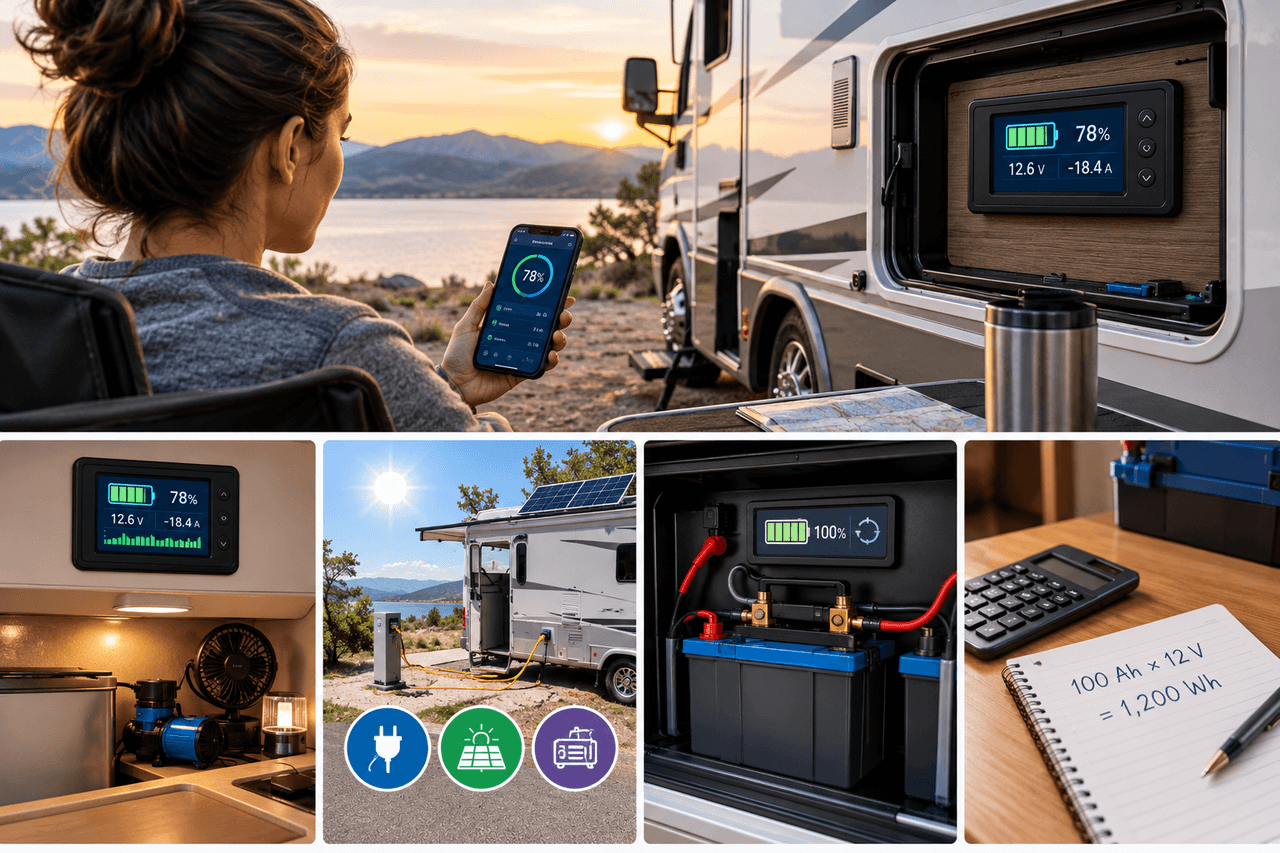

Track daily consumption: Note the amp-hours used overnight and compare them with your battery bank's recommended usable capacity.
Check charging performance: Watch whether the battery gains charge when connected to shore power, running an approved charging system, or receiving solar input.
Synchronize regularly: Follow the manufacturer's instructions for a full charge and synchronization. Incorrect settings or missed current paths can cause readings to drift.
Estimate energy use: Multiply amp-hours by nominal battery voltage to estimate watt-hours. For example, 100Ah at 12V is approximately 1,200Wh before considering conversion losses and other factors.
Recharging with a generator
When camping away from hookups, you can recharge your motorhome's house battery using shore power, solar panels, a compatible alternator charger, or a generator. Understanding how to keep an RV battery charged can help you choose a suitable charging method based on your battery chemistry, daily energy use, and available power sources. Remember that solar output varies with sunlight, shading, panel angle, and weather, so plan for changing conditions when camping off-grid.
Conclusion
A voltage-only panel estimates your motorhome battery's charge, while a shunt-based monitor tracks amp-hours for a more accurate picture, especially with LiFePO4 batteries. Choose a monitor with a shunt rating above your highest expected load, connect every negative to the system side, configure the battery capacity and charged voltage, and synchronize it after a full charge. For extra portable power, the EcoFlow DELTA 3 Max and EcoFlow DELTA Pro offer separate batteries and app-based monitoring alongside your RV battery monitor.
FAQs
Do I need a shunt for an RV battery monitor?
A shunt-based monitor is generally the better choice when you want a more accurate state-of-charge estimate. Voltage-only meters can provide a rough indication but may be unreliable under changing loads.
Can the EcoFlow App monitor my RV's house battery?
No. The app displays information about a compatible EcoFlow power station. Use a separate, compatible battery monitor to track your motorhome's house battery bank.
Where does the battery monitor shunt go?
It is generally installed on the battery's negative connection, with the system's loads and charging sources connected on the system side. Follow the specific monitor's wiring diagram.
What voltage is a fully charged 12V RV battery?
A Trojan flooded lead-acid battery may read around 12.73V after resting when fully charged. Readings vary by battery type, so consult the manufacturer's specifications.
Does a lithium battery's BMS replace a battery monitor?
No. The BMS helps protect the battery, while a separate monitor tracks current use and estimates remaining capacity. Some smart batteries offer built-in monitoring features, but their capabilities vary.
For press requests or interview opportunities, reach out to our media team
media.na@ecoflow.com