EcoFlow DELTA Pro 3 & DELTA 3 Ultra Plus: Price vs. Performance
EcoFlow's new DELTA 3 Ultra Plus portable power station offers many of the same benefits as the higher-performance DELTA Pro 3 at a significantly lower price.
If you're shopping for essential home battery backup, both of these EcoFlow power stations can do the job.
The main differences between them are AC power output, maximum battery storage capacity and scalability, and last but not least, price.
If you're on a tight budget, EcoFlow DELTA 3 Ultra Plus makes essential home backup affordable with the same manufacturing and LFP battery quality, and similar smart home energy management features of a more robust whole home generator like EcoFlow DELTA Pro 3, for about $800 less — an upfront cost reduction of approximately 35%.
If you live in a medium-to-large house with more than four occupants, EcoFlow DELTA Pro 3 may be a wiser long-term investment.
Let's dig into the details so you can make an informed purchase decision that's right for you, your family, and your home.
EcoFlow DELTA Pro 3 vs. DELTA 3 Ultra Plus: Expandability or Lower Upfront Costs?
Feature | EcoFlow DELTA 3 Ultra Plus | EcoFlow DELTA Pro 3 | Comparison & Benefits |
Continuous AC Output Power | 3600W | 4000W | DP3 Wins on Power: The DELTA Pro 3 provides higher continuous and surge power for demanding tools and appliances. |
Surge Power | 7200W | 8000W | Tie: Both portable power stations deliver twice their operating output as surge power (starting watts) to kickstart motor-driven appliances and compressors |
X-Boost Capability | Supports devices up to 4600W | Supports devices up to 6000W | DP3 Wins on Heavy Loads: The DP3 can start and run heavier motor-driven appliances that require high startup wattage. |
AC Voltage Support | 120V Only | 120V / 240V Split Phase (Natively supports 240V appliances) | Crucial Difference: Only the DP3 can natively power 240V appliances (dryers, welders, well pumps) via NEMA 6-20R and L14-30R ports. |
Battery Capacity | 3072Wh (3 kWh) | 4096Wh (4 kWh) | DP3 Wins on Runtime: The DP3 offers approx. 33% more battery life out of the box, keeping devices running longer during outages. |
Expandability | Supports 1 Extra Battery | Supports 2 Extra Batteries | DP3 Wins on Scalability: The DP3 system can be expanded significantly more than the D3 Ultra Plus for long-term power storage. |
Battery Protection | IP20 | IP65 (Internal Battery Pack) | DP3 Wins on Durability: The DP3's battery pack has superior dust and water resistance, making it safer for rugged environments. |
Dimensions (HxWxD) | 15.6" x 12.9" x 24.1" (Compact/Low profile) | 27.3" x 13.4" x 16.1" (Tall form factor) | D3UP Wins on Size: The D3 Ultra Plus is significantly shorter, making it easier to fit under tables or in tight car trunks. |
Weight | 74.3 lbs (33.7 kg) | 113.5 lbs (51.5 kg) | D3UP Wins on Portability: The D3 Ultra Plus is ~40 lbs lighter, making it significantly easier to lift into a vehicle or move around the house. |
Solar Input | 1600W Max (2 ports x 800W each) | 2600W Max (1600W High-PV + 1000W Low-PV) | DP3 Wins on Charging: The DP3 supports larger solar arrays and higher voltage (up to 150V) for faster off-grid recharging. |
Native Car Outlet (Cigarette Port) | Yes (12.6V / 10A) | No (Requires Adapter) | D3UP Wins on Convenience: The D3 Ultra Plus connects directly to tire inflators and car fridges. The DP3 requires a separate adapter to do this. |
Anderson Port | Yes (30A) | Yes (30A) | Tie: Both units feature this high-current 30A port, which is the gold standard for powering RV 12V fuse blocks directly. |
DC5521 (Barrel) Port | No | Yes | DP3 Wins for Tech: The DP3 includes this port, which is commonly used for powering Wi-Fi routers, CCTV cameras, and LED strips directly from DC. |
Total DC Power | 378W Max | 378W Max | Tie: Both units offer the same substantial total DC output capacity. |
USB-C Output | 1x Port (140W Max); 2x Ports (45W Max) | 2x Ports (100W Max each) | D3UP Wins on Tech: The D3 Ultra Plus features a 140W PD 3.1 port, ideal for fast-charging high-performance laptops (e.g., MacBook Pro 16"). |
Current Retail Price* | $1,499 | $2,299 | DELTA 3 Ultra Plus offers many similar benefits to DELTA Pro 3 at a significantly lower price. |
* Direct-to-consumer pricing from ecoflow.com on December 10, 2025. All prices are subject to change.
DELTA Pro 3 and DELTA 3 Ultra Plus are both manufactured by EcoFlow, the global #1 manufacturer and retailer of portable power stations and they share many similarities, the primary differentiators are scalability and price.
A sticker price difference of $800 speaks for itself, but why might you want to spring for the more expensive DELTA Pro Series power station?
Futureproofing Your Home for Energy Security
Choosing the right portable power station or solar generator for home backup requires making some informed decisions about what you want to run during a blackout and for how long.
Essential specs to consider are the maximum AC or DC electricity output, battery storage capacity, and scalability should your off-grid power needs grow.
Feature | EcoFlow DELTA 3 Ultra Plus | EcoFlow DELTA Pro 3 |
AC Output Power | 3600W (Surge 7200W) | 4000W (Surge 8000W) |
AC Voltage Support | 120V Only | 120V / 240V Split Phase (Natively supports 240V appliances) |
Battery Capacity | 3072Wh (3 kWh) | 4096Wh (4 kWh) |
If you live in an apartment or small home, EcoFlow DELTA Ultra Plus may be all the home backup power you need.
However, if you live in a four-person household or consume a substantial amount of on-grid electricity, EcoFlow DELTA Pro 3 is likely better suited to your use case.
Here's why.
Power Output
AC output in watts/kilowatts directly determines which household appliances you can (and can't) start and run with a battery-based power station for home backup.
Direct current (DC) electricity is used to store energy in a battery and in specialized power output applications for recreational vehicles, vans, and devices like smartphones and laptops which also rely on batteries.
But alternating current household electricity (AC) is the worldwide standard for home appliances, although voltage and resistance requirements vary by region.
Out of the box, EcoFlow DELTA Ultra Plus and DELTA Pro 3 have similar output capacities: 3600W vs 4000W, a mere 400-watt difference.
However, EcoFlow DELTA Pro 3 gives you the option to chain 2 or 3 units in parallel, delivering continuous AC output of 8kW (16kW surge) or 12kW (24kW surge).
EcoFlow DELTA 3 Ultra Plus caps out at 3600W (7200W surge).
Of course, you can buy multiple standalone units for different rooms in your home.
But if you connect the home backup battery to your existing circuit board with a transfer switch, you'll need to purchase a more powerful model if your essential home backup requirements expand over time.
EcoFlow DELTA Pro series power stations and whole home generators give you more room to grow.
Storage Capacity and Scalability
Unlike other DELTA 3 series portable power stations like the Classic, EcoFlow DELTA 3 Ultra Plus does offer expandable battery storage up to 11kWh max1, but DELTA Pro 3 provides a maximum 36kWh (Battery Storage) + 12kWh with a full Smart Generator 4000 (Dual Fuel) for 48kWh total — a whole-home generator solution that can you keep your entire house running off-grid indefinitely.
As you probably know, watt-hours and kilowatt-hours measure electricity consumption over time.
Smaller power banks used primarily for charging smartphones, laptops, and other portable electronics often measure storage in amp-hours and milli-amp hours (Ah/mAh), but such devices require far less electricity than essential home appliances like refrigerators and air conditioners.
Gas-powered standby and inverter generators measure consumption differently. It's typically expressed in gallons or liters of fuel consumed per hour to maintain a specific load, rather than a fixed capacity of stored energy like batteries.
With battery-based home backup systems, you can total up the rated power wattage of all the appliances you want to run simultaneously and accurately estimate how long you can go without needing to recharge the unit's lithium iron phosphate (LiFePO4/LFP) battery with grid, solar, vehicle alternator, portable gas generator power or any other available recharging method.
Smart Home Integration and Uninterruptible Power Supply (UPS) Functionality
Both DELTA units offer an industry-leading array of smart home energy management tools built-in that can help you significantly reduce your electricity consumption and save you money on bills.
However, to take full advantage of AI-driven home energy management features that save money by taking advantage of power company time of use rates, you'll need to plug your home appliances directly into EcoFlow DELTA 3 Ultra Plus.
You CAN integrate the unit into your existing home wiring, but only with a manual transfer switch.
DELTA Pro 3 offers seamless compatibility with EcoFlow Smart Home Panel 2 which features a one-way direct connection to the grid that allows for virtually seamless auto-switching to backup UPS power in under 20 milliseconds (~20ms).
Portability for Recreational Off-Grid Use, Van Life, and RVs
Home backup power is far from the only viable application for EcoFlow DELTA Series portable power stations and solar generators, they're also ideally suited for recreational activities or full-time RV life off-grid.
Neither DELTA Ultra Plus or DELTA Pro 3 provide the same level of portability as EcoFlow River and TRAIL DC series power stations, but they're perfect for extended camping and road trips.
EcoFlow TRAIL DC power stations are ideal for content creators and digital nomads who need to power multiple battery-operated devices like iPhones, iPads, laptops, and mobile workstations on the go.
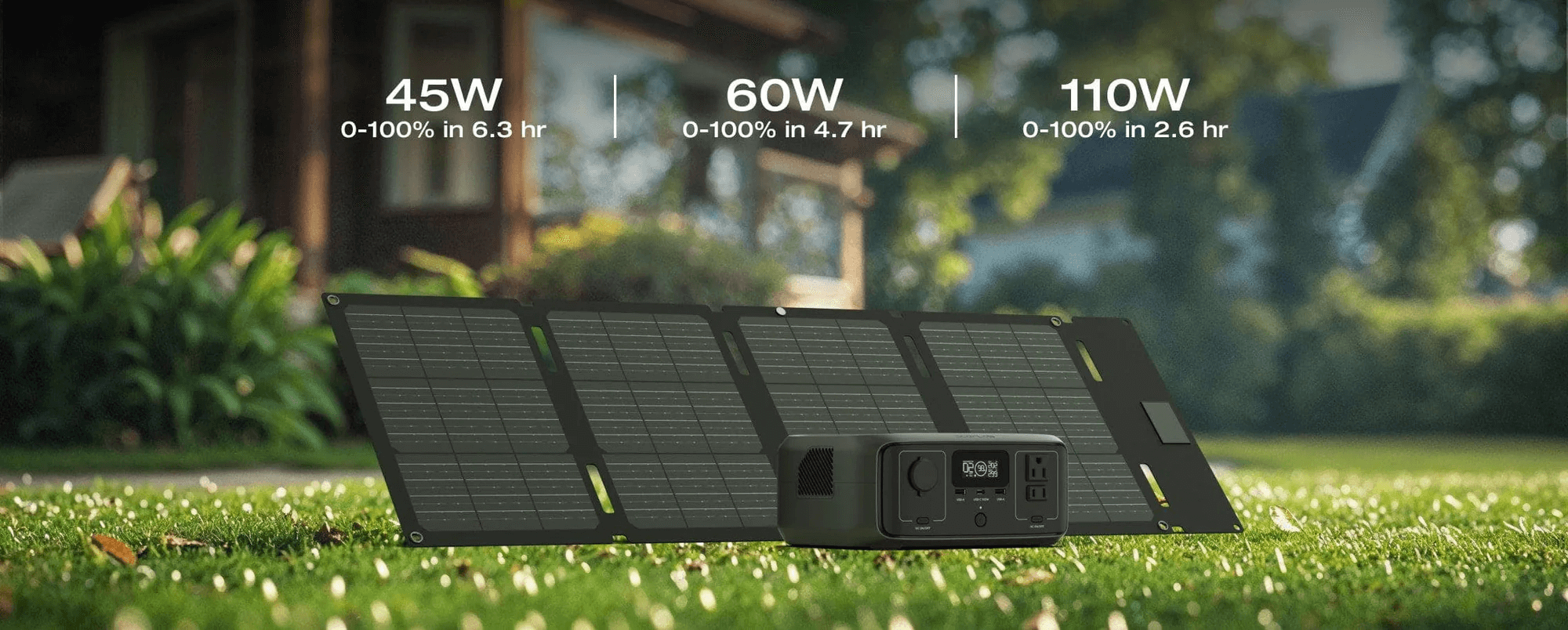
Tiny solar generators like the EcoFlow RIVER 3 + 45W portable solar panel powers up to 600W of appliances and it's compact enough to fit in a backpack.
At a minimum weight of 74.3 lbs, you're not going to take EcoFlow DELTA Ultra Plus or DELTA Pro 3 on a hike.
But DELTA Ultra Plus has a clear portability advantage over EcoFlow DELTA Pro 3.
With a 15.6" x 12.9" x 24.1" compact/low profile build, it's a much better fit for a car or SUV than EcoFlow DELTA Pro 3, which is approximately 21% larger with a 27.3" x 13.4" x 16.1" tall form factor construction.
Ultimately, DELTA Pro 3 has much more versatility for whole home battery backup applications, but EcoFlow DELTA 3 Ultra Plus is a solid choice for both your household and life on the road.
1. 1 × DELTA 3 Ultra Plus + 2 × DELTA Pro 3 Smart Extra Battery with EcoFlow Smart Extra Battery Expansion Adapter
For press requests or interview opportunities, reach out to our media team
media.na@ecoflow.com