DIY Home Battery Backup: How to Build a Backup Power System
A home battery project does not have to begin with a quote for backing up every circuit in the house. For many households, the more practical starting point is a refrigerator, internet equipment, several lights, a sump pump, or the controls and blower for a fuel-fired furnace. Once those loads are identified, the battery and inverter can be sized around how the system will actually perform.
The word DIY needs a clear boundary. A homeowner can compare equipment, measure plug-in loads, choose a location, connect approved battery modules, and test a direct-plug setup. Work inside the service panel—including an inlet, transfer switch, interlock, or new circuit—belongs with a licensed electrician and may require a permit and inspection.
What Is a DIY Home Battery Backup System?
A DIY battery backup for home use stores electricity on-site and makes it available when utility service fails. At its simplest, it is a portable or movable power station supplying appliances through its own outlets. A more integrated version uses approved transfer equipment to serve selected household circuits.
Many current home battery systems place the battery, battery-management system, charger, and inverter in one enclosure. That is usually easier for a homeowner because the manufacturer has already matched the major components and defined the supported batteries and solar inputs.
How a Home Battery Backup System Works
The battery stores DC energy. An inverter converts it into the 120V AC power used by ordinary U.S. receptacles or, on compatible equipment, 120V/240V split-phase power for larger household loads. The charger restores energy from the grid, solar panels, or another source allowed by the manufacturer.
How backup begins depends on the connection method:
Direct Plug-In or UPS/EPS Mode: Devices remain plugged into the power station. When grid input disappears, models with a qualifying transfer function switch to battery power. Transfer time varies, so confirm that the mode is suitable for the connected computer or network equipment.
Panel-Connected Backup: An approved transfer switch, interlock, critical-load subpanel, or compatible smart panel isolates the home from the grid before battery power reaches household circuits. A licensed electrician should select and install this equipment and explain the operating sequence.
Solar panels can extend runtime, but they do not provide unlimited power. The system will continue losing charge whenever household consumption exceeds incoming solar production.
DIY Battery Backup vs. Professionally Installed Backup
The distinction is not simply homemade versus turnkey. Many DIY-friendly systems use factory-built, listed power stations and expansion batteries, while an electrician handles only the connection to the home. Fully installed systems place equipment selection, permitting, commissioning, and warranty coordination under an installer.
Comparison Factor | DIY-Friendly Battery Backup | Professionally Installed System |
Initial Investment | Often begins around $2,500 – $10,000+ for packages or modular equipment; permanent electrical work is additional | Commonly $10,000 – $30,000+ depending on capacity, panel work, solar integration, and local labor |
Project Timeline | Direct-plug Systems can be operating quickly; Panel connection still depends on electrician and permit schedules. | Usually several weeks or longer for design, permitting, utility review, installation, and inspection |
Upgradability | Often expandable with compatible battery packs, subject to the model’s limits | Varies; many installed systems are also modular but may require an authorized installer |
Utility Interconnection & Permits | Usually minimal for an isolated plug-in setup; fixed wiring, transfer equipment, and solar connections may require permits | Typically includes permits, inspections, and utility coordination where applicable |
Servicing & Maintenance | The owner can test equipment and replace approved cord-connected modules; internal repairs remain subject to warranty rules. | Installer or manufacturer service normally covers, hardwired equipment and warranty work |
DIY-friendly equipment can reduce labor and allow closer sizing, but the savings are not automatic. Compare the complete working system, including required electrical work, rather than battery price alone.
How to Size a DIY Home Battery Backup
To size a home battery backup, answer two separate questions: How much power must the system deliver at one time, and how much energy must it store for the desired number of hours? The first determines inverter output; the second determines battery capacity.
List the Essential Appliances You Need to Keep Running
Walk through the house and make a short outage list. Start with equipment that protects food, health, plumbing, heat, or communication. Common priorities include:
Food Storage and Limited Cooking: Refrigerator, freezer, microwave, or a small induction cooker used briefly.
Safety and Water Management: Sump pump, selected lighting, or a well pump where the system supports its voltage and startup load.
Heating Support: Controls, circulator pumps, and the blower for a natural-gas, propane, or oil furnace. Electric resistance heat requires much more energy.
Communication and Work: Modem, router, laptops, monitors, and phone chargers.
Keep ordinary convenience loads separate. An electric dryer, range, water heater, or large space heater can use several kilowatts and may drain a modest battery in a few hours. It is often more economical to leave those circuits off during an outage.
Calculate the Required Power and Battery Capacity
Available DIY home battery backup power must cover both running watts and brief starting or surge demand from motors and compressors. Add the loads likely to run at the same time, then check whether the largest startup event fits within the inverter’s surge rating and duration.
Energy is measured over time. A steady 200W load operating for five hours uses 1,000Wh, or 1kWh. Appliances that cycle require a daily energy estimate rather than a simple multiplication of nameplate watts by 24 hours.
For example, a refrigerator whose compressor draws 150W and runs for about eight total hours per day would use approximately:
150W × 8 hours = 1,200Wh, or 1.2kWh per day
That is a planning example, not a universal refrigerator figure. Room temperature, door openings, model age, defrost cycles, and measured duty cycle can change the result. Add a reasonable allowance for inverter losses and battery reserve. A plug-in watt meter can provide a better estimate for many 120V appliances.
Choose a Backup Runtime for Your Needs
Local outage history provides a useful starting point, but capacity ranges should be treated as planning bands rather than promises:
Short Outages of 6 to 12 Hours: A 3kWh to 5kWh battery can cover a managed group of modest loads, such as refrigeration, internet equipment, laptops, and LED lighting.
Overnight or 24- to 48-Hour Events: A 10kWh to 15kWh system provides more room for refrigeration, a furnace blower, a sump pump, and intermittent kitchen use, depending on actual consumption.
Multi-Day Backup: A 20kWh to 30kWh bank offers substantial storage, but recovery becomes as important as capacity. Solar or another approved charging source must replace enough energy each day to prevent continued depletion.
Climate control changes these estimates quickly. Central air conditioning, an all-electric heat pump in severe weather, or resistance backup heat may call for a larger inverter, more storage, and active load management.
What Components Do You Need for a DIY Home Battery Backup?
A complete system needs storage, power conversion, charging, protection, and a safe connection to its loads. An all-in-one station places most of those functions in one enclosure; separate components require more design work.
Battery Storage for Backup and Daily Energy Use
Lithium iron phosphate, commonly called LFP or LiFePO4, is widely used in current backup equipment. It generally offers a long cycle life and good thermal stability, although temperature, charge level, depth of discharge, and daily use still affect longevity.
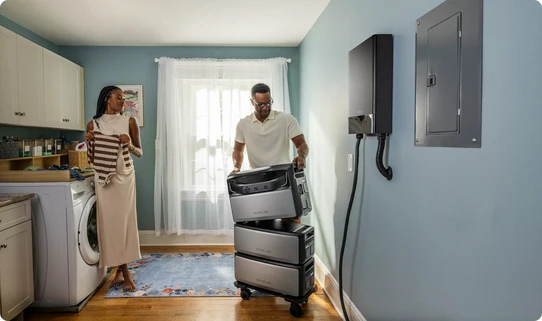
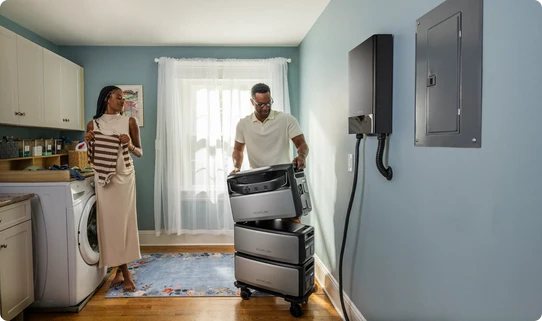
The EcoFlow TITAN 5000 Plus uses a modular approach, beginning around the 5kWh class and accepting compatible expansion batteries for substantially greater storage. That makes it possible to start with essential-load coverage and add runtime later. Adding Extra Batteries increases stored energy and extends backup time, but it does not increase the system’s 7.2kW battery output.
For a residential installation, favor equipment listed and approved for its intended use. A collection of individually certified parts is not necessarily approved as a complete home energy-storage system.
Inverter
The inverter converts battery power into household AC power. Use pure sine wave output for electronics and motor-driven appliances. Confirm continuous wattage, short-duration surge capability, individual outlet ratings, and whether the system supplies only 120V or true 120V/240V split-phase power.
Voltage matters as much as wattage. A 120V inverter cannot operate a 240V well pump or central air conditioner simply because its total watt rating looks large enough. Large motors may also demand far more current at startup than during normal operation.
Charging and Solar Equipment
Grid charging keeps the battery ready between outages. Compatible solar panels can replace part of the energy used during a longer event, while an MPPT controller manages solar input on systems that do not include one internally.
A DIY home battery backup without solar can still recharge from the grid, but it cannot replenish stored energy during an extended outage until an approved charging source becomes available. If solar is added, panel wattage alone does not establish compatibility. Array voltage, current, connectors, and total power must remain within the controller’s limits. Follow the manufacturer’s approved array designs rather than using improvised adapters.
Transfer Equipment and Backup Connections
Direct plug-in backup is the simplest arrangement. Use intact cords rated for the load and location, keep them out of water and walkways, and do not run them beneath rugs or through damaged doorways.
To power household circuits, use an approved transfer switch, interlock, critical-load subpanel, or compatible home-energy panel installed by a licensed electrician. The equipment must prevent backfeeding onto utility lines. Never use a double-male cord to feed a wall receptacle.
Verify that the battery system is approved for the selected transfer equipment, including its neutral and grounding configuration, before any household connection is installed.
How to Plan and Set Up a DIY-Friendly Home Battery Backup System
Homeowners can handle load planning, equipment comparison, placement, modular assembly, and testing. Main-panel work, fixed wiring, service calculations, and transfer equipment require professional involvement.
Check Compatibility and Plan Your Setup
Begin with the appliance list and identify voltage, running power, startup demand, and daily energy use. Most U.S. homes have 120V/240V split-phase service, but a basic backup plan may need only 120V circuits. There is little value in paying for 240V output unless the backed-up equipment requires it.
The EcoFlow TITAN 5000 Classic is a 120V model with 5kWh of battery capacity and 4kW of continuous AC output, making it more relevant to ordinary plug-in loads and 120V circuits than to central air conditioning or a 240V well pump. Those larger appliances require a compatible split-phase model and an appropriately designed connection. Always verify the current production specifications before purchase.
Also plan the installation location and access route. Measure doors, stairs, floor space, and required clearances before delivery, since high-capacity equipment may be difficult to reposition after installation.
Install the Battery, Inverter, and Charging Equipment
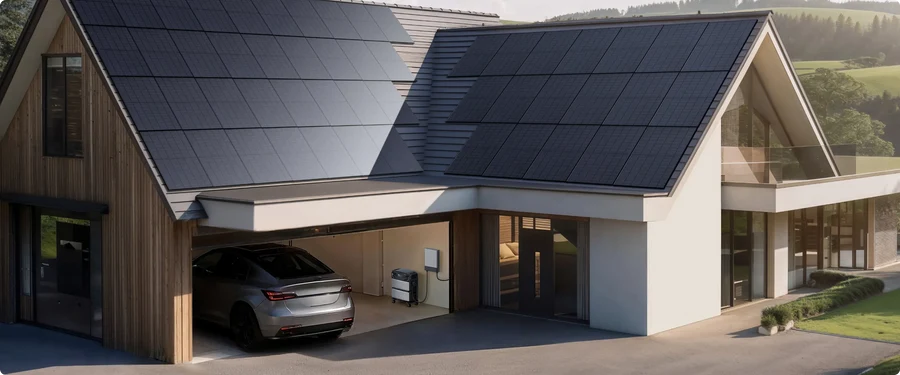
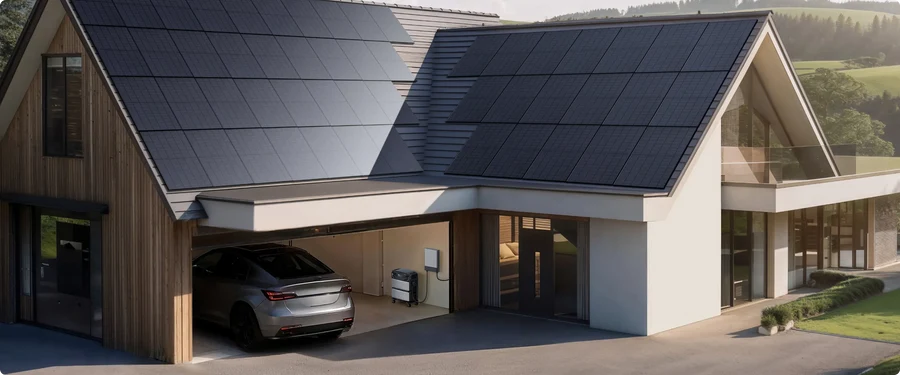
Follow the manufacturer’s location requirements. The battery should remain dry, stable, protected from impact, and within its charging and discharging temperature range. Garages and utility rooms may be suitable when the listed equipment and local code permit them; a damp basement corner or unconditioned shed may not be.
Keep ventilation openings clear and use only approved expansion cables. For a component-based system, DC conductors, fuses, disconnects, battery communication, grounding, and enclosure requirements must be engineered as a system. If the manual does not authorize homeowner assembly, use a qualified installer.
Connect and Configure Backup Loads
Plug-in devices can connect directly to the power station within the rating of each outlet. Avoid stacking power strips or combining cords to reach a higher load than one receptacle allows.
For household circuits, decide with the electrician whether a critical-load transfer switch, interlock, or smart panel fits the service equipment. A critical-load panel keeps the backed-up list small and clear. An interlock can provide access to more circuits but depends on disciplined load management. Turn off high-demand loads before transferring and follow the written operating sequence.
Label the supported circuits and keep instructions near the panel. Everyone who may operate the system should know which breakers remain off and how to return safely to utility power.
Test the System Before an Outage
Charge the battery fully, disconnect from grid input as the manual directs, and run the planned loads through a realistic cycle. A refrigerator or pump should be observed as its motor starts, not only while it is already running.
Watch for overload warnings, excessive heat, loose connections, unexpected shutdowns, or a runtime far below the estimate. If the system feeds household circuits, have the electrician demonstrate the transfer process and confirm that utility power cannot be backfed. Repeat a shorter test periodically and install firmware updates according to the manufacturer’s guidance.
How Much Does a DIY Home Battery Backup Cost?
Cost varies with the equipment and connection method. DIY planning may reduce charges, but it does not eliminate permits, qualified electrical work, or safety equipment.
Battery and Inverter Costs
Battery pricing varies widely with cell quality, enclosure, management electronics, warranty, shipping, and certification. Bare-module prices should not be compared directly with a finished power station that includes an inverter, charger, outlets, display, controls, and warranty support.
For broad planning, a 5kWh to 10kWh packaged or component-based system may place several thousand dollars into batteries and power electronics. Split-phase output, high surge capability, and expandability usually raise the price. Obtain current model-specific quotes rather than applying a single cost per kilowatt-hour to every design.
Installation and Electrical Costs
Electrical cost depends on panel location and condition, cable distance, wall construction, service capacity, permit fees, and the connection method. A simple inlet and manual transfer arrangement may be modest; a new subpanel, service upgrade, or smart energy-management panel can cost considerably more.
Ask the electrician’s proposal to identify labor, permit and inspection fees, transfer equipment, breakers, inlet hardware, conduit, conductors, and any service-panel work. Very low estimates may omit work required for a legal installation.
Solar and Charging Equipment Costs
A small portable array costs less to install but requires outdoor setup and secure storage. A permanently mounted array adds racking, roof or ground attachments, wiring, rapid-shutdown equipment where required, permits, and labor. The advertised panel price per watt covers only part of that project.
A nominal 1kW array will not produce 1kW all day. Daily energy depends on location, season, shade, orientation, weather, and system losses. Size solar around conservative daily production, particularly if it is expected to support a multi-day outage.
Total System Cost and Long-Term Value
The ranges below are planning allowances for a DIY-friendly project, not national price guarantees. Local labor and a service-panel upgrade can move the total substantially higher.
Expense Item | Estimated Cost Range (USD) |
Battery Storage and Power Electronics (5 kWh – 10 kWh) | $2,500 – $7,500 |
Transfer Switch, Interlock, and Connection Hardware | $500 – $2,000 |
Electrician Labor, Permit, and Inspection | $750 – $3000+ |
Solar Array and Charging Hardware (Optional, approximately 1kW) | $1,000 – $3,000 |
Estimated Total Without Optional Solar | $3,750 – $12,500 |
Estimated Total With Optional Solar | $4,750 – $15,500 |
Backup batteries often have a weak financial payback if outage protection is their only benefit. Time-of-Use rate shifting or use of surplus solar may improve the economics, but savings depend on local rates, export compensation, battery efficiency, and cycling strategy. Reliability and avoided disruption may be the main value for many households.
A battery backup vs. generator comparison should include installed cost, fuel or charging costs, maintenance, noise, emissions, required output, and the expected outage duration.
The federal Residential Clean Energy Credit applied to qualifying battery-storage expenditures made through December 31, 2025. Current IRS guidance states that it is not available for expenditures after that date. A system purchased or installed in 2026 should therefore be budgeted without the former 30% residential credit, although state, local, utility, or manufacturer programs may still apply.
Conclusion
A useful DIY home battery backup begins with a short list of essential loads and an honest estimate of how long they must operate. Packaged modular equipment can make selection and expansion more manageable, while direct-plug use avoids permanent wiring altogether.
The homeowner’s role is best focused on planning, measuring, placement, routine operation, and testing. Panel connections, transfer equipment, fixed solar wiring, permits, and inspections belong with qualified professionals. With compatible listed equipment and a code-compliant connection, a battery system can provide dependable outage power without the fuel storage, noise, and combustion exhaust of an engine-driven generator.
FAQ
Are Home Batteries Worth It Without Solar?
Yes, home batteries are worth having even without solar panels because they deliver instant backup power during blackouts and can save money on time-of-use utility rates. You can charge the battery from standard grid outlets during cheap off-peak hours and use that stored power during expensive peak hours or severe weather emergencies.
What Are the Benefits of Having a Home Battery?
Home batteries provide relatively quiet operation, clean pure sine wave output, and backup power without combustion exhaust. Systems with compatible UPS or EPS functions can also provide fast power transfer during outages, although transfer times vary by model. Unlike gas generators, home batteries require no ongoing oil changes and are generally quieter during operation. They can be used indoors or in a garage when the product is rated for that location and installed according to the manufacturer’s instructions and local code.
How Long Does a Battery Backup Last When Power Goes Out?
Backup runtime depends on usable battery capacity and the average power consumption of connected appliances. For example, a 5kWh battery supplying a steady 200W load could provide approximately 21 hours of backup using an 85% usable-energy assumption. Higher loads, including furnace blowers and sump pumps, may shorten runtime, while additional battery capacity or compatible solar charging may extend it.
Which Is Better for Backup Power, A Battery Backup or a Gas Generator?
Battery backups are generally better suited for quiet operation, backup power without combustion exhaust, and powering sensitive electronics. Some models also support automatic power transfer during outages. Gas generators offer lower initial purchase prices for high wattage, but they require ongoing fuel purchases, loud outdoor operation, frequent engine maintenance, and manual setup in bad weather.
How Many Years Will a Home Battery Last?
Under normal conditions, a quality LiFePO4 home battery system generally provides a service life of 10 to 15 years, depending on the model, operating conditions, and warranty. Most modern cells are designed to deliver 3,000 or more cycles before capacity gradually reduces to 80%, though actual lifespan varies based on discharge depth, ambient temperature, and daily load demands.
For press requests or interview opportunities, reach out to our media team
media.na@ecoflow.com