Balcony Solar Panels USA: Why It's Huge in Germany and Still Catching On Here
- Defining Compact Plug-In Solar Systems for American Homes
- Factors Preventing Germany's Plug-and-Play Solar Trend From Spreading to the United States
- The 2026 Landscape for UL Certification and Regional Regulations
- Elements of a Fully Compliant US Plug-In Solar Setup
- Evaluating the Investment Readiness of Compact Solar
- Conclusion
- FAQs
German households have embraced balcony solar for years now, by the hundreds of thousands. Search "balcony solar panels USA" today, and you'll find a market still figuring itself out. The same idea has run into years of red tape here in the States. This piece explains what compact plug-in solar actually is. It compares Germany's fast rollout to America's slower one. It also covers where UL certification and state law stand in 2026, what a compliant setup needs, and whether jumping in now makes sense.
Defining Compact Plug-In Solar Systems for American Homes
What Balcony Solar Actually Is
Before comparing countries, it helps to know what this hardware is. A balcony solar system is smaller and simpler than a rooftop array, typically 400 to 1,200 watts, and it works differently: it connects straight into a standard wall outlet, with no full electrical panel installation involved. The panel itself uses the same photovoltaic cells as any rooftop system and makes electricity the exact same way; The difference sits entirely in how that power gets into your home's wiring.
One Name, Several Meanings
People call it balcony solar, plug-in solar, or plug-and-play solar, and all three names mean the same thing. In US coverage, "balcony solar" and "plug-in solar" are used interchangeably, which is a little imprecise — balcony mounting is only one of several places these systems actually get installed.
The concept itself isn't new or complicated. That's exactly what makes the gap between Germany's adoption and America's so worth explaining.
Factors Preventing Germany's Plug-and-Play Solar Trend From Spreading to the United States
How Germany Built the Rulebook First
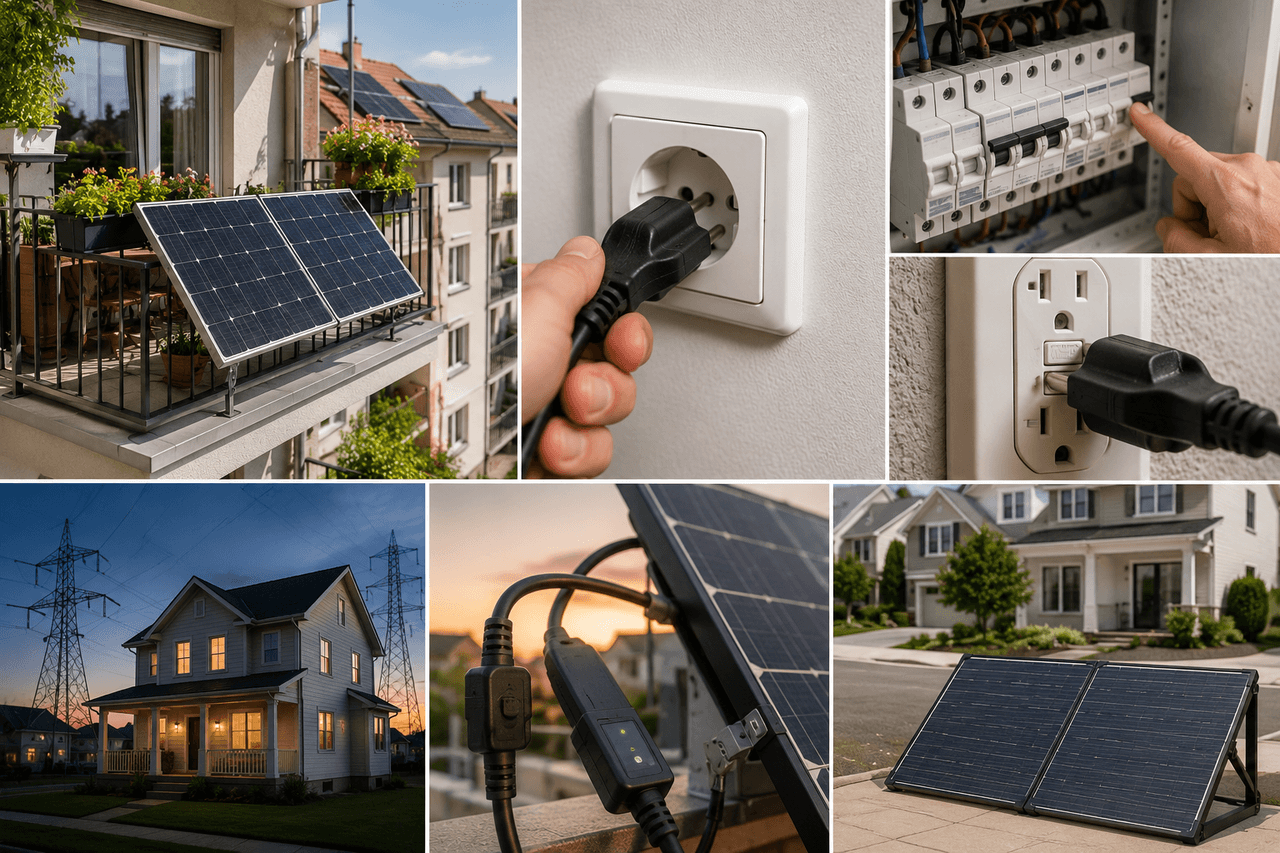
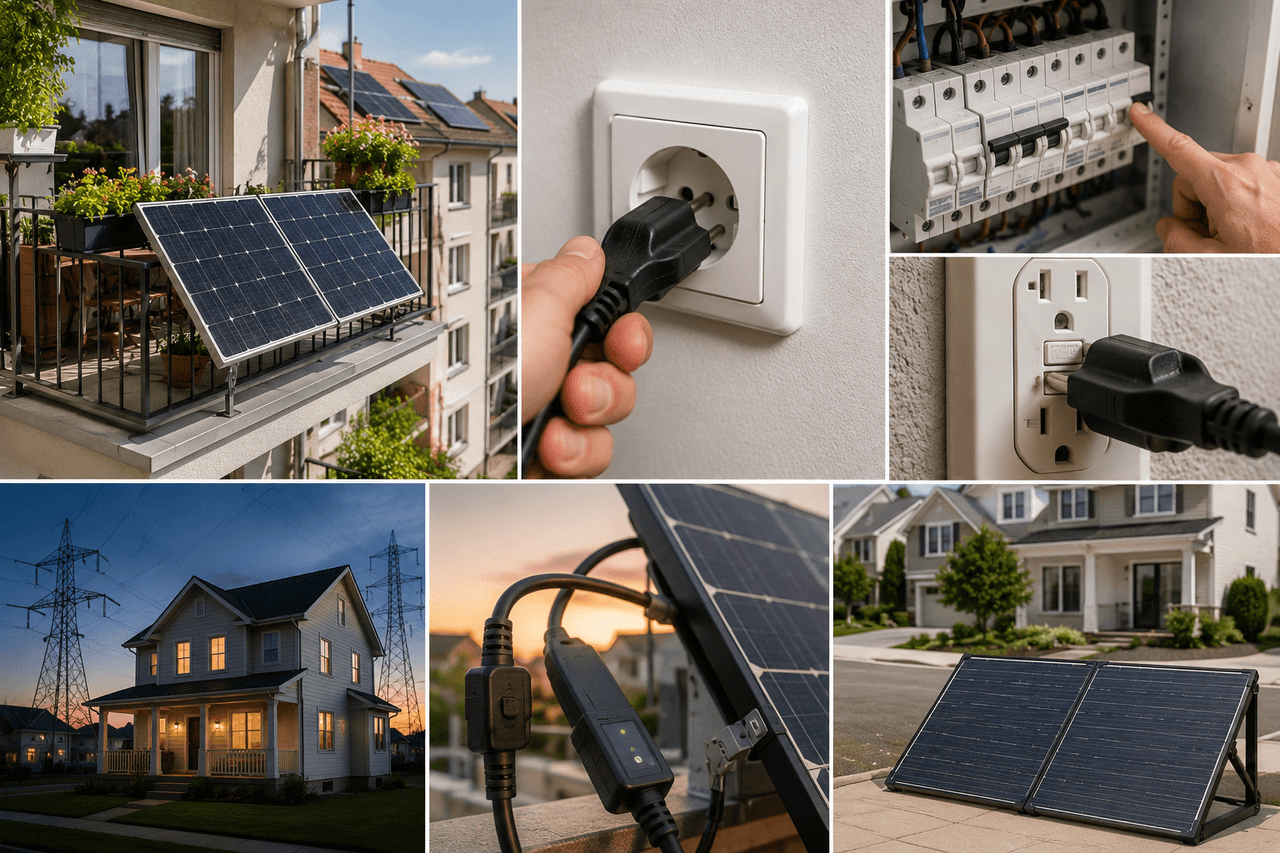
Germany didn't just get lucky with balcony solar. It built the rulebook years before anyone else. Balcony solar usa adoption is still catching up as a result. Germany's grid regulator, the Bundesnetzagentur, now shows more than 1.3 million balcony solar systems formally registered. Millions more are likely running unregistered on top of that.
That boom traces back to 2017. A German technical body published a dedicated safety standard that year, capped at 600 watts at first. A 2024 update to national energy law raised that cap to 800 watts. The technical standard got updated to match.
Why the US Lagged Behind
The US never had an equivalent standard until recently. The National Electrical Code has historically said nothing about plug-in generation. Installers, insurers, and utilities never had one shared rulebook to point to.
Two technical gaps get cited again and again. A standard breaker can't tell the difference between power flowing backward from a solar device and power drawn by an appliance. Both can happen on the same circuit at once. And until recently, no GFCI outlet was certified to handle a circuit that both consumes and generates power. That gap is exactly why GFCI protection against moisture-related electrical faults matters so much for any outdoor-mounted plug-in setup.
The Grids Aren't Directly Comparable
The two countries' grids aren't directly comparable either. Germany runs residential power at 230 volts. The U.S. Department of Energy confirms American homes run on 120 volts instead. German safety thresholds couldn't simply be copied over here, even if the paperwork lined up.
Closing those bidirectional and low-light safety gaps takes real engineering. That's exactly why manufacturers like EcoFlow built purpose-made plug-in hardware for it.
Purpose-Built Hardware Designed to Meet U.S. Safety Standards
Hardware is only half the equation. Regulatory alignment is what actually clears these systems for everyday use.
The 2026 Landscape for UL Certification and Regional Regulations
Even great hardware needs a legal green light. Certification and legislation are two separate tracks. Both are moving right now, just not at the same speed everywhere.
UL 3700 is the first dedicated safety standard for plug-in solar devices in the US. UL Solutions published it in January 2026. It requires overcurrent protection, insulated touch-safe contacts, built-in ground-fault detection, and anti-islanding shutdown. That makes it the first real American answer to Germany's 2017 standard.
Actual certified products are only now catching up to that published standard. The first UL 3700-certified devices are reaching the market gradually through 2026, not all at once. Nine states have enacted plug-in solar legislation as of September 2026. Most cap systems at 1,200 watts. Colorado allows up to 1,920.
State | Status |
|---|---|
Utah, Maine, Maryland, Vermont | Active law |
Connecticut, Colorado, Virginia, New Hampshire | Signed, effective date pending |
New Jersey | Signed September 1, 2026, effective March 1, 2027 |
Utah's HB 340 was the first law of its kind in the country. It exempts qualifying portable solar devices from standard utility interconnection requirements entirely. Meanwhile, California's SB 868 has cleared the legislature and is waiting on a governor's signature. It's one entry in a state-by-state tracker of where plug-in solar is actually legal. States like Delaware, Ohio, and Pennsylvania still have active draft proposals moving through committee.
Certification and legislation settle whether a system can legally connect at all. A buyer still needs to know what a compliant setup actually includes.
Elements of a Fully Compliant US Plug-In Solar Setup
What a Compliant Setup Requires
Legal on paper and safely installed aren't automatically the same thing. A compliant setup has a handful of specific pieces. They all need to be in place together.
A UL 3700-certified microinverter is the baseline. So is ground-fault detection separate from the outlet's own GFCI protection. Anti-islanding shutdown rounds it out, cutting power within milliseconds of a grid outage.
Most state laws cap system size, usually around 1,200 watts per dwelling unit. Germany's flat 800-watt rule doesn't scale by dwelling at all, meaning the US per-dwelling caps are actually more generous in practice.
Circuit, Paperwork, and Next Steps
A compliant install still typically needs a dedicated, GFCI-protected outdoor-rated circuit. A random household outlet won't cut it. Avoiding overloaded circuit matters just as much. The mounting and wiring steps for a plug-in kit cover both, before you ever flip a breaker.
Registration or notification requirements vary by state, even where the systems themselves are legal. Confirming your specific state's paperwork step is still a real part of a compliant install, not an optional formality. Anyone deciding between a small outlet-connected system and a full installation has a place to start. EcoFlow's home solar system resources compare what each path actually covers.
Evaluating the Investment Readiness of Compact Solar
None of this matters much if the economics don't work out. Here's the honest read on where things actually stand. Households in a state with active legislation have a real path here. Utah, Maine, Maryland, and Vermont all count. Pair that with a UL 3700-certified product. A plug in balcony solar panels usa setup becomes a genuinely low-cost way to offset part of one circuit's usage. It's not a whole-home solution. It was never meant to be.
Savings run modest and circuit-specific by design. These are hundreds-of-dollars-a-year systems. They're not a stand-in for a full rooftop array or a whole-home battery. Those bigger setups are where state electricity rates and monthly usage really drive savings.
The realistic near-term path for most of the country is watching two tracks move together through 2026 and 2027. More states are passing enabling laws. More UL 3700-certified products are actually reaching store shelves.
Conclusion
Balcony solar took off in Germany because it had a shared safety standard and a flat wattage cap starting in 2017. The US is only now catching up, with UL 3700 and a nine-state patchwork of enabling laws as of 2026. Check your state's current law and a specific product's UL 3700 status before assuming a system is ready to install where you live. When you're ready to shop, EcoFlow's STREAM Microinverter and STREAM Ultra are built for exactly this setup.
FAQs
What is balcony solar and how is it different from rooftop solar?
A balcony solar kit usa retailers sell uses the same solar cells as a rooftop system. It's just a smaller, 400 to 1,200-watt package. It plugs into a standard wall outlet instead of tying into your breaker panel. It's meant to offset part of one circuit's usage, not power a whole house.
Why is balcony solar so much more common in Germany than in the US?
Germany has had a dedicated technical safety standard since 2017. It also has a flat national wattage cap. That gave manufacturers and regulators a shared rulebook early on. The US never had an equivalent standard until UL 3700 published in January 2026, and state laws are still rolling out one at a time.
Is balcony solar legal in the US in 2026?
It depends entirely on your state. Nine states, including Utah, Maine, Maryland, and Vermont, have enacted plug-in solar legislation as of September 2026. Several more, including California and New York, have bills signed or moving through the legislature.
What is UL 3700, and has EcoFlow's plug-in solar lineup been certified?
UL 3700 is UL Solutions' first dedicated safety standard for plug-in solar systems. It covers shock and fire protection, thermal limits, backfeed controls, and circuit overload safeguards, end to end. It's distinct from UL 1741, which governs grid connection and anti-islanding for traditional microinverters. EcoFlow's STREAM Microinverter and STREAM Ultra already carry UL 1741 and IEEE 1547 grid-safety certifications. Both comply with current state provisions like Utah's HB 340.
How much balcony solar can actually save on a utility bill?
Most 1,200-watt systems save homeowners a few hundred dollars a year. The real number depends heavily on local sun exposure and how the state's interconnection rules are set up. It's a real, if modest, offset on one part of your bill, not a full replacement for grid power.
For press requests or interview opportunities, reach out to our media team
media.na@ecoflow.com