Is Power Bank with Built-in Cable Worth It?
"Low battery anxiety" is a real thing in this fast-paced digital world. But there's something even worse than having a dead phone: having a portable charger that's fully charged but no cable to connect it to your phone. People often lose their cables, which is why power banks with built-in cords have become so popular.
But is this all-in-one design really an improvement, or is it just a way to sell more products? Are you giving up longevity for ease of use?
What Is a Power Bank with Built-in Cable?
Power banks with built-in cables are exactly what they sound like: portable battery packs that have one or more charging lines built right into them. Traditional power banks require you to carry different USB cables, which get lost or tangled. These units, on the other hand, are ecosystems that work on their own.
These days, most of them hide the wire in a groove or use it as a lanyard loop when they're not in use. There is a simple theory behind all of them: Grab, Go, and Charge. This is true whether they are USB-C connectors for new iPhones and Androids or Lightning connectors for older Apple devices.
Core Techs Explained
You might wonder if integrating the cable compromises the technology inside. The answer is no. In fact, the tech often has to be smarter.
Integrated Circuitry: The cable that comes with the battery is wired directly to its Printed Circuit Board (PCB). Compared to external plug-in cords, this lowers electrical resistance, which usually leads to a slightly more efficient transfer of energy.
Protocols for Fast Charging: Good models have built-in lines that handle both Power Delivery (PD) and Quick Charge (QC) protocols. This means that the cord that comes with it can do more than just a slow charge; it can also give your device a high-wattage quick charge that powers it up in minutes.
Charging in Two Directions: Newer models have a built-in wire that can charge your phone (output) and plug into a wall adapter to charge the power bank (input).
What Are the Benefits of Built-in Cable?
Why are users flocking to this design? The advantages go beyond just "not losing the wire."
- It can streamline your everyday carry. By eliminating the need for a separate 3-foot white cable that turns gray at the bottom of your bag, you reduce bulk. The power bank with built-in cable transforms two items into one sleek unit.
- It helps you protect your device's battery health. Premium integrated cables are calibrated to match the power bank's output perfectly. This ensures stable voltage regulation, preventing the power spikes often caused by cheap, gas station third-party cables.1
- You'll never need to untangle a knot again. We have all been there—pulling a charger out of a backpack only to spend two minutes fighting with a bird's nest of wires. With a built-in design, the cable snaps or folds into place instantly. It creates a friction-less charging experience.
Who Will Need a Power Bank with Built-in Cable?
While everyone can benefit from extra power, specific groups of people will find this device life-changing. When searching for the best power bank with built in cables, these users are usually the ones leaving the 5-star reviews:
People who prioritize minimalism - If you hate carrying a tech pouch full of accessories, this is for you. It fits in a pocket or a small clutch without the spaghetti mess of wires.
People who forget cables often - If you have a drawer full of power bricks but can never find a cord when you rush out the door, a power bank with built in cable is your safety net. It is impossible to forget the cable if it is permanently attached.
People who want ultra convenience - Commuters on crowded trains or travelers in cramped airplane seats don't have the elbow room to manage long cables. The short, integrated form factor is perfect for holding the phone and battery in one hand while using the device.

Are These Your Worries?
Even though there are pros, people often don't buy because of real concerns. Let's talk about them.
"Suppose the wire breaks? Does the whole thing become useless?"
It was a problem with the first models. But now, the best makers use TPE that has been reinforced or materials that have been braided and tested to bend thousands of times. Also, most good units have an extra USB port, so if the built-in cable fails, which is very rare, the battery will still work.
"Is the cable too short?"
The wires are short on purpose so that there is less resistance and mess. They are made to "stack," which means to hold the phone and charger together while you use them. But the length of the cable can definitely support your common needs.
"What if I switch phones?"
USB-C is becoming the standard because it is required by the EU and the iPhone 15/16/17 move. Most phones, tablets, and even some computers now come with a built-in USB-C cable that makes them ready for the future.
What to Look For When Buying
Not all integrated chargers are created equal. To find the best power bank with built in cables, you need to look past the cable and check the specs.
GaN: Protecting Battery Health
Gallium Nitride (GaN) is a game-changer. It allows power banks to be smaller and conduct electricity more efficiently with less heat. Heat is the enemy of batteries. A GaN-equipped power bank protects both its own cells and your phone's battery health by keeping temperatures low during rapid charging.
High Output & Capacity
Don't settle for slow 5W charging. Look for a device that offers at least 30W of output via the built-in cable. This ensures you can fast-charge a modern smartphone to 50% in roughly 30 minutes. For capacity, 5,000mAh is great for pockets, while 10,000mAh strikes the perfect balance for travel.
Versatility (Magnetic + Wired)
Why choose between wired and wireless? The top-tier contenders in the market now offer magnetic wireless charging (MagSafe compatible) plus a built-in cable. This gives you the ultimate freedom: use the magnet for convenience, and the built-in cable when you need blazing-fast speed.
Meet EcoFlow RAPID Mag Power Bank
If you are looking for a device that ticks every single box above, the EcoFlow RAPID Mag Power Bank (Built-in USB-C Cable) is the industry benchmark.
Never forget a cable again. With a sleek, built-in USB-C cable, you are always ready for high-speed charging. You don't need to worry about carrying (or losing) extra cords anymore.
Charge without the hassle. It snaps magnetically to the back of your iPhone for instant wireless power. No fumbling with ports—just snap and go.
Keep your device cool and safe. Thanks to EcoFlow's X-Core 2.0 technology, it manages heat intelligently. You get rapid energy delivery without your phone overheating.
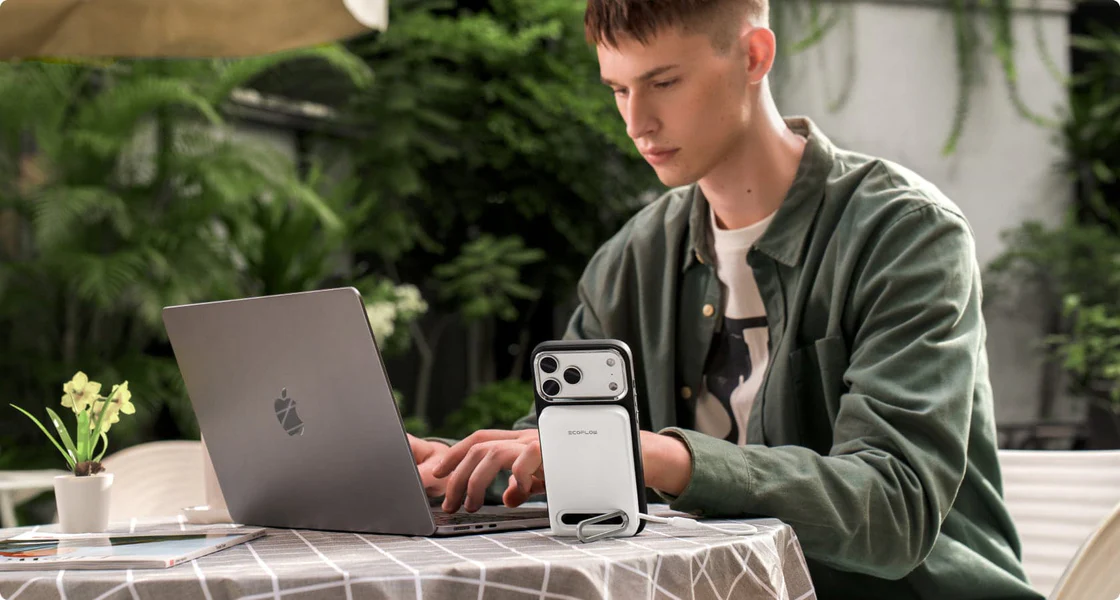
Go hands-free anywhere. It doubles as a phone holder. The hidden stand lets you prop up your phone to watch videos or take calls comfortably, while the non-slip finish keeps it secure in your hand.
Conclusion
So, is a power bank with built in cable worth it? Absolutely. It eliminates the single biggest point of failure in portable charging: the missing cable.
By combining portability, speed, and organization, these devices solve real-world problems for modern users. Whether you are a minimalist commuter or a forgetful traveler, upgrading to a high-quality unit like the EcoFlow RAPID Mag ensures that power is always within reach—no strings (or loose cables) attached.
FAQs
Q1: Can I bring a power bank with a built-in cable on an airplane?
Yes, absolutely. Like standard portable chargers, a power bank with built in cable is allowed on planes, provided it is kept in your carry-on luggage and not in your checked bag. Just ensure the capacity is within the airline's limit (usually under 100Wh or 27,000mAh).
Q2: Does the built-in cable charge as fast as a separate cable?
In most cases, it charges even faster. Because the cable is wired directly to the internal circuit board, there is less resistance. For example, the EcoFlow RAPID Mag supports high-speed Power Delivery (PD) through its integrated cable, far outperforming standard wireless charging speeds.
Q3: What happens if the built-in cable breaks?
Durability is a key feature of the best power bank with built in cables, so breakage is rare with reputable brands. However, if it does happen, most models include an additional USB-C port. This allows you to plug in a separate cable, ensuring the power bank remains usable.
Q4: Can I use the built-in cable to charge the power bank itself?
It depends on the model. Many advanced chargers now feature "bi-directional" built-in cables. This means you can plug the built-in USB-C connector directly into a wall adapter (brick) to recharge the power bank, eliminating the need to carry a separate recharging cable.
For press requests or interview opportunities, reach out to our media team
media.na@ecoflow.com