The Best Solar Generator for Refrigerators in 2026: Keep Food Safe Off-Grid
- What a Refrigerator Needs From Backup Power to Stay Food-Safe
- How to Choose the Best Solar Generator for a Refrigerator in 2026
- How to Size Solar and Battery Capacity for Overnight and Multi-Day Runtime
- EcoFlow Options for Fridge Backup: Which Setup Fits Your Home or Off-Grid Use
- Frequently Asked Questions
- Keep Food Cold Through Outages With a Setup You Can Recharge
Food spoils four hours after an outage, so your fridge backup needs to be ready before the power goes out. The right solar generator comes down to two numbers: enough watt-hours to cover your fridge's daily draw, and a surge rating high enough to handle compressor startup.
This guide shows you how to size both and which setups actually deliver.
What a Refrigerator Needs From Backup Power to Stay Food-Safe
A portable, small 12V refrigerator has different power requirements than a standard 120V home refrigerator. You should estimate any refrigerator's running watts, startup surge, and daily energy use before you buy.
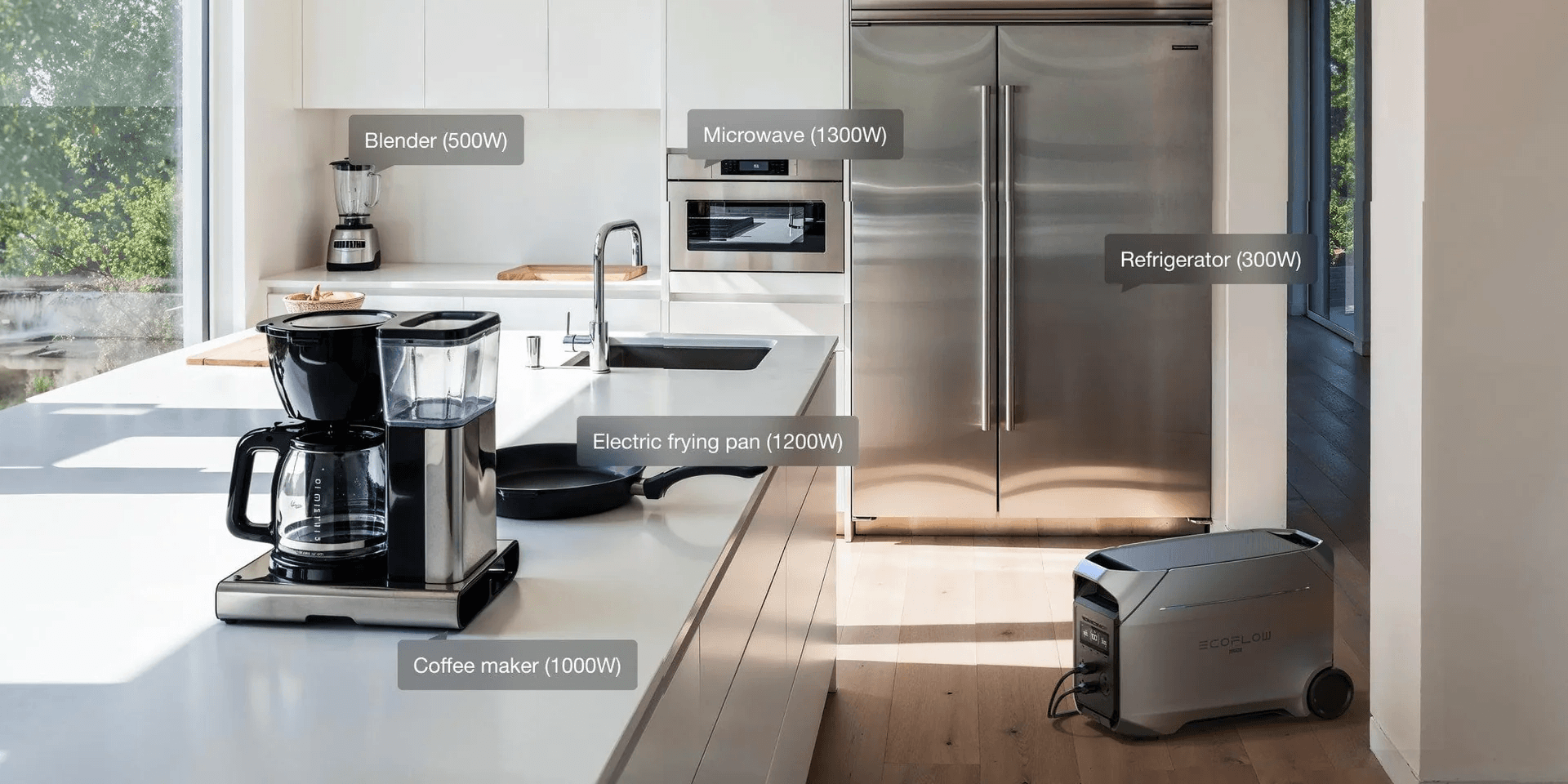
Running watts for a full-size fridge typically fall between 100 and 400 W, with the compressor cycling on for about 8–12 hours each day. The startup surge hits 2–3x the running wattage when the compressor kicks in.
To find your fridge's running watts, check the amp rating on the interior label and multiply that by the voltage.
Daily energy use tells you the total capacity your backup power needs to keep your food safe. The formula is:
Running watts × daily compressor hours = watt-hours consumed per day.
Note that your generator's inverter surge rating must also exceed the fridge's startup surge, or it will trip and shut down.
How to Choose the Best Solar Generator for a Refrigerator in 2026
Here’s what to look for when choosing the best refrigerator solar generator:
Battery chemistry — LFP battery chemistry is the standard for fridge backup. It's rated for far more cycles and a lower thermal runway risk than NMC.
Inverter quality — A pure sine wave inverter output is critical for compressor-driven appliances, because a modified sine wave can cause motor inefficiency or damage.
Inverter surge rating — It should be at least 2.5–3x the fridge's running wattage to handle the compressor startup without tripping.
Usable capacity — This is not the same as rated capacity. Account for inverter conversion loss at about 90–95% efficiency when calculating real-world runtime.
A whole-home generator setup makes the most sense for households that need fridge backup alongside other critical circuits, but a standalone solar generator is sufficient for portable fridge applications.
How to Size Solar and Battery Capacity for Overnight and Multi-Day Runtime
When sizing your setup for overnight use, calculate the fridge's watt-hours for the no-sun window, and then divide that by battery efficiency to get the minimum required capacity.
For example, a 150W fridge that runs for 12 hours overnight draws ~1,800 Wh at 95% efficiency, so you'd need at least a 1,900 Wh battery to carry it through.
As for how long food can last without power, the FDA sets the maximum at four hours for an unopened fridge, so even a modest battery can buy you a meaningful safety margin.
If you're sizing your solar and battery for multi-day outages, add about 1,200–1,500Wh per extra day, plus a buffer for cloudy conditions, which can reduce solar yield.
Size your solar panels by dividing the daily watt-hour draw by average peak sun hours, noting that real-world solar output is typically 70%--80% of rated wattage.
EcoFlow Options for Fridge Backup: Which Setup Fits Your Home or Off-Grid Use
How long your solar backup can run a fridge depends on the fridge's draw, the inverter's efficiency, and whether you're using solar to replenish it during the day.
The EcoFlow DELTA 3 Classic Portable Power Station (1024Wh), with its 1,800W continuous output and 3,600W surge, is sufficient for most standard refrigerators. Pairing it with a 500W solar output allows it to charge fully in ~2.5 hours. It’s best suited for shorter outages or off-grid camping with a portable refrigerator.
The EcoFlow DELTA 3 Ultra Plus Solar Generator (3072Wh) + 500W Solar Kit is an upgraded option with 3,600W total AC output and 7,200W surge, handling even high-surge compressors without tripping. It's the best fit for extended home outages, households that are running the fridge alongside other circuits, or off-grid setups where you need multi-day runtime.
Frequently Asked Questions
What Size Solar Generator Do I Need to Run a Full-Size Refrigerator?
A full-size refrigerator typically has 100–400 running watts, and a startup surge of 2–3 times that. So you'd need a generator with a surge rating of at least 1,500–2,000W.
Can a Solar Generator Handle a Refrigerator’s Startup Surge Without Tripping?
A refrigerator startup surge is the most common trip point. To avoid it, a generator’s surge rating must meet or exceed the fridge's locked rotor starting wattage. Verify your solar generator's surge figure against your fridge's spec label to be sure.
How Long Will a 3000Wh Class Power Station Run a Refrigerator?
At 150W draw with a 90% efficient inverter, a 3000Wh unit provides ~18 hours of runtime. But in the real world, this figure drops to about 12–15 hours when accounting for compressor cycling and ambient temperature.
Is It Safe to Run a Solar Generator Indoors to Power a Refrigerator?
Battery-based solar generators don't produce any combustion emissions, so they are safe for indoor use, unlike gas generators. You should still ensure adequate ventilation to dissipate the heat and keep it away from direct heat sources or enclosed spaces that trap warmth.
Keep Food Cold Through Outages With a Setup You Can Recharge
Sizing a solar generator for your refrigerator comes down to three things: usable watt-hours that cover your fridge's daily draw, a surge rating that won't trip on compressor startup, and LFP battery chemistry for reliable, long-cycle performance. Get those right, and you can keep food safe through outages of any length.
For a setup built to handle it all, explore EcoFlow’s home and off-grid solar generators to find the right fit for your requirements.
For press requests or interview opportunities, reach out to our media team
media.na@ecoflow.com