Battery Backup for Garage Door Opener: How It Works & What to Consider
Most people do not think about the weight of a garage door until the power goes out and the wall button does nothing. There is a manual release, but using it may be inconvenient, and a door with a damaged spring can be dangerously heavy.
A battery backup lets a compatible opener move the door when household power is unavailable. This guide explains what happens during an outage, how long the battery may last, what to check before buying a replacement, and when a portable power station might make sense instead.
How Does a Garage Door Opener Battery Backup Work?
A garage door opener with battery backup still uses household electricity during normal operation. The battery sits inside or beside the motor unit, waiting for an outage. When utility power disappears, the opener draws from that stored charge and switches back once electricity returns.
Normal Operation and Battery Charging
Most residential openers plug into a standard 120-volt ceiling outlet. While that outlet has power, it runs the motor and maintains the backup battery at the proper charge level.
There is usually nothing for the homeowner to turn on. A status light on the motor housing shows whether the battery is charging, ready, low, or due for replacement, although the colors and patterns differ by manufacturer. Check the owner’s manual before treating a red or orange light as a specific fault.
Automatic Switching During a Power Outage
When the power fails, the opener’s control board detects the loss and begins using the battery as an emergency power supply. There is no separate transfer switch for the homeowner to operate. Pressing the wall control or a compatible remote should open the door much as it normally would.
You may notice a few differences. The door can move more slowly, and the opener’s built-in light may remain off to conserve energy. Wi-Fi controls, automatic closing, cameras, and other secondary features may also be unavailable. Which features survive the outage depends on the opener.
Power Restoration and Battery Recharging
The opener returns to household power automatically when electricity comes back. It also begins recharging the battery without requiring a reset.
Many units need about 24 hours to restore a heavily discharged battery, although charging time varies. During that period, the door opener can still operate from household electricity. If the battery warning continues after it has had enough time to recharge, the battery may be worn out or installed incorrectly.


Key Factors to Consider When Choosing a Battery Backup
The model number is the place to start. Garage door batteries are not universal, even when two openers come from the same manufacturer and look nearly identical.
Garage Door Opener Compatibility
Some openers were designed with a battery compartment or a connection for an approved external pack. Others, especially older AC-powered units, have no way to communicate with or charge a backup battery.
Find the model number on the motor housing and look it up in the owner’s manual or manufacturer’s compatibility list. Do not assume that a matching voltage makes a battery suitable. The plug, charging circuit, mounting location, and battery chemistry must also match the opener.
If the manufacturer does not offer a battery for that model, replacing the opener or using a portable power station during an outage may be more practical than attempting a homemade modification.
Built-In vs. External Battery Backup
A built-in battery keeps the installation tidy, while an external pack can be easier to reach. The choice is often made by the opener manufacturer rather than the homeowner.
| Feature | Built-In Battery Backup | External Add-On Battery Pack |
|---|---|---|
| Aesthetics | Usually concealed inside the opener housing | Mounted beside the motor on the ceiling or wall |
| Installation | Included with the opener and internally wired | Requires a bracket and compatible wiring harness |
| Replacement Ease | An access cover usually has to be removed | Battery is generally easier to reach |
| Model Flexibility | Available only on openers designed for it | Works with certain listed compatible models |
An external pack is not a universal retrofit. It still relies on the opener’s control board and charging system, so it should only be installed on models listed by the manufacturer.
Lead-Acid (SLA) vs. Lithium-Ion Batteries
Many garage door openers use a small sealed lead-acid or AGM battery. These batteries are relatively inexpensive and work well with the charging circuits built into common openers. Their main weakness is age, especially in garages that become very hot in summer or remain below freezing for long periods.
A lithium-ion or LiFePO4 battery can offer longer cycle life in products designed around them, but that does not make them automatic substitutes for an SLA battery. Charging requirements are different. Use the chemistry and replacement part specified for your opener rather than choosing a battery solely because it has a longer advertised life.
California SB 969 Requirements
California’s rule dates back to wildfire evacuations in which residents could not open power-operated garage doors after electricity failed. Under SB 969, residential automatic garage door openers manufactured for sale, sold, offered for sale, or installed in California on or after July 1, 2019, must include a battery backup function.
The law does not require homeowners to remove every older opener that is still working. It matters when a new opener is sold or installed. California also restricts connecting a replacement garage door to an existing automatic opener that lacks the required battery backup.
If you are replacing either the opener or the garage door, ask the installer to confirm that the completed setup complies with the law. Violations can carry a civil penalty of $1,000.
How Long Does a Garage Door Opener Battery Backup Last?
There are two useful measures of battery life. One is how much work the battery can do during a blackout. The other is how many years it remains dependable before replacement.
Backup Runtime During a Power Outage
A common manufacturer benchmark is about 24 hours of standby power and roughly 20 complete opening-and-closing cycles at room temperature. That does not mean the motor can run continuously for a full day. It means the charged battery remains available for intermittent use during that period.
Actual performance depends on the opener, the condition of the battery, and the door itself. A large insulated wood door generally requires more effort than a lightweight aluminum one. Very hot or cold weather may reduce available capacity as well, so it is worth limiting unnecessary door cycles during an extended outage unless you can easily recharge your setup with a solar generator.
Typical Battery Replacement Interval
Sealed lead-acid backup batteries often last 1 to 3 years, though a mild garage and infrequent outages may be easier on the battery than repeated heat, cold, or deep discharge. The opener’s warning light or beeping pattern may tell you when replacement is approaching.
Do not rely on age alone. Test the backup according to the owner’s manual, usually by disconnecting household power and operating the door once. If the motor stalls, the warning continues, or the battery cannot hold a charge, replace it with the specified part. Lithium batteries may last longer in systems designed for them, but their replacement interval varies by model.
Can a Portable Power Station Provide Backup Power for a Garage Door Opener?
A portable power station can be useful when an older opener has no battery compartment or when a long outage has drained the built-in pack. The opener must use a standard AC connection, and the power station needs enough output to start the motor.
This approach is less automatic than a built-in battery. Someone has to unplug the opener from the ceiling outlet and connect it to the power station, unless the home already has approved transfer equipment.
Power Requirements for the Garage Door Opener
Garage door motors draw more electricity as they begin moving than they do once the door is underway. Many 1/2 HP and 3/4 HP residential openers use roughly 400W to 800W while operating, but the brief startup demand may be considerably higher. Door weight, motor design, and spring condition all affect the number.
Check the opener’s label or manual rather than sizing a backup system from horsepower alone. A door that has become unusually hard to lift may have a spring or balance problem, and supplying a larger power source will not repair it.
For a compatible AC-powered opener, the EcoFlow DELTA 3 Classic provides 1,800W of continuous AC output and up to 3,600W of surge capability. Its pure sine wave output is also appropriate for electronic controls and safety sensors. Even with sufficient output on paper, test the opener before an emergency and confirm that the power station starts it without an overload warning.
Battery Capacity for Extended Outages
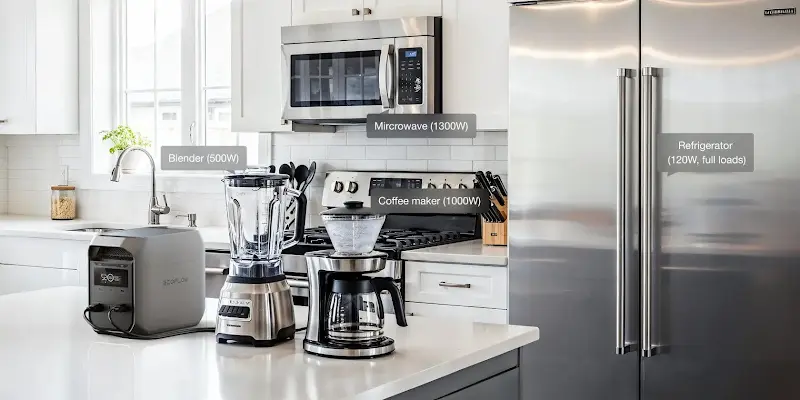
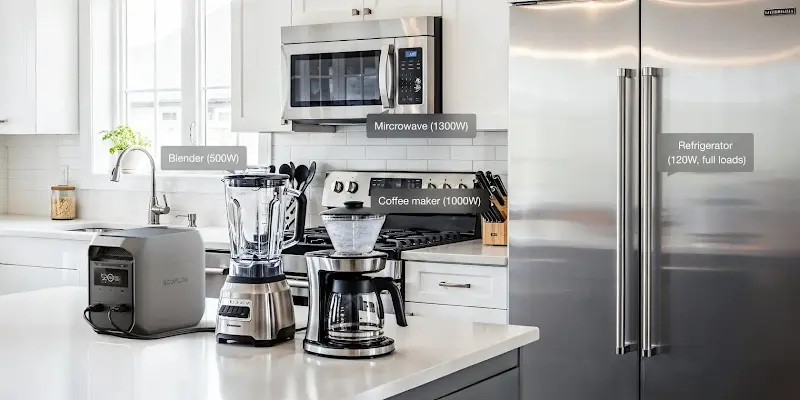
A garage door normally runs for less than a minute at a time, so a few cycles use relatively little energy compared with a refrigerator, heater, or air conditioner. That leaves most of a larger battery available for other household needs.
For longer outages, the EcoFlow DELTA Pro Portable Power Station starts with 3,600Wh of capacity. It can run the garage door intermittently while also supporting selected essentials such as a refrigerator, emergency lighting, router, and phone chargers. Runtime still depends on the combined load, so the display on the power station will give a more useful estimate once the actual devices are connected.
Compatible Power Connections
Using a power station with your garage setup is straightforward:
Direct Plug-In: Unplug the opener’s three-prong cord from the ceiling receptacle and connect it to the power station. If an extension cord is needed, use a grounded 12-gauge or 14-gauge cord rated for the load and length. Keep the power station away from the door tracks, moving hardware, rain, and standing water.
Transfer Switch / Subpanel: A power station may supply the opener circuit through properly installed transfer equipment. The switch, inlet, wiring, and power source must be compatible and installed as required by local code. Never send power into the house through an ordinary wall outlet.
The direct connection is usually simpler for occasional use. Before an outage, make sure the cord reaches and that the power station has a safe place to sit without interfering with the vehicle or door.
Conclusion
A garage door opener battery backup is mainly there to preserve access when the neighborhood loses power. Built-in systems handle that job with little effort from the homeowner, but the battery still needs occasional testing and replacement.
Start with the opener’s model number. It will tell you whether an add-on battery is supported, which replacement part fits, and what the warning lights or beeps mean. If an older AC opener cannot accept a battery, a suitably sized portable power station may run it through the existing power cord.
California homeowners have an additional requirement to consider when replacing an opener or garage door. Wherever you live, test the setup before storm season. Finding a dead battery while the car is already trapped in the garage defeats the point of having backup power.
FAQ
Why Is My Garage Door Opener with Battery Backup Beeping?
The meaning depends on the pattern and the opener model. On some Chamberlain and LiftMaster units, frequent beeping indicates that the opener is currently running on battery power. A chirp about every 30 seconds may instead point to a low or worn battery.
Check the status light and the owner’s manual before ordering a replacement. If normal power has returned, allow the battery time to recharge. Continued beeping may indicate a battery that will no longer hold a charge, a loose connection, or a problem with the charging circuit.
Can I Add a Battery Backup to My Existing Garage Door Opener?
Only if the opener was built to accept one. Look up the model number and check the manufacturer’s approved accessories. A battery with the correct voltage is not necessarily compatible with the opener’s wiring or charging system.
When an older AC-only model has no supported battery connection, the realistic choices are to replace the opener or connect its power cord to a capable portable power station during an outage.
How Do I Open My Garage Door During a Power Outage?
Close the door fully before using the emergency release whenever possible. If the door is open and a spring is broken or weak, disconnecting the opener may allow it to fall.
With the door closed, unlock any manual door lock and pull the emergency-release handle as directed in the owner’s manual. Lift the door carefully by hand. If it feels unusually heavy, will not remain in position, or moves unevenly, stop and call a garage door technician. Those signs may point to a spring or balance problem.
How Many Times Can You Open a Garage Door with a Battery Backup?
About 20 complete cycles during the first 24 hours of an outage is a common manufacturer estimate for a healthy, fully charged battery at room temperature. One cycle means opening the door and closing it again.
A heavy door, cold weather, an aging battery, or repeated use of other opener features may reduce that number. Save the remaining charge by leaving the door closed unless someone needs to enter or leave.
Do I Need to Reprogram the Garage Door Opener After Replacing the Battery?
Usually not. Remote codes, keypad settings, and travel limits are commonly stored in memory that does not disappear when the backup battery is removed.
After installing the new battery, reconnect power and test the wall control, remotes, safety sensors, and automatic reversal. Some models may need their clock, Wi-Fi connection, or app settings checked, so follow the replacement steps in the owner’s manual.
For press requests or interview opportunities, reach out to our media team
media.na@ecoflow.com