Best energy-efficient Space Heater: Types, Costs, and Real Savings
Cold weather sends a lot of people shopping for a small heater. But the label on the box doesn't always match what shows up on the power bill.
Not every space heater marketed as "energy-efficient" actually uses less electricity than a standard model. Most electric heaters turn almost all the power they draw into heat. What really changes is how that heat reaches people, and how many hours the heater runs.
That's the starting point for finding the best energy-efficient space heater. This article covers which heater types save power in practice, what a "solar" heater really means, the hourly cost to run each type, and the habits that stretch any heater's efficiency further.
Space Heater Types Ranked by Efficiency
All 1,500W electric heaters output the exact same amount of heat, regardless of marketing claims. Because efficiency is determined by how that heat is delivered rather than the heating element itself, the most efficient choice depends entirely on your room size, duration of use, and target area.
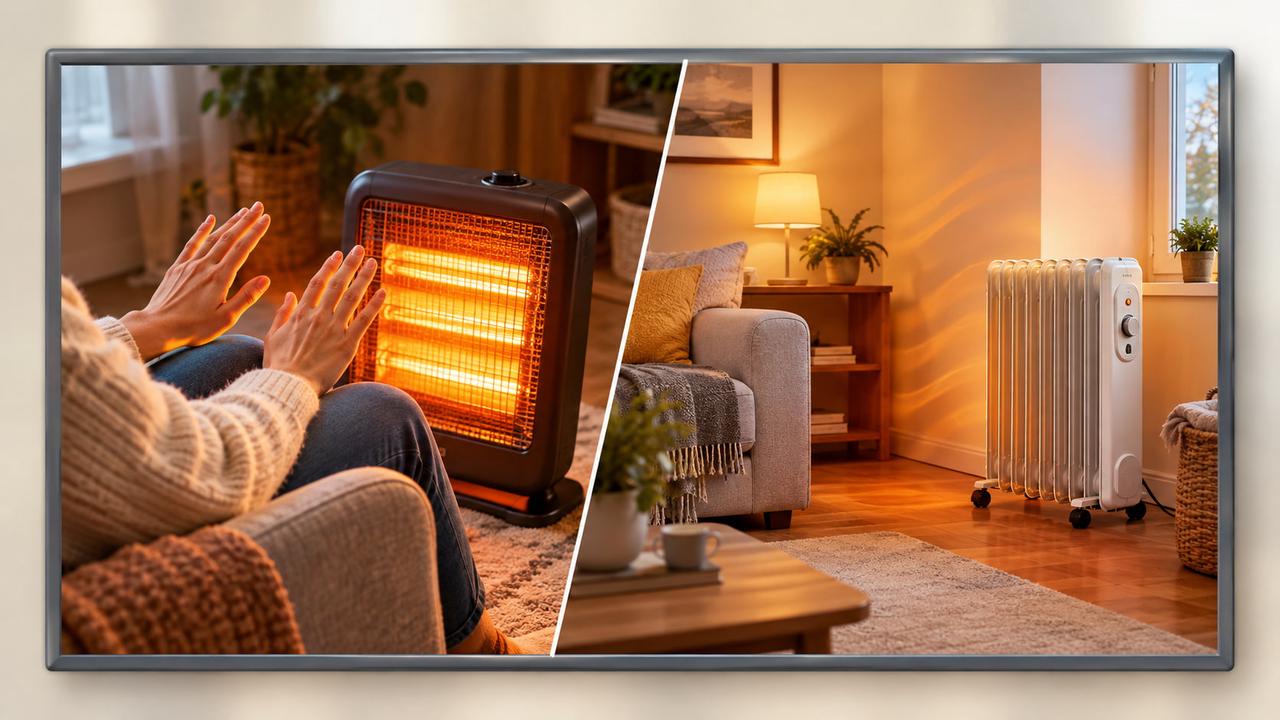
Infrared (Radiant) Heaters: Best for spot heating.
How it works: Warms people and objects directly instead of the surrounding air.
Advantages: Delivers instant comfort and minimizes heat lost to high ceilings or drafty windows.
Drawbacks: Warmth vanishes as soon as you step out of the heater's direct path.
Ceramic Heaters: Best for portability and small spaces.
How it works: Uses a heated ceramic plate and a small fan to push warm air outward.
Advantages: Heats up quickly, moves easily between rooms, and often includes energy-saving low modes (e.g., 750W).
Drawbacks: Loses efficiency in large, open spaces.
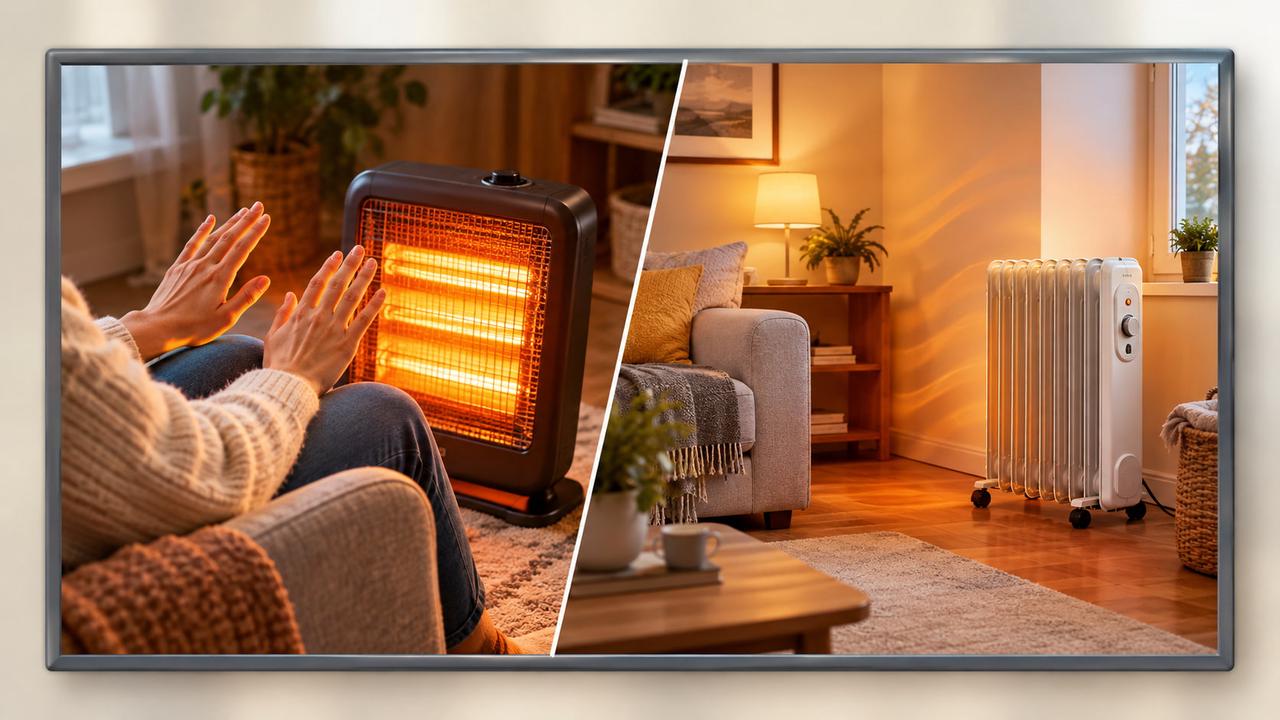
Oil-Filled Heaters: Best for prolonged, steady warmth.
How it works: An internal element warms a sealed oil reservoir, which radiates heat slowly into the room.
Advantages: Continues to release stored heat even after the power cycles off, providing gentle, even comfort for hours.
Drawbacks: Takes significantly longer to warm up, making it inefficient for quick 20-minute sessions.
Side-by-Side Comparison
Heater Type | Typical Wattage | Best For |
Infrared/radiant | 1,000-1,500W | Direct, focused warmth for one spot |
Ceramic | 750-1,500W | Portable use, moving between rooms |
Oil-filled | 1,500W (cycles down) | Longer, steady heat for a whole room |
For a desk or reading chair, the best energy-efficient space heater is often an infrared model. For a closed bedroom on a winter evening, an oil-filled unit usually makes more sense.
Some searches for an efficient heater actually mean something different: a heater powered by solar rather than the grid.
What "solar-powered Heater" Actually Means
No portable space heater runs directly on sunlight the way a solar oven does. The term covers a few different setups, and only one of them applies to most homes.
What Shoppers Usually Find
Anyone searching for a solar-powered space heater tends to land on one of two setups:
A standard electric heater plus stored solar power: Solar panels charge a battery, and the heater plugs into that battery. This is what most listings mean.
A wall-mounted solar air collector: These panels warm air and move it indoors on sunny days. They're a fixed home upgrade, not a plug-in heater, and they stop producing heat after dark.
Why the Distinction Matters
The heater's own efficiency doesn't change. A 750W ceramic heater draws 750W whether the power comes from a wall outlet or a battery. Only the source of that electricity is different.
Where the Savings Come From
A solar-charged battery system can offset a heater's draw on grid electricity. That's where the real savings come from. Panels capture energy during the day, and the battery holds it for the evening.
The size of that offset depends on panel output, winter sun hours, and local electricity rates. Short winter days limit how much a panel can collect. So the offset is usually partial, not complete.
Understanding that distinction sets up exactly where a power station fits into the picture.
Running an Efficient Heater on Stored Power
Pairing an energy-efficient space heater with a power station charged by solar panels offsets its electricity draw. There's no need for a heater built for direct solar operation. Both options below can power a typical space heater for short, intermittent warming sessions. They can also run it longer when the heater is set to a low-wattage mode (500W to 750W) and paired with daytime solar input.
Realistic Runtime Estimates
Battery capacity sets the limit. The table below assumes about 85% usable output to account for inverter losses. Actual runtime shifts with thermostat cycling, room temperature, and battery age.
Heater Setting | 1,024Wh Battery | 2,048Wh Battery |
500W | About 1.7 hours | About 3.5 hours |
750W | About 1.2 hours | About 2.3 hours |
1,500W | About 35 minutes | About 1.2 hours |
A heater with a thermostat often cycles off once the room warms up. That can stretch these numbers.
For a home office or small bedroom, the goal is usually a few focused hours of warmth, not heat around the clock. A mid-size unit covers that well, especially when the heater stays on a low setting. It can also serve as backup power when a winter storm knocks out the grid, which is often when a warm room matters most.
Larger rooms and longer evenings call for more stored energy. Doubling the capacity roughly doubles runtime at the same setting. It also gives daytime solar charging more room to refill the battery before evening.
Whatever the power source, it helps to know the real dollar cost of running a heater by wattage.
The Real Cost to Run a Space Heater
The math is simple. Divide the heater's wattage by 1,000 to get kilowatts. Then multiply by the hours of use and the local electricity rate. For example, a 1,500W heater running for one hour uses 1.5 kWh. At $0.15 per kWh, that comes to about $0.23.
Cost by Wattage
The table below uses $0.15/kWh as an example rate. Many U.S. households pay more than this, so local bills may run higher.
Wattage | Cost Per Hour (at $0.15/kWh) | Cost for 24 Hours |
750W | $0.11 | $2.70 |
1,000W | $0.15 | $3.60 |
1,500W | $0.23 | $5.40 |
Since rates vary by state and season, hourly heater costs can look very different from one home to the next.
Why Real Bills Often Come in Lower
The 24-hour column assumes the heater runs nonstop at full power. Most don't. A thermostat switches the element off once the room reaches its set temperature. That idle time pulls the real hourly average down.
Why a Bigger Heater Isn't Better
A 1,500W heater in a tiny room isn't more efficient. It just reaches temperature faster and then cycles more. In a small space, a 750W setting can often keep the room comfortable at half the hourly draw.
Beyond picking an efficient type, a few daily habits meaningfully affect the actual cost.
Efficient Usage Habits That Actually Help
Heat only occupied rooms: Turn the heater off when leaving, rather than leaving it running in an empty space. Warming a room nobody is using is one of the quickest ways to waste power.
Keep the area around the heater clear: Warm air needs space to circulate instead of getting trapped near the unit. Furniture, curtains, and laundry piles block that flow and raise fire risk. The U.S. Consumer Product Safety Commission (CPSC) advises keeping heaters at least three feet away from anything flammable.
Use a built-in timer or thermostat: This avoids running the heater continuously overnight. A timer can shut it off shortly after bedtime, once the room has warmed.
Close doors and block drafts: A space heater works best in a contained area. Weatherstripping or a draft stopper helps hold warm air in place.
Measured against whole-home heating, space heater electricity use stays more manageable with these habits in place. Warming one room simply takes less energy than warming an entire house.


Conclusion
Infrared and ceramic heaters generally offer the best efficiency for spot heating. Oil-filled models suit longer, steady warmth in a closed room. And a "solar" heater, in most listings, is simply a standard electric heater running on stored solar power rather than the grid.
In the end, the best energy-efficient space heater comes down to fit. An infrared or ceramic unit handles targeted spot heating well. Pairing it with solar-charged battery storage is where the real energy savings come in. Good habits then trim the cost even further.
For homes looking to shift some heating off the grid, the EcoFlow DELTA 3 Classic and EcoFlow DELTA 3 Max both run a space heater on stored, solar-rechargeable power instead of drawing directly from the grid.
FAQs
What type of space heater is the most energy-efficient?
All electric heaters turn nearly all their power into heat, so no type has a big edge at the element. For spot heating, infrared heaters tend to perform best because they warm people directly. For a closed room, oil-filled heaters hold heat well and cycle less often.
Is there such a thing as a heater that runs directly on solar power?
Not in the portable, plug-in sense. Wall-mounted solar air collectors can warm indoor air on sunny days, but they're built into the home. Most "solar" heaters are standard electric heaters running on a battery charged by solar panels.
How much does it cost to run a space heater overnight?
At $0.15 per kWh, a 1,500W heater running nonstop for eight hours costs about $1.80. A 750W setting cuts that to about $0.90. Safety guidance also advises turning heaters off before going to sleep.
Are ceramic heaters cheaper to run than infrared heaters?
At the same wattage, both cost the same per hour. An infrared heater may keep one person comfortable on a lower setting, while a ceramic heater may need longer to warm the air around them.
Can a portable power station run a space heater all night?
Usually not at full power. Eight hours at 750W needs about 6 kWh, plus inverter losses. That's more than most single units hold. A lower setting, thermostat cycling, or expanded battery capacity can extend runtime, but a heater still shouldn't run unattended.
For press requests or interview opportunities, reach out to our media team
media.na@ecoflow.com