Does a Gas Stove Work Without Electricity? Ovens, Burners, and Outage Tips
The power drops during a storm, dinner is half prepped, and you head for the gas range thinking you are covered. Then you turn the oven knob, and nothing happens, even though the burners light up fine. That gap catches many homeowners off guard. Most gas cooktops can be lit by hand during an outage, but most modern gas ovens will not run at all. Here is what to know about why ovens need power, how to light burners safely, your backup cooking options, and how to stay safe around gas.
Will a Gas Oven Work Without Electricity?
Most modern gas ovens need electricity to run, even though the heat comes from gas. Their igniters and safety valves depend on power, so the oven stays dead when the grid does. Every winter storm sends people searching: will a gas oven work without electricity, and for most kitchens the answer is no.
What you own matters more than the brand on the door. These four setups cover almost every US kitchen.
Appliance Type | Works in an Outage? | Why |
Gas cooktop with electronic ignition | Usually yes, if lit by hand | Power only creates the spark, so a match or long lighter does the same job |
Gas oven with a glow-bar igniter | Usually no | The igniter must heat up electrically before the safety valve releases gas |
Older range with a standing pilot light | Usually yes | A small flame burns continuously, so nothing needs power to get it started |
Dual-fuel range (gas top, electric oven) | Burners yes, oven no | The cooktop runs on gas, while the oven is fully electric |
Not sure which row you fall into? Look at the control panel, since a digital clock and touch pad almost always mean a glow-bar igniter underneath. It also helps to know how much electricity an oven uses normally, because that shapes how much backup power you need.
Why Most Gas Ovens Need Power
A glow-bar igniter is a ceramic bar that heats until it glows orange, and the gas valve stays shut until it draws the right current. That sequence is deliberate because it keeps raw gas from filling a cold oven with nothing there to burn it off.
So if you are wondering if your gas oven works without electricity in any form, the igniter settles it. No power means no glow, no open valve, and no gas at the burner. Digital controls, clocks, and convection fans draw current of their own.
The cooktop plays by different rules, and that is the good news during an outage. Those burners are far simpler than the oven below them.
Does a Gas Stove Work Without Electricity?
Most gas cooktops use electricity for one job: making the spark that lights the burner. Take the spark away and gas still flows when you turn the knob, so a match or long lighter does the job. That is why the answer to will a gas stove work without electricity is usually yes.
So does a gas stove need electricity at all? It needs power for the spark, the clock, and the controls, but not for the flame itself. That explains why the cooktop and oven behave so differently.
Check your owner's manual first, since a few newer ranges use electronic valves that stay closed without power. If you are in a dark kitchen asking will my gas stove work without electricity, that booklet answers it fastest. Ask around the block after a storm and you hear the same question twice: do gas stoves work without electricity, and what about the oven?
How to Light a Gas Burner by Hand
Hand lighting is straightforward, but order matters. Get the flame to the burner before you open the gas, never the other way around.
Check your owner's manual to confirm hand lighting is approved for your model.
Hold a long lighter or lit match next to the burner head before touching the knob.
Turn the knob to the light position and keep the flame close until it catches.
Adjust the flame down to the size you need once the ring burns evenly.
If it does not light in a few seconds, shut the knob off and let the gas clear.
If you smell gas at any point, do not light anything. Leave the house, get well away from the building, and call your gas company or 911 from outside. A light switch or a phone indoors is exactly the spark you want to avoid.
A working cooktop changes what is realistic to put on the table. EcoFlow's guide to cooking a holiday meal without power covers how to rework a menu when the oven is out.
Backup Cooking Options During an Outage
If your oven will not work, you still have choices, and some are better than others. Backup power opens the widest range, since it lets you use appliances you already own.
Outdoor grills and camp stoves are the simplest fallback, and they belong outside and nowhere else. All of them give off carbon monoxide, so an open garage door does not make a garage safe. Set them on the driveway or in the yard, away from windows and doors.


Fuel-burning generators raise the same siting questions, plus fuel storage and noise. Batteries skip the exhaust problem but hold a fixed amount of energy, so runtime depends on what you plug in. A look at home battery vs propane generator setups helps here.
Keeping Your Kitchen Powered
Backup power changes the question from what can I cook to what do I want to cook. A whole-home battery runs the oven igniter, the control board, the refrigerator, and the lights as though the outage never happened. For households that lose power several times a year, that is the difference between a disrupted week and an ordinary one.
Sizing is where this gets practical. Whole-home coverage means carrying your heaviest circuits, not a couple of countertop appliances, so capacity and output both need headroom.
Not every household needs that much. If your goal is a microwave, a coffee maker, or one induction burner rather than the whole house, a portable unit around 2 kWh handles it. Renters and apartment dwellers usually land here, since nothing gets wired into the panel.
Gas Appliance Safety During a Power Outage
Gas appliances turn dangerous when people use them for jobs they were never built to do. Carbon monoxide is the biggest risk during an outage, and it is dangerous because you cannot see or smell it. The CDC's carbon monoxide guidance notes that CO shows up in fumes from stoves, grills, fireplaces, gas ranges, and furnaces.

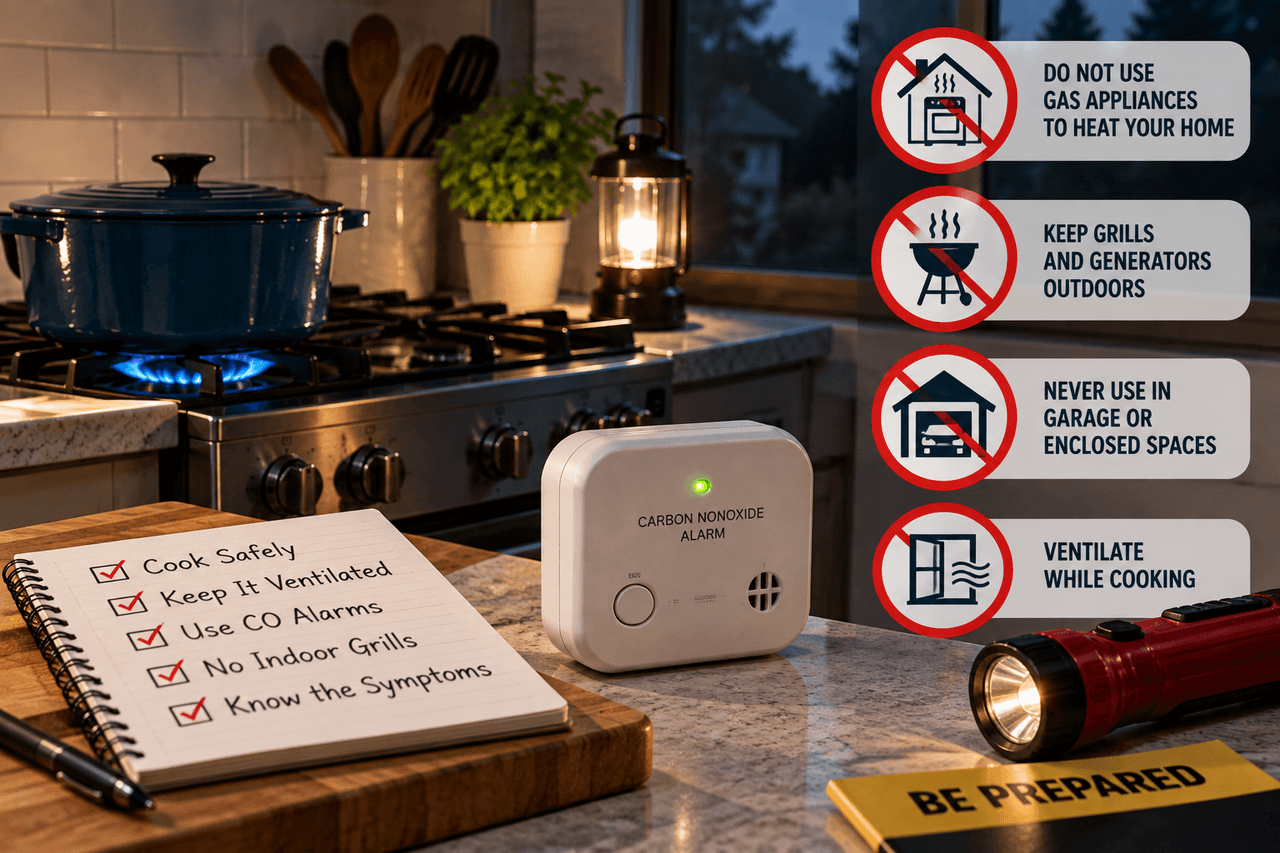
Keep these rules in mind whenever the power is out and the gas is on. Each addresses a mistake that sends people to the emergency room every winter.
Never use a gas oven or stove to heat your home.
Crack a window when you cook on gas for a long stretch.
Install battery-powered CO alarms on every level of the home and outside sleeping areas.
Never run a grill, camp stove, or generator indoors or in an attached garage.
Learn the signs of CO poisoning: headache, dizziness, weakness, nausea, chest pain, and confusion.
That alarm point deserves a second look, since a plug-in unit is useless during the hours you need it. CPSC's carbon monoxide fact sheet is blunt about heating too, warning against gas ranges, ovens, or dryers to warm a house.
Open flames deserve the same attention in a dark kitchen. Cooking is the leading cause of home fires nationwide, according to the U.S. Fire Administration, and candlelight makes it easy to walk away from a lit burner.
Keeping Food Safe
An outage puts your refrigerator on a clock, and it runs fast only if you keep opening the door. The FoodSafety.gov outage chart says a closed refrigerator keeps food safe for about 4 hours, and perishables held above 40°F for more than 2 hours should go in the trash.
Plan your cooking around that window rather than fighting it. Use refrigerated food first, keep the freezer sealed, save shelf-stable items for day two, and see how long food lasts without power in both compartments.
Conclusion
Most gas cooktops can be lit by hand when the power goes out, but most modern gas ovens will not, since their igniters and valves need electricity. Check your manual before a storm, keep a long lighter where you can find it in the dark, and never heat your home with a stove. If outages are routine where you live, backup power from the EcoFlow DELTA Pro Ultra X or EcoFlow DELTA 3 Max puts the kitchen back in play.
FAQs
Will a gas oven work without electricity?
Usually not. Nearly every gas oven built in recent decades uses a glow-bar igniter, and the valve stays closed until that igniter heats on electric current. Ranges with a standing pilot light are the exception.
Can I light my gas stove with a match during a power outage?
Most of the time, yes. Hold a long lighter or lit match next to the burner head first, then turn the knob to the light position. If it does not catch quickly, shut the knob off and let the gas clear.
Do gas stoves need electricity?
Only for the spark. The burners run on gas, so power handles the igniter, the clock, and the controls rather than the flame. That is why the cooktop usually survives an outage while the oven does not.
Is it safe to use a gas stove during a power outage?
It can be, as long as you use it only for cooking and keep the air moving. Crack a window, run the burner no longer than needed, and keep a battery-powered CO alarm working nearby.
Why won't my gas oven turn on when the power is out?
Because the safety system is doing its job. The glow-bar igniter must reach operating temperature before the gas valve opens, and it cannot heat without power. The control board is dead for the same reason.
Can I use my gas oven to heat my house?
No, and this is the rule worth repeating. Both the CDC and the Consumer Product Safety Commission warn against heating a home with a gas oven because of carbon monoxide buildup. Use blankets, close off unused rooms, or find a warming center.
For press requests or interview opportunities, reach out to our media team
media.na@ecoflow.com