Standby Generator Maintenance: The Full Checklist to Keep Your Backup Power Ready
Peer-reviewed research in Applied Energy found that a poorly maintained standby generator has a 50% chance of failing within 48 hours of continuous operation. A well-maintained unit fails only 20% of the time over two weeks of continuous runtime — the typical span of a major outage, when backup power matters most. Keeping a home standby generator running comes down to regular maintenance: knowing its mechanical service requirements are and monitoring its components.
This guide covers the maintenance realities of standby generators, how fuel type affects service intervals, a zero-maintenance battery-backup alternative, a frequency-based checklist, the financial risks of neglect, and warning signs to watch for.
What "Standby Generator Maintenance" Actually Covers
.JPEG)
.JPEG)
Standby generators are fundamentally different from portable generators. A standby generator is permanently installed outdoors on a concrete pad and connects to your home's electrical service panel through an automatic transfer switch (ATS). When utility power fails, the ATS detects the loss, signals the engine to start, and automatically transfers the electrical load in seconds. These are outside units that run year-round under automatic control and need much more extensive maintenance than a portable unit. Portable generators are kept inside and brought out manually in an emergency and serviced on a simple, seasonal schedule.
Maintenance requirements also depend on what type of fuel powers the engine:
Gasoline Systems: Need regular fuel stabilization to prevent varnish buildup and ethanol breakdown in carbureted engines, and frequent oil monitoring due to high operating temperatures.
Diesel Systems: Diesel systems require regular fuel polishing, biocide treatments to prevent algae growth in the storage tank, and regular drainage of the water separator to protect the high-pressure fuel injectors.
Natural Gas / Liquid Propane (LP) Systems: There is no longer any worry about liquid fuel degradation, but accurate checks of the gas pressure regulator, fuel line leak testing, and regular inspection of the spark plug are required.
If you're here for backup power tips but actually have a temporary, manually deployed unit, see How to Use a Portable Generator During a Power Outage for step-by-step operational and safety tips.
The Maintenance-Free Alternative: Battery-Based Home Backup
Battery power stations do not have the mechanical wear points of a fuel-based generator. A whole-home battery backup system has no engine oil to change, no spark plugs or air filters to replace, no exhaust system to monitor, no liquid fuel to stabilize, and no annual service contract to maintain.
The Standby Generator Maintenance Checklist, by Frequency
Standby generators are powered by an internal combustion engine that must be kept ready to start at a moment's notice. The single most effective way to avoid mid-outage mechanical failures is to follow a structured maintenance schedule, since these units sit idle for long periods and are suddenly called into high-demand emergency use.
Frequency | Service Tasks |
|---|---|
Weekly | • Perimeter walk: inspect for leaks, rust, or loose wires. • Remove leaves or snow and surrounding debris for at least 5 feet. • Adhere to the 5-20 min self-exercise cycle (automated). • Verify the control panel shows "Ready" status with no fault codes. |
Monthly | • Test manually under energized load. • Check for fluid leaks and corrosion, and verify "Auto" mode. |
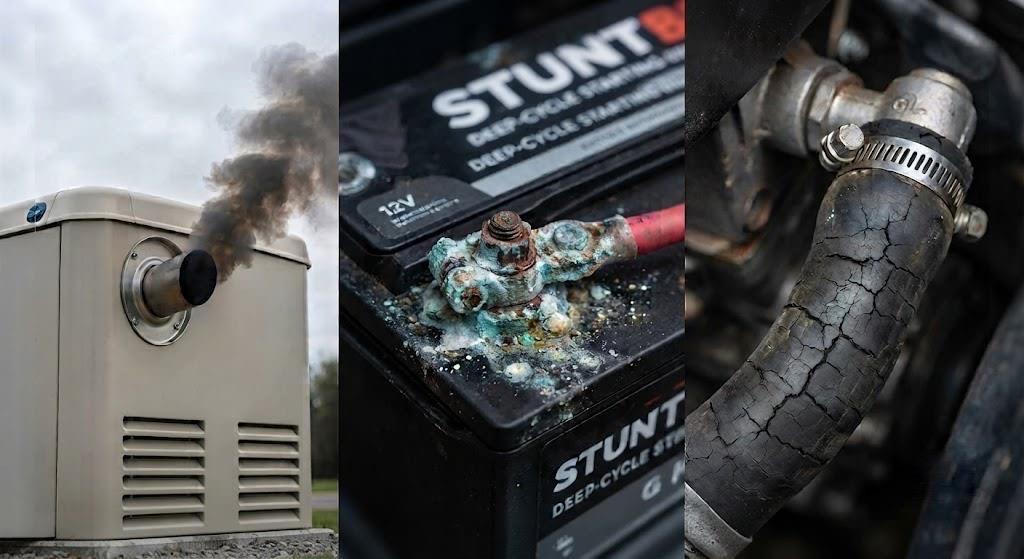
Every 6 Months | • Check air filter element. Replace as required following the storm season. • Clean the battery terminal, tighten the connections and test the voltage. • Check coolant level and rubber hoses (liquid-cooled models). |
Annually | • Change engine oil, oil filter, and fuel filter. • Schedule a professional load bank test and diagnostic. • Test automatic transfer switch for switch-over operation. |
Weekly Maintenance: Walk around the outside of the enclosure and clear away any leaves, snow or debris that might be covering intake vents. You want to maintain a 5 foot clearance around the enclosure for ventilation and fire safety. Verify that the automatic 5 to 20 minute exercise cycle is operating correctly. Listen to weird noises or delays. Verify that the control panel reads Ready and that no fault codes are present.
Monthly Maintenance: Test the voltage regulator and the automatic transfer switch by operating the generator under an active electrical load for 15–30 minutes. Check the cabinet for any fluid leaks. Check the battery case for damage. Ensure the control switch is in the Auto position.
Semi-Annual Inspections: Inspect the air filter and replace it if dirty. Clean the battery terminals, tighten the connections, and use a multimeter to check that the open-circuit voltage is between 12.6V and 13.8V. Check radiator coolant levels on liquid-cooled units and hoses for cracks or soft spots.
Annual Maintenance: Complete engine service including change of crankcase oil, replacement of oil and fuel filter, and fitting of new spark plugs. Have a certified technician perform a load bank test to burn off any unburned fuel deposits and to verify maximum output capacity. Check that the automatic transfer switch is operating correctly.
What Skipping Maintenance Actually Costs
Failure to perform routine maintenance on standby generators can lead to serious financial risks, equipment failure and extensive property damage. Generator parts that are exposed to the elements all year round and not maintained will deteriorate rapidly, even if they are not in use.
Predictable Servicing vs. Emergency Repair Costs: Basic consumables such as oil, filters, and spark plugs, for the annual preventative maintenance require a small, predictable budget. However, emergency calls for storm-time service carry long waits and heavy labor surcharges. In addition to mechanical repairs, a long blackout can mean thousands of dollars in secondary damage such as frozen pipes, flooded basements, and spoiled food.
Warranty Denial and Voided Coverage: Warranty claims are honored by major manufacturers only with documented maintenance records. Manufacturers have grounds to deny claims if an engine or alternator fails due to neglected oil, clogged filters, or low coolant. A lack of service history leaves owners with $2,000+ in replacement costs.
Higher Failure Rates During Outages: Data show that unmaintained generators fail at much higher rates during extended power outages. A unit may be able to pass a short unloaded weekly self-test but fail within hours of continuous heavy operation due to oxidized fuel, degraded oil viscosity or a weak starter battery.
Warning Signs You Shouldn't Ignore
If you see the early warning signs, you can prevent a total system failure during extreme weather events.
Failure to Start or Delayed Cranking: If a generator cranks slowly or fails to crank during its exercise cycle, it usually indicates a bad 12V battery. Other causes include dirty fuel injectors, bad spark plugs, or low oil pressure, which can trigger control panel fault codes.
Engine Overheating: The system has thermal sensors that shut down the engine block if it overheats to protect the engine block. Check the radiator screen for debris or pest nests. If the coolant level is low, or the water-pump belt breaks, liquid-cooled models overheat rapidly.
Power Surges and Voltage Fluctuations: If you notice the lights flickering or appliances surging, it is a sign that your engine is running at inconsistent RPMs or that there is something wrong with the electrical output. This is typically due to dirty fuel injectors, unbalanced loads on the split-phase circuit, or a failing automatic voltage regulator (AVR).
Unusual Noise, Smoke, or Odors:
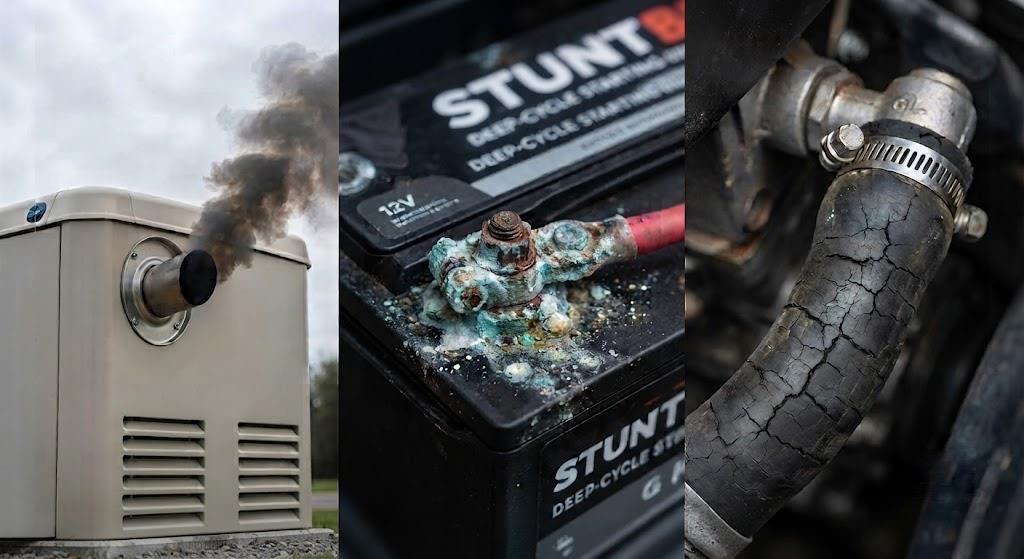
Black Smoke: Too rich fuel mixture, clogged air filter, or stuck choke valve.
Blue/White Smoke: The engine is burning oil due to worn piston rings or worn valve seals.
High-Pitched Squealing: Indicates a loose, out-of-alignment, or worn drive belt.
Burning Electrical Odor: It indicates short-circuited wiring or stator winding overheating.
If your system's warning signs trace back to an undersized or overloaded unit, review the Generator Sizing Guide: Survive Hurricane Power Outages to verify your electrical capacity requirements.
DIY vs. Calling a Professional
Home standby generator maintenance requires simple hands-on work as well as intricate electrical and mechanical servicing. It is important to know what you can safely do yourself and what should be left to a professional, both for your own safety and for the safety of your home's electrical system and equipment.
Homeowner-Safe Tasks:
Weekly Visual Checks: Walk the perimeter, check cabinet seals, clear surrounding debris within a 5-foot radius, check for visible fluid leaks.
Exercise Cycle Monitoring: Listen to abnormal noises during the automated weekly self-test and verify that the control panel indicates a Ready status and no fault codes.
Basic Battery Care: Clean surface corrosion from 12V starter battery terminals with a brush and keep cable connections tight.
Tasks for Licensed Technicians:
Load Bank Testing: Applying simulated electrical loads to test engine horsepower and alternator output at full capacity.
Transfer Switch Servicing: Working in the high-voltage automatic transfer switch panel, inspecting contactors, measuring switchover speed, and testing mechanical interlocks.
Fuel System Calibration: Tuning gas carburetors, bleeding diesel injection lines, or adjusting natural gas regulators.
Full Annual Diagnostics: Engine Compression Tests, AVR Output Tolerances, Electronic Fault Diagnostics.
Operating a portable generator during severe weather requires strict safety protocols to prevent shock, damage, and carbon monoxide poisoning. Before powering up, review the 4 Steps to Safely Using Your Generator in a Storm to prepare for heavy winds and moisture.
Conclusion
Having a home standby generator requires ongoing maintenance, including weekly visual checks and annual professional diagnostics. Neglecting maintenance reduces reliability, risks voiding your warranty, and drastically increases the chances of failure during a blackout. You keep your power ready for severe weather by following a structured maintenance checklist, looking for early warning signs, and knowing when to call a certified technician.
For homeowners seeking a zero-maintenance alternative that eliminates the hassle of oil changes, fuel degradation, exhaust risks, and annual service contracts, battery systems provide reliable whole-home backup. Explore whole-home energy solutions with the EcoFlow DELTA Pro Ultra X and EcoFlow DELTA Pro 3.
FAQs
How often should a standby generator be serviced?
A standby generator needs visual inspections weekly, monthly functional load testing monthly, and a full professional service every 12 months or every 100-200 operating hours.
What happens if I don't maintain my standby generator?
If standby generators are not maintained, they are much more likely to fail when weekly there is a real outage, void the manufacturer's warranty, and you could be paying big bucks for emergency replacement parts.
Can I do standby generator maintenance myself?
Homeowners can safely perform basic visual checks, clear debris, and perform terminal cleaning. A licensed professional is required to perform annual load bank testing, transfer switch maintenance, and electrical diagnostics inside the unit.
How long do standby generators last with proper maintenance?
A standard standby generator should last 1,500 to 3,000 operating hours, or 20 to 30 years, with regular routine maintenance and timely professional servicing.
Does a battery backup system require any maintenance at all?
Battery backup systems require no oil, fuel, spark plugs, or exhaust maintenance. Upkeep includes routine firmware updates, keeping vent paths clean, and monitoring battery health via the mobile app.
For press requests or interview opportunities, reach out to our media team
media.na@ecoflow.com