Powering a Tiny Home With a Portable Solar Generator: What To Know
Compared to a traditional house, a tiny home is substantially smaller—hence the name. In a conventional home, you can connect to the power grid, but that’s not always an option with a tiny home. You need to come up with smart ways to power the lights, appliances, heating, cooling, and other electronics.
There are plenty of options to choose from for supplying power to a tiny home, but which one is the best? Here’s everything you need to know to pick an effective power solution and how it works. And, find out how much power your tiny home actually needs.
Why Tiny Homes Need a Smarter Power Setup
Tiny homes are often on the move and off-grid, making traditional grid electrical connections difficult. There are several alternative electricity generation options, but the smartest one is a portable solar system.
Like any home, the benefits of solar energy include a lowered carbon footprint, lower electricity bills, and complete power resilience. The guarantee of solar electricity isn't just sustainable, but a smart power decision for your tiny home. You won’t have to worry about finding power sources when choosing a parking location or making frequent stops for charging stations.
Core Components of a Portable Solar System
There are three core components of a portable solar system:
Solar Panels: Solar panels are devices that convert sunlight into electricity. You need these to collect sunlight during the day. They can be mounted to the roof, so you don't have to think about moving them when it’s time to recharge the tiny home. Or, you can use portable ones if roof-mounting isn’t practical for your setup.
Batteries: Since the panels can only collect sunlight when the sun is shining, it’s a smart idea to store excess electricity generated for later use. It’s easy to connect whole-home backup batteries with enough storage capacity for the entire tiny home.
Inverter: The initial electricity generated by a solar panel is DC. This can be easily stored in the batteries, but it needs to be converted to AC. An inverter connects between the battery and the tiny home’s electrical system to convert DC into AC.
With an EcoFlow solar generator, the inverter is built into the battery, so you just need to connect the solar panels to the battery.
Sizing Your System: Match Power to Your Daily Use
Finding the right solar generator depends mainly on the amount of electricity required to power all the necessary appliances and electronics. But you don’t want to get a unit that’s too big. The goal is to match the generator size to daily use, with a little extra margin.
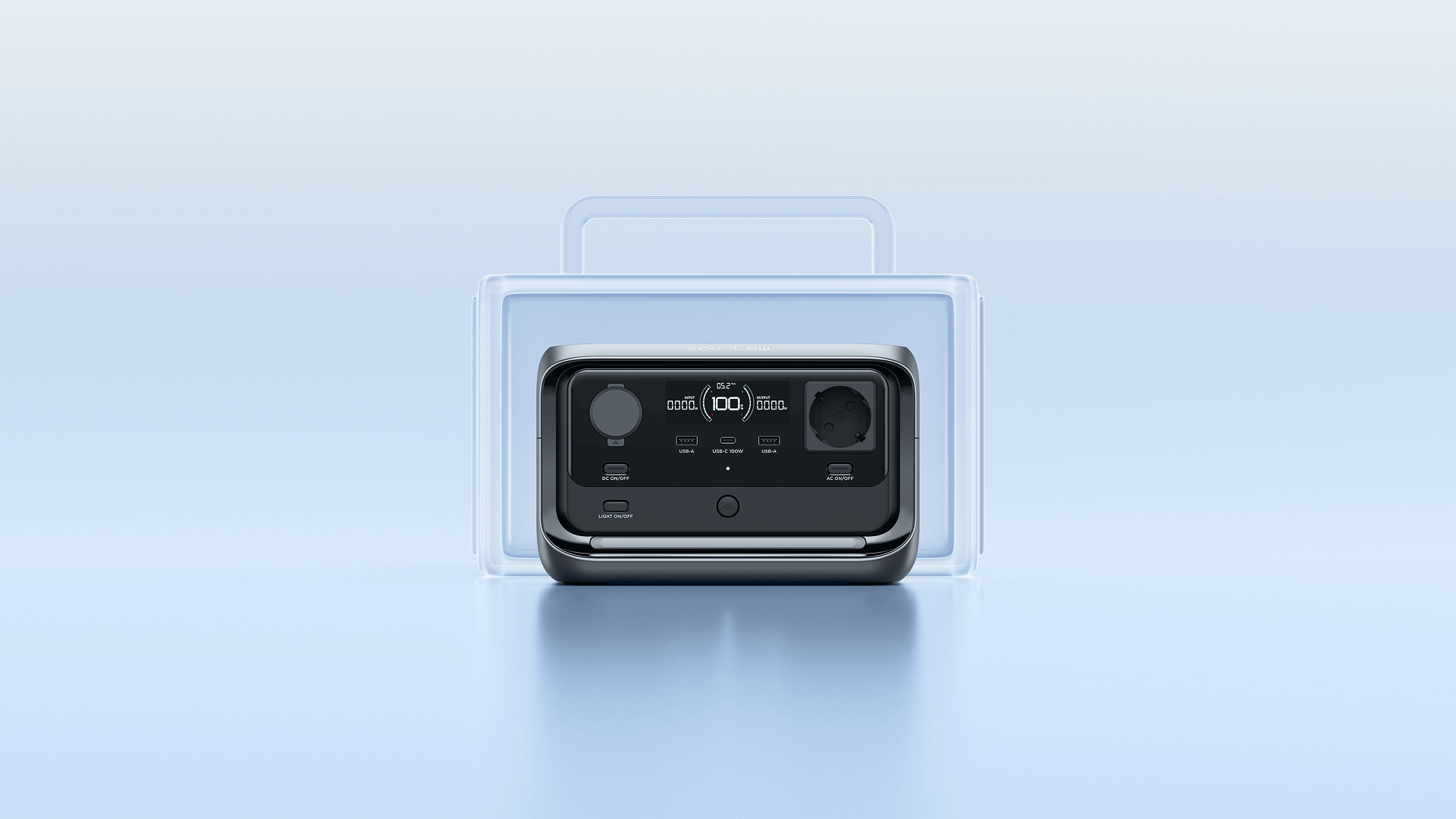
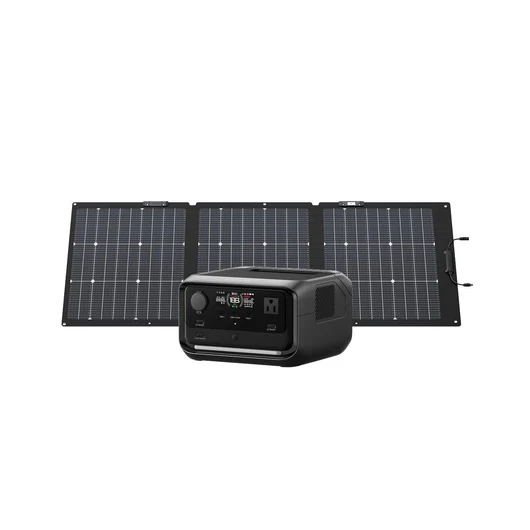
Small, stackable, and expandable units like the EcoFlow RIVER 3 Plus + 160W Solar Panel are clever power options for tiny homes. You can connect battery stations for increased storage capacity for customizable systems.
Calculate the storage capacity your tiny home needs by summing the wattage requirements of each appliance and the duration for which you need to power them.
Appliance Wattage: What You Can Power and for How Long
What you can power and for how long depends on the storage capacity of the solar generator. This metric is expressed in watt-hours (Wh), which represents the amount of wattage the device can provide in one hour before it is empty.
For example, the EcoFlow RIVER 3 Max Plus + 220W Solar Panel has a capacity of 286Wh (expandable up to 858Wh). An appliance that requires 50W to run would last for approximately 5 hours with this solar generator, calculated by dividing 286Wh by 50W, which equals 5.72 hours.
When deciding the size you need, rearrange this equation to solve for Wh. It’s no surprise that different appliances have varying power requirements. Here’s a rough idea of the general wattage requirements of essential appliances and an estimated time of use to get you started:
Refrigerator and freezer: 100-1200W, 24 hrs/day
Lighting: 100-300W, 8 hrs/day
Laptop: 30-100W, 1-2 hrs/day
Microwave: 600-1,000W, 1 hr/day
Electric stove and oven: 3,000-8,000W, 1-2 hrs/day
Water pump: 60-2,000W, 8 hrs/day
Phone charging: 5-20W, 2 hrs/day
Portable AC system: 500-2,000W, 8 hrs/day
Your energy needs and appliance wattage may differ from those listed above, but this can serve as a rough estimate. You should also plan for a wattage spike, which can occur when appliances with compressors or motors start.
Frequently Asked Questions
Can a Solar Generator Power a Tiny House?
Yes, a solar generator can power a tiny house, but keep the battery capacity in mind. The generator must have enough storage capacity to support the home’s energy use and appliances. Many people use these generators to successfully and reliably power their tiny house.
How Much Solar Power Does a Tiny Home Need?
The amount of solar power a tiny home requires depends on what it is powering. Each tiny house is unique, and so are the people living in it. On average, daily energy use ranges from 1-8kWh, but this should be calculated for more accurate numbers.
What Is the Cheapest Way to Power a Tiny House?
The most cost-effective method for powering a tiny house is typically through a solar generator, which combines a solar panel, a battery system, and an inverter. Essential appliances and electronics can be powered by solar energy during the day, and excess electricity is stored in the battery system.
Portable Solar Generators Empower Tiny Home Living
When living in a tiny home, you must maximize and optimize every component, including power sources. A smart power solution for tiny homes is a solar generator. Relying on solar energy enables fully off-grid living, offering the freedom to go wherever desired.
Solar generators comprise solar panels, batteries, and an inverter, enabling the harvesting of solar energy and the generation of electricity. The size of the solar generator you need for your tiny home will depend on the appliances being powered and how long they will be in use. With a wide range of sizes and storage capacities, there’s a power solution perfect for your tiny home, like the EcoFlow RIVER 3 Max Plus + 220W Solar Panel.
For press requests or interview opportunities, reach out to our media team
media.na@ecoflow.com