Joules to Watts Conversion: The Simple Formula for Energy Vs Power
- Energy vs Power: Why Joules and Watts Get Confused
- The Simple Relationship: Joules, Seconds, and Watts
- Joules to Watts Conversion Formula With Clear Examples
- Joules to Watt-Hours: The Conversion You’ll Use for Batteries
- Using Conversions to Size Portable Power for Home, Work, and Outdoors
- Frequently Asked Questions
- Master Energy Math, Improve Planning, and Choose the Right Power Solution
Joules and watts both appear on appliance labels, battery specs, and solar equipment, so they constantly get mixed up. But they measure two different things, and this distinction matters for practical power decisions, like sizing a battery, choosing a generator, or comparing heating systems.
Energy vs Power: Why Joules and Watts Get Confused
Joules (J) are the SI unit of energy in the International System of Units. It measures the total work done or heat transferred.
W (watt) is the SI unit of power, which measures the rate at which energy is used or transferred, defined as one joule per second. The EcoFlow DELTA Pro Ultra X, for example, delivers up to 12 kW of continuous power, a figure expressed in watts.
They're commonly confused because both units appear on energy products, but they describe fundamentally different things. Think of it this way: joules measure the total water in a tank, and watts measure how fast it drains through the pipeline.
The Simple Relationship: Joules, Seconds, and Watts
The core relationship between joules and watts is that one watt equals one joule per second. Time is the key linking variable, because the same amount of energy can produce different watts depending on how quickly it's released.
For example, 500 J released over five seconds is 100W, and the same 500 J released over 10 seconds is only 50W.
The horsepower-to-watts conversion follows the same power unit logic. One mechanical horsepower equals 745.7 W, measuring a rate of energy delivery.
Understanding that watts represent a rate of energy transfer, not a quantity of energy, allows you to read any power spec confidently.
Joules to Watts Conversion Formula With Clear Examples
The formula for converting joules to watts is:
W = J / seconds
You can also reverse the formula to find Joules:
J = W x seconds
Say a device expends 1,200 J in 60 seconds. 1,200 divided by 60 equals 20 watts. In reverse, a 100W appliance running for 30 seconds consumes 3,000 J.
When factoring in time, always use seconds. When using W = J/s, time must be expressed in seconds. If you're working in minutes or hours, convert them first. Time is critical because, without a time value, the conversion is mathematically impossible.
Joules to Watt-Hours: The Conversion You’ll Use for Batteries
A watt-hour is the practical unit for battery capacity. A watt-hour equals 3,600 joules because one watt is one joule per second and one hour contains 3,600 seconds.
The formula is:
Wh = J / 3600. You divide the total J by the number of seconds in an hour.
Most small batteries or appliances are in the watt-hour range, though something much larger, like a whole home generator, operates in the kWh range, which is simply kilowatt-hours, measuring 1,000 watt-hours each.
Example:
18,000 J / 3,600 = 5Wh, roughly the capacity of a very small device battery.
A home battery like the EcoFlow DELTA Pro Ultra X stores 12 kWh (43,200,000 J) — context that makes the watt-hour scale tangible when you're working through these conversions.
For energy billing and comparing batteries, Wh and kWh are the operative units. Joules are simply the physics foundation beneath them.
Using Conversions to Size Portable Power for Home, Work, and Outdoors
When sizing portable power for your home, first you'll need to determine the device's wattage or power draw, and then multiply it by the intended runtime in hours. The result you'll get is the Wh capacity that you need from a battery.
So, a 50W device that runs for 8 hours needs at least 400Wh of battery capacity before accounting for efficiency losses.
DC-to-AC conversion efficiency is important here. Sine wave inverters typically operate at a 75–95% efficiency rate, so your real-world capacity will need to be higher than the raw kWh that the math suggests.
For outdoor and work applications with variable loads, like tools or compressors, consider calculating the peak wattage draw separately from its average draw, because surge wattage at startup can be two to three times the continuous rating.
If you're sizing backup power for HVAC, you'll also want to calculate BTU from watts when sizing your backup solution. One watt equals about 3.412 BTU/hr. So a 1,500 W space heater will produce roughly 5,118 BTU/hr. This figure will help you match your heater output to room size and battery capacity.
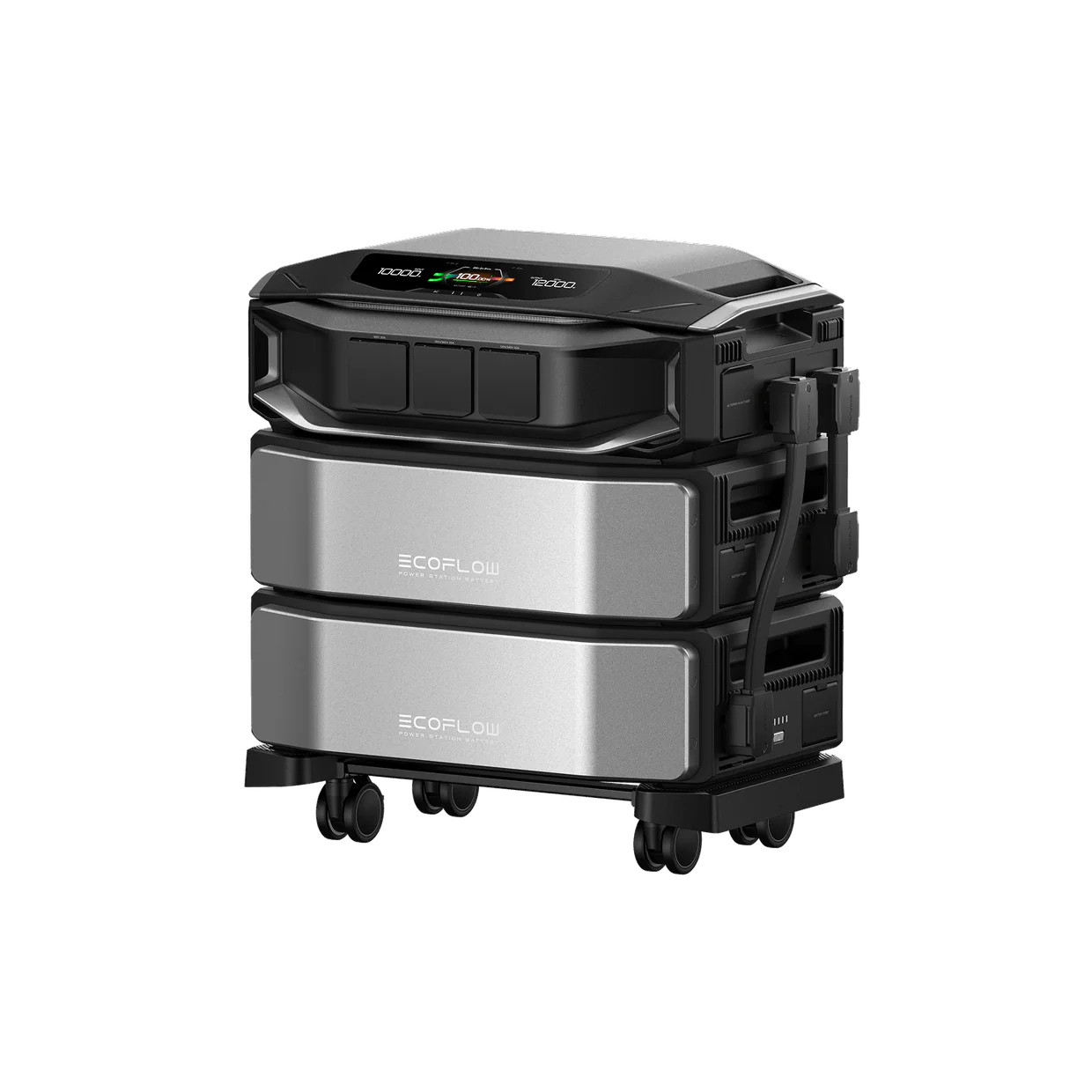
For sizing backup power across high-draw circuits, the EcoFlow DELTA Pro Ultra X starts at 12 kWh capacity and offers 12 kW continuous output. It can support high-draw circuits like HVAC and EV charging and can even scale to 180 kWh with expansion batteries.
Frequently Asked Questions
What Is the Formula to Convert Joules to Watts?
The formula is W = J/seconds. Divide the energy in joules by the time in seconds to get the power in watts. Without a time value, you can't complete the conversion, because joules measure total energy, and watts measure rate.
How Do You Convert Joules to Watt-hours?
To convert joules to watt-hours, divide joules by 3,600, the number of seconds in an hour. The formula is Wh = J /3,600. Wh is the practical battery unit, and joules are the physics units. They're the same quantity at a different scale.
Can Watts and Joules Be Used Interchangeably?
Watts and joules cannot be used interchangeably because watts measure power, and joules measure energy. Watts require a time variable, and joules cannot be converted to watts without time. If you interchange them, you'll create planning errors, which can lead to incorrect sizing.
How Precise Does the Time Measurement Need to Be for Accurate Watts?
For most practical applications like battery planning or appliance sizing, you can round to the nearest second. Precision matters more in surge protection and engineering contexts. For everyday energy math, use consistent units and a reasonable estimate of runtime. Small timing errors will have a minimal impact on capacity planning.
Master Energy Math, Improve Planning, and Choose the Right Power Solution
Joules and watt-hours measure energy, while watts measure the rate at which energy is transferred or consumed. If you're planning for battery backup, watt-hours are your working unit, joules are the foundation, and watts define how fast that stored energy depletes.
Accurate sizing will prevent both underpowered systems that can't run the load and oversized units with high upfront costs. For a whole-home system, the EcoFlow DELTA Pro Ultra X is a good place to start. Just verify that the watt-hours (Wh or kWh) are sufficient for the loads you plan to run.
For press requests or interview opportunities, reach out to our media team
media.na@ecoflow.com