Indoor Generator for Power Outage: Safe Options for Home Backup Power
When people search for an indoor generator, they are often looking for a backup power source that can be used safely inside the home. In practice, that usually means a battery power station rather than a fuel-burning generator. The distinction is important. A battery power station can be used in the house; equipment that burns gasoline, propane, or diesel cannot.
For a short outage, the job may be as simple as keeping food cold and charging a phone. Longer outages bring other concerns: medical equipment, internet access, a well pump, or lights in rooms that are nowhere near the battery. There is no single setup that fits every house.
What Is an Indoor Generator?
Despite the name, most indoor generators do not generate electricity. They store it. A portable power station contains a rechargeable battery and an inverter, which supplies the same type of AC power that comes from a wall outlet.
Larger home batteries do much the same thing, except they may connect to household circuits instead of powering one appliance at a time. Both need to be charged from somewhere, whether that is the grid, solar panels, a vehicle, or an outdoor generator.
Battery equipment does not release engine exhaust while it is in use. It does produce heat, though, so do not crowd it into a sealed cabinet or cover its cooling vents. Keep the unit dry and stop using it if the case is cracked, swollen, or unusually hot.
Why Are Gas Generators Unsafe to Use Indoors?
During a storm, it is tempting to wheel a generator into the garage so it stays out of the rain. Raising the garage door does not make that arrangement safe. Exhaust can collect near the ceiling, move into adjoining rooms, or enter through a window or vent.
Then there are the less obvious problems: a hot muffler beside stored belongings, gasoline being poured in poor light, and electrical cords lying across a wet floor.
SAFETY WARNING: Never run a fuel-burning generator inside a home, garage, basement, crawlspace, shed, porch, carport, or other enclosed or partly enclosed area, even with doors and windows open.
Carbon Monoxide Poisoning
Carbon monoxide gives no useful warning. There is no smell, and the exhaust does not have to look thick or smoky to be dangerous. A headache or wave of nausea may be the first clue, by which point everyone needs to get outside.
The U.S. Consumer Product Safety Commission (CPSC) says portable generators should be operated outside, at least 20 feet from the house, with the exhaust facing away from doors, windows, vents, and nearby buildings. On a small property, the only available spot may turn out to be too close.
Keep working carbon monoxide alarms on every level of the home and near sleeping areas, following the alarm maker’s placement directions. If one sounds, leave first and investigate later. Call emergency services from outside if anyone feels sick or confused.
Fire and Fuel Hazards
A generator that has just stopped running may still be far too hot to refuel. The muffler is the obvious concern, but other engine parts can also ignite gasoline that splashes or drips during filling. Wait for the machine to cool instead of trying to save a few minutes.
Store extra fuel only in a container made for that purpose. It should be kept away from the house, water heaters, furnaces, pilot lights, and electrical equipment that may spark. Renters also need to check the lease or building rules; gasoline and propane storage is commonly restricted in apartments and shared garages.
Electrical Shock and Backfeeding Risks
Storm cleanup and electrical equipment are a bad mix when the ground is soaked. Put the generator on a stable, dry surface and use grounded, outdoor-rated cords. If a connection gets wet, turn off the source before going near it.
Do not try to power the house by plugging the generator into a wall receptacle. Male-to-male cords used for this purpose can leave exposed prongs energized, and the current may travel beyond the house onto utility wiring. A lineworker can be injured by a line that should have been dead.
A generator or battery that supplies household circuits needs proper transfer equipment. Have an electrician install the inlet, switch, interlock, or compatible backup panel required for the specific system and local code.


What Are the Safe Indoor Backup Power Options?
The useful question is not simply, “How big is the battery?” It is what the battery is expected to do. Keeping a router online is a much smaller assignment than running the refrigerator through the night, and neither is the same as backing up a well pump or air conditioner.
Safe indoor generators for home use are battery-based and should be sized around essential loads rather than every appliance.
Portable Power Stations
Portable power stations are meant for appliances and electronics that can be plugged in directly. They are quiet, movable, and do not require permanent installation for that kind of use.
The EcoFlow DELTA 3 Max Portable Power Station (2048Wh) has a 2,048Wh LFP battery with 2,400W rated AC output. A refrigerator, Wi-Fi equipment, laptop, lamps, and phone chargers may all be reasonable loads. They may not be reasonable at the same time, particularly when an appliance has a high starting demand.
The two specifications on the label tell different stories. Output indicates how much equipment the inverter can handle at once. Capacity indicates how much energy is available before the battery needs another charge.
Uninterruptible Power Supplies (UPS)
Many homes already have a UPS under a desk. Its job is to prevent computers and network equipment from going dark the moment power drops. That quick switchover may be enough to keep a router running or give someone time to save work and shut down a desktop computer properly.
Most consumer UPS batteries are small. Their runtime is measured in minutes under a heavy computer load, though a low-power modem or router may last considerably longer. They are not normally bought for refrigerators, pumps, or other household appliances.
Whole-Home Battery Backup Systems
Plugging equipment directly into a battery is simple until the loads are spread around the house. A freezer in the basement and a refrigerator upstairs soon lead to long cords, open doors, and inconvenient cable routes. A home battery supplies chosen circuits at the panel, so the existing outlets and wiring can still be used.
The EcoFlow DELTA Pro Ultra + Smart Home Panel 2 starts with 6kWh of capacity and 7.2kW of output, with support for both 120V and 240V loads. Which circuits receive backup is decided during the installation. Some households may choose refrigeration, lights, internet equipment, and a well pump; another may care more about medical equipment or the garage door.
Large appliances change the calculation quickly. Central air conditioning, electric heat, clothes dryers, and ranges may be supported by a suitably configured system, but their energy use can shorten runtime sharply.
Quick Comparison: Safe Indoor Backup Options
| Backup System Type | Installation Needed? | Typical Capacity Range | Best Suited For | Safe Indoors? |
|---|---|---|---|---|
| Portable Power Station | No permanent installation | About 1,000Wh – 3,000Wh+ | Refrigerators, routers, lights, laptops, phones, and small medical devices | Yes, when used as directed |
| Desktop UPS | Plugs into a wall outlet | About 50Wh – 300Wh | Computers, internet equipment, and brief outages | Yes, when used as directed |
| Whole-Home Battery | Professional installation | About 6,000Wh – 90,000Wh+, depending on the setup | Household circuits, pumps, HVAC equipment, and some 240V appliances | Yes, in an approved location |
How Do You Choose an Indoor Backup Generator for Your Home?
Walk through an ordinary evening at home and note what is actually using electricity. Then imagine the power stays off until morning. The refrigerator probably remains on the list. The second television probably does not.
Food storage, medical devices, a phone, internet equipment, and a few efficient lights make a sensible core list. From there, decide what the budget and battery can reasonably accommodate. Electric heating or cooling may be possible, but either one can turn a modest backup purchase into a much larger project. Before sizing the system, compare your options for whole-home battery backup with direct plug-in backup.
Match Output to Your Essential Devices
Start with the appliance labels and manuals. Add the running wattage of the items likely to operate together, rather than adding everything you own. Leave some room below the station’s continuous output limit.
Refrigerators, freezers, pumps, and tools need extra attention because motors draw a brief rush of power when they start. A 500W running load may ask considerably more of the inverter for a second or two. If the station cannot supply that burst, its protection system may shut off the AC outlets.
Online appliance charts are fine for an initial estimate. Before buying, check the actual appliance. A simple plug-in meter can record a refrigerator or freezer over a full day and remove much of the guesswork. For outage planning, a portable power station emergency guide can help you prioritise the loads that matter most.
Estimate Capacity for the Expected Outage
Battery capacity appears in watt-hours (Wh) or kilowatt-hours (kWh). At its simplest:
Energy needed (Wh) = Average wattage (W) × Hours used
If a refrigerator uses 80 watts while the compressor is running and accumulates 12 hours of run time in a day, the calculation is:
80W × 12 hours = 960Wh
The station has its own electrical losses, so the battery must supply more than those 960Wh. The battery must also cover inverter and system losses, so allow additional capacity rather than sizing the battery exactly to the calculated load. Actual losses vary with the equipment and operating conditions.
Real refrigerators are not laboratory loads. A warm kitchen, a weak door gasket, or children checking the contents every few minutes will make the compressor run longer. In this example, a station with 1,500Wh to 2,000Wh offers more margin for the refrigerator and a handful of small devices, but the number should still be treated as an estimate.
Choose the Right Connection Method
Decide where the battery will sit before buying cords or accessories. It needs a dry location with airflow and a route to the equipment that does not create a hazard.
Direct Plug-In: Appliances connect to outlets on the power station. This requires no change to the home’s wiring. Use grounded cords sized for the load, and keep them out of walkways, wet areas, and door openings where they may be crushed.
Manual Transfer Switch: A compatible backup source connects to an inlet and transfer equipment installed by an electrician. The homeowner follows the prescribed steps to move selected circuits from utility power to backup.
Smart Integrated Subpanel: The panel detects an outage and moves designated circuits to the battery automatically. An electrician should handle the load calculations, permits, equipment selection, and installation.

How Do You Recharge an Indoor Generator During a Prolonged Power Outage?
Stored energy gets a household through the beginning of a blackout. A multiday outage is different. Once the battery percentage starts dropping, the available charging methods determine how useful the system remains.
Solar may work beautifully on a clear day and poorly during the storm that caused the outage. A car outlet works in almost any weather but is slow. An outdoor generator is more predictable, though it brings fuel and exhaust back into the picture.
Recharge with Portable Solar Panels
Compatible portable solar panels can recharge a solar generator while sunlight is available. The label rating is a best-case figure, not what the panel will produce throughout the day. Morning sun, passing clouds, tree shade, heat, and the angle of the panel all affect the result.
Check the battery’s solar input voltage and current limits as well as the connector type. Put the panel in open sunlight and adjust its position if needed during the day. The power station and cable connections should remain sheltered from rain, even though the panel itself is outside.
Recharge from a Vehicle
A standard 12V vehicle outlet often supplies only 100W to 120W to a power station. Recharging a large battery that way can take a long time. For a partial refill, however, it may recover enough energy to run lights, charge phones, or keep the router online.
Check whether the outlet switches off with the ignition; otherwise, it may drain the vehicle’s starting battery. When the engine has to run, move the vehicle outdoors. Leaving the garage door open is not enough.
Recharge from an Outdoor Fuel Generator
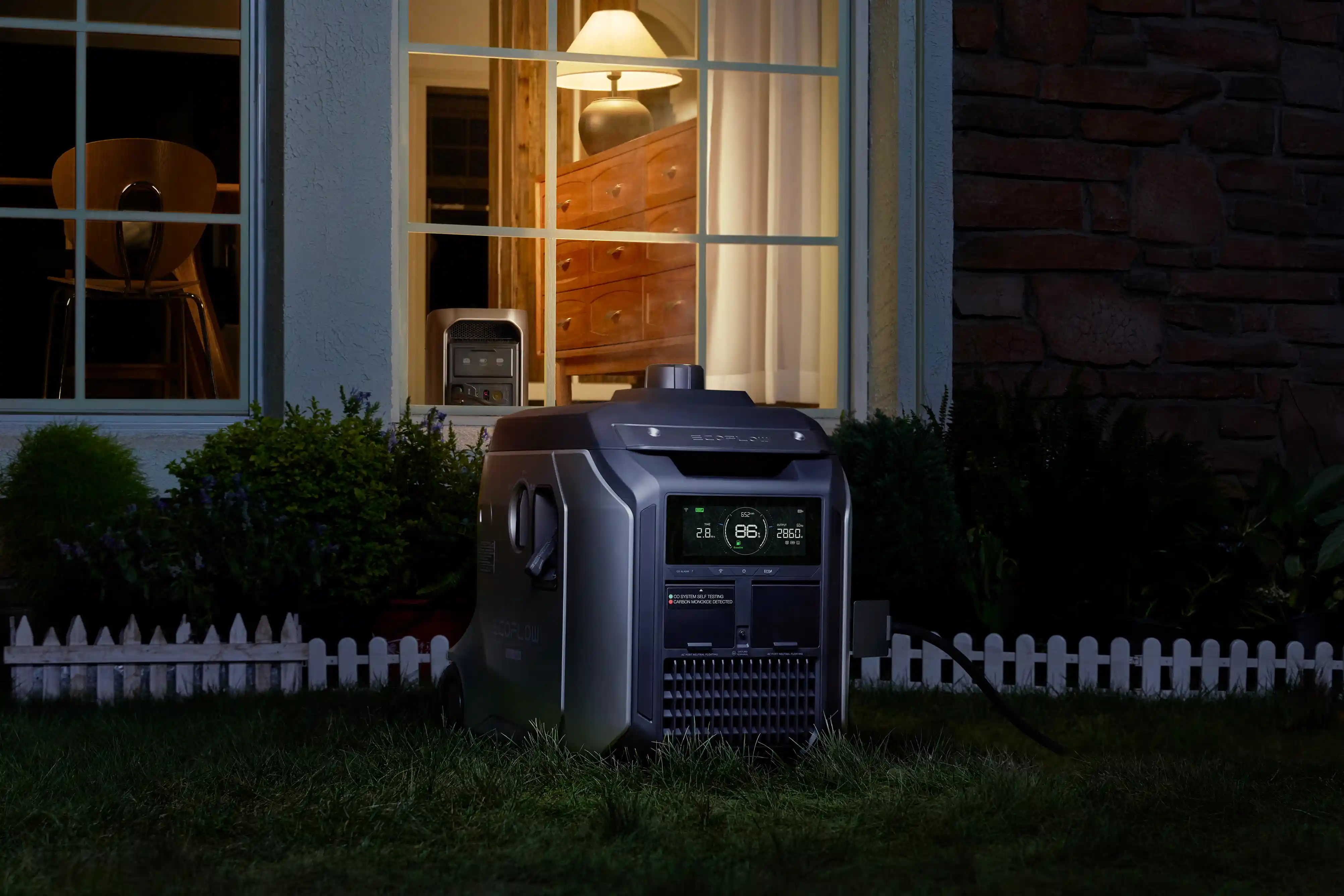
A fuel generator and an indoor battery can be used together. Run the generator outside long enough to recharge the power station, then shut it off and return to quiet battery power. This may be especially useful overnight or when only small loads remain.
The generator must still sit at least 20 feet from the house, with its exhaust facing away from every opening. Keep the charging connection dry and verify that the generator’s output is suitable for the battery charger. Before adding more fuel, shut down the engine and allow it to cool.
Conclusion
An indoor backup system uses stored electricity. A machine with an engine is outdoor equipment, even if it is compact or the garage door is wide open.
For many households, a portable power station covers the part of an outage that matters most: the refrigerator, a few lights, phones, internet access, and essential medical equipment. A home battery becomes worthwhile when those loads are spread across several circuits or include hardwired equipment.
Try the setup on a normal day. See whether the refrigerator starts, whether the cord reaches without crossing a doorway, and how quickly the percentage falls. Those details will matter more during an outage than the ideal runtime shown in an advertisement.
FAQ
Can I Just Plug a Generator into an Outlet?
No. Never plug a generator directly into a household wall outlet. This can cause backfeeding, sending electricity into utility lines and putting both your home and utility workers at risk. To power household circuits safely, use a code-compliant transfer switch, interlock, or compatible backup panel installed by a licensed electrician.
What Can a Portable Power Station Run in a Blackout?
A 1,000Wh to 2,000Wh portable power station can typically handle essentials such as a refrigerator, Wi-Fi router, lights, phones, laptops, and some medical devices. Actual runtime depends on the appliance load, battery capacity, inverter efficiency, and how often each device runs. High-wattage appliances such as coffee makers can also be used if the power station has enough AC output.
How Big of a Generator Do I Need to Power a Gas Furnace?
Many residential gas furnaces need several hundred watts to run the blower, plus additional surge power when the motor starts. Rather than relying on a fixed generator size, check the furnace nameplate and startup requirements, then choose a backup source with enough continuous and surge output. Some systems may require 1,500W or more of available output.
What Is the Smallest Generator Needed to Run a Fridge?
Most modern refrigerators use relatively little power once the compressor is running, but they may draw significantly more for a brief period at startup. Check your refrigerator’s rated or measured running and startup wattage, then choose a generator or power station with enough continuous and surge capacity. For many household refrigerators, a power station with around 1,000W of AC output may be a useful starting point, but the refrigerator’s measured or specified startup demand should determine the final choice.
For press requests or interview opportunities, reach out to our media team
media.na@ecoflow.com