How Many Watts Does a Refrigerator Use? [2026 Guide]
- Refrigerator Power Basics: Watts, Running Load, and Startup Surge
- Typical Refrigerator Energy Use Per Day in 2026
- Refrigerator Wattage Ranges by Type and Size
- How to Measure and Calculate Your Fridge’s Actual Power Needs
- Powering a Refrigerator During Outages: Choosing the Right Backup
- Frequently Asked Questions
- Keep Food Safe and Bills Predictable With Smarter Fridge Power Planning
Refrigerators need constant access to electricity so their compressor can cycle on and off to maintain a consistent temperature to prevent food spoilage and food safety issues. But that constant cycling makes it challenging to estimate your fridge’s real-world daily energy needs.
This guide will explain running watts, startup surges, and daily energy use to help you estimate costs and choose the right refrigerator backup for electrical outages.
Refrigerator Power Basics: Watts, Running Load, and Startup Surge
The running load of a refrigerator is the watts (power) they use while running.
However, fridges and other appliances with electric motors also have startup surges (the additional watts they need just to get started).
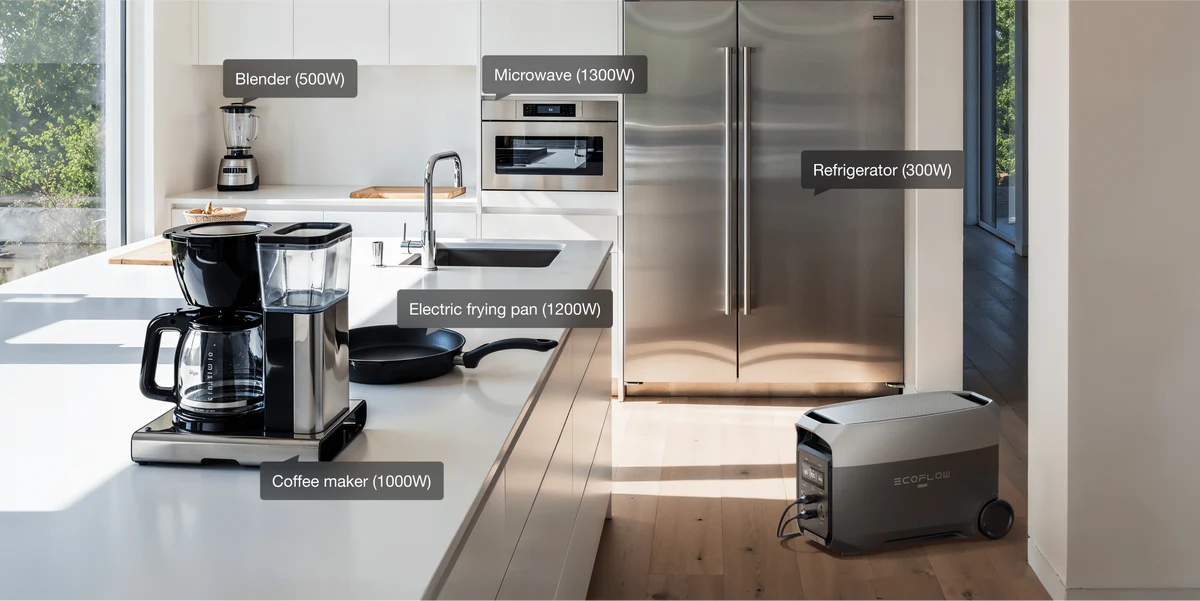
Fridges need surge power to start their compressors, which cycle on and off to maintain a consistent temperature. While temporary, the startup surge is typically 2–3 times the running watts, so that must be factored in when planning backup power.
And to keep your fridge and entire home running through outages, you could consider a whole-home backup power solution.

Typical Refrigerator Energy Use Per Day in 2026
For daily energy use calculations, people sometimes take the running watts and multiply the figure by 24 to get daily watt-hours.
In reality, though, your fridge’s compressor cycles on and off all day long. So it uses high temporary starting watts followed by lower running watts with intermittent, very low standby wattage while the compressor isn’t running, which makes it difficult to calculate.
Typical modern ENERGY STAR refrigerators use 1–2kWh/day. This is verified by real-world studies that suggest a standard refrigerator consumes about 1.82kWh/day. However, older and non-certified models may use up to 4kWh/day (Note: 1000W = 1kW).
Since the average rate of residential electricity in the U.S. is 18.83 cents/kWh as of March 2026, an average refrigerator costs: 1.82kWh/day x $0.1883/kWh = $0.34/day, or about $125/year.
Refrigerator Wattage Ranges by Type and Size
Compact mini-fridges usually draw between 60W and 75W while running, although they can range between 50W and 150W.
Top-freezer models (freezer on top, fridge below) are considered the most efficient standard fridge, consuming between 150W and 400W while running.
Larger side-by-side or French-door models often consume 10–25% more than a similar-sized top-freezer model. This is because they may offer multiple cooling zones, ice makers, and water dispensers, which use more energy, putting their draw between 300W and 800W.
How to Measure and Calculate Your Fridge’s Actual Power Needs
You can calculate running watts by locating the manufacturer’s nameplate stamped on the back or inside the fridge. It should list the refrigerator amp usage and voltage. Then you can calculate watts with this formula:
Watts = Amps x Volts.
To get a broader long-term look at energy consumption, you can check the ENERGY STAR label. It lists an estimate of the yearly kWh. Divide that by 365 to estimate your daily usage.
However, how much energy your fridge actually consumes depends on the room temperature, how many times you open the door, and your settings. Therefore, to eliminate the guesswork, use a watt meter plugged into the outlet with your fridge plugged into it. Leave it for 24 hours to get precise real-world consumption. Then you’ll know exactly how much power it needs when determining the right-sized whole home generator.
Powering a Refrigerator During Outages: Choosing the Right Backup
A mistake people sometimes make is choosing a backup system with an output that matches their running wattage. But it must be able to handle that startup surge, which could be up to 3 times as much. Look for power stations with higher output and with temporary surge power that allows short-term, higher draws.
Next, consider your runtime goals. If you deal with brief power outages that seldom last more than a couple of hours, the EcoFlow DELTA 3 Classic Portable Power Station (1024Wh) with 1800W of output and 3600W of temporary surge power will run most fridges for at least half a day.
However, if you have extended outages or want a scalable option to run additional appliances, the EcoFlow DELTA 3 Ultra Portable Power Station (3072Wh) has 3600W of output and 7200W of temporary surge power. And it's scalable with additional batteries up to 11kWh.
Frequently Asked Questions
How Many Watts Does a Refrigerator Use Per Day?
A standard fridge consumes about 150W–800W while running. But it cycles on and off throughout the day, so it averages between 1000Wh and 2000Wh/day. But older fridges and non-ENERGY STAR-rated ones may use up to 4000Wh/day.
What’s the Difference Between Running Watts and Starting Watts?
Starting watts is the brief surge in power that appliances with electric motors need just to get started, which is typically 2–3 times the running watts. Once it’s started, running watts is the steady power draw needed to keep it running.
How Do I Convert Watts to kWh for a Refrigerator?
First, divide watts by 1000 to convert to kW. Next, take the kW and multiply it by the number of hours it runs each day. Since fridges don’t run continuously, use 8 hours as a rough estimate. If you have a 400W fridge: 8hrs x (400W/1000W/kW = 0.4kW) = 3.2kWh.
What Size Backup Power Do I Need to Run a Refrigerator?
A standard fridge needs 150–800W of output power for its running watts. Then ensure it can handle the temporary starting surge, which could be up to 2400W. Finally, choose a capacity of 1500–2500Wh to ensure it lasts about 24 hours.
Keep Food Safe and Bills Predictable With Smarter Fridge Power Planning
Understanding your refrigerator’s wattage is the first step towards smarter energy planning. By calculating real-world power draw, accounting for startup surge, and choosing backup power with enough output and capacity, you can protect food during outages and manage your electricity costs better.
For dependable, indoor-safe, scalable backup energy for your fridge and other essential appliances, explore the EcoFlow DELTA 3 Ultra Portable Power Station (3072Wh) today.
For press requests or interview opportunities, reach out to our media team
media.na@ecoflow.com