Cut Your Bills Forever with Solar Energy for Household
The UK energy market is always shifting and the prices are always changing. Ofgem reviews energy prices every three months and this means that no one is sure what the costs per kWh will be. They can either go further up or go down. Also, you are exposed to the vulnerability of the national grid which can easily be affected by global factors. Solar energy for household solutions can help you avoid these challenges.
This guide looks at:
Rising costs of UK grid electricity
How to design an efficient solar energy for home
Specialised solar solutions for modern living
Technical components of a high-performance system
EcoFlow powerstream recommended solutions for home
Navigating the Rising Costs of UK Grid Electricity
The Impact of Increasing Utility Rates on Families
Ofgem’s energy price cap was implemented to offer stability. However, in reality it delivered volatility. In 2025, the average annual energy bill for a dual-fuel household exceeded £1,800, and was even higher for homes running heat pumps, EVs, and home offices. Solar energy for homes is the solution to the root problem, shifting your household from the grid to using stored energy from sunlight.
Calculating the Long-term Solar Energy for Home Price
When estimating solar energy for home price, you have to consider two sides, not only one. Many people tend to focus only on the upfront and don’t really consider the other side in terms of cost savings the solutions offer. For example, a fully installed 4kWp rooftop system in the UK currently costs between £5,000 and £8,000 depending on panel specification and inverter type. However, this solar generates roughly 3,400–4,200 kWh annually in Southern England. This translates to £820–£1,000 electricity cost savings per year. Within five years, you can effectively recoup the solar energy for home cost you spent upfront, and you can continue using the same solar panels for years. A solar panel comes with a 25-30 years performance warranty.
Achieving Financial Independence through Home Solar Energy
Apart from cost savings, home solar energy gives you independence from the national grid. This means that changing wholesale prices don’t affect you. Solar energy for your home is your long-term financial hedge because you are not buying electricity at tomorrow's price. You are generating it in today's sunlight.
Designing an Efficient Solar Energy Setup for Home
Optimising Solar Energy Panels for Home Placement
Even though south-facing roofs deliver maximum yield, they are not the only viable option. East-west split captures 80–85% of the equivalent output. They spread generation across more daylight hours, which is useful for houses with morning and evening consumption peaks. A 30–40° pitch angle is the best for UK latitudes. Shade is also another factor that matters, for example, chimneys and neighbouring trees can cause disproportionate losses in string inverter systems. To counter this, solar energy panels for home use microinverters or power optimisers. These deliver panel-level MPPT (Maximum Power Point Tracking) so one underperforming panel doesn't drag down the entire array.
The Role of a Solar Energy Kit for Home in Urban Spaces
If your house is in a conservation area or you are renting in flat dwellers, the traditional rooftop installation is not an option. A solar energy kit for home is the best option and comes with plug-in solar panels, compact ground-mounted arrays, and portable generation units. Anyone can access home solar energy kits. However, its output can be slightly lower than a full rooftop system.
Choosing the Right Solar Energy System for Home Capacity
Before selecting a solar energy system for home, consider your annual kWh figure. You can easily get this figure on any electricity bill. An average household in the UK consumes around 2,700–3,100 kWh per year, making a 3.5–4kWp system suitable to match this energy demand. Add an EV or heat pump and plan for 5–6kWp minimum. A home solar energy system usually generates electricity when most families are out, and that’s why you need battery storage for high-self consumption. Pairing solar energy systems homes with battery storage experience more cost savings than those that rely on grid export alone.
Note: To verify and view all the current up-to-date information on energy usage in the UK, visit Ofgem website's data portal section.
Specialised Solar Solutions for Modern Living
Solar Energy for Small Home Businesses and Remote Work
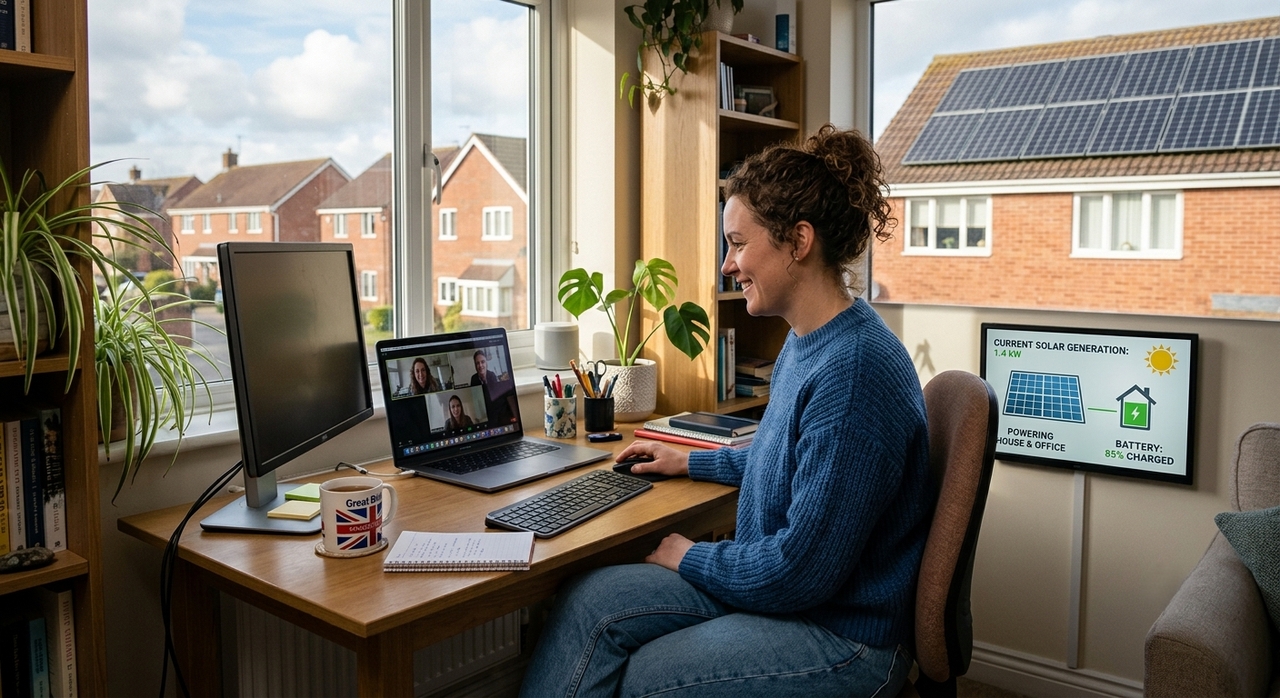
For self-employed and remote workers, the main pain point they face is above-average daytime consumption and real operational risk from power disruption. Solar energy for small home businesses provides the best solution, because the peak solar generation period coincides with the working hours. This means if you have a well-sized solar energy home, you can power monitors, broadband equipment, and ancillary office kit with minimal grid top-up.
Understanding Home Energy Scotland Solar Panels and Grants
Scotland has a more favourable story to tell than many would think. Home energy Scotland solar panels generate significantly more energy through diffuse light than the old technology, with modern bifacial panels and high-efficiency monocrystalline cells. The Scottish people can also benefit from Home Energy Scotland, a government scheme providing interest free loans of up to £15,000 for those who qualify for a renewable installation. This grant structure changes the upfront amount for home solar energy UK residents north of the border.
Note: Visit the Home Energy Scotland Grant and Loan website to learn more about solar panels loans and grants
Integration of Solar Energy Systems Homes and Smart Tech
The latest home solar energy systems are active energy management platforms, not passive generation assets. These solar systems come with real-time monitoring apps that track production and consumption each minute of the day. The apps give you all the data you need to make important cost saving decisions, such as timing high-draw appliances to coincide with peak generation windows. Also, integrating this with smart thermostats and time-of-use tariffs allows solar energy systems homes to autonomously decide when to draw from batteries, when to export, and when to pull from the grid.
Technical Components of a High-Performance System
The Importance of High-Efficiency Microinverters
In modern solar energy for the home system setup, the microinverter is a critical component. A microinverter is different from a string inverter, and is mounted directly on each panel to convert DC to AC at the source. This move guarantees panel-level performance data with no single point of failure, and higher energy harvest from partially shaded or mixed-orientation arrays. The UK climate has lots of cloud cover, and this per-panel MPPT efficiency gain is the real difference-maker.
Streamlining Your Setup with All-in-One Solar Energy Kits
The cost has been greatly reduced with modern solar energy kits for homes. A solar energy kit for home comes with panels, inverter, cabling, and mounting hardware. These are plug-in models which do not need an electrician for the solar component, although grid-tied models will still need a G98 or G99 notification to DNO. The end outcome is a shorter time period between purchase and generation, and not as complex as a custom-built installation
Scalability of a Modern Solar Energy for the Home Strategy
To get more solar energy, you need a good solar energy setup for home. Modular systems grow with your consumption by allowing you to add more panels. So if you add a new EV, a heat pump, or your household is expanding, this setup can accommodate this new energy demand. Also, you can easily add a battery storage system without replacing the existing generation capacity. The secret here is selecting an ecosystem, inverter brand, monitoring platform, battery chemistry, that supports incremental expansion. LiFePO4 battery chemistry is the gold standard because it’s thermally stable, rated for 3,500+ cycles, and consistent across UK temperature ranges
Recommended EcoFlow PowerStream Solutions
When you invest in a smarter energy setup, you are reclaiming your utility expenses. The STREAM Ultra Product Series helps reduce reliance on the national grid, and can slash up to £963 off your electricity bills compared to standard rates. To find the exact amount you can save, simply use our energy calculator.
EcoFlow STREAM Ultra Home Solar Battery
A solar energy for household setup faces one major challenge, what happens when generation stops during evening peak when electricity is most expensive. The EcoFlow STREAM Ultra Home Solar Battery is built to solve this problem by storing surplus energy generated during the day and allows you to draw during peak hours. This cuts your exposure to high unit rates while giving you steady energy supply to run your household. The battery has an integrated MPPT charging controller and real-time smart monitoring for managing dispatch, optimising your solar energy for home cost. The battery is a game changer in solar energy for small home businesses setups by giving you independence from the national grid.
EcoFlow STREAM Series Solar Plant Basic Set (1600 wp)
The Ultra/Pro is built for larger homes that are looking for substantial capacity. For households looking to enter the solar generation game, the EcoFlow STREAM Series Solar Plant is a practical entry point. This setup allows you to reduce grid reliance at a fraction of the cost. This solar energy kit for home comes with EcoFlow STREAM Ultra battery and an EcoFlow 400 W Rigid Solar Panel, that allows you to start generating your own solar energy. This solar energy setup for home is sufficient to run basic household items and kitchen appliances
Conclusion
Many households in the UK are shifting to solar energy for household solutions and we can see this from statistics. As of March 2026, over 2 million households have installed solar and this figure is projected to rise to over 2.4 million households by the end of the year. This is breaking from the norm, where solar systems could only be afforded by a few privileged. Installing these solar energy for homes solutions offers two main benefits, reducing electricity costs and giving you total independence from the national grid.
EcoFlow UK provides you with access to modern solar energy for household solutions, such as the STREAM series. Our technologies are built for the UK conditions, and integrate with your existing home infrastructure. Our products are built with X-Stream technology and you can plug them directly into a standard AC wall outlet. Explore our catalog of products at EcoFlow UK and take your first step toward generating clean, predictable power on your own terms.
Solar Energy For Household Frequently Asked Questions
What is the average solar energy for home cost in the UK?
Panel type, system size (kWp), battery inclusion, and roof suitability all affect solar energy for home cost. For a standard 3.5–4kWp rooftop system without storage, you pay between £5,000–£8,000. And if you add a LiFePO4 battery with 5–10kWh capacity, then you need an additional £3,000–£6,000. For UK residential installations, you can enjoy 0% VAT on these products. Also, you can export surplus generation to the grid and earn additional revenue from Smart Export Guarantee (SEG).
Can I use solar energy for household appliances during a power cut?
If your solar systems are grid tied, they are shut down during a power cut by law to protect engineers working on network lines. However, if you have an integrated battery storage and an islanding function in your solar energy for household setup, you can continue powering your household independently during an outage.
Is a solar energy setup for home effective in cloudy UK weather?
Modern solar panels for home can generate electricity from diffuse light. You don’t need to have direct sunlight in these monocrystalline and bifacial panels. On an overcast day, the output can be 10-25% of peak capacity, which is a decent amount to power your household. In the winter months, generation is lower than in summer months. That’s why it’s important to pair a solar energy setup for home with battery storage that can cover overnight and low-generation periods to keep the system effective year-round.