Solar Charge Controller Explained: MPPT vs PWM and How to Choose the Right One
- What a Solar Charge Controller Does and Why Your Battery Needs One
- PWM Solar Charge Controllers: How They Work and When They Make Sense
- MPPT Solar Charge Controllers: How They Work and Why They Harvest More Energy
- MPPT vs PWM in Real Life: Efficiency, Cost, and Performance in Changing Conditions
- How to Choose the Right Controller for Your System Voltage, Wiring, and Goals
- Frequently Asked Questions
- Get Faster Charging and Easier Expansion With the Right Solar Setup
A solar charge controller sits between your solar panels and battery to ensure your battery doesn’t overcharge, but it also determines how much energy you actually store. Two main types—PWM and MPPT—operate differently and produce noticeably different results.
However, they both have their place. Discover the differences between MPPT and PWM controllers and find out how to choose the right one for your solar power system.
What a Solar Charge Controller Does and Why Your Battery Needs One
Solar panels produce varying voltage and current depending on the intensity of sunlight, panel temperature, and the connected load. A 12V battery may hold up to 12.7 volts, but a solar panel may produce 17 to 22 volts at its maximum efficiency. Without a solar charge controller, that voltage mismatch would overcharge and damage the battery.
A charge controller regulates the voltage and current flowing from the panel to the battery—typically through a bulk, absorption, and float phase—to prevent overcharging. It adjusts power flow using either Pulse Width Modulation (PWM) or Maximum Power Point Tracking (MPPT). It also prevents reverse current flow at night, which would drain the battery back through the panels when the sun goes down.
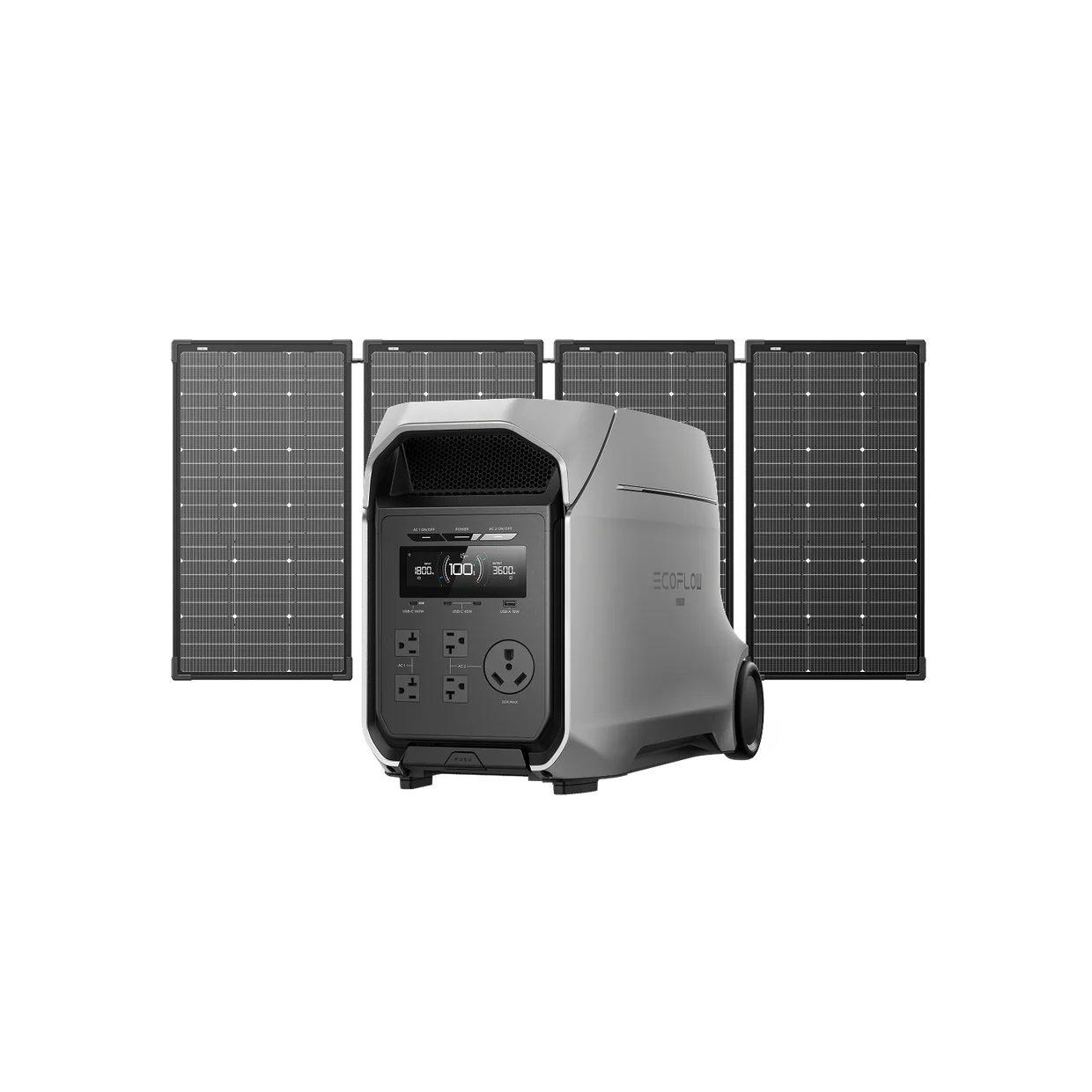
For continued solar power throughout your home, consider a solar generator. Combinations of a solar panel and portable power station like the EcoFlow DELTA 3 Ultra Plus Solar Generator With 500W Solar Kit reduce your reliance on traditional grid power, keeping your home energized even during blackouts.
PWM Solar Charge Controllers: How They Work and When They Make Sense
A PWM controller regulates power by rapidly switching a circuit on and off. Instead of delivering a steady stream of power, it delivers rapid pulses of electricity by interrupting the connection between the panel and battery on and off. As the battery fills, the controller shortens the electrical pulses it sends, safely tapering to a trickle charge once full.
The main limitation with PWM controllers is that the panel voltage must closely match the battery voltage to work efficiently. PWM controllers make sense when you’re working with a small-scale setup where panel and battery voltage closely match, budget-friendly setups where low cost outweighs efficiency gains, and simple installations with no plans for expansion.
MPPT Solar Charge Controllers: How They Work and Why They Harvest More Energy
An MPPT controller operates as a DC-to-DC converter to continuously calculate and adjust the balance between voltage and current. It finds the sweet spot of maximum power, drops the voltage down to the battery voltage level, then converts the excess voltage into additional current.
The maximum power point shifts constantly with temperature and sun intensity. MPPT controllers track these shifts and update the optimal operating point in real time. They harvest more energy during morning and evening hours, under partial clouds, and in cold weather, when panel voltage rises.
MPPT vs PWM in Real Life: Efficiency, Cost, and Performance in Changing Conditions
The major difference between MPPT and PWM is the panel voltage flexibility. PWM controllers must have panels that match battery voltage, while MPPT controllers handle higher-voltage panels. This restriction reduces PWM controllers to 70-80% efficiency. MPPT controllers boast a 95-99% efficiency under the same conditions.
MPPT controllers experience significant gains in cold weather, while the PWM counterpart experiences very minimal gains. MPPT controllers operate much better in higher-voltage arrays and allow for expansions without affecting efficiency. PWM controllers must pull the voltage down to the battery level, preventing any plans of expansion.
The two systems also differ when it comes to partial shading. MPPT controllers re-track shifts in the maximum power point to maintain optimal efficiency, but PWM controllers carry no mechanism for adapting and suffer larger losses.

How to Choose the Right Controller for Your System Voltage, Wiring, and Goals
System voltage is often the determining factor for the right controller. A 12V system is a simple starting point for small setups, but it can quickly reach its limits. A 24V system carries the same wattage at half the current, allowing thinner wires, longer cable runs, and more expansion room. A 48V system, which is typical for whole-home backup power, is the most cost-effective and scalable choice for heavy loads.
Wiring configuration also affects the controller selection. Panels wired in series add their voltages together while keeping the current the same, which suits MPPT controllers. Panels wired in parallel add their currents while keeping the voltage constant, which suits PWM controllers.
To size a solar charge controller, divide the panel wattage by the battery voltage, then add a 25% buffer for safety. For most systems beyond 12V, an MPPT controller is the more practical option.
Frequently Asked Questions
What is the main difference between MPPT and PWM solar charge controllers?
A PWM controller connects the panel directly to the battery and tapers current by rapidly switching on and off, pulling panel voltage down to battery voltage in the process. An MPPT controller uses a DC-to-DC converter to operate the panel at its optimal voltage and current combination.
How much more power can MPPT deliver compared to PWM?
In conditions where panel and battery voltage match, the difference in power is not too large. In systems where the panels have a greater voltage than the batteries they’re feeding, MPPT controllers can deliver 25-30% more power.
Can I use higher-voltage solar panels with a PWM controller?
Technically, yes, but it’s highly inefficient. A PWM controller limits the panel voltage to battery voltage, wasting all energy above that threshold. If you have higher-voltage solar panels, an MTTP controller is the better choice.
Do EcoFlow solar generators use MPPT, and why does it matter?
Yes, EcoFlow solar generators use built-in MPPT charge controllers. This matters because it allows you to expand your setup without worrying about lost efficiency, and it charges the battery faster and more reliably than a PWM controller would.
Get Faster Charging and Easier Expansion With the Right Solar Setup
Choosing between MPPT and PWM depends on system size, panel voltage, and expansion plans. PWM is a cost-effective option best suited to small-scale 12V systems, while MPPT is ideal for anything larger with panels whose voltage is greater than battery voltage.
Enjoy the freedom of MPPT with the EcoFlow DELTA Pro 3 Solar Generator. The expandable unit offers whole-home backup power with efficient solar output.
For press requests or interview opportunities, reach out to our media team
media.na@ecoflow.com