Motorhome Portable Air Conditioner Guide: How to Choose the Right Size and Cooling Power
- Why Motorhome Air Conditioning Is Different from Home Cooling
- Understanding BTU and Cooling Capacity for RV Air Conditioners
- How to Choose the Right RV Air Conditioner Size
- Power Consumption and Energy Efficiency for RV AC Units
- Types of Motorhome Air Conditioners (Which One Fits You?)
- Best RV Air Conditioners by Use Case with Recommended Picks
- Conclusion
- FAQ
Summer road trips are a favorite American tradition. You might be cruising down Route 66, enjoying Utah’s National Parks, or parking near a Florida beach. If you’re in your RV, keeping your living space cool is a top priority. This guide breaks down everything you need to know to choose the right portable air conditioner size and understand cooling power. Plus, it shows you how to manage your energy supply so you can stay cool wherever the road takes you.
Why Motorhome Air Conditioning Is Different from Home Cooling
When you’re at home, you have thick drywall, standard insulation, a solid foundation and possibly shaded by trees. A motorhome is essentially a metal or fiberglass box on wheels. It has many windows and is constantly exposed to direct sunlight. Because of this, heat transfers into an RV much faster than a traditional building, which means your AC has to work twice as hard.
Since your location is always changing while traveling, your environment and power sources fluctuate constantly. You can’t simply plug into a standard electrical grid; in many cases, travelers rely on a solar generator to provide stable, mobile electricity for essential cooling and other onboard appliances.
Understanding BTU and Cooling Capacity for RV Air Conditioners
If you’re shopping around, you need to understand the primary metric used to compare systems, and that is BTUs of cooling power. Let’s look at what this means for your rig.
What BTU Means in RV Cooling
BTU stands for British Thermal Unit, and is the amount of heat an air conditioner can remove from a space per hour. A higher BTU rating means faster and heavier cooling power for your RV. However, bigger isn’t always better. An oversized unit will tend to short-cycle, turning off before it actually dehumidifies the air, leaving you with a cold but humid space.
How BTU Affects Motorhome Temperature Control
The right BTU rating makes sure you have a steady, comfortable climate. If your BTU rating is too low, the compressor runs continuously. This will use more electricity while not cooling to your desired temperature. Having the right size air conditioner keeps the cabin dry and cool without overloading your electrical system.
Recommended BTU by RV Size (Small, Medium, Large)
While layouts of the RV vary, you can follow these general guidelines for matching your motorhome length to the necessary BTU output:
| RV Size / Length | Typical Living Space | Recommended BTU Range |
|---|---|---|
| Small (Class B, Campervans, Teardrops up to 20 ft) | Under 150 sq. ft. | 5,000 – 8,000 BTU |
| Medium (Class C, Small Travel Trailers 20–30 ft) | 150 – 250 sq. ft. | 8,000 – 12,000 BTU |
| Large (Class A, Large Fifth Wheels over 30 ft) | 250+ sq. ft. | 13,500 – 15,000+ BTU (Often requires multi-unit or rooftop + portable combination) |
Common Mistakes When Choosing BTU
The biggest mistake most people with RVs make is buying an AC based solely on floor square footage. They forget to factor in the extreme summer temperatures of states like Arizona or Texas. Another common mistake is assuming a low-cost residential portable AC with a low BTU rating can handle RV cooling demands.
How to Choose the Right RV Air Conditioner Size
Matching BTUs to your trailer length is a good starting point, but also consider the specifics of your RV. These will dictate how much cooling you truly need.
Interior Space, Layout, and Airflow Considerations
The shape of your living space determines how air moves. Tall ceilings, like those in fifth-wheel trailers, trap hot air up high, requiring stronger circulation. If your unit doesn’t have adjustable louvers for air flow or a high enough fan speed, you can end up with pockets of trapped heat in some areas.
Insulation, Windows, and Sun Exposure Impact
RV insulation is notoriously thin. If your RV has a massive front windshield or multiple slide-outs with big windows, the solar heat gain can increase your cooling load by up to 20%. Parking under direct sunlight in a paved campground turns these windows into hot greenhouse panels and increases cooling requirements.
Open vs. Compartmentalized RV Layouts
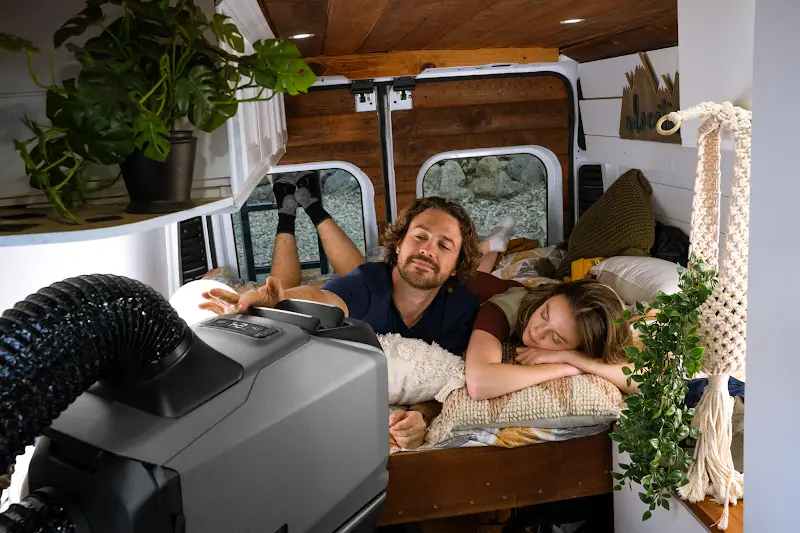
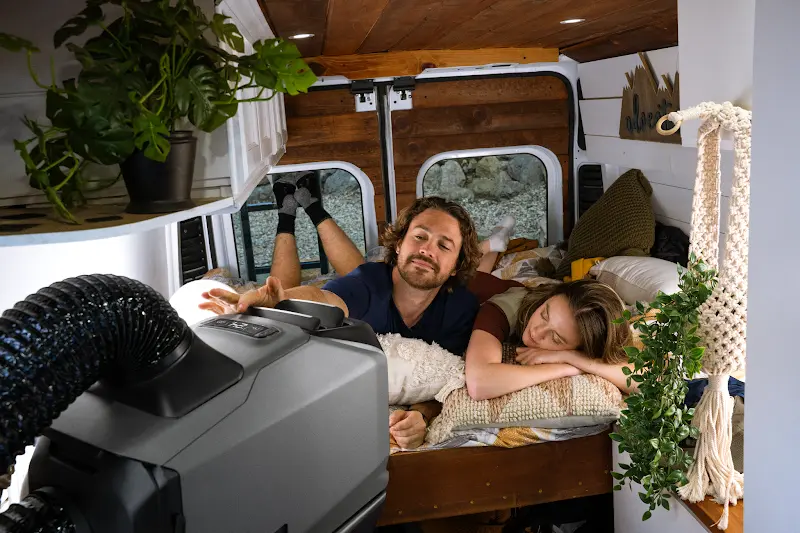
An open-concept campervan allows cold air to travel freely from front to back. However, if your motorhome has separate bedroom doors, privacy partitions, or a blocked-off bathroom block, a single central AC won’t distribute cold air evenly. In these setups, localized or zoned cooling solutions are often considered among the best portable AC for RV living because they help maintain more consistent temperatures in specific areas.
Quick Sizing Checklist for Buyers
When you’re ready to buy, make sure you’ve considered these factors:
Measure your actual interior length, width, and ceiling height.
Count your windows and note which ones have thermal blackout shades.
Identify your primary travel regions (e.g., humid East Coast vs. dry Southwest).
Check your rig’s insulation rating (all-weather vs. three-season camper).
Power Consumption and Energy Efficiency for RV AC Units
Once you know how big of an air conditioner you need, you have to figure out how to power it without overloading breakers. For off-grid or flexible setups, many RV owners now rely on a portable power station as a backup energy source to help stabilize power delivery and support short-term AC operation when shore power is not available.
Wattage and Battery Drain Explained
Air conditioners are big energy consumers. A standard unit can pull anywhere from 1,000 to 1,800 watts during continuous operation, with a massive initial spike when the compressor kicks on. Understanding the solar power requirements for an RV air conditioner beforehand is essential; otherwise, you risk overloading your RV’s electrical system or draining your batteries faster than expected.
Shore Power vs. Generator vs. Solar Systems
Plugging into 30-amp or 50-amp shore power at an RV park makes things easy, but it can limit you to crowded sites. Generators offer freedom but are loud, fuel-intensive, and restricted during nighttime quiet hours at national parks. Solar setups paired with heavy-duty lithium batteries are the ultimate solution when used with highly efficient appliances to be sustainable.
Energy-Saving Features (Inverter, Eco Mode, Smart Control)
Modern portable cooling units use variable-speed inverter compressors. Instead of constantly cycling on and off, an inverter smoothly adjusts its speed according to cooling demand, which significantly reduces energy consumption. If these are used with Eco modes and smart app scheduling, you can reduce your daily energy consumption by half.
Types of Motorhome Air Conditioners (Which One Fits You?)
There are a few different ways to cool your RV. Here’s a comparison of the most popular options on the market.
Rooftop RV Air Conditioners (Most Common Choice)
These are the traditional units mounted on your RV’s roof. One advantage is that they save interior floor space and connect directly to internal ductwork. However, they are permanent, loud, add to clearance height, and difficult to maintain if they break down.
Portable Vented AC Units for Flexible Cooling
These units sit directly on the floor or in a compact storage area and vent hot air outside via a flexible duct run through a window or a dedicated port. They are incredibly versatile because you can remove them during the winter months. Also, they don’t require cutting large holes in your roof.
Evaporative Coolers (Dry Climates Only)
Often called swamp coolers, these use evaporating water to chill the air. They use minimal electricity, which makes them attractive for off-grid users. However, they work best in extremely dry regions like Arizona or New Mexico. If you try using them when the air is very humid like in the Deep South, performance drops significantly in humid climates.
Battery-Powered / Off-Grid Cooling Solutions
Fully DC battery-powered air conditioners run directly from 12V, 24V, or 48V battery systems and are built for mobile living. They bypass the energy losses of an inverter, and are best suited for travelers who want efficiency. With these units you can escape crowded campsites and camp out in the wild.
Best RV Air Conditioners by Use Case with Recommended Picks
To make your shopping easier, we’ve identified the top cooling solutions based on how and where you like to camp.
Best for Small RVs and Campers
For compact rigs, teardrop trailers, and standard campervans, space is your most valuable asset. A compact, low-profile portable unit that fits under a bench or can be placed between the front seats is ideal. You want something lightweight that delivers effective spot-cooling without drawing excessive power.
Best for Large Motorhomes
Class A and large Class C motorhomes generally need a heavy-duty rooftop system as their primary cooling source. However, a supplemental portable AC may be needed to cool separate areas like the master bedroom or rear kitchen. These can eliminate warmer areas without needing to upgrade your entire electrical panel.
Best for Off-Grid Camping
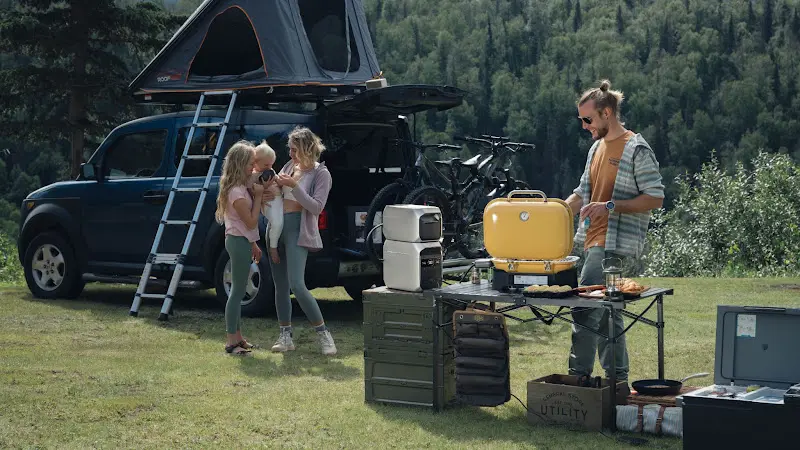
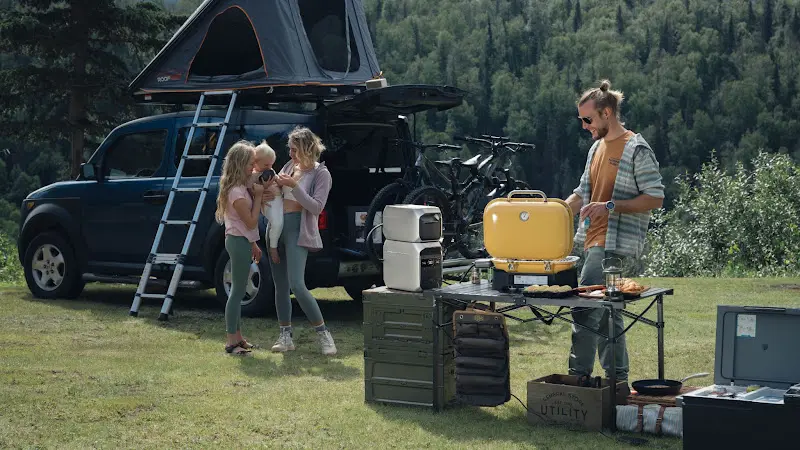
Boondocking tests the limits of your RV’s onboard energy storage. To run a portable air conditioner smoothly away from the grid, you need a reliable power system. We highly recommend pairing an efficient portable cooling unit with the EcoFlow DELTA 3 Ultra Plus + 500W Solar Panel ecosystem.
The DELTA 3 Ultra Plus has a large battery capacity and easily supports running your RV air conditioner. It will keep you cool through hot summer nights without listening to a loud generator. During the day, the high-efficiency 500W solar panel can easily recharge in high-sunlight states like Texas, California, and Nevada. This setup allows travelers to recharge during daylight hours and maintain cooling overnight with reduced generator dependence. This combination is perfect for extended stays in National Parks, boondocking on BLM land, or any cross-country road trip. You can enjoy total energy independence and a comfortable, cool cabin without relying on campground hookups.
Most Energy-Efficient Rv Air Conditioners
In scorching summer regions like Florida, Arizona, or West Texas, interior RV temperatures can shoot up quickly in minutes under direct sunlight. To deal with this, many travelers are choosing low-wattage, highly efficient cooling systems that are super flexible. This way they can avoid reliance on grid power and using loud generators.
The EcoFlow WAVE 3 Portable Air Conditioner is an ideal portable solution that’s designed for lightweight RV cooling demands. The WAVE 3 is engineered with an advanced, high-efficiency thermal system that quickly cools a space while drawing minimal wattage. It easily integrates with portable power stations and solar setups. It’s great to use if you’re parked at a campground, taking a quick break at a rest stop, or preparing for a quiet night’s sleep. The WAVE 3 delivers fast, whisper-quiet, and flexible cooling. Compared to much larger, power-hungry traditional rooftop ACs, it offers unmatched energy management and mobility. Consider it an absolute must-have for van lifers and off-grid enthusiasts searching for energy independence across the US.
Conclusion
The secret to a comfortable summer on the road is finding the perfect balance of BTU capacity, physical size, and power efficiency. Don’t let oppressive heat waves confine you to expensive commercial RV resorts. Be prepared by combining a smart, highly efficient cooling unit like the EcoFlow WAVE 3 with an independent energy setup like the DELTA 3 Ultra Plus. Then you can confidently explore America’s most beautiful backroads, stay cool, and travel more comfortably through hot summer conditions.
FAQ
What Size Portable Air Conditioner Do I Need for a Motorhome?
You generally need a portable air conditioner ranging from 8,000 to 12,000 BTUs for a standard-sized motorhome. This range comfortably cools spaces between 150 to 250 square feet. However, if you regularly camp in high-temperature, unshaded regions like the Southwest, or if your rig has minimal insulation and large windows, you should look toward the higher end of that scale to compensate for the extreme heat gain.
How Many BTUs are Needed for a 30-Foot RV?
A 30-foot RV typically requires at least 13,500 to 15,000 BTUs of total cooling power to maintain a comfortable temperature. Because 30 feet of living space contains multiple rooms and slide-outs, many owners choose to supplement their main rooftop air conditioner with a flexible 8,000 to 10,000 BTU portable unit to handle localized hot spots in the bedroom or living area.
Do Portable RV Air Conditioners Need Venting?
Yes, all true portable air conditioners must be vented outside to cool your RV effectively. The cooling process naturally generates a massive amount of hot, humid exhaust air that must be pushed out through a window kit or a dedicated wall vent; otherwise, the unit will dump the heat straight back into your living space, making it impossible to cool down.
Is a Rooftop AC Better than a Portable Unit for RVs?
Neither is universally better, as the ideal choice depends entirely on your travel style, spatial layout, and installation flexibility. Rooftop units are excellent for saving interior floor space and providing centralized, ducted cooling for larger rigs, while portable units win on versatility, quieter operation, easier maintenance, and the ability to be removed entirely during cooler seasons.
For press requests or interview opportunities, reach out to our media team
media.na@ecoflow.com