How Long Does a Home Backup Battery Last?
- How Long Can a Home Backup Battery Power a House?
- What Factors Affect Home Battery Runtime?
- How Does Battery Capacity Impact Backup Duration?
- What Appliances Use the Most Backup Power?
- How Can You Extend Home Battery Runtime During an Outage?
- Frequently Asked Questions
- Home Backup Battery Runtime Depends on Capacity, Usage, and Energy Management
“Runtime” is the term used to describe how long a battery backup can last. A battery’s runtime depends on three variables: capacity, total power draw, and recharge availability.
The length of an outage and the size of your load will determine what size system you need, but adding solar can potentially extend the runtime indefinitely if the weather allows. Understanding your own usage is the best starting point to find the right backup for your home.
How Long Can a Home Backup Battery Power a House?
The runtime of a whole home backup power solution ranges widely. For reference, a five to 10 kWh battery can cover essential loads for several hours. A larger whole-home backup system with 20 kWh+ capacity can provide backup for multiple days, especially if it's paired with solar recharging.
Expandable home battery backups, like the EcoFlow DELTA Pro Ultra X Whole-Home Backup Power give you the flexibility to add capacity until its runtime is sufficient for what you need to power and the typical outage length that you experience. Its standard capacity is 12kWh, but you can scale it up to 180kWh with expansion batteries, with the potential to support full-home circuits including central AC.
Run time isn't a fixed metric. It shifts based on the loads that you're running. The same battery might last 24 hours in one household and only five hours in another, if the second has a much higher total energy consumption.
What Factors Affect Home Battery Runtime?
There are three primary factors that affect how long a backup battery can last: total stored capacity, running wattage draw, and whether solar recharging is available during the outage.
Storage Capacity: This is how much energy is stored within the battery itself. A home battery is limited by its maximum storage capacity.
Wattage draw: This is the total running wattage of all the appliances you're powering simultaneously.
Solar Recharge Availability: When solar charging is available, it extends the runtime significantly because AC charging is not required.
Other factors that play a role include inverter efficiency, battery chemistry, and temperature. Efficiency will reduce the usable capacity by roughly 10-15%, so look at its rated efficiency. LFP battery chemistry is better at handling deeper discharges than lead-acid batteries, but this primarily impacts total lifespan rather than runtime. And finally, extreme temperatures (both hot and cold) can negatively impact performance and accelerate degradation.
How Does Battery Capacity Impact Backup Duration?
Battery capacity in kWh is the ceiling of a backup's runtime. If you can double the capacity, you will roughly double the backup time for the same load.
So, a 10kWh battery that's running a 1kW load can last for about 10 hours, but a 20kWh battery under the same draw can last roughly 20 hours.
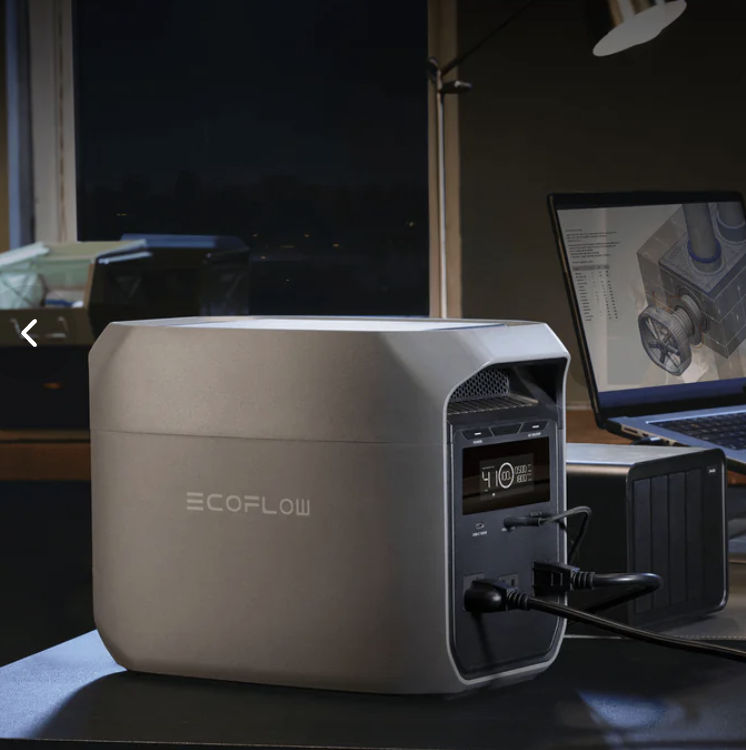
The EcoFlow DELTA 3 Classic Portable Power Station (1024Wh) can handle essential devices like a mini fridge (~17 hours), a CPAP machine (~17 hours), or laptop charging (~13 charges). It's better suited for short outages or single-room needs.
Modular systems also allow capacity to be added incrementally, so there's no need to oversize upfront. As you add capacity, you'll also increase your backup duration if your load stays the same.
What Appliances Use the Most Backup Power?
A refrigerator has an average running draw of 100 to 200W (about 1.5–2 kWh per day), and it's often the top priority during outages, because it runs continuously and keeps food safe.
The central AC unit typically uses the most backup power, about 3,000 to 5,000W while running. It is the single biggest drain on battery reserves, and can cut multi-day backup to just a few hours if it's run unchecked.
Electric water heaters, well pumps, and sump pumps have a high surge wattage at startup and will require systems that are rated for surge loads.
Runtime for low-draw essentials like LED lights, Wi-Fi routers, phone charging, and laptop charging can be extended significantly when you turn high-draw appliances off. It also costs much less when you buy a battery sized only for critical circuits, rather than whole-home backup.
During an outage, try this practical approach. Divide your appliances into categories of "must run" or "can wait." “Must run” items include refrigerator, lights, and medical equipment, while “can wait” items would be the dryer, the dishwasher, and the AC unit. Powering only the “must run” category can extend a 10 kWh battery runtime from a few hours to a full day.
How Can You Extend Home Battery Runtime During an Outage?
Basic strategies to extend battery runtime during an outage include prioritizing essential circuits and avoiding running high-draw circuits like HVAC systems, dryers, and dishwashers during an outage. Essential loads can include refrigeration, lighting, communication, and medical devices.
Solar recharging is also helpful to extend runtime indefinitely when sunlight is available. The panels could continue generating and feeding the battery even during a hurricane outage if conditions allow.
Frequently Asked Questions
Can a Home Battery Power an Entire House?
A home battery can power an entire house, but it will require significantly more capacity, usually around 20 to 30 kWh, to support HVAC, kitchen appliances, and multiple other circuits simultaneously. Modular systems can be scalable high enough to handle a whole-home load.
How Long Do Home Backup Batteries Last?
The runtime per charge of a home backup battery can be around 10 to 24 hours if you're powering essential loads on a 10kWh system. But it can last for days if you have solar recharging and carefully manage your loads.
Home Backup Battery Runtime Depends on Capacity, Usage, and Energy Management
Runtime is far more complex than one single answer that applies for every home. The number will depend on what you're pairing and how much energy you have stored.
Solar integration is the best and most reliable way to extend your backup runtime beyond what a battery alone can provide, giving you energy generation capabilities without needing AC power.
Start by looking at your essential load list and calculating the watt-hours needed to power everything simultaneously. Then size your backup solution accordingly and build out from there as your needs change.
For press requests or interview opportunities, reach out to our media team
media.na@ecoflow.com