What Is a Carbon Offset and How Does It Work for Home Power?
You have probably seen the option to "offset your carbon" when booking a flight or checking out online, usually for a couple of extra dollars. It sounds responsible, but it is rarely clear what you are actually paying for, or whether it changes anything. This guide clears that up. First, what a carbon offset really is, how the system is supposed to work, and where it genuinely helps. Then something more direct: how generating and storing your own clean energy at home cuts emissions you can actually measure, instead of paying someone else to cut them for you.
What Is a Carbon Offset and How Does It Work?
A carbon offset is a way to cancel out emissions you cannot avoid by paying for an equal reduction somewhere else. If a flight or a month of home energy use puts a ton of carbon into the air, you fund a project that keeps a ton out, and the two are meant to balance.
Here is how the pieces fit together:
The credit is the basic unit. One carbon credit, sometimes called a carbon offset credit, stands for one metric ton of carbon dioxide, or the equivalent in other greenhouse gases, that has been prevented or removed. The U.S. Environmental Protection Agency measures emissions in these standardized tons, so a credit from a wind farm and a credit from a forestry project count on the same scale.
A program keeps it honest. Projects list with carbon registries and get checked against independent standards like Verra or the Gold Standard. When you buy a credit, it is "retired" so no one else can claim the same reduction. A credit is only as good as the proof behind it, so it pays to understand how offsets are certified first.
Avoidance and removal are not the same. Avoidance projects prevent emissions that would otherwise occur, such as funding a wind farm instead of a gas plant or keeping a forest standing. Removal projects pull carbon that is already in the air back out, through tree planting or direct air capture. Removal tends to be more dependable, since avoidance rests on a "what would have happened otherwise" claim that is hard to prove.
If you do buy offsets, three things separate a solid credit from a shaky one: a recognised registry, third-party verification, and a clear account of why the reduction is additional, meaning it would not have happened without your money.
Types of Carbon Offset Projects and Common Real-World Examples
When you buy an offset, your money lands in one of a handful of project types. Knowing which is which helps you judge whether it is money well spent.
Renewable energy. Funding solar farms, wind, and hydro helps push fossil-fuel power off the grid. In parts of the country that still lean on coal or gas, this can displace a real amount of carbon.
Forestry and land use. Planting trees and protecting existing forests stores carbon in wood and soil. These projects are popular and easy to picture, but they invite a fair question: what happens if the forest burns or gets logged in twenty years?
Methane capture. Dairy farms, landfills, and wastewater plants leak methane, which traps far more heat than carbon dioxide over the short term. Capturing it, often to burn for energy, is one of the higher-impact options.
Efficiency projects. Distributing clean cookstoves or upgrading local infrastructure cuts the energy people waste, so less has to be generated in the first place.
Not every project in these categories is strong. Forestry offsets in particular have drawn scrutiny for overstating how much carbon they lock away, which is one more reason to check the registry and standard behind any credit before you buy.
Carbon Offsetting vs. Direct Emission Reduction
Here is the question that trips people up: is buying an offset the same as actually cutting your own emissions? Not quite, and the gap is worth understanding before you spend money either way.
Factor | Buying carbon offsets | Direct reduction at home |
How it works | Fund an emissions cut somewhere else | Cut emissions at the source yourself |
Where the cut happens | Off-site, through a funded project | On-site, at your own address |
Certainty | Depends on project quality and verification | Directly measurable at your own meter |
Ongoing cost | Recurring purchase to keep balancing | Upfront cost, then lower running costs |
Best used for | Emissions you cannot avoid, like flights | Everyday home energy use |
.png)
.png)
A few points give that comparison teeth:
Reduce first, offset second. Climate researchers are fairly consistent here: cut what you can at the source, then use offsets only for what you truly cannot avoid, like a cross-country flight. Offsets work best as a backstop, not a substitute.
Offsets have known weak spots. Voluntary markets deal with greenwashing, forests that do not stay protected, projects that would have happened anyway, and the same reduction being counted twice. That does not make offsets useless, but it does explain why a cut you can see and measure carries more weight.
The most direct move is at home. Trading a gas generator and peak-hour grid power for home solar and battery storage cuts emissions right where you live, with nothing to verify and no registry involved.
Replacing Offsets with Action: Clean Battery Storage Solutions
This is where the conversation gets practical. Offsets try to balance your emissions after the fact. A home battery does something different: it helps you avoid the dirty power in the first place. Store energy from your solar panels, or pull cheaper power from the grid overnight, and you can run your home on it later instead of leaning on a fossil-fuel generator or the grid at its most carbon-heavy.
How much storage you need comes down to two questions: how much of your home you want to keep running, and for how long. A short list of options covers most households, and choosing the right size is mostly a matter of matching capacity to your real usage.
EcoFlow DELTA 3 Max (2048Wh)
For a lot of homes, mid-size backup is the sweet spot. A 2 kWh unit like the EcoFlow DELTA 3 Max can keep the essentials going through an outage: refrigerator, lights, internet, and phones. Pair it with solar and those essentials run on clean stored power instead of a generator idling in the driveway. It is a sensible starting point if you want reliable backup without committing to a whole-home system.
EcoFlow DELTA Pro 3
If you want to cover most of the house, a larger modular unit like the EcoFlow DELTA Pro 3 takes on that job without the permits and professional installation a hard-wired system usually requires. Built to replace a fossil-fuel standby generator, it can bring the emissions from your backup power close to zero when it runs on stored solar energy, and its modular design lets you start smaller and add capacity as your needs grow.
EcoFlow DELTA Pro
Already have solar and want room to grow? A 3 kWh-class unit like the EcoFlow DELTA Pro expands as you add batteries and works with home panels, so more of your everyday and backup power comes from the sun rather than the grid or a generator. It suits households easing into energy independence one step at a time.
How Home Solar + Battery Storage Achieves Active Carbon Reduction
It is fair to ask whether a battery really shrinks your footprint or just moves it around. Here is where the reductions actually come from.
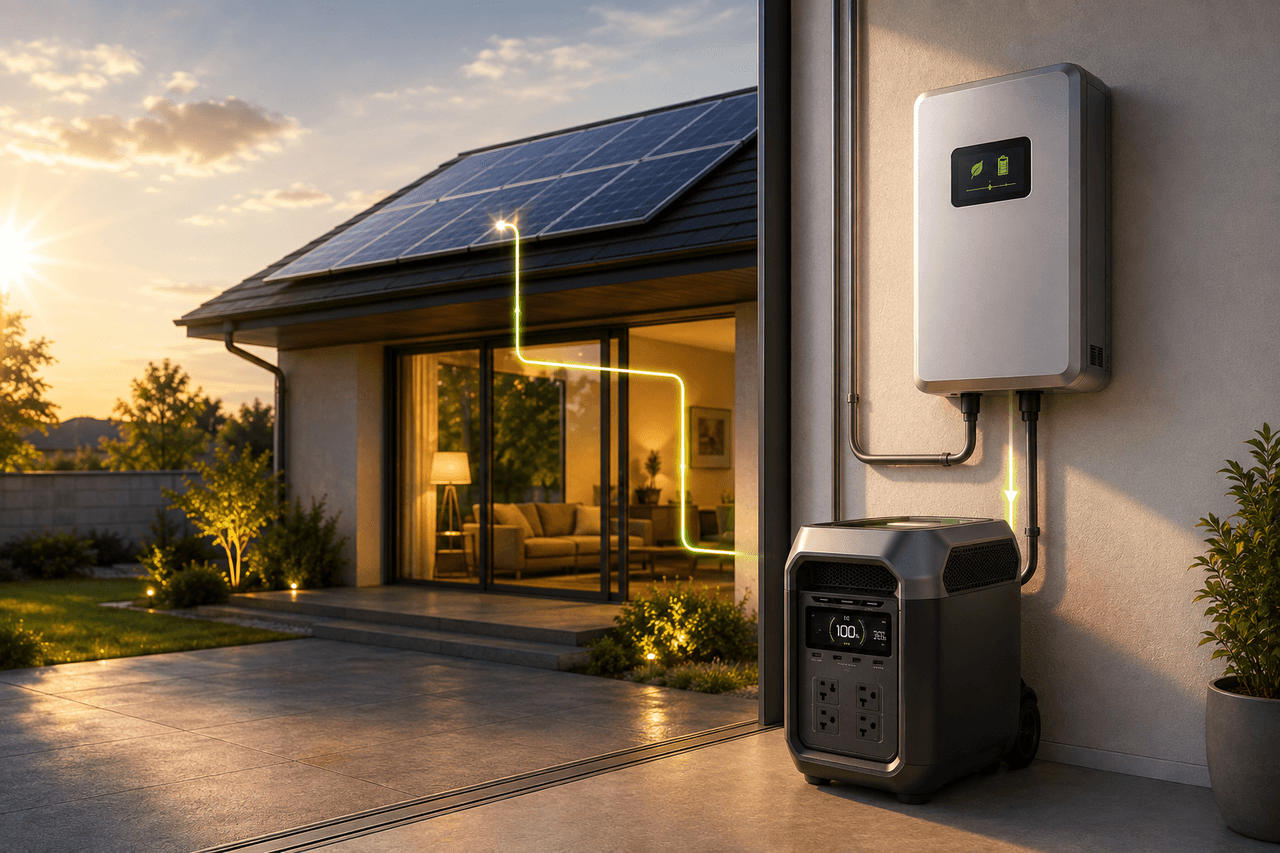
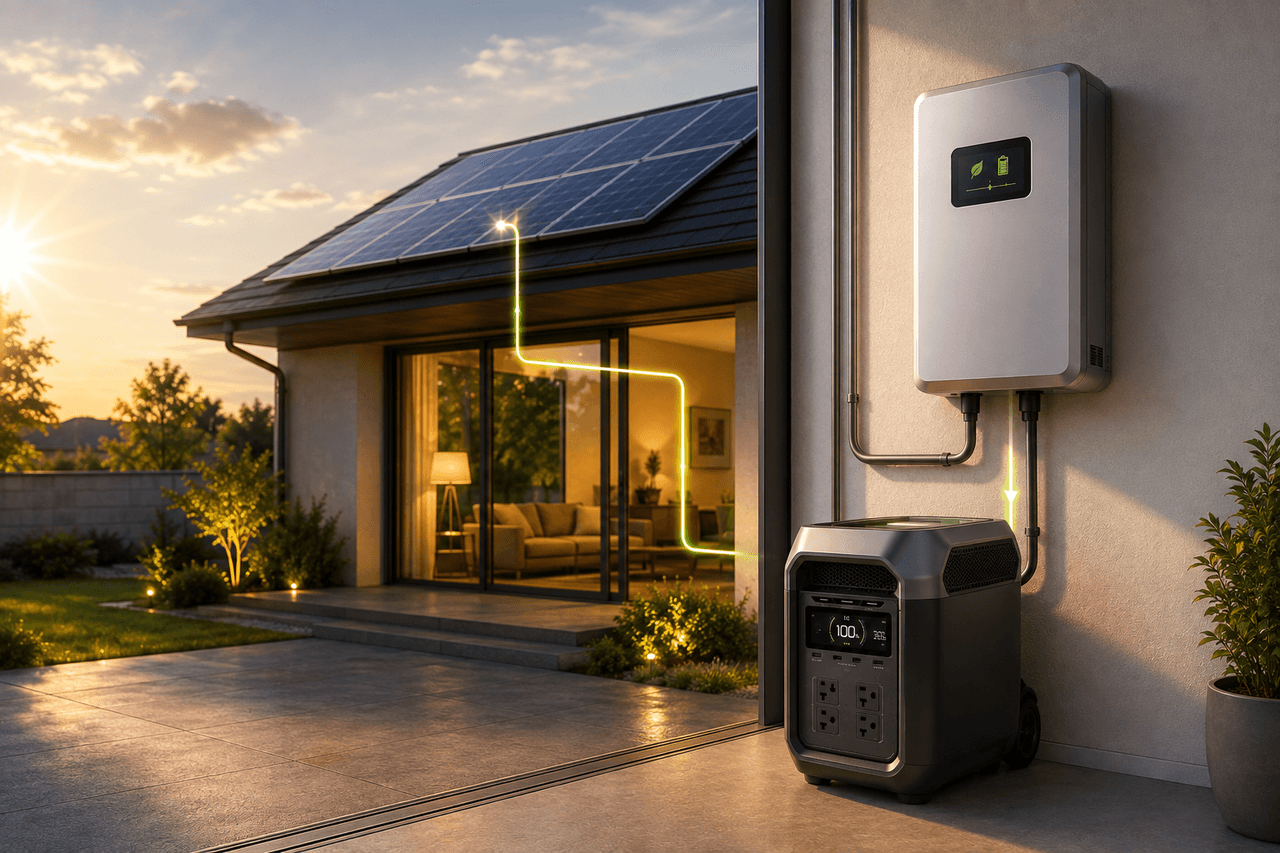
No more generator exhaust. A gas or propane generator pumps out carbon dioxide, carbon monoxide, and fine particulates the whole time it runs. Carbon monoxide is dangerous enough that Ready.gov warns never to run one indoors or in a garage. A charged battery gives off none of that, so a multi-day outage no longer means days of fumes outside your door.
Cleaner power at the worst hours. Grid electricity is dirtiest during evening peak demand, when utilities fire up carbon-heavy "peaker" plants to keep up. Store solar energy by day and use it in the evening, and you skip those hours entirely. In states with time-of-use rates, that same shift trims your bill, since peak power is also the most expensive. The U.S. Energy Information Administration tracks how demand decides which plants run.
Savings that stack up. Clean home energy lowers your utility bills while cutting emissions for good, one of the rare cases where the cheaper choice and the greener choice point the same way. A well-sized home battery setup keeps those benefits coming whether the grid is up or down.
There is also a flip side worth knowing. In some states, homeowners with solar can earn tradable clean-energy credits, often called SRECs, for the power they generate. SREC programs vary widely by U.S. state and are not available in every region. So depending on where you live, going solar can put you on the earning end of the credit market rather than the buying end.
Conclusion
So where does that leave you? Carbon offsets are not a scam, but they are not a free pass either. Treat them as a last resort for the emissions you genuinely cannot avoid, like an unavoidable flight, and only when the credit comes from a verified, well-run project. For the emissions under your own roof, the stronger move is to stop creating them in the first place. Pair solar with battery storage and you get reductions you can measure at your own meter, month after month, along with lower bills and backup power when the grid goes down. If that is the direction you want to head, take a look at EcoFlow's home battery and solar storage options and match the capacity to what your household actually needs.
FAQs
What is a carbon offset credit and how is it measured?
One credit equals one metric ton of carbon dioxide, or the equivalent in other greenhouse gases, that a verified project has prevented or removed. Registries issue and track the credits, and that standard unit is what lets very different projects be compared fairly.
What is the difference between carbon offsetting and carbon reduction?
Offsetting pays for a cut somewhere else to balance your own emissions. Reduction cuts them at the source, like running your home on stored solar instead of a generator. The usual advice is to reduce first and offset only what is left.
Do individual consumers or households need to buy carbon offsets?
No. For households, offsets are entirely voluntary. Many people get more certain, lasting impact by lowering their home emissions first and offsetting only the small remainder they cannot avoid.
How can home battery storage help lower my household carbon footprint?
By storing clean solar or cheaper off-peak power, a home battery cuts your reliance on fossil-fuel generators and dirty peak-hour grid electricity. EcoFlow's DELTA series is built to run household essentials on that stored clean energy.
Are carbon offset programs regulated by government agencies?
Most voluntary offset programs are overseen by independent standards and registries like Verra and the Gold Standard rather than a single government agency, though some formal compliance markets are regulated. Those standards are what give a credit its credibility.
For press requests or interview opportunities, reach out to our media team
media.na@ecoflow.com