How Many Watts Does an Electric Blanket Use? Wattage and Cost Guide
An electric blanket provides an energy-efficient source of heat, as it localizes the power to the core area. However, if you want to ensure your electric blanket runs safely during a winter blackout or while camping off-grid, the EcoFlow DELTA 3 Plus can keep you warm all night without draining your main battery.
But how many watts does an electric blanket use and what kind of power station will you need to run one off-grid or during a blackout? This article will answer all the questions.
How Many Watts Does an Electric Blanket Use?
Most electric blankets draw between 50 and 200 watts. Throw blankets and single-bed models are priced between the lower and higher ranges. Queen and king-size blankets with dual controls are priced at the higher end of the spectrum.
For example, if you run a typical 100W electric blanket for 8 hours over the course of one night, it will consume about 0.8 kilowatt-hours (kWh).
Energy Used= 100W x 8 hours = 800 Wh =0.8 kWh
Also, the wattage listed on your blanket’s label is for the maximum amount of power it consumes when set to the highest heat setting. Modern heating blankets have built-in thermostats and control circuitry that cycle the heating element on and off when the blanket reaches your desired temperature. Thus, you are likely to use less power per 8 hours than the max rated power.
What Changes an Electric Blanket Wattage?
Not all electric blankets draw power at the same rate. The number of watts your blanket will actually draw from an outlet or a battery depends on a few factors.
1. Size and Surface Area
The size of the blanket also affects how much energy it uses. A small blanket requires less wiring to heat it. A king size blanket covers more surface area and will require more heating elements and electric blanket wattage to warm the entire bed.
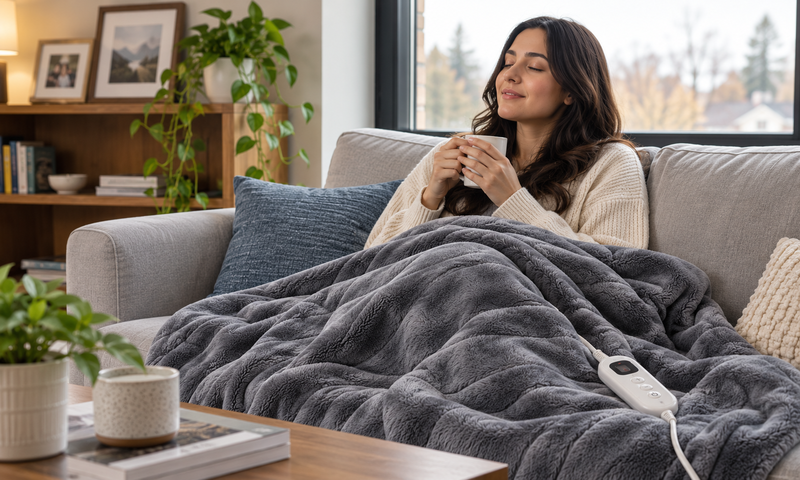
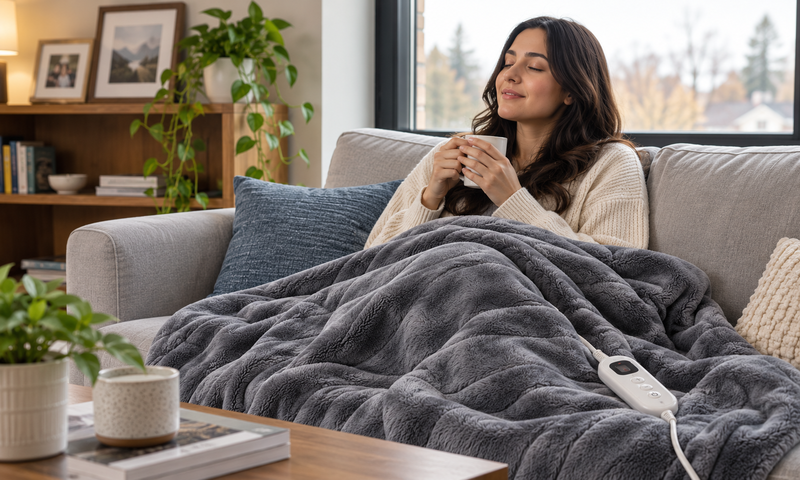
2. Heat Setting
Ultimately, the controller settings determine how much energy is used. Turn the blanket up to high and the coils will continue drawing power until they reach their maximum capacity. If the setting is low or medium, the power is turned on and off intermittently, saving many watt-hours over time.
Adjusting your heat setting directly affects total electric blanket wattage use, as lower settings draw power intermittently rather than continuously.
3. Controller Design and Dual Zones
Larger blankets are often equipped with two-zone thermostats, so two people can heat their respective sides of the bed independently. Both sides should be turned up to maximum, but turning them down to half uses the most electric blanket wattage.
How Much Does It Cost to Run an Electric Blanket?
Calculating exactly how much it costs to use an electric blanket is as simple as finding the local utility rate per kilowatt-hour (kWh).
Cost = (Wattage x Hours / 1000) x Electricity rate per kWh
Assuming the average US residential utility rate is $0.18 per kWh:
Using a 100W blanket for 8 hours:
(100 W x 8 h)/ 1000 x $ 0.18= 0.8 kWh x $$0.18 =$$ 0.14 per night
Even if you ran a larger 200W blanket at full heat all night, it would still cost about $0.29 per night, compared to running a portable space heater that can easily run over $2.00 to $3.00 for the same period.


Can You Run an Electric Blanket on a Power Station or Battery?
When taking an electric blanket for camping, boondocking, or using it during a power outage at home, the most important considerations are not just cost, but also battery life.
To determine the duration for which an electric blanket will run on a portable power station, divide the capacity of the power station (in watt-hours, Wh) by the blanket’s draw (in watts).
Estimated Runtime (hours) = Battery Capacity Wh x 0.85 / Electric Blanket Wattage (W)
Knowing electrical formulas like Watt's Law and Ohm's Law can help you quickly calculate the voltage, current, and wattage of your off-grid appliances.
If you are looking for dependable off-grid heating or emergency power, match the power draw of your blanket to the power output of the right portable power station to ensure you stay warm throughout the night.
If you are still unsure, pick up the DELTA 3 Plus if you need one or two blankets running, easy to carry in your car, plenty of space to store in the glove box, and enough for a night out camping or a power outage at home.
But if you've got a bigger set-up (think two blankets and want to have the fridge running or some lights on), the DELTA 3 Max Plus is probably the safer choice. It'll have the extra juice you need to accommodate more blankets and other items, so you don't have to choose between being warm or keeping the food cold during a winter outage.
Conclusion
Electric blankets are among the most cost-effective ways to bundle up during a cold winter. It costs less than a dollar a night to run off the grid and it is one of the cheapest ways to combat cold weather.
Electric blanket wattage is more important when planning for energy off-grid travel or backup home power. By choosing a low-wattage blanket and pairing it with a portable battery, you can keep warm all night no matter where you are.
FAQs About Electric blankets
Do electric blankets use a lot of electricity?
No. Electric blankets are among the most efficient heating devices available. They consume between 50W and 200W of energy, much less than central heating or typical 1,500W space heaters.
How many watts do I need to run an electric blanket?
To use a standard electric blanket from an AC outlet or battery inverter, you need a power source capable of running 100W-200W of continuous AC output. Most portable power stations can handle this load.
Are low wattage electric blankets worth choosing?
Yes, low wattage electric blankets (50W-80W) are great for portable power stations since they provide a warm blanket and draw minimal amp hours.
How much does it cost to have an electric blanket on for 1 hour?
At the average U.S. electricity rate of $0.18 per kWh, an electric blanket of 100W for 1 hour costs approximately 1.8 cents ($0.018).
For press requests or interview opportunities, reach out to our media team
media.na@ecoflow.com