EcoFlow DELTA 3 Ultra Plus vs. Jackery HomePower 3000 - Head to Head Comparison
For many households, portable power stations like EcoFlow DELTA Ultra Plus and Jackery HomePower 3000 represent the sweet spot for essential home backup power.
Both are also compact and lightweight to take on the road in your van or RV for reliable off-grid power.
EcoFlow DELTA Ultra Plus and Jackery HomePower 3000 have similar battery storage capacities and AC power output specs — essential metrics for any off-grid generator or battery backup system.
However, only one of the two power stations offers additional benefits like expandability and automated home energy management.
Let's explore the differences in depth.
.png)
EcoFlow DELTA Ultra Plus and Jackery HomePower 3000 Direct Comparison (Specs)
Feature | EcoFlow DELTA 3 Ultra Plus | Jackery HomePower 3000 |
|---|---|---|
Capacity | 3072Wh (Expandable) | 3072Wh (Fixed / Non-Expandable) |
AC Output (Continuous) | 3600W (4600W with X-Boost) | 3600W |
AC Surge Power | 7200W | 7200W |
Solar Input (Max) | 1600W (2x 800W ports) | 1000W Max |
RV DC Output | 30A Anderson Port (378W) | None (Standard 10A Car Port only) |
DC Input Voltage (Car/Truck) | 12V / 24V / 48V (Native Support) | 12V Only (24V Not Supported) |
USB-C Output | 140W Max (Port 1) | 100W Max |
UPS Transfer Time | < 10ms | < 20ms |
Battery Chemistry | LiFePO4 (LFP) | LiFePO4 (LFP) |
Home Transfer Switch Output | 30A (120V) w/ TOU Cost Savings | 30A (120V) Basic Backup |
Smart Features | TOU Mode, Storm Guard, X-Boost | Standard App Control |
As you can see, EcoFlow DELTA Ultra Plus and Jackery HomePower 3000 have nearly identical battery storage capacities out of the box, while DELTA 3 Ultra Plus provides 20% more continuous power output.
But to truly make an informed purchase decision, you need to take a closer look under the hood.
EcoFlow DELTA Ultra Plus and Jackery HomePower 3000 Feature Comparison
Let's dive into what makes EcoFlow DELTA Ultra Plus and Jackery HomePower 3000 different.
Scalability vs. Fixed Capacity
Storage capacity is a vital consideration for any home backup battery system.
Out of the box, Jackery HomePower 3000 and DELTA 3 Ultra Plus have the same capacity: 3072Wh.
The difference between the two power stations is expandability.
Jackery HomePower 3000 is a closed, standalone off-grid power source.
If you underestimate your electricity consumption needs between charges or find that you're experiencing longer power outages at your location, you don't have the option to add an extra battery.
You'll need to invest in another power bank if Jackery HomePower 3000's stock battery doesn't meet your needs.
EcoFlow Delta Ultra Plus, on the other hand, offers you multiple expansion options for future-proof scalability.
EcoFlow Delta Ultra Plus and Jackery HomePower 3000 Expandability Comparison (Wh)
Model | Storage Capacity (Stock) | 1 x DELTA 3 Max Extra Battery * | 2 x DELTA 3 Max Extra Battery * | 1 x DELTA Pro 3 Extra Battery * | 2 x DELTA Pro 3 Extra Battery * |
EcoFlow DELTA 3 Ultra Plus | 3072Wh | 5120Wh | 7168Wh | 7168Wh | 11264Wh |
Jackery HomePower 3000 | 3072Wh | ❌ | ❌ | ❌ | ❌ |
EcoFlow Delta Ultra Plus offers you two different pathways to expand your battery storage capacity.
Add 1 or 2 EcoFlow DELTA 3 Max Plus (2048Wh) Smart Extra Battery for a maximum of 7168Wh capacity.
Add 1 or 2 EcoFlow DELTA Pro 3 (4096Wh) Extra Battery for a maximum of 11264Wh.
You can't mix and match the 2 different models of Extra Battery, so choose carefully.
EcoFlow DELTA Ultra Plus maxes out at 11264Wh capacity.
If that's not enough, you've got options!
EcoFlow DELTA Pro Ultra X offers the ultimate in scalability with up to 184kWh of capacity.
That's over 60 times the capacity of DELTA Ultra Plus (standard) and Jackery Home Power 3000.
Chances are you don't need that much storage capacity, but unlike Jackery HomePower 3000, EcoFlow Delta Ultra Plus gives you room to grow without buying a new portable power station.
AC Output and X-Boost Technology
The primary power output spec for portable power stations and generators is continuous AC or DC output, typically measured in watts and kilowatts.
Fossil fuel generators sometimes use volt-amps (Va) and kilovolt-amps (kVa) because it represents a more accurate metric of actual power output after accounting for inefficiency, which is inherent in all internal combustion engine systems.
Continuous AC output is the equivalent of the metric you'd get by plugging to the grid. It measures the uninterrupted flow of electricity from a power source (except for minor undesirable variations, such as voltage drops and surges).
The rated power requirements of household appliances is typically measured in watts and kilowatts of continuous electricity output needed to operate the device.
For example, a 300W refrigerator requires 300W of electricity to run.
However, it requires significantly more wattage to start than it does to operate.
You rarely worry about starting watts vs. running watts when plugging appliances into your wall outlets.
The utility grid acts like an infinite reservoir of power. If your refrigerator compressor or air conditioner needs a massive spike of energy to start up, your home's circuit breaker usually lets that power flow without tripping, although the lights may dim briefly.
Portable power stations and solar generators are much less forgiving.
They rely on digital inverters that have hard limits. If an appliance demands even 1 watt over the generator's surge limit, the system will instantly shut down to protect its internal electronics.
This is where having sufficient surge power becomes critical. A higher surge rating provides more overhead for starting high-wattage motor and compressor driven appliances, like central AC or well pumps.
On paper, this category looks like a tie. Both the EcoFlow DELTA 3 Ultra Plus and the Jackery HomePower 3000 are rated for 3600W of continuous output and 7200W of surge power.
However, EcoFlow pulls ahead in real-world versatility thanks to its proprietary X-Boost technology.
While the Jackery has a hard limit of 3600W, the EcoFlow DELTA 3 Ultra Plus can power high-wattage resistive appliances rated up to 4600W (like heavy-duty dryers, heaters, or electric grills) by intelligently lowering the voltage and amperage to prevent the system from overloading.
With Jackery HomePower 3000 , if you exceed 3600W, the breaker trips.
EcoFlow's X-Boost provides a "soft landing" that keeps the appliance running.
UPS Switchover Speed (For Computers, Hard Drives, and Other Precision Electronics
Desktop computers, servers and hard drives depend on an uninterrupted power supply (UPS) to prevent data corruption and damage to sensitive components.
EcoFlow DELTA 3 Ultra Plus provides data center level UPS auto-switchover of 10 milliseconds (<10ms) or less.
Jackery HomePower 3000 offers <20ms auto-switching, which is more than fast enough if you're not a computer or hard drive.
10 milliseconds is barely the blink of an eye.
But that blink can make all the difference if you're concerned about data integrity and precision electronics in your home office or entertainment center.
RV and Van Life Compatibility
If you're planning on taking your power station on the road for extended RV trips or VanLife applications, you'll probably be grateful for the dedicated Anderson Powerpole output from EcoFlow DELTA 3 Ultra Plus.
This Anderson port allows you to plug your existing 12V fuse box directly into the portable power station, enabling you to run house lights, water pumps, roof fans, and other RV appliances directly.
Jackery HomePower 3000's 12V outlet is the equivalent of a "cigarette lighter" port, which are always hard-capped at 10 amps (10A) of power output.
EcoFlow’s 30A Anderson Port is rated for 30A (~378W), providing 3x the DC power output of Jackery's 10A cigarette port.
To use Jackery HomePower 3000 effectively in an RV or van with 12V lights and appliances, you must use the AC inverter built into the unit.
Battery power is always stored as direct current (DC) electricity and an inverter converts it to alternating current (AC) for household use.
DC-to-AC conversion is an inherently inefficiency (but often necessary)
process that leads to power loss.
In situations where DC-to-DC power is viable, it's 15-20% more efficient than converting DC to AC and back to DC again.
In such applications, Jackery HomePower 3000 is likely to expend 15-20% of its battery life in heat and overhead power loss.
EcoFlow DELTA 3 Ultra Plus's Anderson port eliminates the energy inefficiency of unnecessary double conversion.
Charging Methods
EcoFlow DELTA 3 Ultra Plus offers significantly more options to recharge the power station than Jackery HomePower 3000.
Charging Method Specifications
Charging Method | EcoFlow DELTA 3 Ultra Plus | Jackery HomePower 3000 |
|---|---|---|
AC Wall Charging | 1800W Max (Adjustable speed) | 1800W Max (Fixed speed) |
Solar Input Power | 1600W Max (2x 800W ports) | 1000W Max |
DC Input Voltage | 12V / 24V / 48V (Native Support) | 12V Only (24V Not Supported) |
Car Charging Speed | 12V/24V/48V (Up to 800W w/ Alternator Charger) | 12V Standard (~100W Limit) |
Generator Charging | Auto-Start/Stop (via EcoFlow Smart Generator) | Manual AC Connection Only |
More charging options means greater flexibility and energy security at home or on the road.
Solar Charging Input (PV)
If you're planning on using either EcoFlow DELTA Ultra Plus or Jackery HomePower 3000 with solar panels, the EcoFlow power station offers more solar charge input to get you fully charged faster.
For example, with 2 x 800W PV inputs (1600W total), you can connect up to 4 x EcoFlow 400W portable solar panels to the unit.
Jackery HomePower 3000 has a 1000W cap on solar charge input. Any electricity generated in excess of 1000W will be lost.
Home Wiring Integration (Manual Transfer Switch)
Jackery HomePower 3000 and EcoFlow DELTA Ultra Plus both provide the capability to connect to your home circuit board and wiring through a transfer switch.
Both units have multiple outputs built into the exterior, allowing them to power appliances and charge devices as standalone units.
However, if your primary application for the power station is home battery backup, integration with a transfer switch can be more convenient.
EcoFlow whole-home generator systems like DELTA Pro 3 and DELTA Pro Ultra X offer next-level home energy management capabilities by connecting to your home circuit board via an automatic transfer switch or EcoFlow Smart Home Panel 3.
EcoFlow DELTA 3 Ultra Plus and Jackery HomePower 3000 can only be connected to your home circuitry with a manual transfer switch.
That means that both units will sit idle while the grid is operational and must be manually engaged in a blackout.
To take advantage of EcoFlow's extensive home energy management features, upgrade to a true whole-home generator from the DELTA Pro Series or operate the portable power station as a standalone unit.
Smart Home Software: Automation vs. Monitoring
The ability to connect a portable power station or solar generator directly to your home wiring through a manual transfer switch is the most convenient option for many homeowners strictly shopping for reliable home backup power during blackouts.
Both EcoFlow DELTA 3 Ultra Plus and Jackery HomePower 3000 are equally well-suited for that application.
It's when you operate EcoFlow DELTA 3 Ultra Plus as a standalone unit that its smart home energy management, early warning systems, and X-Boost functionality really shine and set it apart from Jackery HomePower 3000.
EcoFlow Delta Ultra Plus and Jackery HomePower 3000 Standalone Feature Comparison
Standalone Feature | EcoFlow DELTA 3 Ultra Plus | Jackery HomePower 3000 | Why It Matters |
|---|---|---|---|
High-Wattage Support | 4600W (via X-Boost) | 3600W (Hard Limit) | X-Boost allows EcoFlow to power resistive loads (like space heaters) that exceed the rated limit without tripping, whereas Jackery will overload. |
UPS Transfer Speed | < 10ms (Server-Grade) | < 20ms | EcoFlow provides tighter protection for sensitive electronics like desktop gaming PCs and NAS drives, preventing reboots during grid flickers. |
Bill Savings (TOU) | Automated (Time-of-Use Mode) | Manual Schedule Only | EcoFlow intelligently cycles battery power during peak billing hours to lower energy costs; Jackery requires manual schedule programming. |
Storm Preparedness | Storm Guard (Auto-Detection) | Manual Intervention | EcoFlow automatically detects local severe weather alerts and prioritizes charging the battery to 100% to prepare for outages. |
Generator Automation | Auto-Start/Stop (w/ Smart Gen) | Manual Plug-in Only | When paired with a Smart Generator, EcoFlow automates recharging during long outages. Jackery requires you to physically go outside and start a gas generator. |
The benefits of a fully-integrated whole-home battery backup system paired with an automatic transfer switch or smart home panel are undeniable.
If that's what you're looking for, consider a whole home generator from the EcoFlow DELTA Pro Series.
But if you're looking for a fully featured standalone automated backup power solution for essential appliances, EcoFlow DELTA 3 Ultra Plus is hard to beat.
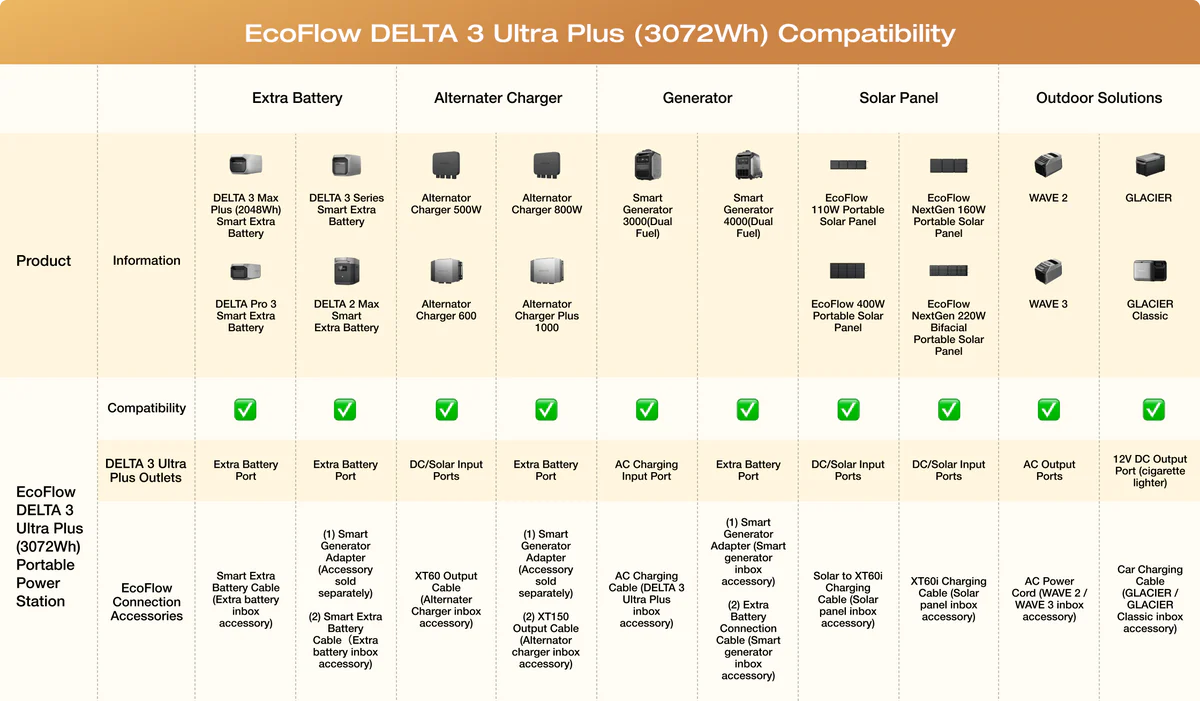
Cross-Device Compatibility
When you buy an EcoFlow portable power station, solar generator, or smart device, you're buying into an ecosystem.
As you can see from the graphic above, EcoFlow DELTA 3 Ultra Plus offers seamless integration with a wide variety of charging adapters, Smart Generators, and Smart Devices like the EcoFlow WAVE 3 portable AC/Heater and EcoFlow Glacier Portable Refrigerators.
Key Features of Portable Power Stations
When evaluating portable power stations, generators and other off-grid electricity storage devices, here are the critical factors to consider.
Power Output Capacity
Energy Storage and Expandability
Fuel Source and Efficiency
Power Quality (Clean vs. Dirty Power)
Automatic Start
Reliability
Maintenance-Free?
Portability and Indoor Use
Warranty & Lifespan
Permitting / Compliance
Final Thoughts
Rising demand and rapidly improving technology have made essential home battery backup and whole-home backup generators more accessible than ever.
Home battery storage solutions like portable power stations and solar generators offer many benefits over portable gas and conventional standby generator systems.
EcoFlow is the No. 1 portable power station brand in the world based on sales and revenue in 2024.[2]
Check out EcoFlow DELTA 3 Ultra Plus and our extensive range of off-grid and home backup power solutions today.
Resources Cited
Energy.gov. “Department of Energy Releases Report on Evaluating U.S. Grid Reliability and Security,” July 7, 2025. https://www.energy.gov/articles/department-energy-releases-report-evaluating-us-grid-reliability-and-security.
Data source: Frost & Sullivan "2024 Global Portable Energy Storage Market Report."
Product References*
EcoFlow DELTA 3 Ultra Plus Product Manual
Jackery HomePower 3000 Product Manual
*Disclosure: All specifications, performance data, and product descriptions in this comparison are drawn directly from manufacturer documentation and public datasheets as of December 2025. Information is provided for factual comparison only and may vary by region, firmware, or configuration.
Disclaimer: Jackery is a trademark of Jackery Inc. This comparison was independently conducted by EcoFlow US and is not sponsored by Jackery.
For press requests or interview opportunities, reach out to our media team
media.na@ecoflow.com