Air Cooler vs Air Conditioner: Which Is Better for Cost, Cooling & Energy
- Air cooler vs air conditioner: what’s the difference?
- Air cooler vs air conditioner electricity consumption
- Portable air conditioner vs evaporative cooler
- Dyson air cooler vs air conditioner: premium comparison
- Air conditioner vs air cooler: which is better overall?
- Air cooler vs air conditioner health and comfort
- Comfort levels in different environments
- The hidden cost: long-term electricity usage
- 5 ways to reduce cooling costs in summer
- Conclusion
- FAQs
The decision between an air cooler vs air conditioner can have a huge impact on your comfort, your electricity bill and your total energy bill. Both these systems aim at the cooling of indoor spaces, though they are completely different in operation and best for different climates, room sizes and household requirements.
When it comes to keeping your home cool during hot summer days without adding a huge cost to your electricity bill, it's important to understand how cooling systems perform and how much energy they consume. Portable evaporative coolers and air conditioners have their own advantages, disadvantages and expenses. Also, using home storage solutions can definitely lower your electricity costs.
Air cooler vs air conditioner: what’s the difference?
The primary distinction between an air conditioner vs cooler is the cooling technique they make use of. An air cooler uses evaporation to cool the air, while an air conditioner uses refrigerants and compressors to actively remove heat from indoor air.
Air coolers tend to be less expensive to purchase and use lower power in the colder months or for smaller areas. During hot and humid weather, air conditioners can deliver more powerful cooling effects with greater consistency – but they tend to use up a lot more electricity.
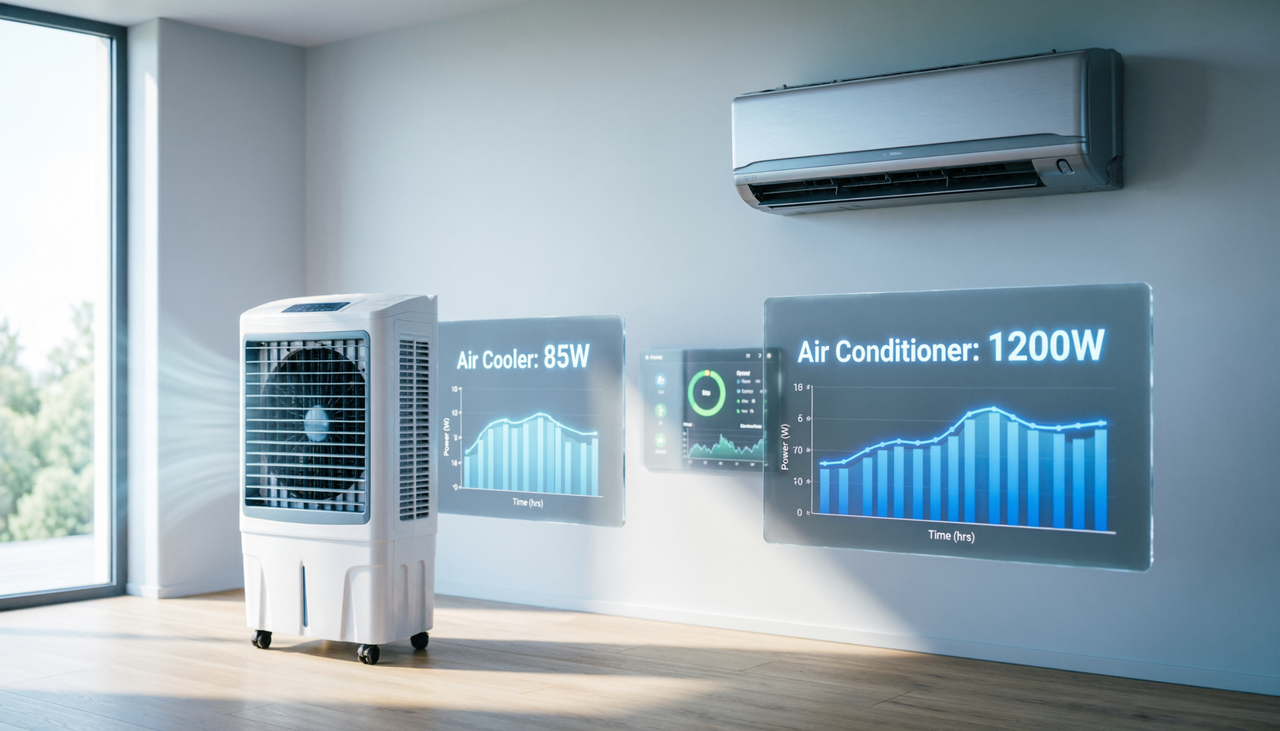
How an air cooler works (evaporative cooling)
Before you can make a comparison between an evaporative cooler and an air conditioner, you must learn how evaporative cooling works. The air coolers draw warm air through cooling pads soaked with water. As the water evaporates, the air leaving the system cools and its humidity increases.
This process is most effective on dry landforms of low moisture levels, where evaporation occurs rapidly. Air coolers typically:
A fan and water pump system should be used.
Use less electricity than air conditioners
Needs ventilation and airflow for cooling to work
Slightly raise indoor humidity
Air coolers are generally lighter, easier to move around, and have lower daily running costs, as they involve no compressors or refrigerants.
How an air conditioner works (refrigerant cooling)
An air conditioner vs cooler comparison also illustrates the air conditioner's active cooling. Air conditioners consist of refrigerant gas, compressors, and condenser and evaporator coils that absorb heat inside the house and discharge it outside.
Air conditioners differ from evaporative coolers in that:
Achieve more cooling even in moist environments
Use a more accurate temperature control device.
Decrease the humidity in the house.
Use more electricity because of the operation of compressors
This is because air conditioners are more appropriate for large houses or offices, or for extended periods during a heatwave when more stable cooling is required inside the building.
Air cooler vs air conditioner electricity consumption
Running cost is one of the main factors you have to consider when you debate air cooler vs air conditioner electricity consumption cost. Power consumption will depend on the size of the appliance, its cooling capacity, and the number of hours of use per day.
Air coolers use a lot less energy, since it is only used to run the fans and water pumps. The compressors and refrigerant systems of air conditioners use significantly more energy to keep the air in the room cool.
Typical power usage comparison (watts & cost)
The difference between the air cooler and air conditioner consumption becomes more apparent when looking at the typical consumption of each unit, which is measured in watts:
Appliance Type | Average Power Usage | Estimated Cost Per Hour (UK) |
Air cooler | 50W–200W | Low |
Portable air conditioner | 900W–1500W | Moderate to high |
Split air conditioner | 1500W–3000W | High |
For example:
A 100W air cooler consumes approximately 0.8 kWh per day over 8 hours.
A 1500W air conditioner consumes approximately 12kWh per day if it's used for 8 hours.
Evaporative coolers are several times less expensive in the summer than air conditioners are.
Monthly and seasonal running costs
An electricity cost comparison between portable air conditioner vs evaporative cooler systems for an entire summer will vary significantly. Air coolers are usually less expensive for occasional or moderate cooling, while air conditioners will save more electricity but cost more.
Seasonal changes involve:
Energy-efficient cooling systems: save on electricity bills, maintenance costs
Fridges and freezers: lower energy costs and improved cooling efficiency
For long-term use, electricity costs significantly impact operating costs.
Selecting an appropriate cooling system for a home is a decision that should consider various factors, such as comfort needs, climate, and expected electricity usage, for households concerned about higher energy bills.
Portable air conditioner vs evaporative cooler
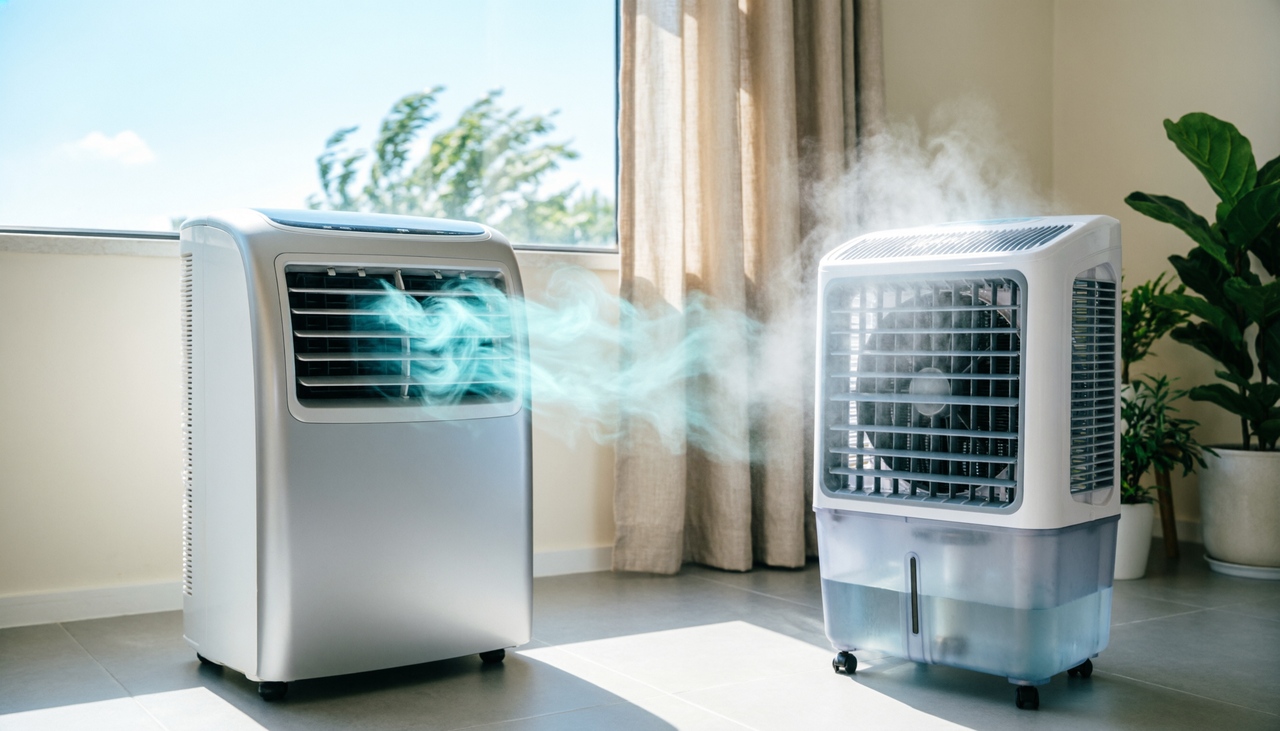
The decision to go with a portable air conditioner vs an evaporative cooler will depend on the size of the room, what you're looking to cool, and how much power you have to spend. Portable air conditioners are more effective at cooling because they actively draw heat from the room, whereas evaporative coolers are more effective for airflow and moisture-based cooling and consume less energy.
While a portable air conditioner can be used in enclosed spaces or during hotter spells in the summer, an evaporative cooler may be sufficient for many households during mild summer days.
Which is better for small spaces?
In a typical evap cooler vs air conditioner comparison for a small bedroom, small office or studio apartment, this is often about ventilation. Evaporative coolers are most effective in areas with open-air circulation and limited space to cool. Portable air conditioners work best in closed rooms with greater cooling requirements.
In compact UK spaces, during the warmer months, portable cooling systems are increasingly helpful, as they provide cooling without proper installation, wherever you are comfortable. Products such as the EcoFlow WAVE 3 Portable Air Conditioner are designed to provide cooling to smaller indoor areas, such as caravans and temporary workspaces. The add-on battery offers up to 8 hours of uninterrupted use, perfect for a full night of restful sleep, whether you are tent camping or having outdoor fun in distant places. This unit offers both cooling and heating solutions and can be managed through the EcoFlow application.
When we compare with common evaporative coolers, portable air conditioners generally provide much better performance in humid UK weather. These air conditioners use refrigerant cooling rather than relying solely on air flow and water evaporation. However, evaporative coolers can still remain a suitable option for users who are looking for lighter cooling needs
Which is more cost-effective?
When it comes to air coolers vs air conditioners electricity consumption, evaporative coolers can definitely be much cheaper in the long run.
When you use an air cooler, you use much less electricity.
The portable units use more watts because they have compressors.
Evaporative coolers are typically cheaper to buy.
Electricity bills are higher in summer because the air conditioners consume more electricity.
Evaporative coolers may be the more economical choice for homes focused on energy savings, particularly if they are used only on a limited basis.
Dyson air cooler vs air conditioner: premium comparison
There is a slight difference between a Dyson air cooler and an air conditioner, since the latter offers more heavy-duty cooling power than the former, with airflow, purification, and comfort. Dyson air coolers circulate air effectively and use less power, and when it comes to cooling, air conditioners use more power as it gets hotter.
Dyson air coolers might be a cost-effective alternative to conventional air conditioners for UK households that only need cooling during brief summer spells.
Air conditioner vs air cooler: which is better overall?
There is no definite answer as to which is better than an air cooler or an air conditioner as this will depend on the climate and cost of the unit as well as the comfort level expected. Air conditioners are more powerful, can maintain the temperature more effectively and air coolers are cheaper in operating cost and more energy efficient.
Households with a focus on reducing their electricity costs are more likely to use an air cooler, whereas those seeking higher cooling during hot spells are more likely to use air conditioning.
Cooling performance vs cost
The primary difference between the biggest air cooler and air conditioner is its cooling power and running cost. Air conditioners cool rooms more quickly and keep the temperature lower, but they use much more electricity.
In moderate climates where cooling is not required for extreme conditions, air coolers offer a more gentle cooling and a higher level of energy efficiency.
Best option for UK climate
If you are just comparing air coolers and air conditioners for the vast majority of the homes in the UK, air coolers will be the preferable option for the average summer. In contrast to hotter countries, many homes in the UK do not need to be constantly cooled by air conditioning systems.
Air conditioners are more useful during heat waves or in homes that are poorly ventilated, but when there's occasional use and electricity costs are important then air coolers are more useful options.
Air cooler vs air conditioner health and comfort
When considering the air cooler or an air conditioner's health, it is often the long-term humidity, air quality, and comfort that are the main topics of debate. Both have different effects on the indoor environment, which can affect personal comfort levels.
Air coolers increase the moisture in the air and air conditioners take moisture out of the air and reduce humidity!
Air quality and humidity differences
The difference between an air conditioner vs a water cooler is that the latter maintains the natural humidity level in the rooms, and some people enjoy the dry and humid weather better. Air conditioners dehumidify but help to cool the room faster, and may cause the air to become dry for extended periods of time.
This difference may cause problems for people who are sensitive to dry air or who don't enjoy breathing.
Comfort levels in different environments
Climate and room conditions are important in determining comfort levels. Evaporative coolers can be used with little electricity and provide a refreshing sensation in dry, or slightly warm, weather. Air conditioners are generally more effective and stable in cooling when it is humid or very hot.
The decision between an air cooler vs air conditioner comes down to the extent of cooling you require and the amount of electricity that you are prepared to consume for your day to day comfort.
The hidden cost: long-term electricity usage
Appliance cooling can be inexpensive in the short term, but the costs can add up over time when the electric bill is tallied. The electricity consumption difference between air cooler and air conditioner is more pronounced during the summer season when the air cooler is in use for long periods of time.
Although the cooling unit may be efficient, it can add up to the cost of electricity in the home over time, particularly with fluctuating electricity costs in the UK. When homes make use of portable air conditioners often, electricity expenses during the summer months can be a significant portion of home utility bills.
How to reduce cooling costs with smarter energy use
The first step to lower cooling costs is to take a more efficient approach to cooling your home and your appliances. By leveraging efficient cooling methods and renewable energy sources, households can significantly reduce their power consumption and running costs of air coolers, and air conditioners.
They can do this by:
For cooler parts of the day, cooling appliances are used.
Cleaning up the house with fresh air and insulation.- Clearing the home and freshening up the air.
Selecting energy-efficient cooling systems
Eliminating costly peak hour electricity consumption
Combining cooling applications with solar generation and battery storage will further reduce reliance on the grid and help stabilise long-term electricity costs.
EcoFlow STREAM solutions for powering cooling appliances
Home battery storage systems are becoming popular among households that want to manage electricity costs and use appliances more efficiently. During peak demand, the stored solar energy can be used to run cooling appliances, reducing their ongoing energy consumption.
EcoFlow STREAM Ultra X Home Solar Battery
The EcoFlow STREAM Ultra X Home Solar Battery is the answer for families who wish to have a more intelligent energy management system in their daily lives and who are seeking more efficient energy using for cooling appliances. It stores surplus solar energy for the day, and use it when the demand outweighs the supply from the solar panels, thus lowering the use of expensive grid electricity.
This is particularly helpful for running portable air coolers, fans, small air conditioners, and other common household items during the hot summer months. It provides an intelligent energy-management solution, delivering homeowners long-term energy savings while keeping them warm and comfortable.
EcoFlow STREAM Ultra/Pro/Max Home Solar Battery
The EcoFlow STREAM Ultra/Pro/Max Home Solar Battery system is suitable for homes that consume more electricity and have larger cooling needs. The system integrates cutting-edge energy storage technology and solar panels to generate electricity, allowing homeowners to lower their electric bills while ensuring a steady power supply for major appliances.
It is suitable for homes that often use portable air conditioners, more than one cooling unit, entertainment systems and kitchen appliances. It allows customers to save electricity generated by them during the day and consume it at a later time when electricity demand is greater and electricity prices are higher.
5 ways to reduce cooling costs in summer
Use cooling appliances only when needed
One of the easiest ways to lower the air cooler vs air conditioner electricity consumption is to avoid running cooling devices continuously. In summer, be sure to switch appliances off when nobody is around, as this will definitely help to cut your energy bills.
Improve airflow inside your home
The rooms have better airflow, which means they naturally feel cooler. Keeping windows open during cooler evening hours and draping them to prevent direct sunlight will help keep heat out, thereby reducing the need for costly cooling systems.
Choose energy-efficient cooling appliances
Today's cooling appliances are built to be more cost and energy efficient, but still provide the same level of comfort. A key factor in comparing air conditioner vs cooler systems is to look at the wattage and efficiency ratings, as this can help to reduce the costs of running the equipment in the long run.
Use fans together with cooling systems
Operating a fan in parallel with an air conditioner can be a help in distributing the cool air and thus the air conditioner can be set at a cooler setting. This simple change can save on energy consumption and keep the home comfortable.
Combine cooling with solar energy storage
Households can use cooling appliances while relying less on costly grid electricity, thanks to solar panels and home battery storage. This method is gaining popularity in lowering summer electricity bills and to achieve long term energy efficiency in households.
Conclusion
The decision between an air cooler vs an air conditioner will come down to the cooling needs, budget and long-term electricity priorities. Air coolers have lower running costs and energy efficiency, whereas air conditioners provide much better cooling performance in hotter weather. As energy prices continue to move up and down, most UK households are increasingly concerned about reducing their energy bills whilst keeping their homes warm and cosy.
The correct cooling equipment is only part of the equation; using electricity more wisely can help achieve even greater savings. The integration of energy-efficient cooling systems with solar power and battery storage, like the EcoFlow STREAM series, can enable households to minimise reliance on power from the grid, reduce annual cooling expenses, and achieve year-round energy stability.
FAQs
Is an evaporative cooler effective in humid weather?
In the humid environment, an evaporative cooler vs air conditioner comparison becomes particularly crucial. Evaporative coolers are based on the evaporation of water and the less effective the cooling the higher the humidity. These circumstances may result in reduced cooling performance compared to a traditional air conditioning system.
Evaporative coolers are best suited for dry climates.
Due to the high humidity, evaporation efficiency is lowered.
During humid weather, air conditioners typically work better.
Evaporative coolers may still function effectively on mild and moderately dry summer days for households in the UK. However, air conditioners may be more effective in providing a steady cooling effect on humid heatwaves.
Do air coolers use water continuously?
Yes, indeed, it is common practice to use water in most air coolers for cooling. A difference between an air cooler and an air conditioner is that air coolers use water-soaked cooling pads to cool the air naturally.
The volume of water that can be used is dependent on:
Room temperature
Humidity levels
Cooling duration
Fan speed settings
Most of the home air coolers are built to work effectively and generally need to be refilled once in a while and do not require regular maintenance.
Which cooling option is quieter for bedrooms?
Many make the air cooler than the portable air conditioners which are used in the bedrooms of many households. A Dyson air cooler vs air conditioner comparison also reveals that the best air coolers are often designed to produce quieter air flow and night comfort.
Portable air conditioners typically make more sound due to:
Compressor operation
Exhaust systems
Stronger cooling fans
If you are a light sleeper or have a smaller bedroom, you may find that quieter air coolers will cool you down better while you sleep.
Can solar energy help power cooling appliances?
Yes, solar energy can be used to power fans, air coolers, and some air conditioners efficiently. With air cooler vs air conditioner power consumption becoming a growing issue for electricity bills, many homeowners are installing air coolers and solar panels with battery storage.
Electricity is produced by solar panels during daylight hours.
Energy can be stored in home batteries for later use.
Energy stored can be used to power cooling equipment during the peak period.
This reduces the need for grid electricity and can make a big difference in your household's energy savings over the long term in warmer weather.