EV Tax Credit Canada Guide: Charging and Powering Your EV with EcoFlow
Thanks to new federal incentives and better home charging solutions, electric vehicles (EVs) are now cheaper than ever in Canada. But to really get the most out of your savings, it’s not just the upfront rebate you should consider, but also where and how you charge.
Charging your electric vehicle at home can save significant money, especially when paired with renewable energy systems and backup batteries. This guide breaks down the latest federal EV incentives, the cost of charging at home, and how EcoFlow can power your vehicle more efficiently.
What EV Incentives Are Available in Canada?
Canadians can benefit from numerous solar power rebates and other sustainability incentives. For instance, we can take advantage of the newest federal Electric Vehicle Affordability Program (EVAP) that applies to all EVs purchased or leased on or after February 16, 2026. The program will be accepting applications on March 31, 2026.
The EVAP offers incentives for electric vehicles made in Canada or in countries that have free-trade agreements with Canada. These incentives include:
up to $5,000 for battery-electric and fuel cell electric vehicles
up to $2,500 for plug-in electric-gas hybrid vehicles
Additional incentives for purchasing electric vehicles and installing Level 2 EV chargers may be available at the provincial and municipal levels, so be sure to research your area for more information.
Why Home EV Charging Matters for Canadian Drivers
Home EV charger installation is crucial for Canadian drivers, as it’s the most convenient and affordable way to charge your electric vehicle. Simply plug it in when you get home from work, and it’s ready for you the next day.
Also, for those of us who live in more rural areas, having a charger at home for your vehicle makes it a viable option if you live far from a charging station.
Another important benefit of having a home charger is that you can even charge your vehicle during a power outage using a whole home generator.
The Cost of Charging an EV at Home in Canada
While some free charging stations are out there, they are typically slow chargers available at places like shopping malls to encourage you to shop there. Paid charging stations are generally much faster, but they also charge a lot more than you would pay at home using your own power.
A slow, Level 1 overnight charger usually comes free with your vehicle that you plug into a standard wall outlet. However, Level 2 chargers are much faster, and you won’t have to wait all night to get a charge. These typically cost around $2000 when fully installed, including labour, supplies, and any necessary permits or inspections, although you may have provincial rebates to help reduce the cost.
Still, once installed, you’ll pay roughly ⅓ to ⅕ of what you might pay at a public charging station, depending on your electricity rates. This translates into about $7–$12 for a full charge at home compared to $15–$25 or more at public charging stations. In provinces like British Columbia and Quebec with cheap hydropower, you can save significant money. Even in provinces like Alberta, which have high electricity rates due partly to a heavy reliance on natural gas, you will still pay less charging at home.
And, if you use solar panels to charge your EV, after you pay for the cost of your panels, your charging could be free for 20 years!
How EcoFlow Supports Home EV Charging
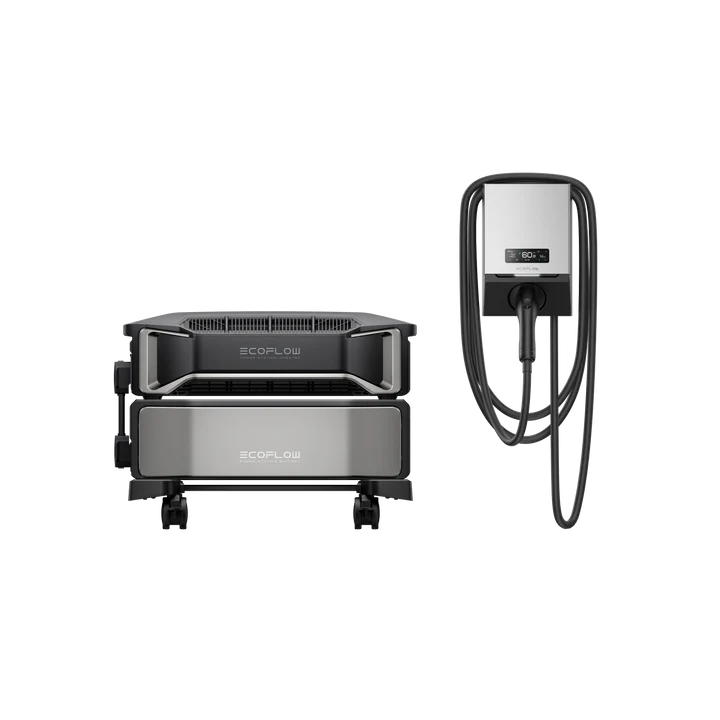
With the EcoFlow DELTA Pro ULTRA + PowerPulse EV Charger (9.6kW), you can add up to 35 miles of range per hour (based on a Tesla Model 3 under ideal conditions), helping reduce charging time and making overnight charging more convenient for most EVs.
The fast charger delivers up to 40A and 9.6kW of output, and it seamlessly integrates with the EcoFlow DELTA Pro Ultra and EcoFlow Smart Home Panel 2. That way you can automatically optimize your household power, EV charging, appliances, and backup systems. Smart charging modes help prioritize excess solar energy or off-peak electricity rates to reduce charging costs.
The included 25-foot cable provides flexible parking options, while plug-and-play compatibility with NEMA 14-50 outlets means no hardwiring is required if an outlet is already installed. With a NEMA 4 rating, the charger is built to withstand harsh weather conditions for reliable outdoor use.
Another benefit of having a whole-home backup power solution is that if the grid fails during an emergency, you can still charge with battery backup. Then you can still evacuate or seek medical help even when gas drivers can’t because the pumps are shut down.

Frequently Asked Questions
Is there a federal EV tax credit in Canada?
Yes, the new federal Electric Vehicle Affordability Program offers up to $5,000 for battery-electric and fuel cell electric vehicles and up to $2,500 for plug-in electric-gas hybrid vehicles for all EVs purchased or leased on or after February 16, 2026.
Is It Cheaper To Charge an EV at Home in Canada?
It’s always cheaper to charge an EV at home than using a public paid charging station. Generally speaking, you may pay $7–$12 for a full charge at home compared to $15–$25 or more at public charging stations.
Understanding Incentives Helps Maximize EV Savings
Canada’s federal EV incentives are making it easier than ever to switch to electric, reducing your upfront costs by up to $5000. In addition to provincial rebates that you may also get for your EV or charger, you can save even more money when you charge at home.
Pairing your electric vehicle with an EcoFlow DELTA Pro ULTRA + PowerPulse EV Charger (9.6kW), means you can charge faster and more efficiently, taking advantage of AI modes that automatically charge your vehicle with the cheapest and/or cleanest energy available. The battery within it also means you can even charge your EV when the grid goes down.