Best Apple Wireless Chargers to Buy in 2026
- Key Factors to Consider Before Buying an Apple Wireless Charger
- MagSafe vs. Qi2: What Apple Users Need to Know in 2026
- Compatibility Guide for iPhone, AirPods, and Apple Watch
- How We Chose the Best Apple Wireless Chargers Featured in This List
- The Top Apple Wireless Chargers Worth Buying in 2026
- Conclusion
- FAQ
If you use multiple Apple devices, the tangle of cables for your iPhone, AirPods, and Apple Watch can quickly become frustrating. As wireless technology continues to mature, cutting the cord is no longer a convenience, it’s the expected standard. In 2026, with Qi2 now firmly established alongside Apple’s own MagSafe, the wireless charging market offers faster speeds and better alignment than ever before, but it can also feel more complex to navigate.
Whether you’re recharging your devices after a weekend ski trip in Whistler or streamlining a home office setup in downtown Toronto, choosing the right wireless charger matters. Charging speed, safety, and design all play a role in how seamlessly your devices fit into daily life. This guide breaks down the current options and highlights the best Apple wireless chargers available in 2026, helping you power your entire Apple ecosystem efficiently and with confidence.
Key Factors to Consider Before Buying an Apple Wireless Charger
Before clicking “Add to Cart,” taking a moment to understand charging standards and specifications can save you from slow performance and unnecessary upgrades. In 2026, the difference between an average charger and a great one often comes down to certification, power delivery, and long-term reliability. These are the factors that matter most when choosing an Apple wireless charger today.
1. Charging Speed and Wattage
Charging speed directly affects how quickly your device is ready to go again. For MagSafe enabled iPhones, the maximum wireless charging speed is 15W, but only when paired with a properly certified MagSafe charger. Standard Qi wireless charging typically tops out at 7.5W for iPhones. If you’re considering a multi-device charging station, check the wattage allocated to each charging pad, as power is often split unevenly between the iPhone, Apple Watch, and AirPods.
2. Certified MagSafe vs. Qi2 Compatibility
Wireless charging in 2026 revolves around two main standards. Certified MagSafe chargers are Apple approved and deliver the full 15W charging speed with precise magnetic alignment. Qi2, the newer open standard built on Apple’s magnetic technology, also supports 15W charging and consistent alignment for compatible devices. Chargers described only as “MagSafe compatible” usually offer magnetic attachment but are limited to 7.5W charging, which can feel noticeably slower in daily use.
3. Heat Management and Safety Features
Higher charging speeds naturally produce more heat, and how a charger manages that heat matters. Poor thermal control can slow charging through throttling and may affect long-term battery health. Look for features such as temperature regulation and Foreign Object Detection (FOD), which help ensure safe operation. This is particularly important for overnight charging, a common routine in households across Canada.
4. Build Quality and Material Durability
A wireless charger is something you’ll use every day, so construction quality matters. Materials like aluminium, reinforced plastics, and woven fabrics tend to hold up better over time than cheaper alternatives. For chargers designed to travel, such as compact power banks or foldable stations, strong hinges and reinforced connection points are especially important for long term durability.
5. Power Adapter Requirements
Many high speed wireless chargers do not include a wall adapter, which can lead to disappointing charging speeds if paired with an underpowered plug. To achieve full 15W MagSafe or Qi2 performance, a power adapter rated at 20W or higher is typically required, preferably one that supports USB Power Delivery (PD). Always confirm adapter requirements before purchasing.
6. Device Compatibility Across Apple Products
If you regularly charge an iPhone, Apple Watch, and AirPods, a 3-in-1 charging station offers the most streamlined setup. Make sure the station supports Apple Watch fast charging for newer watch models and that the AirPods charging area is compatible with wireless charging cases. Verifying these details upfront ensures all your devices charge efficiently without compromise.
MagSafe vs. Qi2: What Apple Users Need to Know in 2026
The shift to magnetic wireless charging has changed how Apple devices are powered, but it has also introduced new terminology that can be confusing at first glance. While MagSafe and Qi2 rely on magnetic alignment for better performance, there are important differences and expectations Apple users should understand in 2026 before choosing a charger.
Charging Speed Differences
Certified MagSafe accessories deliver up to 15W of wireless charging to supported iPhones, which remains the benchmark for fast, cable-free charging. Qi2, the newer open standard, is designed to match this exact performance. A Qi2-certified charger also delivers 15W alongside magnetic alignment, closing the performance gap that existed with older Qi chargers. In practical terms, seeing a Qi2 logo in 2026 means you can expect the same top charging speed as a MagSafe-certified product.
Magnetic Alignment and Strength
Both MagSafe and Qi2 use a built-in magnetic ring to keep the phone perfectly aligned with the charging coils. This precise positioning improves efficiency and consistency, especially during quick, everyday charging moments. Whether you’re dropping your phone onto a charger while heading out to catch a ferry or setting it down between meetings, magnetic alignment removes the guesswork that older flat charging pads required.
Supported iPhone and Accessory Models
MagSafe charging is supported on iPhone 12 and newer models. Qi2 support begins with iPhone 13 and newer devices, provided they are running compatible iOS updates. Looking ahead, Qi2 is expected to become the common standard across a wide range of accessories and brands, making it easier to mix and match chargers without sacrificing performance.
Practical Efficiency and Heat Management
Because both standards guarantee proper alignment, MagSafe and Qi2 chargers are generally more energy-efficient than traditional non-magnetic Qi pads. Less energy is lost through misalignment, which reduces heat buildup during charging. Chargers designed with efficiency in mind, such as the EcoFlow RAPID Mag Wireless Charging Station (3-in-1 Foldable), focus on directing more power to your devices and less into excess heat, supporting long-term battery health.
Certification Labels to Check
To ensure full charging speed and safety, always check for clear certification markings. Understanding these labels helps ensure you’re getting the performance you expect and not settling for slower charging disguised by magnetic convenience.
Made for MagSafe (MFM) indicates full Apple certification and guaranteed 15W charging.
Qi2 Certified confirms support for the new 15W magnetic wireless charging standard.
MagSafe Compatible means magnetic attachment is supported, but charging speed is typically limited to 7.5W.
Compatibility Guide for iPhone, AirPods, and Apple Watch
Apple’s ecosystem offers excellent cross-device integration, but wireless charging compatibility can still vary depending on model generation and charger design. Understanding these nuances helps ensure all your devices charge efficiently, especially when using a shared or multi-device setup.
MagSafe Charging Differences Across iPhone Generations
All MagSafe capable iPhones, starting with iPhone 12, work with MagSafe chargers, but charging behaviour can differ slightly between generations. Newer Pro models tend to handle sustained wireless charging more effectively thanks to improved internal thermal management, which can result in more consistent speeds over longer sessions. It’s also worth noting that some older MagSafe chargers may require firmware updates to fully support Qi2-certified devices, particularly as standards continue to evolve.
Wireless Charging Performance Variations Among AirPods Models
Not all AirPods cases offer the same wireless charging experience. AirPods (2nd generation with Wireless Charging Case), AirPods (3rd generation), and all AirPods Pro models support standard Qi wireless charging. However, only AirPods Pro (2nd generation) and later cases support MagSafe, which provides magnetic alignment and a more reliable charging position. This distinction becomes especially noticeable when using vertical or angled charging stands.
Fast-Charge Requirements for Apple Watch Series
Apple Watch fast charging is supported on Series 7 and newer models, allowing the battery to reach around 80 percent in roughly 45 minutes under the right conditions. This feature requires a dedicated Apple Watch Fast Charging module. When choosing a 3-in-1 charging station, always confirm that the Watch charging puck is clearly identified as supporting fast charging, as standard Watch chargers will still work but at noticeably slower speeds.
Case Thickness and Accessory Impact on Magnetic Alignment
Phone cases can significantly affect wireless charging performance. Cases thicker than roughly 3 mm may weaken the magnetic connection, leading to misalignment or reduced charging speeds. For best results, use cases specifically labelled as MagSafe compatible or Qi2-compatible, ideally with an integrated magnetic ring. This helps maintain strong alignment and ensures your iPhone can consistently reach full 15W charging speeds.
Power Distribution Limits on Multi-Device Charging Stations
Power sharing is an important consideration with multi-device chargers. Even if a charging station is connected to a high wattage adapter, such as a 65W power supply, that energy is divided across devices. A well designed 3-in-1 station typically allocates power along these lines: up to 15W for an iPhone using MagSafe or Qi2, around 5W for an Apple Watch using fast charging, and approximately 5W for AirPods. Ensuring the combined demand stays within the station’s input limits prevents slowdowns. For a clean, reliable desk setup in an Ottawa apartment or home office, the EcoFlow RAPID Mag Wireless Charging Station (3-in-1) handles this distribution smoothly and consistently.
How We Chose the Best Apple Wireless Chargers Featured in This List
Choosing the “best” wireless chargers requires more than confirming a 15W rating on the spec sheet. Our evaluation focused on how each charger performs in everyday scenarios, from desk use at home to portable charging on the road. The goal was to identify products that deliver consistent performance, strong build quality, and real long-term value for Apple users in 2026.
1. Performance and Charging Curve Testing
We measured how quickly each charger brought an iPhone to 50 percent and 80 percent battery, while closely monitoring the charging curve throughout the session. A high-quality charger maintains its peak charging speed for as long as safely possible before gradually tapering off. To ensure fair comparisons, we used the 10,000 mAh Anker MagGo Power Bank as a reference point when testing chargers with more demanding power profiles.
2. Magnetic Alignment and Stability Evaluation
Magnetic strength and alignment were tested through intentional misplacement and movement. The strongest chargers snapped into position immediately and held securely even when the phone was lifted or repositioned. This stability is especially important for portable use, such as charging in a car or during a long drive across the Prairies, where vibration and movement are unavoidable.
3. Thermal Performance and Safety Metrics
Heat management played a major role in our rankings. Using a thermal camera, we monitored surface temperatures on both the charger and the device during peak charging periods. Chargers that delivered fast speeds while keeping temperatures under control performed best, as excessive heat can reduce charging efficiency and affect battery longevity over time.
4. Build Quality and Long-Term Reliability
We evaluated materials, construction, and overall durability, paying attention to details like surface finishes, cable reinforcement, and hinge strength on foldable designs. A good wireless charger should tolerate daily use, whether it’s being packed into a gym bag, carried during travel, or sitting on a cluttered desk year after year without losing stability or performance.
5. Price-to-Value Assessment
Finally, we weighed performance and features against price. A higher cost is justified when a charger offers certified 15W wireless speeds, fast Apple Watch charging, solid thermal control, and durable construction. Products that balanced these elements effectively stood out as the best overall choices for Apple users looking to invest once and use confidently for years.
The Top Apple Wireless Chargers Worth Buying in 2026
After extensive hands-on testing and side-by-side comparison, a few wireless chargers clearly stand out for their balance of speed, reliability, and thoughtful design. These options deliver consistent performance in real-world use and represent the strongest choices for Apple users in 2026.
Best Essential MagSafe Charger for Routine Power-Ups
For users who value simplicity and guaranteed compatibility, Apple’s own solution continues to set the baseline.
Apple MagSafe Charger
As an Apple designed accessory, this charger offers seamless integration with iOS, dependable 15W MagSafe charging speeds, and automatic firmware support through Apple updates. It does exactly what it promises without added complexity. This makes it an ideal choice for a minimalist desk setup, a bedside charger, or a dedicated spot for quick top-ups throughout the day.
Best Portable and Travel-Friendly Apple Wireless Chargers
When portability matters, whether you’re flying from Toronto to Vancouver or spending time outdoors, flexibility and dependable power become essential.
EcoFlow RAPID Mag Power Bank (Built-in Cable)
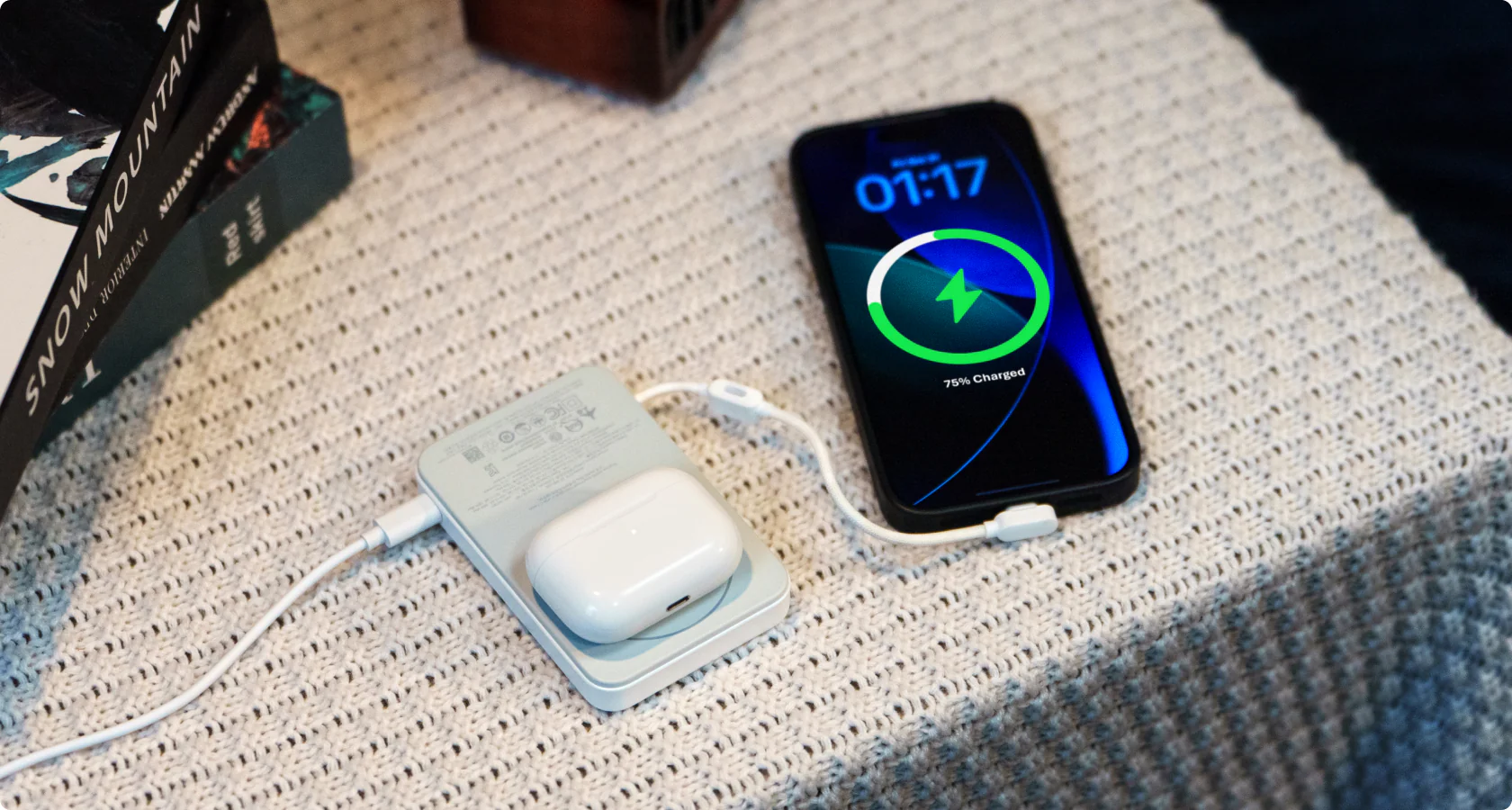
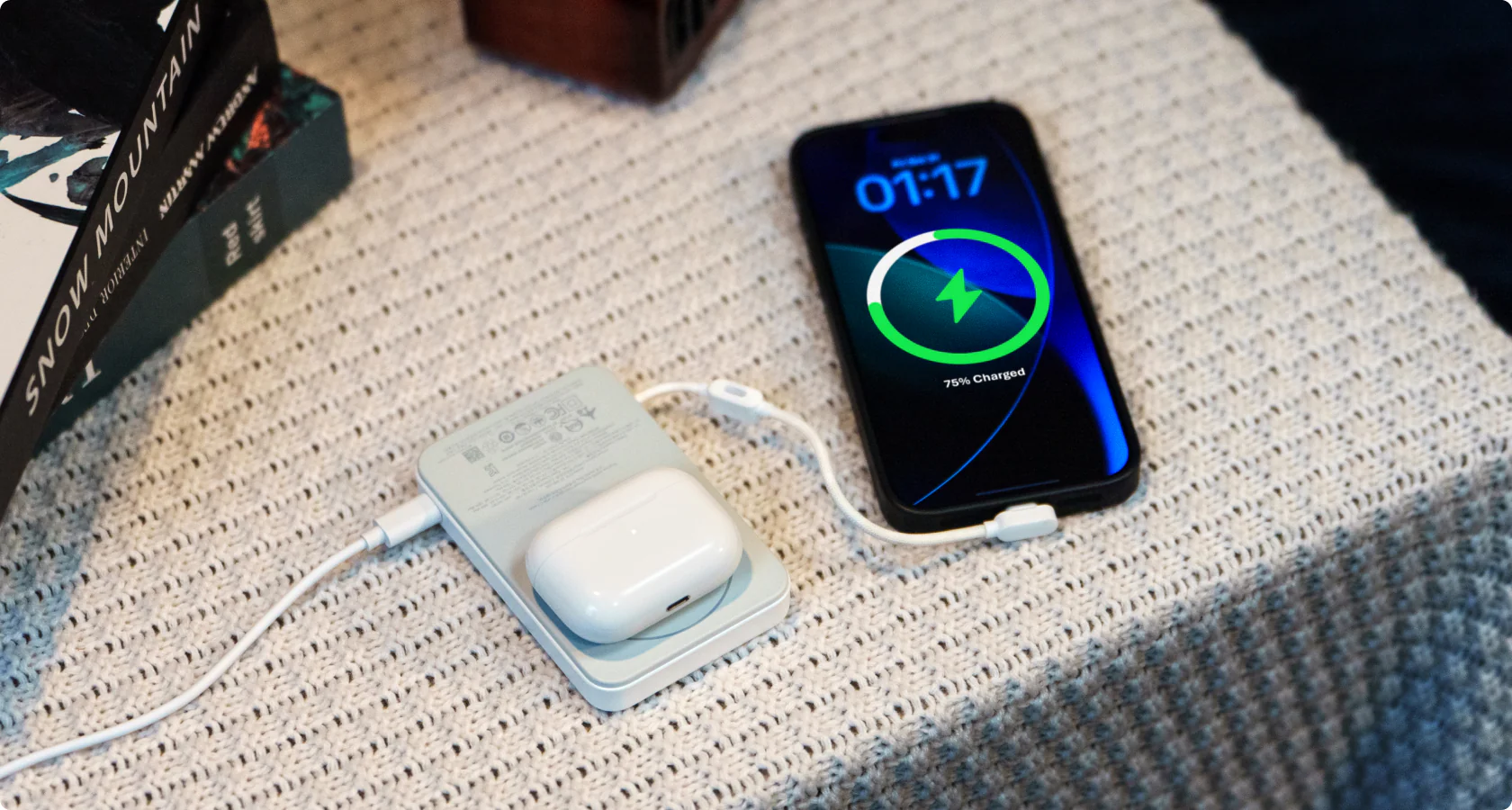
The EcoFlow RAPID Mag Power Bank (Built-in USB-C Cable) stands out for how well it adapts to different charging scenarios. It combines magnetic wireless charging for iPhones with the speed and reliability of a built-in USB-C cable. When outlets aren’t available, it works as a wireless charging pad for your phone, making it useful at airports, cafés, or even remote campsites near Banff National Park. The integrated cable adds another layer of practicality, allowing fast wired charging for larger Apple devices like an iPad. This dual approach makes it a strong all-around travel companion for Apple users who don’t want to carry multiple accessories.
Best 3-in-1 Apple Charging Stations for Your Workspace
For users who rely on the full Apple lineup, a single, well designed charging hub can simplify daily routines significantly.
EcoFlow RAPID Mag Wireless Charging Station (3-in-1)
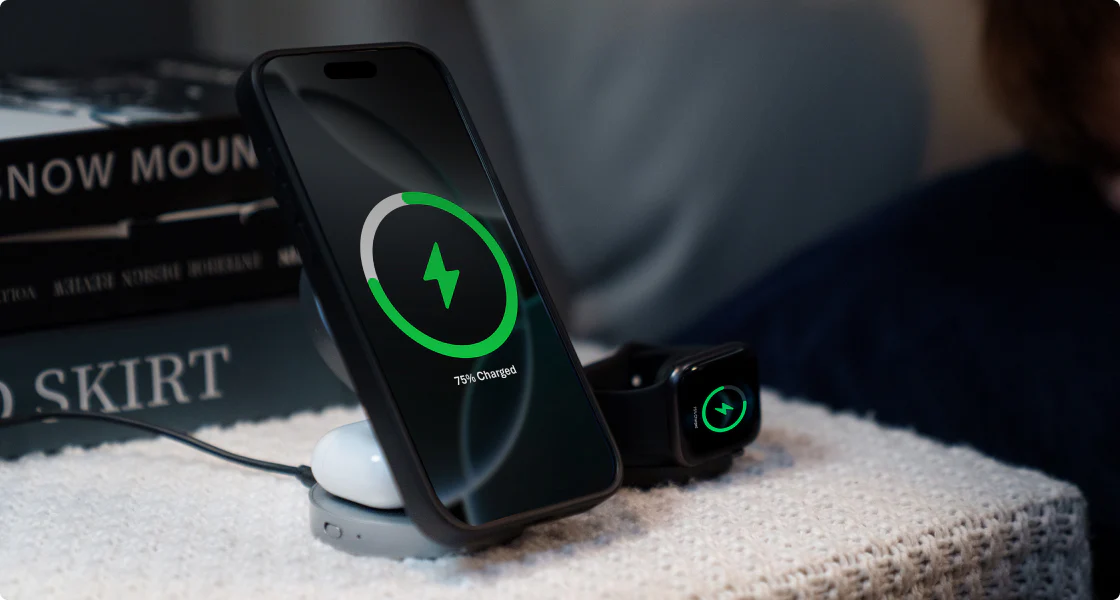
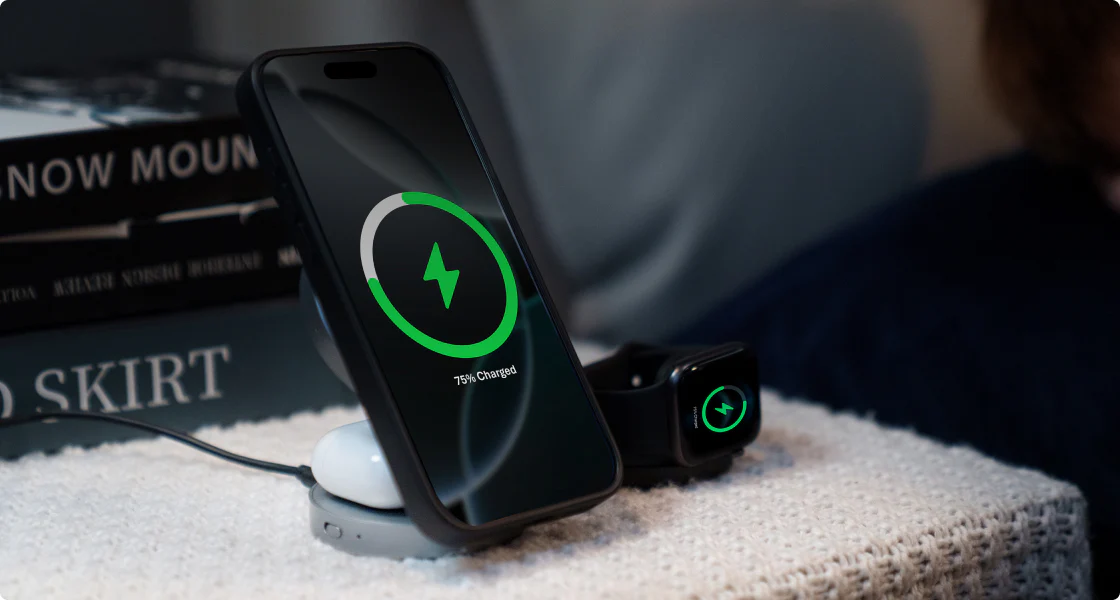
Designed with the complete Apple ecosystem in mind, the EcoFlow RAPID Mag Wireless Charging Station supports Qi2 certification, ensuring full 15W wireless charging with precise magnetic alignment for iPhones. It also includes a dedicated Apple Watch fast-charging module and a separate wireless charging area for AirPods, allowing all three devices to charge simultaneously without compromise.
What sets this station apart is its thoughtful engineering. The foldable design makes it compact enough for travel, yet when opened, it presents a clean, understated look that fits naturally into a modern desk or home office. Its balance of performance, portability, and visual simplicity firmly positions it as one of the most refined workspace charging solutions available in 2026.
Best Pocket-Friendly Power Apple Wireless Charger
For all day power that slips easily into a jacket or coat pocket, a compact power bank with full speed wireless charging makes a noticeable difference. Portability matters just as much as performance when you’re away from a desk, whether that’s during a long walk, a day at a concert, or hours spent navigating a busy city.
Anker MagGo Power Bank
Anker’s latest MagGo power bank supports the Qi2 standard, delivering the full 15W magnetic wireless charging speed, double what older MagSafe-compatible power banks could manage. Its 10,000 mAh capacity is enough to provide multiple top ups for an iPhone, while the slim, well balanced design keeps it genuinely pocket friendly. The strong magnetic hold allows for hands free use while charging, making it a dependable option for extended outings where access to outlets is limited.
| Product | Standard / Certification | Max iPhone Charging Speed | Apple Watch Fast Charging | AirPods Wireless Charging | Best For |
|---|---|---|---|---|---|
| Apple MagSafe Charger | Certified MagSafe (MFM) | 15W | No | Yes (Qi) | Minimalist, single-device charging |
| EcoFlow RAPID Mag Power Bank | Qi2 Certified (Magnetic Power Profile) | 15W | No | Yes (Qi) | Travel, outdoor use, emergency power |
| EcoFlow RAPID Mag Wireless Charging Station (3-in-1) | Qi2 + Apple Watch Fast Charger | 15W | Yes | Yes | Desk setup, full Apple ecosystem |
| Anker MagGo Power Bank | Qi2 Certified | 15W | No | Yes (Qi) | Pocket-friendly, all-day portable power |
This comparison highlights how Qi2 has leveled the playing field in 2026, making it easier to choose between chargers based on form factor and use case rather than sacrificing speed.
Conclusion
Wireless charging in 2026 is no longer about compromise. Precise magnetic alignment and the widespread adoption of the Qi2 standard have brought full 15W wireless charging speeds to a broader range of accessories, not just Apple-certified hardware. This shift gives Apple users more flexibility than ever when choosing how and where to charge.
Whether you value the portability and versatility of the EcoFlow RAPID Mag Power Bank or prefer the streamlined, all-in-one convenience of the EcoFlow RAPID Mag Wireless Charging Station (3-in-1), there is now a fast, reliable option for every lifestyle. By selecting chargers with proper certification, strong thermal management, and thoughtful design, you can simplify daily charging and enjoy the full freedom and reliability of the Apple ecosystem, without reaching for a cable.
FAQ
1. Does wireless charging harm battery health?
No. Modern wireless charging, particularly Certified MagSafe and Qi2, is designed with advanced thermal and power management systems. These chargers actively monitor battery temperature and automatically slow charging when necessary to keep the battery within a safe operating range. Some warmth during charging is normal and does not harm the battery under normal use.
2. Do MagSafe cases affect charging speed?
A properly certified MagSafe case includes an integrated magnetic array that ensures precise alignment between the phone and the charger. This alignment allows the full 15W charging power to pass through efficiently. In contrast, non-magnetic cases or cases thicker than roughly 3 mm can interfere with alignment, reducing charging speed and overall efficiency.
3. How fast is Qi2 compared to old wireless charging?
Previous generations of standard Qi wireless charging limited iPhones to about 7.5W. The Qi2 standard introduces the Magnetic Power Profile (MPP), enabling up to 15W wireless charging. This effectively doubles charging speed compared to older Qi chargers and brings performance in line with Certified MagSafe accessories.
4. Are 3-in-1 Apple charging stations safe for nightly use?
Yes, high-quality 3-in-1 stations are designed to be safe for nightly use. They include over current, over voltage, and temperature protection. Products like the EcoFlow RAPID Mag Wireless Charging Station (3-in-1) manage power distribution to ensure each device charges optimally and safely overnight.
5. What is the 20/80 rule in iPhone?
The “20/80 rule” is a general guideline for extending long term battery health. It suggests keeping your iPhone’s battery level between roughly 20 percent and 80 percent whenever possible. Regularly charging from near empty to 100 percent, or leaving the battery at full charge for long periods, can place additional long term stress on lithium-ion batteries.