Wireless Power Bank vs. Regular Power Bank: How to choose
- The Core Technology Behind Wireless Power Banks
- Key Performance Differences at a Glance
- Speed Differences Between Wired and Wireless Charging
- Safety Features and Energy Efficiency
- Device Compatibility Across Your Tech Ecosystem
- Portability Considerations for Daily Carry
- Practical Applications in Different Environments
- Price Points and Value Analysis
- Selection Criteria Based on Your Lifestyle
- Conclusion
- Frequently Asked Questions
Whether to opt for a wireless power bank or a traditional power bank entirely depends on one’s lifestyle. Traditional power banks have the advantage of wired connectivity, while wireless power banks have several benefits, such as ease of charging with no cables needed, due to their magnetic attachment properties. These differences will be highlighted in the comparison below.
The Core Technology Behind Wireless Power Banks
The major difference between these charging options resides in their method to deliver power to your devices.
A wireless power bank offers the advantage of not requiring any charging cables, thanks to its use of electromagnetic induction to charge your device directly. With these kinds of power banks, you only need to place your device on top of the power bank, and it will start charging. Most modern power banks have magnets to align your device for efficient charging.
Traditional power banks require physical connectors via USB-A, USB-C, or Lightning interfaces. It is necessary to carry cables with you to connect to the power bank and then to your device. Though not a big deal, it matters in situations where you need instant charging on multiple occasions during the day.
The charging technology itself differs greatly. Wireless charging involves generating an electromagnetic field with coils in your charging pad to induce currents in your phone's receiver coil. Standard power banks transport electric currents through conductive cables, meaning that energy transfer is efficient, albeit less convenient.
Key Performance Differences at a Glance
Knowing these core features will enable you to assess for yourself which type of power bank better fulfills your needs. Below is a comparison table for some crucial performance features for both wireless and wired power banks.
Feature | Wireless Power Bank | Regular Power Bank |
Charging Speed | 5W-25W (Qi2.2) | 18W-100W |
Energy Efficiency | 70-80% | 90-95% |
Time to 50% (iPhone) | 31-48 minutes | 25-30 minutes |
Device Compatibility | Wireless-enabled only | Universal with cables |
Typical Weight (10,000mAh) | 230-280g | 180-220g |
Price Range (10,000mAh) | $50-80 | $20-40 |
Use While Charging | Hands-free attachment | Cable tethered |
These specifications reveal that each type excels in different areas, which directly impacts how they perform in real-world scenarios.
Speed Differences Between Wired and Wireless Charging
Charging speed remains one of the most critical factors when selecting a portable power solution.
Traditional Wired Performance
Wired power banks typically deliver faster charging speeds than their wireless counterparts. A standard wired connection can provide 18W to 100W of power, depending on the power bank's specifications and your device's capabilities. This means you can charge a smartphone from empty to 50% in roughly 30 minutes with appropriate fast charging protocols.
Modern Wireless Capabilities
Wireless power banks have traditionally offered slower charging speeds, with early models maxing out at 5W to 7.5W. However, newer technologies have dramatically improved performance. The latest Qi2.2 certified models can deliver up to 25W of wireless power, significantly narrowing the gap with wired charging. A magnetic power bank for iPhone using Qi2.2 technology can now charge compatible devices much faster than previous generations.
Pass-through charging capability matters for both types. Better wireless models allow simultaneous charging of your phone and the power bank itself, which proves invaluable during overnight stays or travel when you want to wake up with all devices fully charged.
Safety Features and Energy Efficiency
How each technology handles power affects safety, as well as what charge you end up with.
Power Conversion Efficiency
Energy efficiency varies significantly for each type. For wired charging, energy is transferred with 90-95% efficiency, while for wireless charging, energy is transferred with 70-80% efficiency, with the rest being wasted in the form of heat due to electromagnetic induction. It means that for example, in a 10,000mAh wire charge, there is more charging capacity than in a wire charge.
Temperature Management Systems
Issues such as heat production affect both types, with heat generation being more prevalent in wireless models. The process involved in generating electromagnetic fields entails generating heat, while holding two electronic devices together traps heat between them. Good models of wireless power banks have temperature detection mechanisms with tests running into millions on a daily basis to curb excessive heating.
Battery life has a direct relationship with heat management. High temperatures cause faster degradation in Li-ion batteries, thereby shortening their lifespans. High-end wireless devices contain materials with improved thermal properties, while active cooling systems maintain operating temperatures below 107°F.
Device Compatibility Across Your Tech Ecosystem
Understanding which devices work with each power bank type helps you avoid compatibility frustrations.
Universal Wired Connections
Universal compatibility favors traditional power banks. Any device with a charging port can connect to a regular power bank using the appropriate cable. This includes smartphones, tablets, cameras, portable speakers, smartwatches, and countless other gadgets. You need just one power bank to charge all your electronics.
Wireless Charging Limitations
Wireless charging power banks require your device to have built-in wireless charging capability. Most flagship smartphones from recent years include this feature, but budget phones, older models, and many non-phone devices lack wireless charging receivers. Your laptop, camera, and older smartphone collection won't work with wireless charging alone.
Many premium portable wireless charger power bank models include both wireless and wired charging options. These hybrid designs offer maximum flexibility by providing USB-C and USB-A ports alongside the wireless charging surface. You get the convenience of wireless charging for compatible devices while maintaining the ability to charge anything through traditional ports.
Portability Considerations for Daily Carry
The physical dimensions and weight of your power bank directly impact how often you'll actually carry it.
Size and weight play crucial roles in daily portability. Regular power banks can pack higher capacities into relatively compact designs because they don't need wireless charging coils and magnetic components. A 10,000mAh wired power bank might measure slightly smaller than its wireless equivalent with the same battery capacity.
Wireless models make up for their slightly larger size with superior handling during use. A magnetic wireless power bank attaches directly to your phone's back, allowing you to use your device while it charges. You can scroll through social media, take photos, or answer calls without dealing with dangling cables.
How pocket-ability is influenced by form factor varies. Wired charging bases carry easily in bags but are cumbersome to carry while powered via cable. Wireless charging bases provide a consolidated phone-body-and-charge-unit, which is convenient to carry while holding, especially with one’s hands, though depth varies.
Practical Applications in Different Environments
Various scenarios highlight the strengths and weaknesses of different charging methods. Below is an example comparison to showcase the performance of different types of power banks in typical scenarios.
| Scenario | Best Choice | Reason |
| Air Travel | Regular Power Bank | Multiple ports for simultaneous device charging, secure cable connections during turbulence |
| Daily Commute | Wireless Power Bank | One-handed functionality, no cable management in dense areas |
| Office Work | Regular Power Bank | Quick charging during short breaks,can charge laptop and phone |
| Outdoor Activities | Regular Power Bank | More dependable connection, better for rugged environments |
| Casual Browsing | Wireless Power Bank | Comfortable to hold phone while charging, cable-free convenience |
| Hotel Stays | Hybrid Model | Pass-through charging for overnight device charging |
| Video Calls | Wireless Power Bank | Hands-free attachment allows natural phone positioning |
It’s clear from the above break down that your primary use case will drive your purchase decision.
Travel and Long Journeys
Traveling scenarios remind us why each type is better suited to different situations. For example, on long flights or travels by train, having a power bank with multiple charging points is ideal for charging multiple devices, such as your phone, tablet, or earbuds, all at once.
Daily Commutes and Urban Use
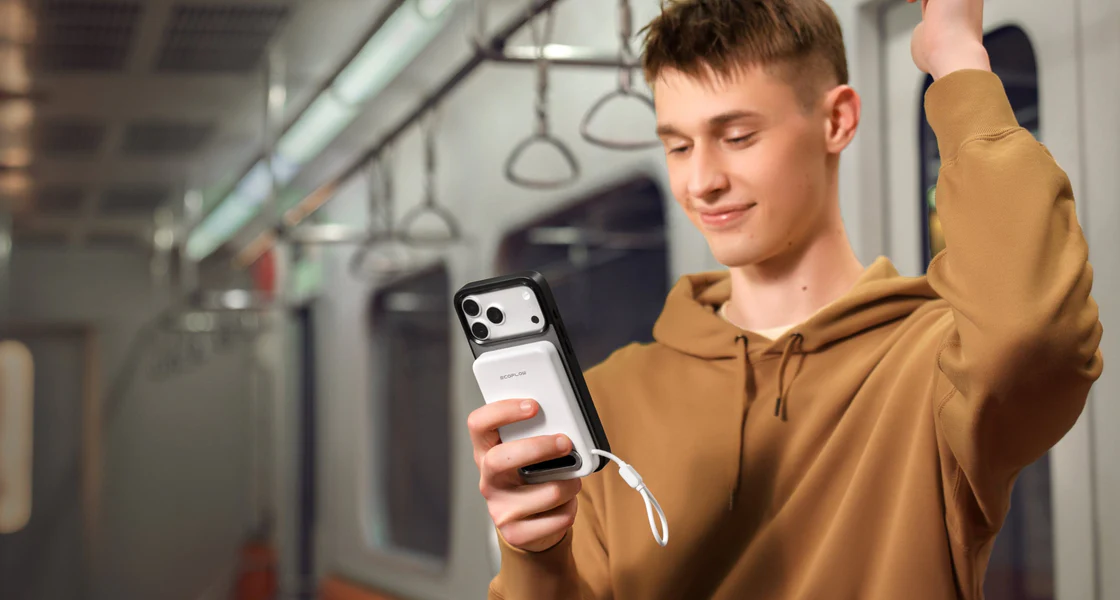
Responsive designs work best for daily commutes. It looks awkward to be on a crowded subway holding your phone and portable power bank through a cable. The iPhone wireless power bank simply latches to the rear portion of your phone and enables you to browse with one hand while holding something else with your other hand.
Outdoor Activities
Outdoor functions also have their own constraints. For instance, for hiking or for taking pictures, charging needs to be secure, with no disconnection if the charging pack in your backpack changes position. Cabled charging is more reliable for such functions. Some cordless designs have an unexpected magnetic attachment, with some designs having 11N forces of magnetism, holding in excess of two pounds.
Price Points and Value Analysis
Budget concerns affect what type of power bank would be best for your pocketbook.
Prices for wireless and wired power banks vary based on their complexity. Simple wired power banks with 10,000mAh capacity will cost about twenty to thirty dollars. Wireless power banks with the same capacity will cost anywhere from fifty to eighty dollars.
These premium features result in increased prices for both types. Power banks with 100W output, multiple interfaces, and enhanced safety features demand a higher price point. High-end wireless power banks with Qi2.2 certification, improved materials, and fast wireless charging functions are substantial investments.
The EcoFlow RAPID Mag Power Bank (Built-in USB-C Cable) is one such example of optimal wirelss power bank designs with its built-in cable functionality, incorporating versatility in wirelss, via, and Mag charging support into one compact package.
Long-term value depends on your usage patterns. Frequent travelers who value convenience might find wireless models worth the premium. Others, likely those with many devices, might choose to invest in something with ample power for wired connectivity.
Selection Criteria Based on Your Lifestyle
Using your individual patterns, you should make your final decision between these two different technologies.
Here’s the decision matrix below to see what type of power bank you prefer based on your choices:
| Choose Regular Power Bank If You... | Choose Wireless Power Bank If You... | |
| Need fastest possible charging speeds | Value cable-free convenience above all | |
| Charge multiple device types regularly | Primarily charge wireless-enabled smartphones | |
| Have budget constraints | Want premium user experience | |
| Travel with cameras, laptops, tablets | Commute daily with just your phone | |
| Require maximum energy efficiency | Prefer one-handed phone operation | |
| Own devices without wireless charging | Use your phone heavily while charging | |
| Need to charge devices in extreme conditions | Want minimal bulk in your pocket |
It's made clear in this model that neither alternative is better than the other, and it’s determined on individual needs.
It’s in the end what you do with your portable power. If you require the most charging speed, operate multiple devices at once, require support for devices with non-wireless charging, or wish for the lowest mAh/cost, then look no further than a traditional power bank.
Opt for a magnetic charging bank for iPhone or other wireless-capable devices if you prize cordless functionality, wish to charge while operating your phone, prefer a minimalistic carry solution, or simply charge wireless-capable smartphones or earbuds.
Many users have found it necessary to have both for different functions. It’s recommended to have a high-capacity wired power bank in your traveling kit for high charging sessions while carrying a compact wireless power bank for everyday pocket carry.
Conclusion
Both wireless and regular power banks offer distinct advantages for different situations. Regular models excel in charging speed, efficiency, and universal compatibility, making them ideal for power users and multi-device scenarios. Wireless options provide unmatched convenience and usability for modern smartphones, though at a premium price. Evaluate your typical charging needs, device compatibility, and budget to select the best solution for your lifestyle.
Frequently Asked Questions
Q1: Can Wireless Power Banks Charge Through Phone Cases?
Common thickness for charging in popular power banks is 3mm, with less efficient charging in thicker or metallic designs. Alignment with magnets requires favorable materials in cases, like removal from protective housing to enable wireless charging.
Q2: How Much Slower Is Wireless Charging Compared to Wired?
Older wireless power banks used to have charging rates of 5-7.5W, while wired charging rates are 18W+ for faster charging. Newer, Qi2.2 certified, wireless charging pads support charging rates of 25W, almost like wired charging. It depends on your device’s capability to charge wirelessly.
Q3: Do Wireless Power Banks Damage Phone Batteries?
Devices such as certified wireless power banks with appropriate regulation mechanisms for temperatures do not affect phone batteries any worse than charging via cables. It is essential to purchase safe products, such as certified Qi devices, to avoid any dangers posed by low-capacity charging devices.
Q4: Can You Use a Wireless Power Bank While It's Charging?
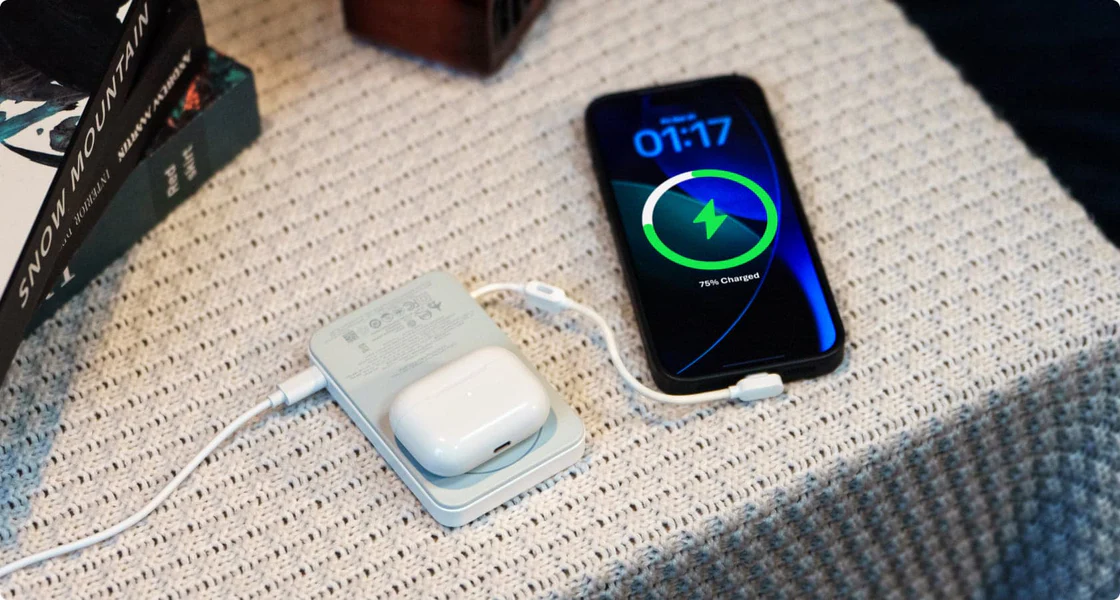
Some power banks have pass-through charging, which enables you to charge your smartphone wirelessly while charging your power bank at the same time. It is, however, dependent on the model, so check its features before buying.
Q5: What Capacity Wireless Power Bank Do You Need for Daily Use?
A 10,000mAh wireless power bank is likely to deliver 1.5 to 2 full smartphone charges, taking into consideration the loss in efficiency during wireless charging. For extreme use, one could opt for a 20,000mAh capacity. A 5,000mAh capacity could be optimal for occasional users.
For press requests or interview opportunities, reach out to our media team
media.na@ecoflow.com