Is Tornado Alley Shifting East? What the Research Shows
For decades, "Tornado Alley" has meant one specific stretch of the central U.S. Lately, that's changing. Research over the past several years points to tornado alley shifting east, moving hundreds of miles from the corridor most people grew up hearing about.
Here's what the data actually shows, why it's happening, and what it means if you live in the newly affected region.
The shift has been building for decades rather than happening overnight, and it matters whether you're in the traditional Plains corridor or the new one further east. The risks look different depending on where you land.
One thing holds true no matter which alley you're in: severe storms knock out power, sometimes for days. Keeping something like the EcoFlow DELTA 3 Plus Portable Power Station around before storm season starts is one less thing to worry about when the sky turns green.
What Is Tornado Alley?
The phrase goes back to 1952, when U.S. Air Force meteorologists Ernest J. Fawbush and Robert C. Miller titled a research project "Tornado Alley." The two had already made history four years earlier, issuing the first successful tornado forecast in 1948 after correctly predicting a tornado that struck Tinker Air Force Base in Oklahoma.
Their original study covered a corridor running from Lubbock, Texas, through eastern Colorado and Nebraska. Over time, meteorologists broadened that footprint into the definition most people know today: a stretch of the central U.S. covering parts of Texas, Oklahoma, Kansas, Nebraska, and South Dakota.
A version of that map still shows up in the Storm Prediction Center's own tornado FAQ, even though NOAA has never adopted "Tornado Alley" as an official term.
The boundary was always loosely defined. People often reduce it to one question: did tornado alley move gradually over decades, or all at once? The honest answer is gradually, tracking slow-moving changes in moisture and drought patterns rather than any single event.
Has tornado alley shifted enough to redraw that old map for good? Most researchers say yes, at least for now.
Is Tornado Alley Actually Shifting East?
Is tornado alley shifting east, or is this a headline that's outlived its data? The research backs it up.
A 2018 paper in npj Climate and Atmospheric Science by Victor Gensini of Northern Illinois University and Harold Brooks of NOAA's National Severe Storms Laboratory analyzed nearly four decades of tornado data, from 1979 to 2017. It found a statistically significant eastward shift in both tornado frequency and tornado-favorable atmospheric conditions.
The numbers are hard to ignore. Tornado alley shifted somewhere between 400 and 500 miles east over that period, according to that research and the follow-up work it inspired.
Classic Tornado Alley, centered on Texas and Oklahoma, has seen tornado activity decline, while eastern Missouri and Arkansas, western Tennessee and Kentucky, and northern Mississippi and Alabama have all seen it climb. Some meteorologists now call this new zone Dixie Alley or Midwest Alley.
A February 2022 study in Environmental Research Communications, led by Niloufar Nouri and Naresh Devineni, looked specifically at large tornado outbreaks rather than single storms, and found the same eastward pattern. Outbreaks are now clustering more tightly in this new region than they ever did in the old one.
Has tornado alley moved for good, or could it snap back? Whether tornado alley shifted permanently is still debated in some corners of meteorology, though the direction of the trend itself isn't. Most researchers studying it think the pattern reflects a genuine, ongoing climate shift rather than a short-term blip.
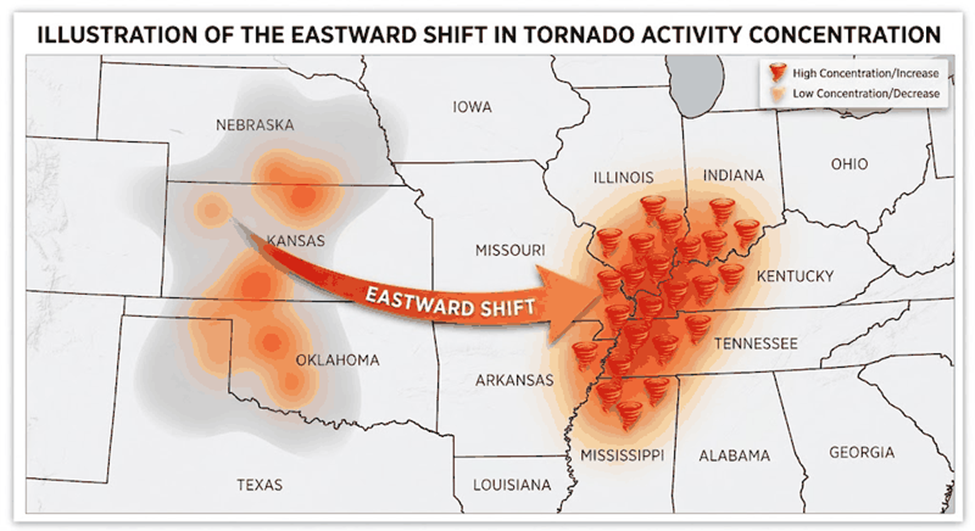
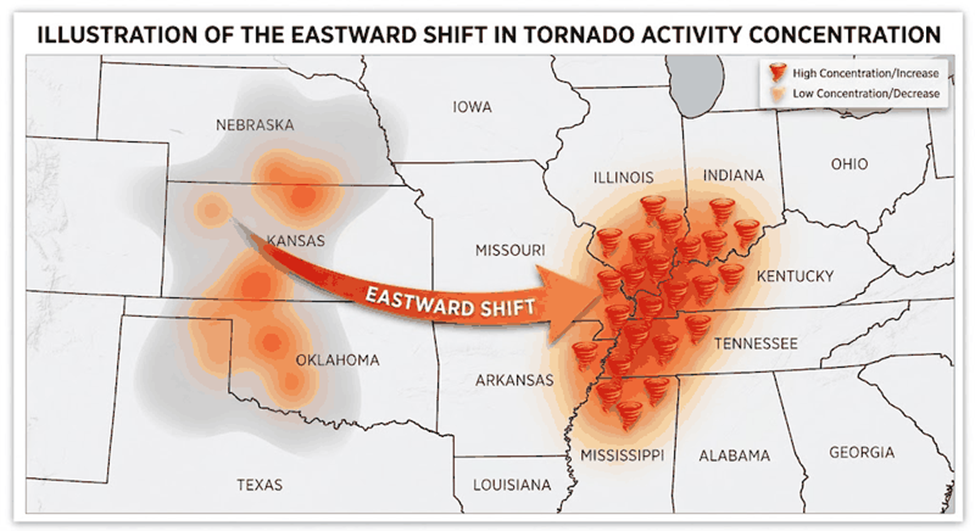
Tornado Alley, Then vs. Now
Period | Core Activity Zone | Common Name |
1950s–1980s | Northeastern Texas, central Oklahoma, southern Kansas | "Classic" Tornado Alley |
1989–2019 | Eastern Missouri, Arkansas, western Tennessee and Kentucky, northern Mississippi and Alabama | Dixie Alley / Midwest Alley |
Why Is Tornado Alley Shifting East?
Why is tornado alley shifting east in the first place? The leading explanation ties back to a decades-long megadrought across the Southwest. Less moisture in that region means fewer of the ingredients that used to fuel tornado formation across the traditional Plains corridor.
At the same time, the Gulf of Mexico has been running warmer, and that extra heat is pushing more moisture into the Mississippi and Tennessee River valleys, the same corridor tornado alley moving east has settled into. Warmer, wetter air feeds the atmospheric instability that supercells need to form.
One overlooked detail: the "dry line," the boundary separating the wetter eastern U.S. from the drier western U.S., has itself moved roughly 140 miles east since the late 1800s. That line plays a direct role in fueling storm formation, and its slow eastward creep tracks closely with where the biggest tornado outbreaks now cluster.
What Does This Mean for People Living in the New Risk Zone?
Understanding why is tornado alley shifting east explains where the risk sits on a map. What it means for the people living there is the more urgent part.
Is tornado alley moving into places less prepared for it? In several concrete ways, yes.
Purpose-built tornado shelters, common across a lot of traditional Tornado Alley towns, are far less common through the Southeast.
Manufactured homes are also more prevalent in the newly affected region, and they perform far worse in high winds than site-built houses, one of several factors in how tornadoes cause damage so differently depending on the structure. Add in population density well above the Great Plains average, and a given tornado is simply more likely to hit somewhere people actually live.
Timing adds another layer of risk. Tornadoes in the Southeast strike overnight more often than tornadoes in the traditional corridor, and storms that hit between midnight and sunrise are roughly 2.5 times more likely to be fatal than the same tornado hitting during daylight.
People asleep don't hear warning sirens, and darkness makes an approaching funnel much harder to spot. For a closer look at what to do in the minutes before and after a warning, see our tornado safety guide.
Staying Prepared for Power Outages During Severe Weather
Whichever alley you live in, tornadoes and the storms that spawn them knock out power, sometimes for days at a stretch. The story of tornado alley shifting is really a story about preparedness spreading to places that never used to need it.
Having a reliable backup source ready before severe weather season starts is one of the few genuinely useful steps anyone can take here. Browse the full range of portable power stations to find the right fit for your household, or see the two options below.
EcoFlow DELTA 3 Plus Portable Power Station for Essential Backup Power
For essential backup without the complexity of a full-size system, the EcoFlow DELTA 3 Plus covers shorter outages and everyday electronics. It's a practical fit for anyone who doesn't need whole-home capacity, just reliable power for the essentials during a shorter interruption.
EcoFlow DELTA Pro 3 Portable Power Station for Higher-Power Backup Needs
For homeowners who need more capacity, or who are ready to replace a gas generator entirely, the EcoFlow DELTA Pro 3 is built for the job. It handles higher-power appliances and longer, more demanding backup needs without any of the fuel storage or maintenance a gas engine requires.
Conclusion
Research points to a real eastward trend in tornado activity, driven largely by shifting moisture patterns tied to a warming climate, even though scientists don't all agree on exactly where to draw the new boundary.
What matters most for readers is understanding their actual regional risk and being prepared, whether they live in the traditional corridor or the newly expanding one.
If severe weather knocks out the power at your place, the EcoFlow DELTA Pro 3 is ready the instant the lights go out, with nothing to troubleshoot and no fuel to store between storms.
FAQs
Which states are considered Tornado Alley?
The traditional definition covers parts of Texas, Oklahoma, Kansas, Nebraska, and South Dakota. With tornado alley moving east, states like Arkansas, Missouri, Tennessee, Kentucky, Mississippi, and Alabama now see a larger share of significant tornado activity.
Where is Tornado Alley in the United States?
Classic Tornado Alley runs through the central Plains, roughly from northern Texas up through Nebraska. The newer high-activity zone sits further east, centered on the lower Mississippi Valley and mid-South, sometimes called Dixie Alley.
What does "Tornado Alley" mean?
It's an informal term, not an official NOAA designation, describing the part of the country with the highest concentration of tornado activity. The term was coined in 1952 and never had one fixed boundary, which is exactly why "is tornado alley shifting east" is still such an active research question today.
Did Tornado Alley move east for good, or could it shift back?
Researchers can't rule out another shift, but the current data points to a sustained change tied to long-term climate patterns rather than a temporary swing. Most meteorologists studying the trend expect the eastward pattern to hold, at least for the coming decades.
Which countries experience the most tornadoes?
The United States sees more tornadoes than any other country by a wide margin, followed by Canada, Bangladesh, and parts of Europe. No other country has a region that produces the volume or intensity seen across the U.S., in either the traditional or the newly shifted zone.
For press requests or interview opportunities, reach out to our media team
media.na@ecoflow.com