EcoFlow Delta 3 Max Plus vs. Bluetti AC180: Head to Head Comparison
America’s utility grid is under unprecedented strain.1
Not only are electricity bills skyrocketing, but power outages are becoming more frequent and prolonged than ever.
With blackouts increasingly an inevitability in large areas of the US, consumers are increasingly shopping for essential home backup power.
EcoFlow and Bluetti are two of the biggest direct-to-consumer retailers and wholesalers of portable power stations and solar generators worldwide.
Let’s take a deep dive into how two popular models, EcoFlow DELTA 3 Max Plus and Bluetti AC180 compare in terms of technical specifications and performance.
EcoFlow Delta 3 Max Plus vs. Bluetti AC180: Direct Comparison (Specs)*
Technical Specification | EcoFlow Delta 3 Max Plus | Bluetti AC180 |
Battery Capacity | 2048 Wh | 1152 Wh |
Cell Chemistry | LFP (LiFePO4) | LFP (LiFePO4) |
AC Output (Continuous) | 3000 W | 1800 W |
AC Output (Surge) | 6000 W | 2700 W |
AC Charging Speed | 1800 W (0-80% in 56 min) | 1440 W (0-80% in ~45 min) |
Solar Input (Max) | 1000 W (Dual 500W MPPT) | 500 W (Single MPPT) |
Solar Voltage (Voc) | 11-60 V (15A/18A) | 12-60 V (10A) |
UPS Switchover | < 10 ms | ~ 20 ms |
Noise Level | < 30 dB | ~ 45 dB |
Weight | 22.1 kg (48.7 lbs) | 16 kg (35.3 lbs) |
Connectivity | App, Wi-Fi + Bluetooth | Bluetooth |
|
|
|
DC Output | 30A Anderson + 140W USB-C | 10A Cigarette + 100W USB-C |
Warranty | 5 Years (with registration) | 3-5 Years (region dependent) |
The comparison isn’t quite apples to oranges…
EcoFlow DELTA 3 Max Plus does come with significantly more battery storage capacity and output power right out of the box.
But both power stations use lithium-iron phosphate battery cells (LFP/LiFePO4), widely regarded as the most efficient and long lasting currently available on the consumer market.
EcoFlow DELTA 3 Max Plus is significantly more expensive.
Depending on when and where you purchase it, it might cost up to $700 or $800 more.
But if price isn’t your only priority, there’s a lot to like about EcoFlow DELTA 3 Max Plus that Bluetti AC180 doesn’t offer.
Let’s take a look at some of the standalone features that set EcoFlow DELTA 3 Max Plus apart.
EcoFlow Delta 3 Max Plus vs. Bluetti AC180 Standalone Feature Comparison*
Standalone Feature | EcoFlow Delta 3 Max Plus | Bluetti AC180 | Why It Matters |
High-Wattage Support | 3800W (via X-Boost) | 2700W (via Power Lifting) | X-Boost allows the EcoFlow to power heavy-duty appliances (like large heaters or table saws) that exceed the standard inverter limit. The Bluetti AC 180 hits its ceiling much sooner. |
UPS Transfer Speed | < 10ms (Data-Center Grade) | ~ 20ms (Standard EPS) | EcoFlow's faster UPS switchover helps ensure that sensitive devices like desktop computers, NAS drives, and servers don't suffer data corruption or permanet damage from power surges and voltage drops. 20ms switchover speed is considered to slow for sensitive electronics |
Bill Savings (TOU) | Automated (Time-of-Use Mode) | Manual Monitoring Only | EcoFlow DELTA 3 Max Pro lets you to automatically charge from the grid when power is cheap (off-peak) and use battery power during peak demand hours. Bluetti offers manual monitoring and switchover only. |
Storm Preparedness | Storm Guard (Auto-Detection) | Manual Intervention | EcoFlow integrates with online online weather data sources to automatically charge to 100% when a severe storm warning is issued. If you’re using the power station for essential home backup, this offers additional peace of mind. |
Generator Automation | Auto-Start/Stop (w/ Smart Gen) | Manual / Complex Wiring | When paired with an EcoFlow Smart Generator, Delta 3 Max Plus can recharge indefinitely during long outages without human assistance as long as there’s fuel. |
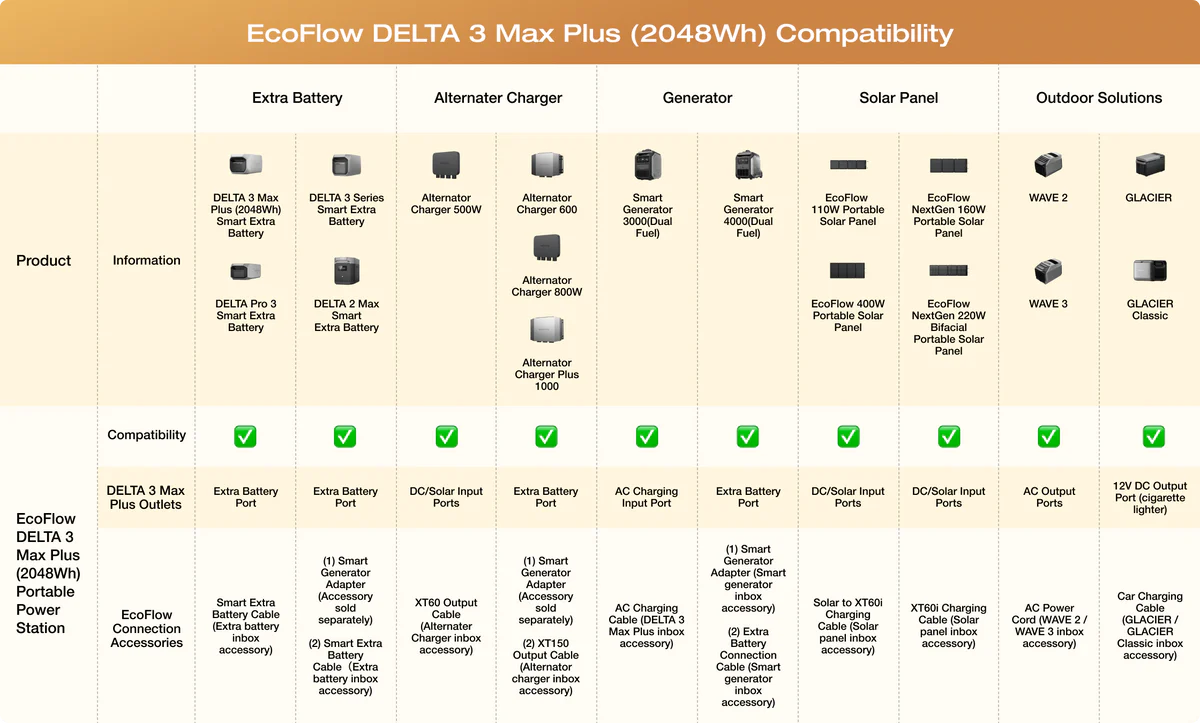
Smart Home Energy Management
EcoFlow DELTA 3 Max Plus is part of a growing ecosystem of smart home devices, energy management systems and a wide range of accessories that greatly extend its capabilities through seamless compatibility.
Key Features of Portable Power Stations and Generators
When evaluating portable power stations, generators and other off-grid electricity storage devices, here are the critical factors to consider.
AC/DC Power Output Capacity (Wattage/Current/Voltage)
The continuous power output of a portable power station or generator determines what kind of appliances you can run and how many you can operate at the same time.
For appliances and HVAC systems with motors or compressors, such as refrigerators and air conditioners, additional power output is a short burst to start the unit up.
These two separate power ratings are often referred to as starting and running watts.
Ensure that you have enough power output to operate all the appliances and devices you want to run simultaneously.
Energy Source
All generators and home battery backup systems require an energy source.
Energy can be generated with renewable energy technology like solar panels or by burning fossil fuels.
Utility grid electricity and alternative energy sources like vehicle alternator chargers can be used to store energy in rechargeable batteries for later use.
Many generators or portable power stations have a limited number of energy sources they can use.
EcoFlow DELTA 3 Max Plus can store energy and output power from a wide variety of sources, including solar panels, Smart Generators, 800W Alternator Charging, and grid power.
Storage Capacity
Battery storage capacity is typically measured in watt-hours and kilowatt-hours for large off-grid power stations.
For fossil fuel portable, standby, and inverter generators, capacity depends on whether they’re connected to a continuous source of power such as natural gas mains or if they rely on fuel stored in a tank or canister (such as propane).
Ensure that your generator or portable power station has sufficient storage capacity to run what you want to run for as long as you want to run it for before you need to recharge or refuel.
Expandability
Most EcoFlow portable power stations and solar generators come with the option to add additional storage by purchasing extra batteries.
For example, DELTA 3 Max Plus is expandable up to 10kWh with EcoFlow Smart Extra batteries.
Bluetti AC180 doesn’t offer modular expandability.
Power quality (Clean vs. Dirty Power)
Portable gas generators are notorious for outputting “dirty” power, meaning that there are significant fluctuations in the quality of the electrical output, largely due to a phenomenon called total harmonic distortion (THD).
Dirty power doesn’t matter much for power tools and some household appliances, but it can permanently damage sensitive electronics like computers and cause irretrievable data loss with hard drives.
EcoFlow DELTA 3 Max Plus outputs pure-sine wave clean power, making it uniquely suitable for applications like emergency backup for a home office.
Maintenance Requirements
Portable gas and standby generators typically require routine maintenance, often every six months or less.
Flooded lead acid (FLA) batteries found in some low-end, low-wattage power stations can also require routine maintenance, such as checking fluid levels and watering the battery.
Sealed lead acid (SLA/VRLA) deep cycle or maintenance-free batteries don’t require routine care and attention, but have shorter cycle life than lithium-ion based battery cell chemistries like nickel manganese cobalt (NMC) and LiFePO4.
Portability
Power stations tend to be much lighter and more compact than portable gas and inverter generators.
Indoor use
Under no circumstances can portable gas or whole-home standby generators be installed or used indoors.
Any generator that burns fossil fuels emits carbon monoxide (CO), an odorless gas that can kill within minutes even in a well-ventilated room.
By law, most fossil fuel generators must be installed or operated a minimum of 20 feet from the nearest door or window.
Battery based portable power stations and solar generators are safe for indoor use.
For example, EcoFlow DELTA Pro Ultra X is certified IP54 for indoor and sheltered outdoor installation and use
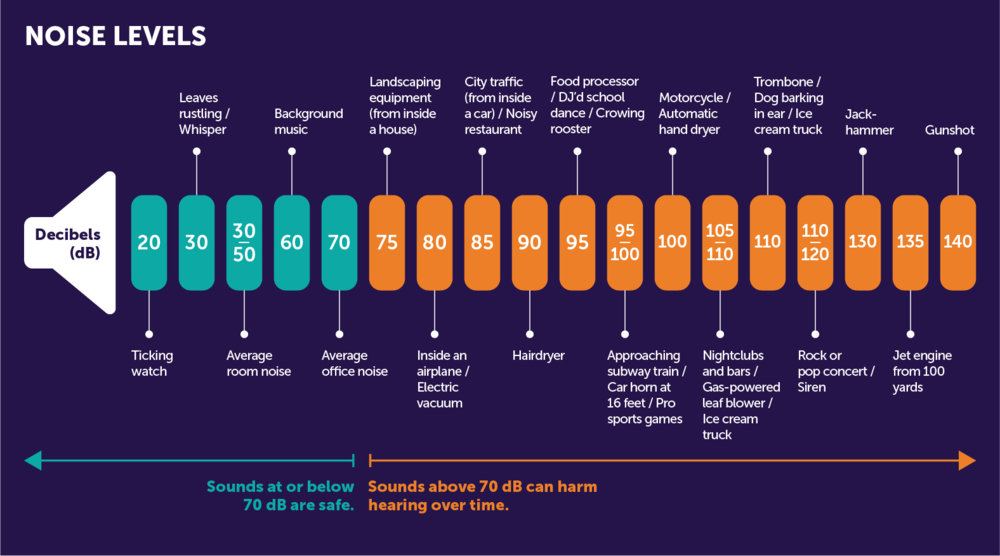
(Source: Hearing Health Foundation)
Operating Noise
Not only are fossil fuel generators prohibited from indoor installation and use by law, they’re extremely noisy.
Many portable gas generators produce 80 – 100 decibels when operating at full load.
That’s the rough equivalent of an approaching subway train or a car horn at 16 feet.
EcoFlow DELTA 3 Series portable power stations have operating modes as quiet as ≤ 30 dB under light electrical load.
Lifespan & Warranty Protection
Most EcoFlow power stations and whole-home battery backup solutions carry a 5 year warranty, but are rated to operate for 10 years plus of everyday use if you follow the manufacturer’s guidelines.
Standby generators from reputable manufacturers typically offer 5-year limited warranties and may come with an offer to purchase extended protection as fossil fuel generators require routine maintenance anyways.
Portable power stations typically do not.
Permitting and Zoning Requirements
Any whole-home generator that connects directly or bi-directionally to the utility grid is subject to stringent installation and sometimes permitting and zoning regulations.
For example, EcoFlow DELTA Pro Ultra X which can connect one-way directly to grid power using Smart Home Panel 3 must be installed by a licensed electrician.
However, unlike fossil fuel-powered standby generators, it typically doesn’t require zoning, HOA, or building permits.
Price
Last but not least, there’s the matter of cost.
If budget is your primary concern, portable gas generators typically cost less upfront than off-grid and backup battery systems like EcoFlow DELTA 3 Max Plus.
However, they also have ongoing fuel costs, require routine maintenance, and can’t be used indoors.
The price of standby inverter generators that run on natural gas is often comparable to a whole-home generator solution from EcoFlow.
Home battery backup has a reputation for being expensive, but that’s no longer the case if you’re comparing systems from manufacturers with similar reputations for reliability and quality.
Plus, if you use solar and/or grid power, a whole-home backup system like EcoFlow DELTA Pro 3 can save you money on electricity bills and even provide a healthy return on investment over time.
Check out EcoFlow’s off-grid power solutions today.
Resources Cited
Energy.gov. “Department of Energy Releases Report on Evaluating U.S. Grid Reliability and Security,” July 7, 2025. https://www.energy.gov/articles/department-energy-releases-report-evaluating-us-grid-reliability-and-security.
Product References*
EcoFlow DELTA 3 Max Plus Product Manual
Bluetti AC180 Product Manual
*Disclosure: All specifications, performance data, and product descriptions in this comparison are drawn directly from manufacturer documentation and public datasheets as of January 2025. Information is provided for factual comparison only and may vary by region, firmware, or configuration.
For press requests or interview opportunities, reach out to our media team
media.na@ecoflow.com