Transform Your Off-Grid Comfort With a Reliable Solar Powered Fan
The 2026 summer is here. It’s that time of the year when temperatures are expected to rise which means the same for electricity bills. If you are in off-grid locations, stuffy attics, in remote outbuildings, or in areas where grid power is out of reach, it can be difficult to maintain comfortable airflow. And this is where a solar powered fan can make all the difference. These devices use the sun’s free energy, giving you a cost-effective and environmentally friendly solution for cooling during the hot summer days and nights.
This guide looks at:
The mechanics behind a solar powered fan
Major benefits to expect when transitioning to a solar fan
The top practical applications of solar powered fans
Key features to consider before buying a solar fan
How to build the ideal auto fan solar system for your space
Understanding the Mechanics Behind a Solar Panel Fan
A solar panel fan is a ventilation system that converts sunlight directly into usable electricity through photovoltaic (PV) cells. This is how it works: sunlight hits the panels semiconductor material, dislodging electrons to generate direct current (DC) electricity. This DC current is the one that runs into the fan’s motor, spinning the blades which help cool your space. These fans don’t require electricity from the grid.
A solar panel fan doesn’t need an inverter to convert DC current to AC, and it doesn't have a utility meter ticking upwards. It has a simple setup and it doesn’t depend on external infrastructure. Solar fans are compact, self-contained, and wiring free, and give people the ability to use the sun’s green energy at no cost.
Major Benefits of Transitioning to a Solar Fan
Drastically Reducing Monthly Energy Costs
Running a conventional electric fan continuously through a British summer adds up — fast. At current standing rates, a standard 50W electric fan running 8 hours daily can cost upwards of £30 per month. A solar fan running on free solar energy? Effectively zero per month in fuel costs.
Note: This calculation has been made using the current electricity price cap of 24.67p per kWh. This is not a fixed rate, but changes quarterly. Therefore, to get the up-to-date rate, visit Ofgem official website.
The return on investment for most solar powered fans is typically achieved within one to two seasons of regular use, after which the unit generates savings every single day it operates. No subscription. No tariff surprises.
Eco-Friendly Cooling With Zero Emissions
From the latest government numbers, each kilowatt-hour of grid electricity you consume has a carbon footprint of about 233g. So, this means that when you run your solar powered fans, you are reducing this figure to zero, and if you scale this across the entire summer the reduced carbon footprint is significant. Energy-intensive HVAC systems can consume 1,000W or more per hour, and replacing these with solar powered fans you can actually see the difference in the carbon footprint you are making.
If you are working toward net-zero targets or you are aiming to align with the UK’s Climate Change Act, a great strategy that can help is switching from grid-dependent cooling to solar fans.
Seamless Off-Grid and Emergency Reliability
When you are connected to the national grid, you can expect power cuts to happen at any moment. However, a solar and fan can keep running even during summer storms or scheduled grid maintenance, making them reliable in spaces where heat build-up can cause real damage, such as server rooms, wine stores, or pet enclosures. Solar fans also eliminate the need for grid connection entirely in permanent off-grid setups like cabins, canal boats, and agricultural outbuildings.
Top Practical Applications for Solar Powered Fans
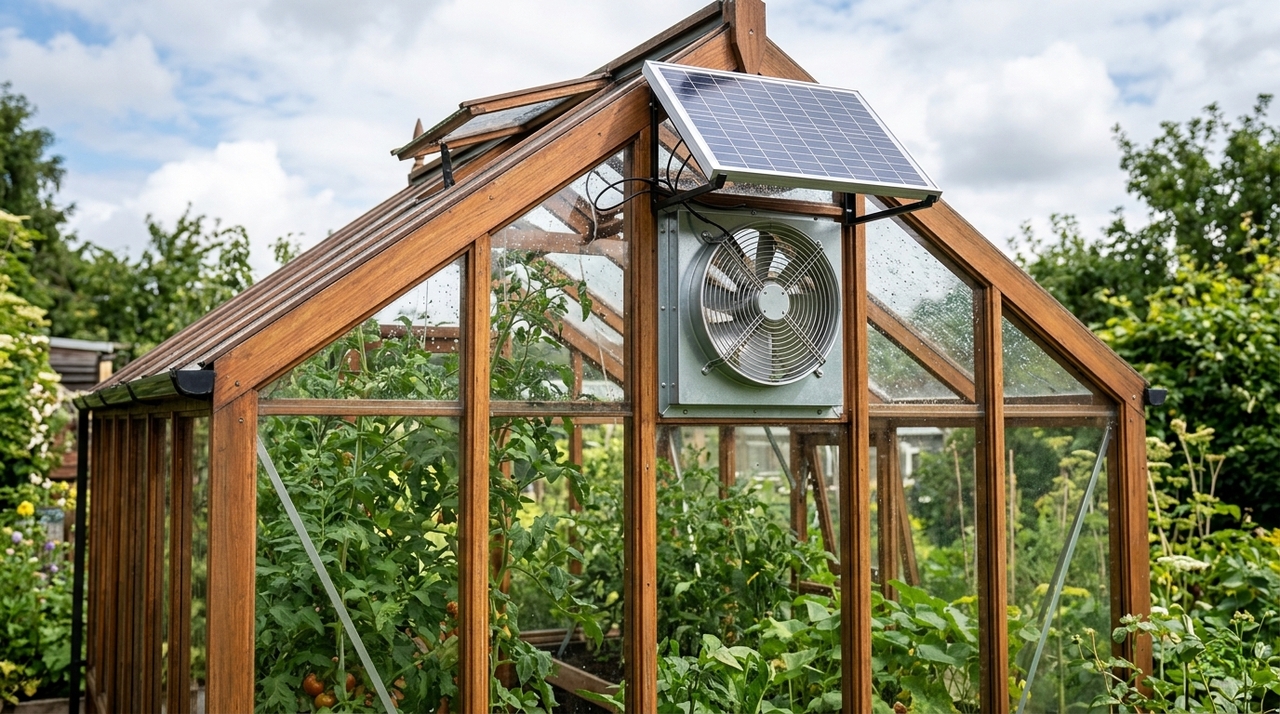
Optimising Plant Health With a Solar Powered Greenhouse Fan
A solar powered greenhouse fan addresses one of the most persistent headaches in horticulture: heat stress. Greenhouses trap radiant energy efficiently—which is exactly what they're designed to do—but without active ventilation, internal temperatures can soar to 40°C or higher on a clear July day. That kind of heat wilts crops, accelerates fungal growth, and destroys seedlings overnight.
With a solar greenhouse fan, you can regulate temperatures, reduce excess humidity, and prevent the spread of airborne pathogens like Botrytis. And during the sunny days, the fan has enough power to run, and it's during this period when the temperatures inside greenhouses are high. In simple words, more sun means more heat and high temperatures, but it also means more solar energy for the solar fans to run.
Removing Trapped Attic Heat Using a Solar Powered Extractor Fan
Attics are natural heat traps. On a summer afternoon, temperatures in this space can reach 70°C, which can cause degradation to roof insulation, warp timber joists, and push heat into living spaces. When temperatures rise, it means your air conditioning units have to work harder to keep them low. Installing a solar powered extractor fan at the ridge of your roof can help remove this superheated air continuously during daylight hours.
Attic ventilation reduces ceiling-level temperatures by 10-15°C, and this helps minimize the cooling loads in rooms below. A solar extractor fan helps reduce this without increasing your electricity costs.
Ventilating RVs, Sheds, and Garages
A compact auto fan solar can be used to fix stale, humid air in enclosed spaces. Air flow is a necessity in garden sheds for storing chemicals to prevent condensation damage. In garages, accumulation of VOC fumes from paint and fuels creates a health hazard space. For each case, a small solar fan can provide enough air circulation to make each space safe and usable.
Key Features to Evaluate Before Buying
Airflow Capacity and CFM Ratings
CFM—Cubic Feet per Minute—is the standard measure of a fan's airflow output. To calculate the CFM you need, multiply your space's volume (length × width × height in feet) by the recommended air changes per hour (ACH) for that environment: typically 20–30 ACH for greenhouses and 10–15 ACH for attics. Divide that figure by 60 to get your minimum CFM.
An undersized solar fan won't shift enough air to make a meaningful difference. Always size up slightly to account for panel inefficiency on partially overcast days.
Solar Panel Wattage and Conversion Efficiency
What determines how fast and consistent a solar fan motor can run is its panel wattage:
For a small shed, 10W panel is adequate
For a greenhouse or attic, 20-40W panel is sufficient
Monocrystalline panels have the best efficiency-to-size ratio of about 20-22% compared to polycrystalline panels that have efficiency-to-size ratios of 15–17%. This information is crucial, especially if you have limited mounting space or when cloud cover reduces available irradiance.
Battery Storage and Hybrid Power Capabilities
One critical limitation of direct-solar fans is that they stop running when the sun sets. In temperature sensitive spaces, such as greenhouses, this is a serious gap that can cause a lot of damage. Therefore, consider systems that have integrated lithium battery backup or hybrid AC/DC. For the best cycle life and thermal stability, look for units with LiFePO4 battery chemistry.
Motor Durability and Type (Brushless vs. Brushed)
How long a solar powered fan functions without experiencing mechanical breakdown is determined by the internal motor type. A solar powered fan uses the brushless DC motor because it eliminates internal friction entirely, reducing wear and noise. This also improves energy conversion, making them more efficient. This is the opposite for a solar powered fan with a brushed motor.
Material Build Quality and Weatherproofing Standards
Solar powered extractor fans and solar greenhouse fans are usually permanently installed outdoors. However, if they are built with weaker materials, they can easily be destroyed by UV exposure, rain, frost, and salt air (in coastal locations). So, when looking to buy a solar powered fan, choose ones made from aluminium or stainless steel housings. Avoid those made from standard ABS plastic. Also check the Ingress Protection (IP) rating:
IP44 that indicates the fan can withstand water splashes from any direction but not rain proof
IP54 that indicates the solar powered fan is dust proof and water proof (including from the rain)
IP55 that indicates that the solar fan can withstand dust ingress and low-pressure water jets from any angle
IP65 that indicates the solar fan is dust-tight and can withstand low-pressure water jets
IP67 that indicates that the solar powered fan is entirely dust-tight and can withstand temporary immersion in water for up to 1 metre for 30 minutes
IP68 that indicates that the solar fan is fully resistant to dust and can withstand continuous submersion in water
Building the Ideal Auto Fan Solar System for Your Space
Creating an auto fan solar setup is a direct method of installing a tailored solar powered fan network that addresses the specific layout and environmental conditions of your property. Let's look at a couple of high-performance configurations that solve distinct structural ventilation pain points.
Achieving Continuous 24/7 Airflow With the Delta 3 Max Plus Smart Battery Setup
You need to have an intelligent power reserve to back up your solar powered fan system to sustain comfortable airflow throughout dark summer nights. The Delta 3 Max Plus Smart Battery Setup is a portable solution that helps you fix this problem. This system absorbs and stores excess energy during peak sun hours and stores it so that you can use it during night hours, keeping your solar fans running. What makes it even a more attractive option is its LiFePO4 battery chemistry that guarantees years of use.
Upgrading to Active Climate Control With the EcoFlow WAVE 3 Portable Air Conditioner + Wave 3 Add-on Battery
UK summer temperatures can rise up to 40.3°C which can be higher than the cooling capacity of a standard solar powered fan alone. The EcoFlow WAVE 3 Portable Air Conditioner + Wave 3 Add-on Battery is an efficient, off-grid solution that offers rapid temperature suppression. It draws power from your solar installations and uses its advanced mechanics to lower ambient temperatures quickly. What makes it even more efficient is that it actively removes heavy thermal loads from RVs or workshops, unlike a typical solar powered fan that focuses on moving existing air.
Conclusion
A solar powered fan is a practical solution that solves real problems, while keeping your electricity costs low. However, to get the most out of your solar fans investment, you must purchase a unit that can actually meet your needs. Therefore, when purchasing, focus on the specifications of each product. Consider the space where you want to install it, panel type, and motor technology. This will help you get a solar powered fan that can run for 15-20 years with minimal intervention.
EcoFlow is the home of modern technology systems, such as solar panels, home battery systems, and smart energy solutions. We offer a wide range of cooling solutions that are designed to meet your specific needs. Explore our full catalog and find the right solution for your home, garden, and off-grid setup.
Solar Powered Fan Frequently Asked Questions
Do Solar Powered Fans Work at Night or on Cloudy Days?
Solar powered fans with integrated battery reserves store energy during peak daylight hours and draw on it after sunset—meaning ventilation continues around the clock. Direct-sun models without battery backup will slow down proportionally as UV irradiance drops and stop entirely in darkness. For critical environments like greenhouses, always choose a system with battery storage or a hybrid AC power fallback.
Are Solar Extractor Fans Difficult to Install Yourself?
Most solar extractor fans and solar fans are genuinely plug-and-play. The solar panel typically mounts via adhesive pads or a simple bracket, the fan unit fits into a standard vent aperture, and the two connect with a pre-wired DC cable. No electrician needed, no Part P notification required in most residential installations. Basic DIY competence — drilling, sealing, and securing a bracket—is all it takes.
How Long Do Solar Panel Fan Systems Typically Last?
A well-specified solar panel fan system—brushless motor, monocrystalline panel, quality housing—should deliver efficient performance for 15 to 20 years. Solar panels degrade slowly, typically losing around 0.5% efficiency per year, meaning a quality panel still operates at roughly 90% capacity after 20 years. Brushless motors, with no contact wear, will frequently outlast the panel itself.