How Many kWh Does a House Use? UK Household Energy Guide for 2026
- What Does kWh Mean in Household Electricity Usage?
- Average Household Electricity Usage by Home Size and kWh
- Monthly and Yearly Household Energy Consumption
- Common Reasons Household Electricity Usage Increases
- Smarter Energy Solutions for Managing Household Electricity Usage
- Tips for Reducing Household Electricity Usage
- Conclusion
- FAQs
What Does kWh Mean in Household Electricity Usage?
The first step to understanding electricity consumption is to grasp what a kilowatt hour (kWh) is. While many people in the UK will encounter a kWh measurement on their energy bills each month, not everyone will fully understand the impact that a kWh has on energy bills and how much energy they use on a daily basis.
Typically, those searching for how many kwh does a house uses are looking to either estimate their electricity costs, compare their household use, or identify ways to lower their increasing costs. As the cost of electricity in the UK varies, so too does the importance of monitoring how much kWh is used; thus, many UK households are looking for reliable electricity storage solutions to lower their costs.
Difference between electricity and gas kWh usage
The unit of measurement for electricity and gas is kWh, but how they are used varies in most homes. Appliances, lighting, electronics, and home devices run on electricity and gas is used in heating systems, boilers, and cooking.
Some of the factors that affect electricity usage for households interested in learning how many kwh of electricity does a house uses are:
number of appliances
working from home
entertainment devices
kitchen equipment
heating or cooling requirements for the season.
However, gas consumption tends to rise when the winter months are cold and central heating systems are operating more often.
Why do UK households monitor kWh usage more closely
As electricity costs rise and the way we use electricity continues to evolve, many households are now focused on how many kWh a house use per day. As a result of the smart meters and apps for monitoring energy consumption, people have become more aware of their electricity use and can do so at real-time.
Several factors are making households more conscious of their energy usage:
Rising electricity prices
Increased remote work
Growing use of smart home gadgets
Higher appliance usage
An understanding of energy efficiency and conservation methods
A household should be able to understand the amount of kWh they are using each day, which will help them identify areas where they could use electricity more efficiently.
Average Household Electricity Usage by Home Size and kWh
The amount of electricity used depends on the size of a property, the number of people who live there and the number and kinds of appliances that are used daily. Families with additional bedrooms tend to use more electricity as they tend to use extra lighting, heating appliances, an entertainment system, and kitchen appliances.
For those looking into how many kwh does a average house use, they can know the average energy usage by home size to help them estimate their bills, or to help them understand where to start cutting energy usage.
How many kWh does a 2 to 3 bedroom house use?
The average UK 2–3 bed house typically uses 6–12 kWh daily, depending on the number of people living in the house and how it is used. Electric consumption varies from 2,000 to 4,000 kWh per year.
Home Size | Average Daily Usage | Average Annual Usage | Common Factors Affecting Usage |
2 Bedroom House | 6–9 kWh | 2,000–3,000 kWh | Small families, limited appliance use, occasional remote work |
3 Bedroom House | 8–12 kWh | 3,000–4,000 kWh | More occupants, home office setups, increased cooking and heating use |
How many kWh does a 4 to 5 bedroom house use?
The bigger the family, the more electricity is needed because of the extra rooms, appliances, and daily activities of the extra people. The amount of energy that a typical 4 to 5 bedroom house uses each day will range from 12 to 25 kWh, depending on how much energy the household uses.
Those who are wondering how many kwh does a 4 bedroom house use or how many kwh does a 5 bedroom house uses are wondering why bigger houses tend to rack up bigger electricity bills.
Home Size | Average Daily Usage | Average Annual Usage | Common High-Energy Activities |
4 Bedroom House | 12–18 kWh | 4,500–6,500 kWh | Multiple appliances, larger kitchens, home entertainment systems |
5 Bedroom House | 18–25 kWh | 6,500–9,000 kWh | Electric vehicle charging, extensive heating, multiple occupants |
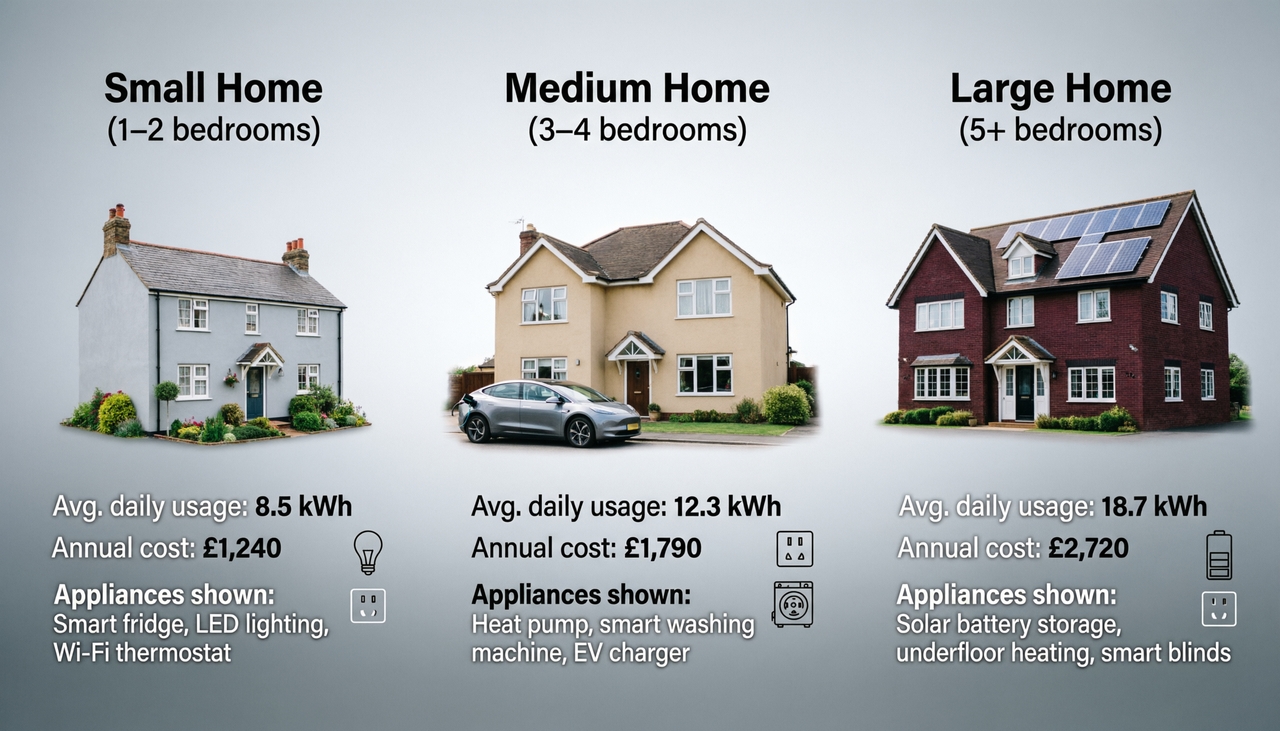
Factors that affect daily electricity consumption
There are a number of factors that can affect the amount of kWh a house consumes per day, even within similar sized homes. The amount of electricity used each day will vary with the property as well as the way the property is used by the household and the season.
Some factors that can impact household electricity use are:
appliance efficiency
number of occupants
heating systems
working from home
seasonal weather conditions
UK households tend to use more electricity in the winter months as the need for lighting, heating and using electrical appliances indoors rises.
Monthly and Yearly Household Energy Consumption
After households have become aware of their electricity consumption on a day-to-day basis, they can explore how electricity is used over a longer period. The amount of energy consumed each month and each year depends on weather, home size, appliance use, and lifestyle.
When considering how many kwh does a house uses in a month, for many UK homeowners, it is helpful to be familiar with the general trends of electricity usage throughout the year.
How many kWh does a house use in a year?
The average UK domestic dwelling unit uses 2,500 to 4,500 kWh of electricity a year (higher figures for larger properties and for high-consumption households). Households with electric heating systems, or several setups of a home office, tend to have more electricity usage per year.
Several factors that impact yearly kWh consumption of a house when inquiring how many kwh does a house use in a year:
property size
number of occupants
heating systems
appliance efficiency
remote work habits
seasonal weather changes
Yearly energy use tracking will assist households in getting a sense of long-term energy trends and making better forecasts about their future energy costs.
Why winter electricity usage is usually higher
UK households use more electricity in colder weather. During the winter months, some people spend more time indoors, which means they use lighting, heating equipment, TV and electronic devices for more time.
During winter evenings, electricity consumption can spike due to several factors, including:
Lights are used for longer periods
Electric heaters are more expensive to operate
appliances are used more frequently indoors
The charging time is increased, and entertainment systems are in use longer
Extremely cold weather may also lead to more use of tumble dryers, electric cooking devices, and hot water systems in the winter.
Common appliances that consume the most electricity
Some home appliances use much more energy than others. Knowing which devices consume the most electricity can help households avoid wasted energy and save on their bills each month.
Common appliances that increase the number of kWh per day that a house uses are:
electric heaters
tumble dryers
ovens and electric cookers
refrigerators and freezers
washing machines
gamers' PCs and TVs for entertainment use.
A house with various appliances, high consumption devices, running all day long, will show differences in electricity usage, which is noticeable in its monthly bills.
Common Reasons Household Electricity Usage Increases
Recent years have seen a significant change in household electricity use due to the increasing number of people working from home, smart devices and the greater reliance on energy-intensive appliances during the day. Two houses with the same size footprint can have vastly different electricity costs based on their usage and habits.
For households seeking to know “how many kwh does a house use a day?” One of the first steps towards improving energy efficiency and reducing monthly electricity costs is to determine the primary reasons for increased electricity consumption.
High-power appliances and heating systems
One of the main reasons for electricity bills to be higher in the home is the use of high power appliances. Any items that heat up or are used for a long time will use much more electricity than smaller items.
These are the top energy-consuming appliances that tend to be responsible for most of the energy used in homes, which are being researched to determine how much are the kwh of a house per day:
electric heaters
ovens and cookers
tumble dryers
electric showers
air conditioning systems
Heating systems can be particularly costly in colder weather, when appliances are used for hours per day.
Remote work and home office electricity usage
The rise of remote working has also led to more electricity being used in many homes each day. Laptops, monitors, routers, lighting systems, printers and charging devices are commonly found in home offices throughout the day.
For those tracking their home's kWh, working from home can make a significant difference in electricity costs, as:
Devices stay on for longer periods of time.
The lights are turned on during the day to help with the heating
Internet equipment is kept on all the time.
Other appliances are used more often.
Families where everyone at home is working remotely or attending school either at home or online could have even greater electricity usage.
Smarter Energy Solutions for Managing Household Electricity Usage
More and more people are now seeking to move beyond just monitoring energy use as they become more aware of the rising cost of electricity in their homes. While knowing how many kwh does a house use is a valuable piece of information, managing that electricity more efficiently is increasingly valuable because it is important to cut long-term household costs.
Households can now store electricity and use solar energy better, and reduce their dependence on the public electricity grid when they use electricity the most. Home energy management is becoming more and more a part of daily life, particularly for homes with greater daily energy loads, and smart battery storage plays a key role.
STREAM Ultra for everyday household energy management
The EcoFlow STREAM Ultra aims to provide an intelligent and convenient solution to power consumption for households. STREAM Ultra comes with an integrated inverter and an extendable battery pack to enable energy storage and consumption more efficiently during the day.
STREAM Ultra can be used for common electricity use in a home that tracks how many kwh does a house use per day, such as the following:
lighting systems
TVs & entertainment equipment
Laptops and home office equipment
Smart home devices and routers
using kitchen appliances during the daytime
The system can also integrate with solar energy systems, which allows users to make more efficient use of renewable energy and decrease their reliance on the electrical grid.
STREAM Ultra X for households with higher energy demands
The EcoFlow STREAM Ultra X is a more powerful home energy management solution for larger households or homes with greater electricity consumption. It is intended for households with more than one appliance, more home office appliances, and with a higher daily consumption of electricity.
If you're trying to find out how many kwh does a house use in a month, you might want to consider STREAM Ultra X to help manage:
larger appliance usage
home entertainment systems
Several work-from-home options
Includes kitchen and laundry appliances
A higher peak electricity demand in the evening hours
STREAM Ultra X offers users expandable energy storage capacity, along with high AC output, making it ideal for homes looking to enhance their energy efficiency and minimize their need for grid power over the long run.
Tips for Reducing Household Electricity Usage
Making lifestyle changes isn't always a prerequisite to using less electricity at home. Households can find ways to use appliances more efficiently, monitor their energy consumption, and make other lifestyle changes that will reduce their daily energy consumption and long-term electric bills.
Use energy-efficient appliances
Modern appliances that are energy efficient use less electricity and still provide the same output. Over time, older devices are replaced by newer ones, which can help lower energy consumption in the home.
Turn off unused electronics and standby devices
Many electronics are still using electricity when not in use. Keep unnecessary devices off standby to reduce unnecessary daily power consumption.
Monitor electricity usage with smart systems
Smart meters and monitoring systems with applications enable households to increasingly monitor their daily energy consumption and find out where their energy is being wasted.
Use high-power appliances during off-peak periods
Households can use electricity more efficiently by running dishwashers, washing machines or charging devices during off-peak hours.
Improve home energy storage and solar usage
Households could save energy and energy costs, and lower their dependence on the grid, by using home battery systems and solar-powered energy solutions, which provide long-term energy efficiency.
Conclusion
If you know how many kwh does a house use, you can better control your energy use, budget for your energy bills, and see where you can be more efficient. The electricity demand varies from day to day and from year to year, depending on factors like how much electricity consumers use, remote work, appliance usage, and the weather.
With electricity prices on the rise, many homes are looking to use electricity in smarter ways than just monitoring. Family-level energy storage solutions, such as EcoFlow STREAM Ultra and STREAM Ultra X, store and utilize electricity to improve efficiency and decrease reliance on the public grid. Smart energy practices and contemporary energy storage methods can help contribute to long-term, sustainable, and cost-effective home energy management.
FAQs
What appliances use the most electricity in a home?
Certain household appliances use much more power than others. The most significant sources of kwh use for a typical home are:
electric heaters
tumble dryers
ovens and cookers
Electricity-using appliances with high-wattage or long-running cycles tend to be the biggest contributors to energy costs. Efficient appliances and usage times can help to lower overall consumption.
Why does electricity usage increase during winter?
Winter is a time when electricity consumption tends to be higher, as people spend more time indoors with increased demand for heating, lighting, and using household appliances. Any home that has been studying how many kwh does a house uses at night will detect a greater usage at night during the colder months.
Some of the common causes of higher energy bills during the winter are:
longer lighting hours
electric heating systems
Increase in the use of appliances indoors
Household energy use can be greatly influenced by seasonal weather variations in both monthly and long-term consumption.
How can households reduce daily electricity consumption?
Consumers can save energy each day by using more efficient appliances, turning off equipment not being used and tracking energy consumption more carefully with smart meters or energy management systems.
There are simple ways that can help a house that's trying to lower how many kwh does a house use in a month, such as using LED lighting, turning off appliances when they aren't being used, and other ways to use the appliances more efficiently.
Are solar battery systems useful for lowering household energy bills?
Yes, solar battery systems can be used in homes to store energy for use when needed and thus reduce dependence on grid electricity. The EcoFlow STREAM series of systems aim to enable smarter energy management at the household level and enhance electricity efficiency.
For households that want to keep track of how many kwh a house consumes over a year, energy storage systems might be useful:
Further develop solar energy use
minimise peak electricity demand
promote sustainable energy consumption
Increasingly, these are being adopted as household choices for a more flexible and energy-efficient energy package for the home.