Upgrade Your Home Efficiency With the Best Energy Saving Light Bulbs
- Why Switching To Energy Saving Light Bulbs is No Longer Optional for UK Homeowners
- Navigating the Technical Jargon of Energy-Saving LED Light Bulbs
- Dealing With the Fit Frustration, Energy Saving Light Bulbs Bayonet Cap and Screw Types
- A Comparison of Energy Saving Incandescent Light Bulbs and LED Technology
- Beyond the bulb, Taking Home Energy Independence to the Next Level
- Recommended Energy Solutions For a High-Efficiency Home
- How to Find the Best Energy Saving Light Bulbs For Home Use
- Conclusion
- Energy Saving Light Bulbs Frequently Asked Questions
Energy bills in the UK have been relentless. Between repeated Ofgem price cap adjustments and the broader cost-of-living squeeze, millions of households are asking the same question: Why is my electricity bill still so high when I'm already trying to cut back? The answer is often hiding in plain sight, literally above your head.
One of the fastest and lowest-effort changes you can make to lower your electricity costs is installing energy saving light bulbs. If you properly implement it across your home, you can see the results in your electricity bill.
This guide looks at:
Why you should switch to energy saving light bulbs
Understanding the technical jargon of energy-saving LED light bulbs
Energy saving light bulbs bayonet cap and screw types
A comparison of energy saving incandescent light bulbs and LED technology
Recommended energy solutions to help keep your household energy costs low
How to find the best energy saving light bulbs for home use
Why Switching To Energy Saving Light Bulbs is No Longer Optional for UK Homeowners
Let’s break down some numbers. These calculations are based on the current Ofgem energy price cap of 24.67p per kWh. If you are using a traditional 60W incandescent bulb for four hours daily, the bulb consumes 87.6 kWh per year. And the electricity cost you’ll pay will be £21.61 per year.
If you swap this bulb for an LED that’s drawing 8-9W, you’ll immediately notice the difference in the energy consumed and the cost you pay. The LED bulb consumes 11.68kWh per year, assuming it still runs for 4 hours on a daily basis. The total electricity cost you pay translates to £2.88 per year. As you can see the difference is huge, and it’s just for one bulb. If you multiply this across 20 bulbs in a typical three-bedroom home, your savings can exceed £300 annually.
Note: This calculation has used the current Ofgem energy price cap of 24.67p per kWh. This figure is not constant but changes. Always check on the Ofgem’s official website for the up-to-date electricity price cap.
The environmental case is equally clear. Light bulbs energy saving at LED efficiency levels produce around 75% fewer carbon emissions than incandescent alternatives. According to the Energy Saving Trust, lighting accounts for approximately 11% of the average UK household's electricity consumption, not an insignificant share.
The payback period for energy saving light bulbs UK, the point at which upfront costs are recovered through lower bills, is typically three to six months. After that, every saving is pure gain, from a bulb rated to last 15,000 to 25,000 hours. The economics leave very little room for debate.
Navigating the Technical Jargon of Energy-Saving LED Light Bulbs
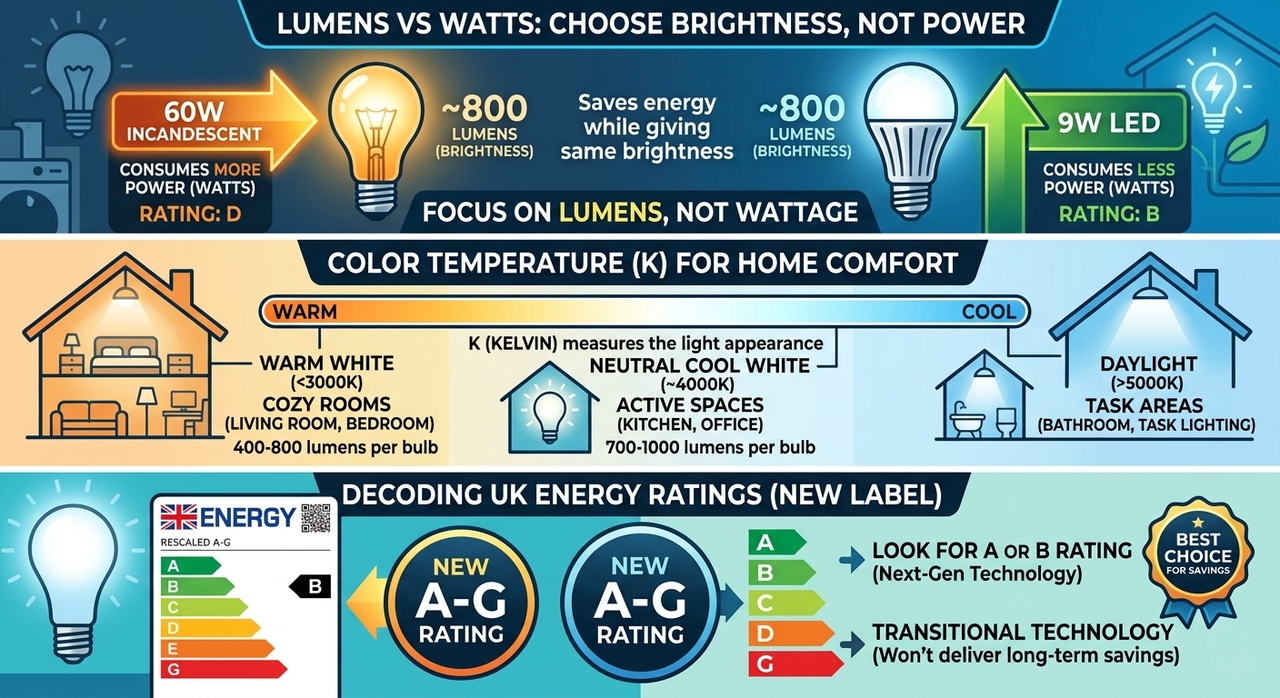
Lumens versus Watts and Why Brightness Matters More Than Power Consumption
Lumens vs watts confuse a lot of buyers. Watts measure power draw. Watts don’t measure brightness. Lumens are the ones that measure brightness. Let’s add a perspective to this, a 60W incandescent produces roughly 800 lumens, and so does a quality 8–9W LED.
When shopping for energy-saving LED light bulbs, focus on lumen output, not wattage. 400-800 lumens per bulb are ideal for a living room. For a kitchen, look for 700-1,000 lumens bulbs.
Understanding Colour Temperature and How to Choose Between Warm White and Cool Daylight for Home Comfort
Colour temperature is what determines if the room is cosy or clinical. It’s measured in Kelvin (K). For bedrooms and living rooms, consider warm white (which is usually below 3,000K). Neutral cool white is about 4,000K and is best for home offices and kitchens. Above 5,000K is daylight which is excellent for bathrooms, but harsh in relaxation spaces.
Decoding Energy Ratings and What the New UK Energy Labels Mean for Your Purchase
The UK rescaled its A–G energy rating system in 2021. Previously A+++ and A++ rated products were reclassified, mostly as B or C, to make space for next-generation technology at the top. When selecting energy saving light bulbs UK, look for an A or B rating. Anything C or below is transitional technology that won't deliver the long-term savings you're after.
Dealing With the Fit Frustration, Energy Saving Light Bulbs Bayonet Cap and Screw Types
The UK is split between two dominant fittings. The B22 bayonet cap, the push and twist mount most common in older British homes; and the E27 Edison screw, more prevalent in modern luminaires and European-style fittings. Smaller variants, the B15 and E14, appear in decorative and candelabra fixtures.
Many buyers searching for energy saving light bulbs bayonet fittings leave the shop with the wrong product entirely. The fix is simple: check the old bulb before disposing of it, the fitting type is stamped on the base.
Dimmer compatibility deserves its own mention. Not all bayonet energy saving light bulbs, or screw-fit LEDs, are designed for dimmer circuits. Using a non-dimmable LED on a dimmer causes flickering, buzzing, and early failure. Look explicitly for dimmable on the packaging, and check that your dimmer switch supports LED loads. Most standard dimmers require a minimum load of 10–25W, which creates complications when each LED draws just 8–10W.
A Comparison of Energy Saving Incandescent Light Bulbs and LED Technology
The phrase energy saving incandescent light bulbs is largely a marketing construct. True incandescent technology is fundamentally wasteful, roughly 90% of the energy consumed is emitted as heat, not light. Halogen energy savers improved on this marginally (around 25–30% efficiency gain), but they're now being phased out under UK legislation.
Energy saving LED light bulbs use a semiconductor to convert electricity directly into light. In these bulbs, there is almost no heat produced as a by-product. A quality LED rated at 25,000 hours will outlast approximately 25 halogen equivalents. This means that also hidden costs of frequent replacements and disposal are also eliminated in the process.
In 2026, if you are looking for longevity, lower maintenance, and genuine energy reduction, energy saving LED light bulbs are your best option.
Beyond the bulb, Taking Home Energy Independence to the Next Level
Energy saving light bulbs are the starting point, not the finish line. Once lighting is optimised, the logical next step is addressing when and how grid electricity is consumed. The UK grid is most carbon-intensive and most expensive during peak hours, typically 4–7pm. Efficient lighting is step one. Powering your home intelligently is step two.
EcoFlow's Stream home energy ecosystem makes that second step practical. Rather than simply reducing consumption, it enables homeowners to generate, store, and deploy solar energy on their own schedule, substantially reducing dependency on the grid and its price swings.
Recommended Energy Solutions For a High-Efficiency Home
EcoFlow STREAM Series Solar Plant
The EcoFlow STREAM Series Solar Plant directly addresses a frustration that persists even after switching to energy saving light bulbs: grid rates don't care how efficient your home is during peak hours. This plug-in solar battery system captures solar energy during the day and stores it for use when electricity costs peak in the evening.
For a home already running best energy saving light bulbs, the battery capacity stretches considerably further. Your LED lighting load is low; stored solar power covers it easily and extends into other appliances. Built on LiFePO4 battery chemistry with MPPT charge regulation, it's engineered for safety, longevity, and reliable indoor use, practical energy independence rather than a theoretical one.
450W Rigid Solar Panel + STREAM Ultra X Bundle
If you are looking to commit seriously and get true energy independence, the 450W Rigid Solar Panel + STREAM Ultra X Bundle is your real solution. The 450W rigid panel generates enough energy on a good sunny day to charge the Ultra X, which you can use to power your home’s entire lighting load.
Now combine this with energy saving light bulbs for home, you have an alternative that lowers your electricity costs. LEDs reduce your consumption and the Ultra X stores what the solar generates. The high-capacity battery means short winter days and overcast skies don't eliminate your solar advantage, you're drawing on stored energy rather than defaulting to the grid at peak rates. This bundle is meant to help you reduce your long-term electricity bills, overdependence on the grid, and give you energy freedom.
How to Find the Best Energy Saving Light Bulbs For Home Use
Before you purchase the best energy saving light bulbs UK, check on this list:
Only choose energy saving LED light bulbs with rating A or B only
The energy saving light bulbs should provide a minimum lifespan of 15,000 hours or choose premium options that guarantee over 25,000 hours
Check on the warranties, reputable brands provide a two to five year warranty
Check the fitting type of the energy saving LED light bulbs, i.e. B22, E27, E14, or GU10
The energy saving light bulbs should have a lumen output that is matched to room function, not wattage
Check whether the energy saving light bulbs have dimmer compatibility
On cost, energy saving light bulbs free of charge are genuinely available to qualifying UK households. The Government's Energy Company Obligation (ECO4) scheme, delivered through energy suppliers, provides subsidised or fully funded energy efficiency improvements. Check eligibility before spending anything.
Conclusion
When it comes to home energy efficiency, energy saving light bulbs are still the lowest-hanging fruit. These bulbs guarantee minimal upfront cost, immediate cost savings, and don’t require a specialist for installation. If you correctly select the A-rated LEDs, together with the right fitting, and that have dimmer compatibility, you can expect 80-90% reductions in your lighting costs.
If you are looking to go further and gain complete energy independence, EcoFlow provides the STREAM series and Ultra X home solar battery systems. These are solutions we provide that can work alongside your efficient LED lighting and other home appliances. In 2026, reducing what you consume and generating what you need is the best strategy for creating a resilient energy strategy. Visit us today and start building a home that runs smarter, not just cheaper.
Energy Saving Light Bulbs Frequently Asked Questions
Do energy saving light bulbs really save that much money?
Yes, the difference is substantial. Energy saving light bulbs consume 80–90% less electricity than traditional incandescent bulbs for an equivalent lumen output. A single LED running four hours per day saves approximately £15–£20 annually compared to a 60W incandescent. Scaled across a full home, total yearly savings can exceed £300, with no change in behaviour required.
Can I use energy-saving LED light bulbs in any light fixture?
Not automatically. Energy-saving LED light bulbs are available across all common UK fittings, B22 bayonet, E27 screw, E14 small screw, and GU10 spotlight, but matching the fitting before purchase is essential. Enclosed or deeply recessed fixtures with poor ventilation can trap heat around the LED driver, shortening its operational life significantly. Always check the manufacturer's guidance on enclosed-fitting compatibility before installing.
Why do my energy saving light bulbs flicker when I turn them on?
Flickering is almost always a compatibility issue between a non-dimmable LED and a dimmer switch circuit. Dimmers function by rapidly interrupting current flow, a process standard LEDs aren't designed to handle. Replace the bulbs with explicitly "dimmable" energy-saving LED light bulbs and confirm that your dimmer switch is rated for low LED loads, ideally with a minimum load threshold of 10W or less. Resolving both sides of the equation eliminates the problem entirely.