Nova Scotia Hurricane and Power Outage Guide: What NS Power Customers Need to Prepare
- Why Nova Scotia Hurricanes Often Lead to Long Power Outages
- How to Track an Outage With Nova Scotia Power and Set Expectations
- What to Do Before the Storm: A Practical 72-Hour Outage Prep Checklist
- Staying Safe During a Power Outage at Home
- Choosing Backup Power That Fits Your Home and Your Essentials
- Frequently Asked Questions
- Stay Ready for the Next Storm With a Safer, Quieter Backup Plan
Nova Scotia is one of the most hurricane-exposed provinces in Canada. Over the years, major storms have caused widespread and multi-day power outages as just one of the impacts they leave behind. The only reliable buffer is thorough preparation before the storm arrives because grid restoration after a large hurricane can take a while.
As a Nova Scotia resident, here's how to prepare for all power possibilities for this hurricane season and those in the future.
Why Nova Scotia Hurricanes Often Lead to Long Power Outages
When Atlantic hurricanes reach Nova Scotia, they may already be post-tropical systems, but they still bring destructive winds and heavy rainfall.
In 2026, the hurricane season outlook is predicted to be slightly weaker than usual due to La Niña transitioning to neutral atmospheric patterns in the Atlantic.
While this can mean fewer and weaker storms for the United States, it can also shift storm tracks northward, increasing the probability that tropical systems make landfall or brush Atlantic Canada rather than recurving offshore.
Rapid storm intensification is also becoming more common. Atlantic tropical storms are now more than twice as likely to escalate to major hurricanes within 24 hours compared to the baseline set between 1971 and 1990. This compresses the warning window for NS communities and can create a last-minute sense of urgency.
Long power outages during hurricane season should be an expectation, not a surprise. And sometimes, the best planning is investment.
Whole home backup power solutions like the EcoFlow DELTA Pro Ultra are designed specifically for multi-day outage scenarios where grid restoration timelines are unpredictable, giving your home a sense of energy independence even when restoration is unknown.

How to Track an Outage With Nova Scotia Power and Set Expectations
The best way to track an outage as a Nova Scotia Power customer is with the NS Power outage map, which is updated every 10 minutes with details including outage cause, crew status, and estimated restoration time.
Note that the ETR updates are estimates and not guarantees.
When NS Power begins restoration work, their priorities fall in this order:
Emergency safety.
Substations and main transmission lines.
Critical services like hospitals, fire, and water per the provincial EMO.
Circuits serving the greatest number of customers.
Smaller groups and individual accounts as needed.
What to Do Before the Storm: A Practical 72-Hour Outage Prep Checklist
Before a power outage in Nova Scotia hits, here's how to prepare yourself and your family for comfort and safety for 72 hours:
Water: Store a minimum of 4 litres per person per day for drinking and basic hygiene. Fill bathtubs before storms make landfall as a secondary supply for flushing.
Food: Stock non-perishable food in a manual can opener. Precook and refrigerate meals you plan to eat within the first 24 hours while cold storage is still safe.
Device charging: Fully charge your phones, power banks, laptops, and medical devices before the storm makes landfall, because recharging options are limited if the grid goes down.
Lighting and communication: Pack a hand-crank or battery-powered radio so you can get alerts. Include spare batteries as backup.
Documentation: Store copies of family IDs, insurance policies, and medication lists in a waterproof and portable container.
Staying Safe During a Power Outage at Home
When power goes out, there's more to think about than just electricity.
Grid failure can create the secondary hazard of CO poisoning caused by fuel-burning equipment brought indoors. Health Canada requires any gas generators be operated at least 6 meters from any building, with the exhaust directed away from doors and windows.
Downed power lines are another risk. You should treat any downed line as live, stay at least 10 meters away, and always call NS Power's outage line to report it.
Once power is restored, voltage fluctuations can damage electronics, so unplug any sensitive devices during the outage and allow the grid to stabilize before reconnecting.
As for food safety, an unopened fridge can hold safe temperatures for approximately four hours, and a full freezer can keep things safe for 48 hours if the doors stay closed.
Choosing Backup Power That Fits Your Home and Your Essentials
A portable power solution is a safe and indoor-capable alternative to gas generators. There are no CO emissions, no fuel storage. It operates silently, and is compatible with solar recharging to extend your runtime during long outages.
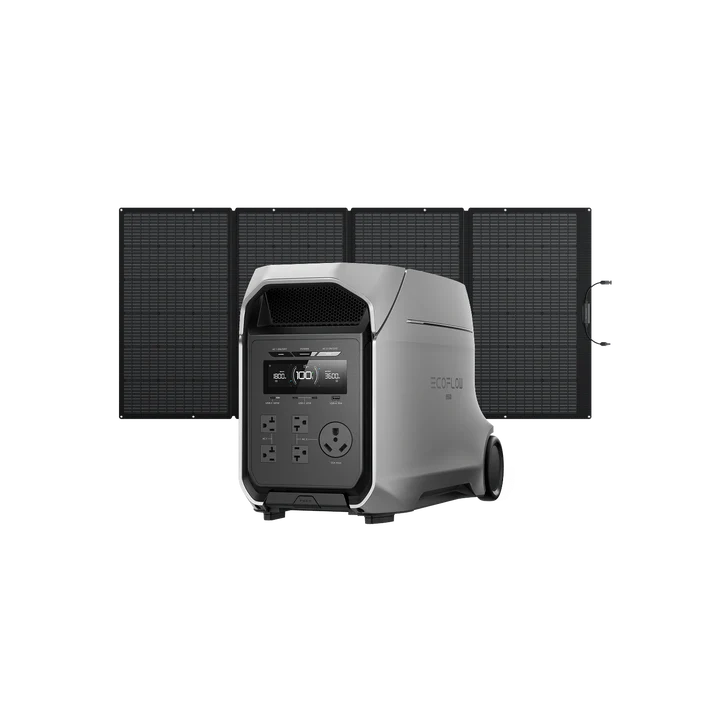
A bundle like the EcoFlow DELTA 3 Ultra Plus + 400W Solar Panel can keep you reliably connected through a Nova Scotia grid failure. With an expandable capacity of 3–11kWh, it can power your most important appliances, like your fridge, microwave, TV, washer, PC, and water pump. At the 11kWh end, it can even support up to 3 days of everyday living during an extended outage.
A home battery backup system like the EcoFlow DELTA Pro Ultra is smart if you’re looking to invest in a more complete off-grid power solution for your home. This system has 6–90kWh of expandable capacity, enough to provide backup for weeks, with 7.2–21.6kW output to power every home appliance. It has uninterrupted power flow and auto-switchover, so when the Nova Scotia grid fails, the EcoFlow DELTA Pro Ultra will switch battery backup automatically, no manual intervention.
Frequently Asked Questions
How Do I Check the Status of My Power Outage in Nova Scotia?
Use NS Power’s live outage map, which is updated every ten minutes with new details. You can search by address to see restoration estimates, cause, and crew status. Without internet access, you can call 1-877-428-6004.
How Long Do Hurricane-Related Power Outages Usually Last in Nova Scotia?
Power outage duration varies depending on the storm’s severity and location. Rural customers restore last under NS Power’s triage model, so if that’s you, plan for at least 72 hours without power for a significant named storm.
Can I Use a Portable Power Station Indoors During an Outage?
It’s safe to use battery-based portable power stations indoors during an outage because they don't produce combustion emissions, unlike gas or propane generators. Fuel-burning generators must be operated at least six meters from any building.
What Should I Do First When the Power Goes Out?
Once your power is out, confirm that the outage is external by checking the NS Power Outage Map. You can also check your breakers to see if anything is tripped. Then, unplug major appliances to protect them against surge damage when the power returns. Keep your fridge and freezer closed to preserve cold and safe food.
Stay Ready for the Next Storm With a Safer, Quieter Backup Plan
Because of Nova Scotia’s hurricane exposure, aging overhead grid, and long post-restoration windows, household-level backup is an insurance policy against a worst-case scenario.
Being fully prepared means you have supplies to last you 72 hours, a plan for tracking restoration progress, and a backup power source that can cover critical household loads safely indoors.
Explore EcoFlow’s full-home backup power solutions to find a system that can keep your home on while the grid is down.