Energy Efficiency Grants: Save Big on Home Energy Upgrades
- What are energy efficiency grants?
- Popular energy efficiency grants in the UK
- Eligible home energy efficiency upgrades for grant funding
- The optimal home energy efficiency solution
- Real-world scenarios & tangible savings with grant-funded upgrades
- How to apply for energy efficiency grants & maximize benefits
- Conclusion
- FAQS
What are energy efficiency grants?
Energy efficiency grants are financial incentives offered by governments or organizations to help households and businesses reduce energy consumption and lower utility costs. These grants support upgrades that improve a home's energy performance, such as better insulation, renewable energy systems, and smarter power management solutions. With rising energy prices, many people are also turning to solar and batteries as a flexible and reliable way to manage electricity needs. In this article, we'll guide you on how to save big on home energy upgrades while making your home more efficient and sustainable.
Popular energy efficiency grants in the UK
Government grants for energy efficiency play a vital role in helping households and businesses cut energy use, reduce emissions, and manage rising utility costs. These schemes vary by country and region, but they are typically grouped into key categories that make clean energy improvements easier and more affordable.
1. National government schemes
National schemes are the foundation of UK energy efficiency support, with clear rules and eligibility. Key programs:
Scheme Name | Compliance Key Points | Key Data & Details |
|---|---|---|
Energy Company Obligation (ECO4) | For low-income/benefit households or poor-performing properties, it requires EPC D–G and benefit/low-income proof. | Runs until March 31, 2026; free/subsidised insulation, heat pumps (solar panels limited, local rules apply). |
Great British Insulation Scheme (GBIS) | Insulation-only support (no heating/renewable upgrades). | Extends insulation funding beyond ECO4 eligibility; covers loft/wall insulation for all residential energy types (not just off-gas mains). |
Direct low-carbon heating subsidy; not a tax rebate. | Extended to 2029/30; up to £7,500 per household for air/ground-source heat pumps. | |
Distinct from local "Warm Homes Local Grants"; aligned with national energy efficiency goals. | Runs 2026–2030; £15 billion total funding; free upgrades for low-income households, BUS extension, and £2 billion low-interest loans for ordinary homes. |
2. Local & targeted support schemes
Alongside national initiatives, regional and local authorities provide targeted grants for energy-efficient homes, focusing on specific communities or needs.
Scheme Name | Compliance Key Points | Key Data & Details |
|---|---|---|
Targeted at fuel-poor households, off-gas homes, or properties with EPC < D; eligibility varies by local council. | Free upgrades (insulation, heat pumps, solar) in participating areas (local coverage varies). | |
Funding aligned with ECO4 and WHP; councils set eligibility beyond national thresholds. | Widens ECO access to more homes, even those not receiving traditional benefits. |
3. Tax rebates & energy credits
Tax rebates and energy credits are another form of government grants for energy efficiency, helping homeowners recover part of their investment through reduced tax bills or post-installation credits.
Incentive Name | Compliance Key Points | Key Data & Details |
|---|---|---|
VAT Relief for Energy Efficiency Improvements | Requires proof of eligible installation and compliance with UK energy standards. | 0% VAT on eligible installations (insulation, heat pumps, solar) until March 2027. |
Eligible technologies include insulation/low-carbon heating; installation records must be kept for claims. | Tax rebates for businesses investing in energy efficiency technologies. |
Note: The information provided is for general reference only. Government policies, eligibility criteria, funding amounts, and timelines are subject to change and may vary by region. All details shall be governed by the official announcements from the UK government and relevant authorities.
Eligible home energy efficiency upgrades for grant funding
If you're looking to make your home greener and more cost-efficient in 2026, several energy efficiency grants UK schemes can help cover the cost of upgrades. These government-backed programmes support improvements that reduce energy waste, lower bills, and make homes warmer and more comfortable
1. Insulation & draft-proofing
Insulation remains the most widely funded improvement under UK grant schemes. Programmes such as ECO4 (ending March 31, 2026) and the Warm Homes: Local Grant support loft, cavity wall, solid wall, floor insulation, and draught-proofing for eligible homes, particularly those with low EPC ratings (D–G). ECO4 is funded by large energy suppliers and prioritises low-income or benefit-receiving households. These upgrades reduce heat loss and can cut heating bills significantly, often with little or no upfront cost for qualifying households.
2. Heating & cooling solutions
UK grants increasingly prioritise low-carbon heating, with the 2026-launched £15 billion Warm Homes Plan reinforcing this focus. The Boiler Upgrade Scheme (BUS) continues to offer grants of up to £7,500 toward air-source or ground-source heat pumps in England and Wales, helping homeowners move away from gas boilers—with BUS funding increasing annually through 2030 and expanded to include cooling-enabled heat pumps. In addition, the Warm Homes: Local Grant and Warm Homes Plan can fund heat pumps and related heating upgrades as part of a wider home efficiency package, with the Warm Homes Plan targeting up to 5 million home upgrades by 2030.
3. Renewable energy technology
Some energy-efficient home grants also support renewable energy installations, a key focus of the Warm Homes Plan. Under the Warm Homes: Local Grant, eligible households may receive funding for solar panels, often alongside insulation or heating improvements. The Warm Homes Plan further supports solar and battery storage through low-interest or interest-free loans for all households, while low-income households may qualify for free solar+battery packages—with battery storage included where funding allows, helping households store and use more of their self-generated electricity.
4. Smart energy management devices
Smart energy controls are increasingly included within funded upgrades. Schemes like ECO4 (until March 2026) and local Warm Homes projects often cover smart thermostats and heating controls, enabling better regulation of heating systems and reducing wasted energy. These devices enhance the impact of other upgrades by helping households manage energy use more efficiently, aligning with the Warm Homes Plan's goal of improving overall energy management for all households.
Upgrading to smart systems can enhance the value of other funded improvements, helping you get more from your renewable or heating upgrades. This is also where innovative options like solar systems from EcoFlow can fit in, offering flexible power support and smart load management alongside traditional home systems.
The optimal home energy efficiency solution
While grants cover many upgrades, combining them with smart solar and storage solutions—like EcoFlow's STREAM Series—lets households maximise savings, store renewable energy, and reduce reliance on the grid.
For larger households: 450W Rigid Solar Panel + STREAM Ultra X
For households with higher daily electricity demand, the EcoFlow 450W Rigid Solar Panel + STREAM Ultra X offers a powerful and reliable home energy solution. With a 3.84 kWh battery capacity and up to 1,200 W of continuous output, the STREAM Ultra X can efficiently power essential appliances such as TVs, ovens, fans, refrigerators, microwaves, coffee makers, and other household devices—reducing dependence on the grid while ensuring smooth, uninterrupted operation.
By storing solar energy generated during the day, the system allows households to use clean, self-generated electricity in the evening or during peak-cost hours, reducing electricity bills and increasing energy independence. Its compact, all-in-one design makes it easy to install and integrate with existing home setups, providing a simple way to maximize self-consumption and take full advantage of renewable energy.
For energy-intensive homes: 450W Rigid Solar Panel + STREAM AC Pro + STREAM Ultra
For homes that use a lot of electricity, combining a 450W Rigid Solar Panel + STREAM AC Pro + STREAM Ultra creates a robust solar-plus-storage system that can significantly cut grid dependence and manage higher power demands.
At the core is the EcoFlow STREAM Ultra, a 3.84 kWh solar battery with a 1,200 W continuous output, Wi-Fi/Bluetooth connectivity, and an IP65 weather-resistant design suitable for indoor or outdoor use. Paired with the STREAM AC Pro (also 1,200 W AC output), the system can deliver up to 2,300 W total AC output, enough to power high-demand household appliances such as washing machines, dishwashers, ovens, refrigerators, microwaves, and space heaters.
Even better, this system lets you place the units wherever you need them—unlike traditional setups that require everything to be stacked in one spot. You can spread them around your home to make the most of solar energy, store extra power, and deliver electricity exactly where it’s needed, keeping your appliances running smoothly without wasting energy.
Combined with the EcoFlow's OASIS Home Energy Management System, the system enables real-time monitoring, smart energy optimisation, and precise control over your home's energy flow, making it an extremely efficient, cost-saving solution for modern households.
Real-world scenarios & tangible savings with grant-funded upgrades
Energy efficiency grants don't just look good on paper; they deliver real, measurable savings when applied to the right home upgrades. Below are practical, real-world scenarios showing how grant-funded improvements can reduce energy bills, increase independence from the grid, and improve long-term home value.
Scenario 1: solar + home storage
A homeowner installs rooftop solar panels with partial funding from an energy efficiency grant, significantly reducing upfront installation costs. By pairing solar generation with a home energy storage solution, excess electricity produced during the day can be stored and used during peak evening hours.
This setup cuts reliance on grid electricity, lowers monthly bills, and protects against price fluctuations. In homes seeking flexibility or backup power, portable storage options such as EcoFlow systems can complement fixed installations by providing scalable, plug-and-play energy support when needed.
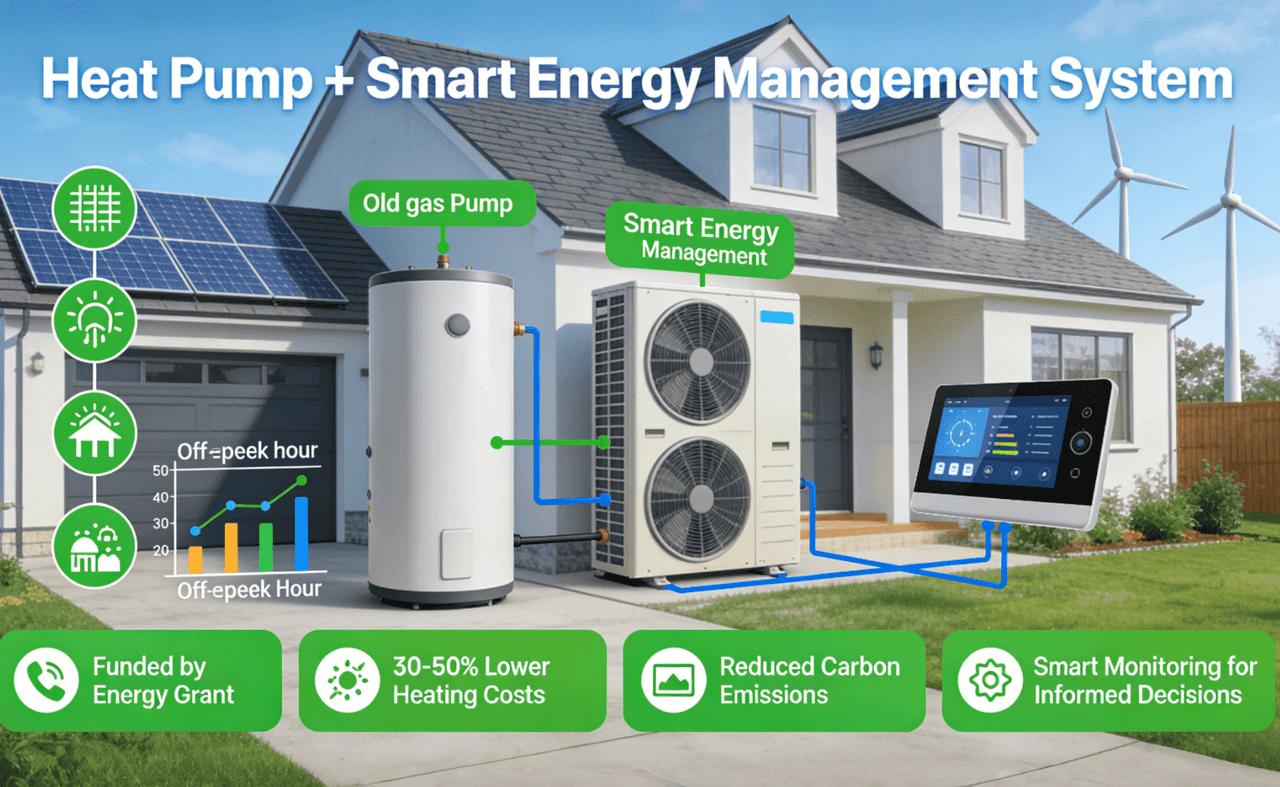
Scenario 2: heat pump + smart energy management system
Using an energy-efficient heat pump funded partially by an energy grant, a household replaces an old gas boiler to heat the home more efficiently. Pairing this with a smart energy management system allows the family to monitor consumption, optimise heating schedules, and run the heat pump during off-peak hours or when renewable energy is available.
This combination reduces heating costs by 30–50% compared to conventional systems while maintaining consistent comfort and lowering carbon emissions. Smart monitoring also helps homeowners make informed decisions about other appliances, further maximising energy efficiency.
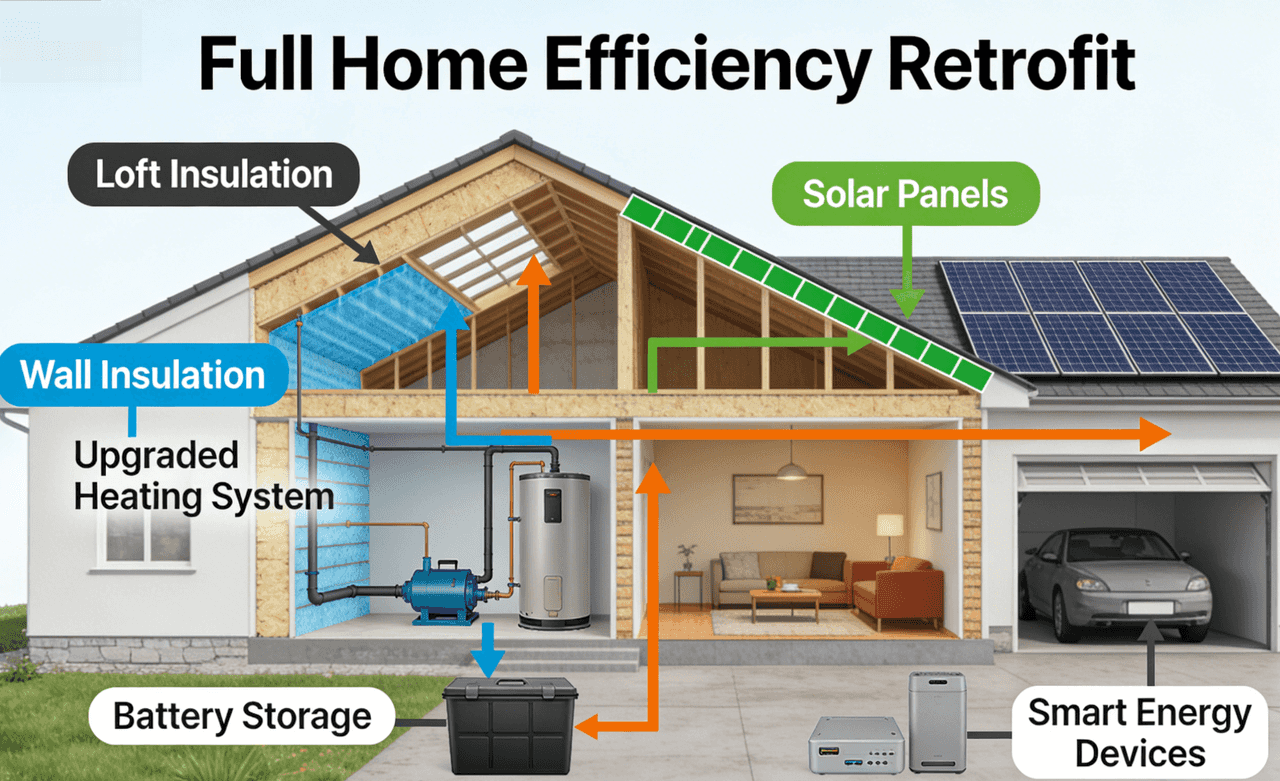
Scenario 3: full home efficiency retrofit
In a comprehensive retrofit, a home receives grant-funded insulation, heating system upgrades, solar panels, and smart energy devices. Loft and wall insulation reduce heat loss, while solar generation and battery storage provide renewable energy. Efficient heating systems and smart controls optimise energy use throughout the home.
Together, these improvements significantly reduce grid dependency and energy bills, sometimes by 40–60% annually, while increasing property value and comfort. This layered approach represents the maximum impact of energy efficiency grants, showing how multiple upgrades work together to create a truly low-energy home.
How to apply for energy efficiency grants & maximize benefits
Applying for grants for energy efficiency can unlock significant funding for home improvements, but success depends on understanding eligibility, preparing the correct documentation, and following the application steps carefully. Here's a detailed guide on how to apply for energy-efficient grants:
Step 1: Critical eligibility criteria
Before you begin an application, make sure you meet the specific eligibility criteria for the grant you're targeting. These can vary between schemes such as ECO4, Warm Homes Local Grants, or other local energy efficiency programmes. Common criteria include:
Property requirements: Your home must typically meet certain standards, such as having a valid Energy Performance Certificate (EPC) below a specified rating.
Occupancy status: You must be a homeowner or have landlord consent if you're renting.
Income or benefits: Many schemes use income thresholds or benefit receipts as qualifying factors. Evidence of Universal Credit, Pension Credit, or similar benefits may be required.
Local rules: Some grants are tied to specific regions, council tax bands, or targeted demographics. Always check local authority conditions before applying.
Step 2: Required documentation for a successful application
Accurate documentation is crucial. Most government schemes require a set of proofs to verify eligibility. Here are the commonly required documents:
Proof of identity: Valid passport or UK driving licence.
Proof of residence: Recent utility bill, council tax bill, or mortgage statement dated within the last 3 months.
Property ownership or tenancy agreement: Confirms you have rights to make improvements.
Energy Performance Certificate (EPC): Shows your home's current efficiency rating.
Income & benefits evidence: Payslips, benefit award letters, or bank statements if applying through a means-tested route.
Installer quotes & certification: Some schemes require quotes from accredited installers or proof of certification (such as MCS for renewables).
Tip: Keep all documents clear, up-to-date, and in the required format. Incomplete or outdated paperwork is a leading cause of delays or refusals.
Step 3: Step-by-step grant application process
Here's a step-by-step walk-through of the application journey for most UK energy efficiency grants:
Check eligibility first
Use official government tools or grant checkers provided by energy suppliers to confirm whether your home qualifies before doing any paperwork.
Prepare documentation
Gather all required documents listed above. Having everything ready reduces delays and helps your application move smoothly.
Submit your application
Depending on the scheme:
Apply online via the UK government or Ofgem portal.
Go through your energy supplier (for ECO4 and similar schemes).
Contact your local council for area-specific grants.
Property assessment
If your application is accepted in principle, a qualified surveyor will often carry out a home assessment to determine what measures your property qualifies for and advise on the best improvements.
Approve & schedule work
Once your funding offer is issued, review and accept it within the valid timeframe, usually a few months. After that, you can schedule installation with approved contractors.
Installation & final claims
Install the approved measures. Some schemes require post-installation confirmation, such as updated EPC ratings or completion reports, before final funding is released.
Conclusion
Energy efficiency grants provide a practical way to upgrade your home, cut energy costs, and increase comfort. By combining grant-funded improvements with smart solutions like EcoFlow solar and energy storage systems, homeowners can maximise savings, boost energy independence, and create a more sustainable living environment. These strategies not only minimize utility bills but also future-proof homes against rising energy prices.
FAQS
Who is eligible for an energy support grant?
Eligibility for energy support grants like the UK's ECO4 scheme usually depends on household income or benefit status. You may qualify if you or someone in your home receives means‑tested benefits such as Universal Credit, Pension Credit, Income Support, or similar support, or if your household income is below a set threshold (often around £31,000/year). Your property typically also needs a lower energy rating to qualify for funded upgrades. When upgrading your home through these grants, pairing improvements with efficient systems and energy solutions from EcoFlow can help maximise savings and reduce reliance on grid power.
What medical conditions are eligible for the ECO4 scheme?
Under the ECO4 scheme, if someone in your household has a health condition made worse by living in a cold home, you may qualify for support even without benefits. Qualifying conditions commonly include cardiovascular issues, respiratory diseases (like asthma or COPD), limited mobility, and immunosuppression, provided these are verified by a medical professional. These upgrades, such as improved insulation or solar plus storage systems, can work alongside products like EcoFlow's energy management solutions to create warmer, healthier, and more efficient homes.
Do over-60s get help with energy bills?
While there isn't a specific grant solely based on being over 60, older adults often qualify for schemes like ECO4 if they receive eligible benefits or have low income, or via local support schemes targeted at pensioners. Some local councils also run discretionary help for older residents to reduce energy costs. Integrating efficient energy upgrades funded by grants with technologies like EcoFlow home energy storage or solar solutions can further help older households lower bills and maintain reliable power.