Horsepower to Watts: How to Convert HP to Watts (1 HP = How Many Watts?)
- Quick Answer: 1 HP = 746 Watts
- What Is Horsepower and What Is a Watt? (Simple Explanation)
- HP to Watts Conversion Formula (1 HP = ? Watts)
- Quick HP to Watts Conversion Table (Common Values)
- How to Convert HP to Watts Step-by-Step
- What Can Different HP Levels Power? (Real-Life Use Cases)
- Why HP to Watts Conversion Matters in Canada
- What Size Generator or Power System Do You Need? (Based on HP)
- Common Mistakes When Converting HP to Watts
- HP vs. Watts: Which One Should You Use?
- Conclusion
- FAQs
Ever stood in a Canadian Tire aisle looking at a new lawnmower or an air compressor and wondered why the box says “2 HP” but your portable power station only talks about “Watts”? It’s a bit of a head-scratcher. Whether you’re trying to figure out if a heavy-duty sump pump will actually run during a spring thaw or just sizing up a new shop tool for the garage, you’re going to run into these two different languages of power: Horsepower (HP) and Watts (W).
In this guide, we will show you exactly how to get the conversion right, and how you can make sure not to fry your circuits or buy a backup battery that’s underpowered for the job. We’re going to skip the textbook fluff and look at how converting HP to Watts actually works when you’re dealing with real gear in a Canadian home.
Quick Answer: 1 HP = 746 Watts
If you just need the quick math to get back to your project, here’s the key: 1 mechanical horsepower equals approximately 746 Watts. To convert HP to Watts, you just multiply that horsepower number by 746. So, if you’re looking at a 2 HP motor, you’re looking at roughly 1,492 Watts of power to keep it spinning. It’s a simple multiplier, but as anyone who’s ever tripped a breaker knows, the “rated” power and what actually happens when you flip the switch can be two very different things.
What Is Horsepower and What Is a Watt? (Simple Explanation)
What Is Horsepower (HP)?
Horsepower is a unit of measurement for power originally developed by James Watt in the 18th century to compare the output of steam engines with the power of draft horses. Today, we mostly use it to describe the “muscle” behind engines and large electric motors.
What Is a Watt (W)?
A Watt (W) is the standard unit of power in the International System of Units (SI). It measures the rate of energy transfer. If you’ve ever checked the back of a microwave or looked at a lightbulb, you’ve seen Watts in action. It’s essentially the universal language of electricity.
Why These Units Are Often Compared
We compare these units because they both measure the same thing: work over time. Think of HP as the “old school” way of measuring raw strength and Watts as the “modern” way of measuring electrical flow. When you buy a motorized appliance here in Canada, the motor might be rated in HP, but your home’s electrical panel and your monthly hydro bill are all calculated in Watts and Kilowatts. This can be a bit confusing when you’re trying to figure out if your backup battery can handle your shop tools, but once you know they are two sides of the same coin, the planning gets a lot easier.
HP to Watts Conversion Formula (1 HP = ? Watts)
Converting these units depends on exactly what kind of “horse” you’re talking about. While they all measure power, the specific math shifts slightly depending on the industry or the region the equipment came from.
Standard Conversion Formula
For most DIY projects, garage tools, and home appliances in Canada, we use the mechanical (or imperial) horsepower constant. It’s the baseline math you’ll use 99% of the time:
Watts=HP×746
Electrical Horsepower vs. Mechanical Horsepower
Here’s the key: while 746W is the standard for mechanical HP, “Electrical Horsepower” is a specific term used by some motor manufacturers and is defined as exactly 746.12 Watts. It’s a tiny difference, but engineers like the precision.
Also, watch out for the metric system. In Europe, they often use 1 PS (Pferdestärke), which sits at about 735.5 Watts. If you’re importing high end German shop tools, that’s a number you might run into. However, for anything you’re buying at a local hardware store in North America, sticking with 746 is your safest bet for a reliable estimate that won’t leave you underpowered.


Quick HP to Watts Conversion Table (Common Values)
Here’s a handy cheat sheet for the most common ratings you’ll find on tools and appliances around the house or in the shop. It’s a great reference for when you’re standing in the garage trying to figure out if your circuit can handle a new purchase.
| Horsepower (HP) | Watts (W) | Common Equipment |
|---|---|---|
| 1/4 HP | 186.5 W | Small fans, fountain pumps |
| 1/2 HP | 373 W | Garage door openers, sump pumps |
| 1 HP | 746 W | Small pool pumps, large fans |
| 1.5 HP | 1,119 W | Table saws, high-end blenders |
| 2 HP | 1,492 W | Dust collectors, treadmills |
| 5 HP | 3,730 W | Large shop compressors |
How to Convert HP to Watts Step-by-Step
Let’s walk through a couple of real world scenarios to see how this math works when you’re out shopping for gear or setting up a workspace in the shed.
Example 1: Small Electric Motor
Suppose you have a small workshop motor rated at 1.5 HP.
Formula: 1.5×746
Theoretical Result: 1,119 Watts
Important: HP measures a motor’s output, but no machine is 100% efficient. In real-world use, a 1.5 HP motor (1,119W output) typically draws ~1,400W of actual power.
The Bottom Line: Always budget 15%–25% extra wattage above the theoretical math to account for energy loss and ensure your power station can handle the true load.
Example 2: Air Compressor in Canada
You’ve picked up a 3 HP air compressor for some home renovations in Ontario.
Formula: 3×746
Result: 2,238 Watts.
Keep in mind that motors often have a “starting wattage” (surge) that is significantly higher than their running wattage. If you’re sizing a generator for multiple tools, knowing exactly how many Watts does an air compressor use under load can prevent you from overloading your circuits.
Reverse Conversion (Watts to HP)
If you already know the Watts and want to find the HP, just flip the math around:
Formula: Watts ÷ 746 = HP
Example: A 1,500W space heater is roughly equivalent to 2 HP. While we don’t usually rate heaters in horsepower, it’s a great way to visualize just how much “muscle” your appliances are pulling from the grid.
What Can Different HP Levels Power? (Real-Life Use Cases)
Numbers on a spec sheet are one thing, but what do they actually look like when you’re standing in your garage or kitchen? To help you visualize the “brawn” behind these ratings, here is how horsepower typically translates to the tools and gadgets we use every day in a typical Canadian home.
| Horsepower (HP) | Estimated Watts | Typical Applications |
|---|---|---|
| 0.5 HP | ~373W | Perfect for a standard kitchen garbage disposal or a small basement sump pump. |
| 1 – 2 HP | ~746W – 1,492W | The Sweet Spot: High-performance blenders, table saws, or large home treadmills. |
| 3 HP | ~2,238W | Large shop air compressors or heavy-duty wood planers. |
| 5+ HP | 3,730W+ | Usually reserved for industrial machinery or large central AC compressors. |
Once you hit that 1-2 HP range, you’re dealing with a significant amount of energy. This is exactly why knowing these conversions is so helpful for planning your power needs. Whether you’re looking at portable battery backups for a summer storm or sizing a circuit for a new workshop tool, getting the wattage right ensures you have enough overhead.
This becomes especially important for high-load systems like basement sump pumps, where incorrect sizing can lead to failure during outages—making it essential to know how to choose a sump pump battery backup before the next storm hits.
Beyond that, remember that these are estimates. Here’s the key: a “high efficiency” motor might pull fewer Watts for the same HP output compared to a cheaper, older model. Essentially, always check the actual nameplate on your specific gear if you’re pushing the limits of your power supply.
Why HP to Watts Conversion Matters in Canada
Living in Canada means dealing with some pretty unique power challenges. Whether you’re planning an off-grid trip into the Rockies or just trying to keep the lights on during a Quebec ice storm, your power strategy depends on these numbers.
Choosing the Right Generator or Solar System
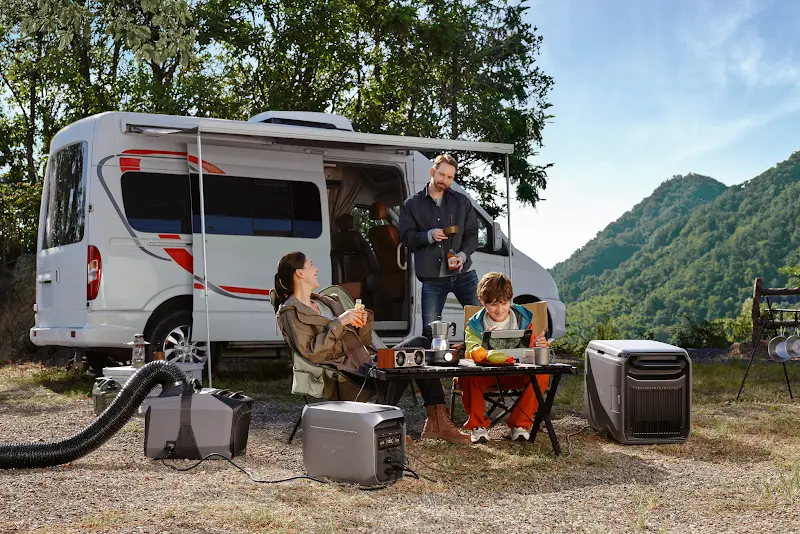
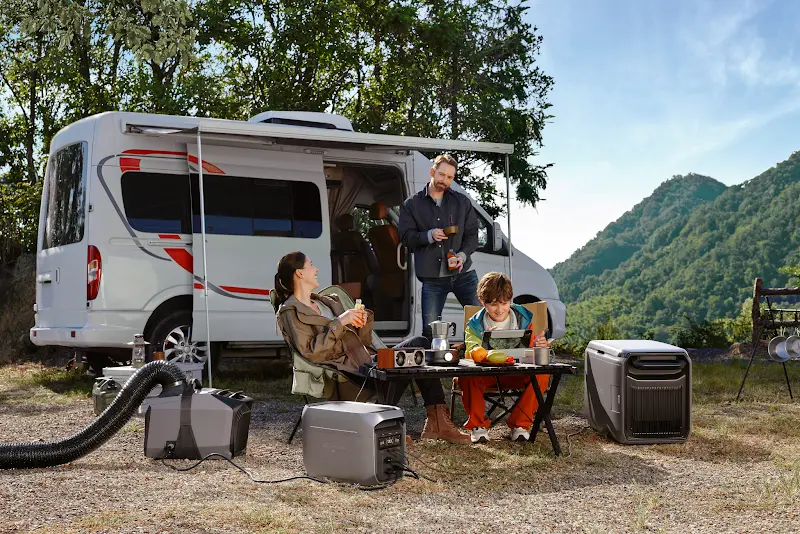
If you’re prepping for an emergency or heading out for a weekend of RV camping, knowing your wattage is the difference between a working campsite and a dead battery. Many people find that once they convert HP to Watts, a flexible, portable power solution is way more practical than a clunky, loud gas generator. For gear in the 1-2 HP range (roughly 750W-1500W), a unit like the EcoFlow DELTA 3 Max Plus Portable Power Station (2048Wh) is built for exactly this kind of load.
It packs a 3,000W AC output and can handle surges up to 6,000W, which is huge for managing the high-torque startup of small motors. Also, it offers a clean, quiet way to keep your gear running without the noise or exhaust of traditional fuel generators.
Estimating Hydro Costs in Canada (kWh Explained)
1 HP motor running for 1 hour ≈ 0.746 kWh.
Utility companies like BC Hydro or Hydro-Québec bill you in Kilowatt-hours (kWh). By converting your high-HP equipment to Watts, you can actually see what it’s costing you to run. For example, a 1 HP motor running for an hour uses about 0.746 kWh. Here’s the key: if you know your local rate, you can forecast your monthly “Hydro” costs before the bill even arrives. In some cases, homeowners integrate a solar generator to offset this consumption during expensive peak-rate periods, using stored energy to power high-HP tools without increasing their hydro bill.
1 HP motor running for 1 hour ≈ 0.746 kWh.
Comparing Equipment Across Regions
Be careful if you’re importing tools from overseas. A “1 HP” motor from a metric-focused region might be slightly lower in wattage around 735W, compared to our North American standard. This can cause weird performance issues on our 60Hz grid. In short, always double check the label for the specific Wattage to make sure it plays nice with your home setup.
What Size Generator or Power System Do You Need? (Based on HP)
Once you’ve done the math, the next step is choosing a system that can actually carry the weight. In Canada, where winter blizzards can knock out the grid for days, a small portable battery just won’t cut it for a whole house.
If you’re running multiple high-HP appliances, like a 1.5 HP well pump, a furnace blower, and a full sized fridge, you need a heavy hitter. The EcoFlow DELTA Pro Ultra Whole-Home Backup Power is designed for these exact high stakes scenarios. It’s a whole home backup system that delivers a massive 7,200W continuous AC output (which you can expand all the way to 21.6kW).
On top of that, consider that it features a 6kWh starting capacity, which is crucial for handling the heavy inductive loads of multiple motors starting at the same time. Even when the temperature hits -20°C, its durable LFP (Lithium Iron Phosphate) battery chemistry and advanced thermal management keep your essential high wattage equipment humming. Here’s the key: it provides that “set it and forget it” peace of mind during a deep freeze. The point is, if you have high-HP gear that simply cannot fail, this is the level of power you should be looking at.
Common Mistakes When Converting HP to Watts
Even with a calculator in hand, it’s easy to trip up on a few technicalities. These little details are usually what lead to buying the wrong generator or constantly tripping a circuit breaker. Avoiding these common pitfalls will help you keep your equipment running smoothly without any unexpected shutdowns.
Ignoring Surge Power: This is the big one. Many HP-rated motors need 2-3 times their running Watts just to start up. This “starting wattage” is a brief, intense spike in energy required to get the motor spinning. Always check the label for “Starting Watts” or “Locked Rotor Amps” (LRA) to ensure your power system can handle that initial burst.
Mixing up kW and HP: It’s a common mix-up, but remember that 1 kW (1,000 Watts) is actually quite a bit more than 1 HP (746 Watts). They aren’t a 1:1 swap. If you have a 2 kW power station, don’t assume it’s the same as a 2 HP motor, you’ve actually got a bit of extra headroom there, which is a good thing!
Forgetting the Environment: While not a math error, remember that high-wattage equipment generates a lot of heat. Since we use Celsius in Canada, keep an eye on those temps. If your motor is working hard in a small garage or a backyard shed during a summer heatwave, you need proper ventilation. Heat increases electrical resistance, which can make your equipment less efficient and more prone to overheating.
HP vs. Watts: Which One Should You Use?
Use Horsepower to measure mechanical capability, like how much a hoist lifts or a saw cuts. It’s all about the machine’s physical output and performance. Switch to Watts for anything electrical, like checking battery capacity or circuit breaker limits. While HP shows what a motor can do, Watts tells you what it takes from your power supply. At the end of day: Use HP for tool muscle and Watts for electrical safety.
Conclusion
Converting HP to Watts is a simple bit of math that saves a massive amount of hassle. By sticking to that golden rule: 1 HP = 746 Watts, you can confidently size your backup power systems, figure out your hydro costs, and make sure your shop tools are actually getting the “juice” they need. To put it simply, that true preparedness requires the right battery for the specific gear you own. Whether you’re tossing an EcoFlow DELTA unit in the truck for a weekend getaway or hooking up a full home backup to survive a winter storm, knowing your power numbers is the first real step toward energy independence. Here’s the key: once you understand the load, you’re in control of the switch. In short, do the math first, and you’ll never be left in the dark.
FAQs
1. Is 1 HP Always Equal to 746 Watts?
In North America, 746 Watts is the standard conversion for mechanical horsepower. While you might see slight variations like metric horsepower (735.5W) or boiler horsepower in specific industries, 746W is the number to use for almost all consumer tools and appliances you’ll find in Canada.
2. How Many Watts Is a 2 HP Motor?
A 2 HP motor is approximately 1,492 Watts. You get this by multiplying 2 by the 746-Watt constant. Just remember that this is the running power; the motor will likely pull more than this during the first second it’s turned on.
3. Can I Use HP to Estimate Electricity Bills?
You definitely can. Convert your gear’s HP to Watts, then divide by 1,000 to get the Kilowatts (kW). Multiply that by your local Canadian hydro rate to see what an hour of run time costs. The reality is that most motors aren’t 100% efficient, so your actual bill might be about 15% higher than the theoretical math suggests.
4. What’s the Difference Between kW and HP?
The main difference is the system of measurement. Kilowatts (kW) is a metric unit, while Horsepower (HP) is imperial. Here’s the key: 1 kW is about 1.34 HP, so a Kilowatt is actually a “stronger” unit than a single Horsepower. The take away here, if you have a 1 kW power station, it can handle a bit more than a 1 HP motor.