Understanding AC/DC Power Supply: Types, Uses, and How to Choose
Brownouts are common in the Philippines, but power concerns are not always about keeping devices running during an outage. A damaged or incompatible adapter can also affect Wi-Fi routers, CCTV cameras, and LED lights, which need the correct voltage and current to work properly.
This guide explains how an AC/DC power supply works, the main types available, and when a portable power station may be the more suitable option.
What Is an AC/DC Power Supply?
An AC/DC power supply converts alternating current (AC) from a wall outlet into the direct current (DC) required by electronic devices. AC is commonly used to distribute electricity through the grid, while a DC power supply provides the direct current required by electronic circuits, battery-powered systems, and low-voltage equipment.
Devices such as Wi-Fi routers, CCTV cameras, laptops, and LED lighting often require power conversion before they can use electricity from an outlet. An external adapter or internal power module converts the incoming AC and regulates the output to match the device’s voltage and current requirements.
An AC/DC power supply may include components such as rectifiers, filters, transformers, and voltage regulators. Together, they convert the incoming electricity and provide a regulated DC output for the connected equipment.
How Does an AC/DC Power Supply Work?
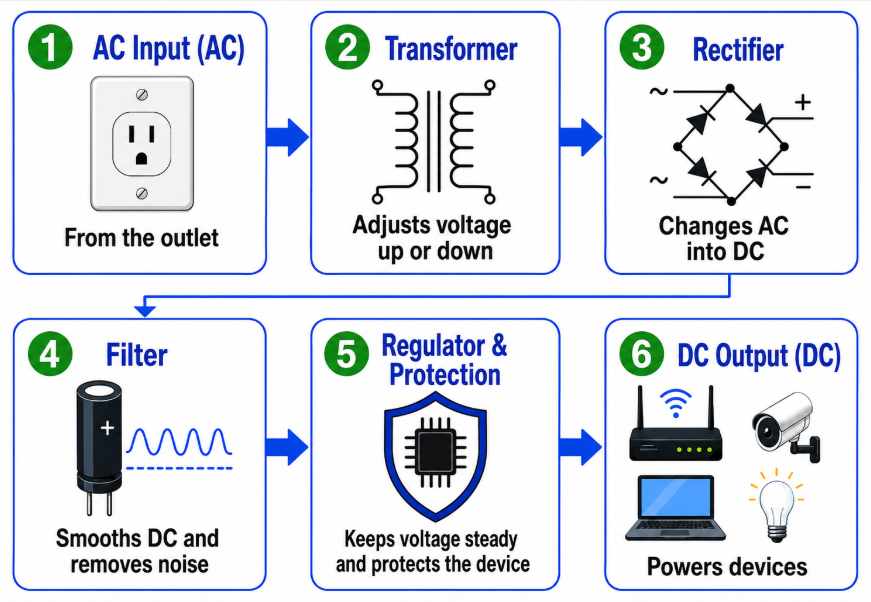
An AC/DC power supply takes AC electricity from a wall outlet and converts it into the lower-voltage DC required by an electronic device. For instance, a Wi-Fi router adapter may receive 230V AC from the outlet and deliver 12V DC to the router.
Although the exact circuit varies, most AC/DC power supplies perform four main functions:
1. Transformer
The incoming AC voltage is adjusted to a more suitable level. In many household adapters, the transformer steps down the outlet voltage before it moves to the next stage.
2. Rectifier
Diodes then change the alternating current into pulsating DC. Electricity now flows in one direction, although the output is still uneven.
3. Filter
Capacitors smooth these remaining fluctuations and reduce ripple and electrical noise. The result is a cleaner DC signal that is more suitable for electronic components.
4. Regulator and Protection
At the final stage, the regulator holds the output near the required voltage even when the input or power demand changes. Protection circuits may also help reduce the risk of damage from short circuits, overload, overheating, or a sudden power surge.
Once the conversion is complete, the adapter supplies the voltage and current required by equipment such as routers, CCTV cameras, laptops, and LED lights. Modern switched-mode power supplies may arrange these stages differently, but they perform the same core tasks of voltage adjustment, conversion, filtering, regulation, and protection.
Common Types of AC/DC Power Supplies
AC/DC power supplies are available in different designs to meet the requirements of various applications. They differ in conversion method, efficiency, size, output noise, enclosure, and intended application. The most common types include linear power supplies, switching power supplies, external adapters, and open-frame power supplies.
AC/DC power supplies are generally grouped by conversion method and physical form. Conversion technology influences efficiency, heat, size, and output noise, while the form factor determines where the unit sits and how its components are protected.
AC/DC Power Supplies by Conversion Method
Feature | Linear AC/DC Power Supply | Switching AC/DC Power Supply (SMPS) |
Size and Weight | Usually larger and heavier | Smaller and lighter |
Energy Efficiency | Generally lower | Generally higher |
Heat Output | Produces more heat | Generates less heat at a similar load |
Output Noise | Typically lower | May produce switching noise |
Main Advantage | Clean, low-noise output | Compact size and higher efficiency |
Main Limitation | Bulkier and less efficient | May require additional filtering |
Linear AC/DC Power Supply
Linear models rely on a transformer, rectifier, filter, and linear regulator to produce DC output. Their low electrical noise makes them suitable for audio equipment, test instruments, and interference-sensitive circuits.
The simpler circuit comes with several trade-offs. These units tend to be bulkier, consume more energy, and release more heat, particularly when the input voltage is much higher than the required output.
Switching AC/DC Power Supply (SMPS)
High-frequency switching allows an SMPS to convert and regulate electricity with smaller transformers and components. This approach provides better efficiency and a more compact size than most linear alternatives.
Laptop chargers, Wi-Fi router adapters, CCTV systems, LED drivers, and communication equipment frequently use this technology. Additional filtering may be required when sensitive circuits need especially low ripple and minimal electromagnetic interference.
AC/DC Power Supplies by Form Factor
Type | Placement | Enclosure | Main Characteristic |
External Adapter | Outside the device | Fully enclosed | Easy to connect or replace |
Open-Frame Unit | Inside the equipment | No complete enclosure | Compact and designed for built-in installation |
Enclosed Unit | Inside or near the equipment | Metal or plastic casing | Offers added physical protection |
DIN-Rail Unit | Inside a control cabinet | Enclosed and rail-mounted | Supports organised panel installation |
External AC/DC Adapter
Placed outside the equipment, an external adapter connects a wall outlet to a low-voltage electronic device. Routers, modems, CCTV cameras, monitors, and LED lights often rely on this familiar plug-in format.
Many models provide 12V DC, but voltage alone does not determine compatibility. Current rating, connector size, and polarity must also match the device specifications.
Open-Frame AC/DC Power Supply
Open-frame units leave their internal components exposed because they are designed for installation inside another product or protective enclosure. This design saves space in displays, appliances, communication equipment, and embedded systems.
Because some components may carry hazardous voltage, installation should be handled by qualified personnel with proper enclosure protection and ventilation.
Enclosed AC/DC Power Supply
A metal or plastic casing shields the internal circuitry from accidental contact and physical damage. Compared with an open-frame unit, this format works better where the converter needs to operate as a separate fixed module.
LED signage, access control systems, security equipment, and commercial installations often use enclosed models. Depending on the power rating, the casing may include ventilation slots, a cooling fan, or terminal connections.
DIN-Rail AC/DC Power Supply
DIN-rail units clip onto a standard metal rail inside an electrical cabinet or control panel. Their narrow shape helps keep wiring organised and makes individual components easier to inspect or replace.
They are frequently found in factory automation, building controls, sensors, telecommunications equipment, and machinery. Common outputs include 12V, 24V, and 48V DC, with 24V widely adopted in control systems.
Where Are AC/DC Power Supplies Used?
Many devices around the home cannot use electricity from a 230V wall outlet directly. An AC/DC power supply changes the incoming AC into the lower-voltage DC required by electronic circuits, either through an external adapter or a converter built into the equipment.
Home Electronics
Laptops, monitors, televisions, game consoles, speakers, and other household electronics contain components that run on DC power. Depending on the product, conversion may happen inside the device or through a separate adapter connected to the outlet.
The output requirements differ between models, so voltage, current, connector size, and polarity should be checked before replacing an adapter.
Internet and Home Security Devices
Wi-Fi routers, modems, CCTV cameras, smart doorbells, and access control devices often operate on 5V, 9V, 12V, or another low DC voltage. Their adapters take AC electricity from the outlet and provide the specific output required by the equipment.
For homes with several security cameras, a central AC/DC unit may supply power to multiple devices instead of relying on a separate adapter for each one.
Lighting and Smart Home Systems
LED strips, cabinet lights, smart hubs, sensors, and selected home automation devices also rely on low-voltage DC electricity. An adapter, LED driver, or built-in converter sits between the wall outlet and the connected equipment.
The power supply must match the required output voltage and provide enough current or wattage for the combined load. An undersized unit may cause unstable operation or overheating.
Chargers and Rechargeable Devices
Phones, tablets, laptops, power banks, cordless tools, and rechargeable household devices store energy in batteries that require controlled DC input. Their chargers convert AC from the outlet and regulate the electricity delivered during charging.
A similar conversion stage is found in some home energy storage systems when they recharge from the grid. The AC/DC circuit prepares the electricity for charging, while the battery stores it for later use.
How to Choose the Right AC/DC Power Supply
The right power supply should match both the device specifications and the installation setup.
Input rating: For use in the Philippines, the unit should support the nominal 230V AC, 60Hz supply. A 100–240V, 50/60Hz input range is also suitable when shown on the product label.
Output voltage: The DC voltage must match the device rating, as excessive voltage may damage the equipment.
Current capacity: For standard adapters, the rated current should meet or exceed the device requirement. When one unit powers several devices, their combined load should remain within its rated output.
Connector and polarity: Check the plug size, pin type, and polarity, since similar-looking connectors may not be compatible.
Design and protection: Choose a model suited to the installation, with protection against short circuits, overload, overvoltage, and overheating.
A standard AC/DC power supply still relies on grid electricity. A UPS or portable power station is more suitable when devices need to remain powered during a brownout.
AC/DC Power Supply vs Portable Power Station
An AC/DC power supply is suitable when a device only needs the correct DC output from an available wall outlet. If the goal is to keep several household devices running during a brownout, a portable power station may be more practical.
Feature | AC/DC Power Supply | Portable Power Station |
Main Function | Converts AC electricity into regulated DC power | Stores electricity and provides AC and DC outputs |
Energy Storage | No | Yes |
Requires Grid Power While Operating | Usually yes | No, once charged |
Typical Uses | Electronics, control systems, LED equipment and battery chargers | Brownouts, outdoor activities and off-grid power |
An AC/DC Power Supply for Direct Power Conversion
An AC/DC power supply is useful when a device needs regular power from a wall outlet rather than backup electricity. This may apply when replacing a lost or damaged adapter, installing a CCTV camera or LED lighting system, or supplying continuous power to equipment such as a Wi-Fi router, monitor, or smart home device.
It is usually the more direct option for one device or a fixed low-voltage setup. Since it does not store electricity, another backup source is still needed if the equipment must remain on during a brownout.
A Portable Power Station When You Need Stored Power
A portable power station is useful when electricity needs to be stored for later use rather than supplied directly from a live wall outlet. At home, it can help keep the internet, lights, phones, electric fans, laptops, and selected appliances running during a brownout. It can also provide convenient power for outdoor gatherings, road trips, remote work, or places where outlets are not readily available.
The EcoFlow DELTA 3 Max Portable Power Station suits households that want flexible power for daily essentials and selected appliances. It can support devices such as a Wi-Fi router, lights, electric fans, laptops, and compatible kitchen equipment during a brownout or when electricity is needed away from home.
Its balance of capacity and output makes it a practical option for families preparing for short to moderate power interruptions without moving to a larger home energy setup.
The EcoFlow DELTA Pro 3 Portable Power Station is better suited to homes that need to operate more devices at the same time or require power for longer periods. It can support larger household loads, including a refrigerator, home office equipment, and selected cooking appliances.
Its expandable capacity also gives households greater flexibility when preparing for extended brownouts, severe weather, or areas where electricity restoration may take longer.
Conclusion
Understanding how an AC/DC power supply works, the types available, and where it is used makes selection easier. The right unit should match the device’s voltage, current, connector, and installation needs, while households that also require stored electricity for brownouts or use away from an outlet may consider a portable power station.
FAQs
What is the difference between AC supply and DC supply?
An AC supply provides an output in which voltage and current periodically change direction, while a DC supply provides current that flows in one direction. AC is commonly used for mains electricity and many motors or appliances, whereas regulated DC is used by electronic circuits, batteries, routers, cameras, LED systems, and control equipment. A DC output is not automatically stable; its voltage stability depends on the regulation and design of the power supply.
Is a 12V power supply AC or DC?
A 12V power supply can be either AC or DC, depending on the device specifications. However, most 12V power supplies used for electronics, LED lighting, cameras, and small devices provide 12V DC output. Always check the label or product specifications to confirm whether the output is AC or DC before use.
How to tell if a power supply is AC or DC?
You can identify whether a power supply is AC or DC by checking the label on the unit. AC output is usually marked with “AC” or a wave symbol (~), while DC output is marked with “DC” or a solid line over a dashed line symbol (⎓). The input and output ratings can also help determine the power type.