DC Generator: Working Principle, Components, Types, and Industrial Applications
DC generators are commonly used where stable direct current helps equipment run more smoothly and efficiently. They support practical needs such as battery charging, control systems, communication devices, and mobile electronics, helping keep essential tools powered in both industrial and everyday scenarios. Understanding how a DC generator works makes it easier to choose the right solution for applications that rely on reliable, direct power.
What Is a DC Generator?
A DC (Direct Current) generator is a device that converts mechanical energy into direct current electricity, providing a steady and reliable flow of power. In the Philippines, DC generators are commonly used in remote barangays, islands, off-grid homes, small businesses, and telecom systems, often paired with battery storage or solar systems to ensure continuous electricity.
Key Components of a DC Generator
Armature (Rotor) – The rotating part where voltage is generated.
Armature Windings – Conductors on the armature where electricity is induced.
Field Winding / Field Magnet – Produces the magnetic field necessary for voltage generation.
Commutator – Converts the induced voltage in the armature into direct current.
Brushes – Transfer current from the rotating armature to the external circuit.
Frame / Yoke – Supports the generator structure and provides a magnetic path.
Poles (Magnetic Poles) – Create the magnetic field that interacts with the armature.
End Bells and Bearings – Support the rotating shaft and ensure smooth operation.
Output Terminals – Connect the generator to external circuits or batteries.
Types of DC Generators
DC generators are classified based on how the field winding is excited and connected.
1. Separately Excited DC Generator
The field winding is powered by an external DC source (not from the generator itself), allowing independent control of the field current and output voltage.
2. Self-Excited DC Generators
In these generators, the field winding is powered by a portion of the generator’s own output, making them the most common type in industrial and practical applications. Self-excited DC generators are further divided into:
Shunt DC Generator – Field winding connected in parallel with the armature; provides a relatively stable output voltage across varying loads.
Series DC Generator – Field winding connected in series with the armature and load; current strengthens the field at higher loads, but voltage regulation is poor.
Compound DC Generator – Combines series and shunt windings for better voltage regulation.
3. Permanent Magnet DC Generator
Uses permanent magnets instead of field windings to produce the magnetic field. Common in small or portable applications, less so in larger industrial machines.
How a DC Generator Works
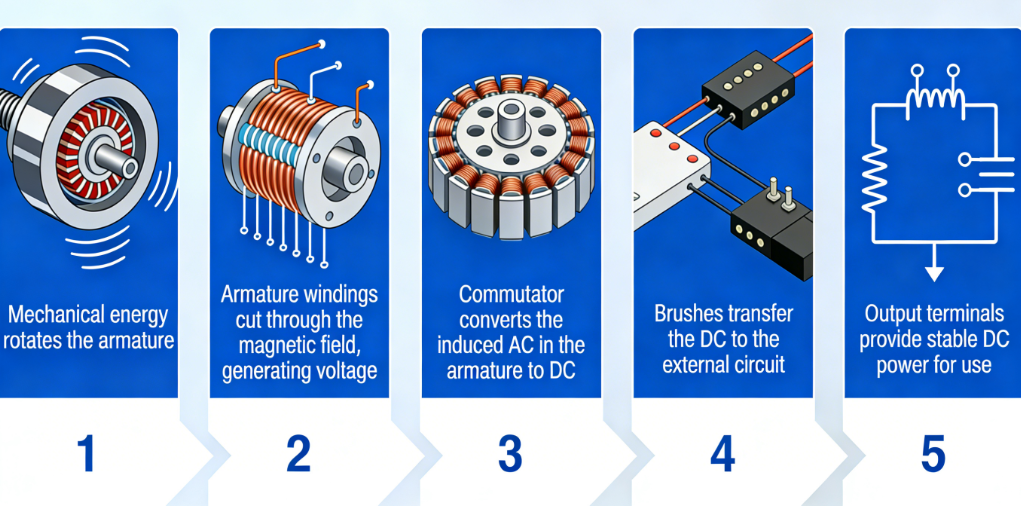
A DC generator converts mechanical energy into direct current electricity through the interaction of a rotating conductor and a magnetic field. Its operation can be explained step by step using its main components:
Rotation of the Armature: Mechanical energy (from an engine, turbine, or motor) rotates the armature inside the magnetic field.
Induction of Voltage: As the armature windings cut across the magnetic flux produced by the field poles and field windings, an electromotive force (EMF) is induced in the windings.
Conversion to Direct Current: The induced voltage in the armature is naturally alternating. The commutator reverses the connections at the right moments to ensure the current flows in one steady direction, creating direct current.
Current Transfer to External Circuit: Brushes maintain contact with the rotating commutator, transferring the DC electricity from the armature to the output terminals.
Power Delivery: The DC voltage is now available at the terminals and can be supplied to batteries, control systems, or DC-powered devices.
Working Diagram
Losses in a DC Generator
When a DC generator converts mechanical energy into electrical energy, some of the input power is not delivered as usable output. These losses occur within the machine’s electrical and mechanical parts, raising the temperature and lowering the efficiency. They are generally classified into four main types:
1. Copper Losses (Electrical Losses)
This is the energy lost as heat in the armature and field windings due to resistance when current flows. It includes:
Armature copper loss — heat in the armature winding.
Field copper loss — heat in the field (shunt or series) winding.
Brush contact resistance loss — voltage drop where brushes touch the commutator.
Copper losses increase with load current and are often the largest portion of total losses.
2. Iron Losses (Core Losses)
These occur in the iron core of the armature as it rotates in the magnetic field. They include:
Hysteresis loss — energy used to repeatedly magnetize and demagnetize the core.
Eddy current loss — currents induced in the iron that create heat.
Iron losses are present whenever the machine operates, regardless of load.
3. Mechanical Losses
These are the energy losses due to physical movement and friction, such as:
Bearing and brush friction — resistance from moving parts.
Windage loss — air resistance from the rotating armature.
Mechanical losses are usually relatively small but still reduce overall efficiency.
4. Stray Load Losses
These are miscellaneous losses that are hard to calculate precisely, caused by effects like:
Flux distortion due to armature reaction.
Short‑circuit currents during commutation.
Stray losses are typically estimated as a small percentage of output power.
Applications of DC Generator
DC generators are most effective for smaller, specialized loads or systems closely tied to electronics, rather than for broad site-wide power distribution.
DC generators are particularly well suited to:
• Battery connected equipment that already runs on direct current
• Control panels and monitoring systems that need a stable DC input
• Telecom and signal equipment where output stability matters
• Field or off-grid setups where compact power is easier to deploy
• Vehicle mounted or mobile applications built around DC hardware
Another practical advantage is that DC generators can reduce extra conversion steps when the end devices already run on direct current. That can make the overall setup cleaner and more efficient in the right environment. For workloads centered on DC devices and mobility, a smaller, purpose-built system often makes more sense—examples include solutions like the EcoFlow TRAIL 300 DC Portable Power Station, which integrates DC generation and storage for off-grid or mobile use.
Not every jobsite needs a full industrial generator. When the load is lighter, the runtime is shorter, and the team cares more about quiet operation, easy transport, and fast setup, a is often the more practical choice. That is
If your work requires more versatile, multi-scenario use, you can consider another portable power station equipped with multiple charging interfaces, such as DC, AC or other ports to support a wider range of devices.
The EcoFlow RIVER 2 Pro Portable Power Station fits this role naturally. It supports AC, car, solar, and USB-C charging, and reaches full charge in 70 minutes. For crews running laptops, cameras, routers, testing tools, or small devices over a shorter working window, that is a far more sensible fit than moving a full industrial unit from one point to another. If that is the direction your workload is already taking, the next useful step is comparing what actually makes the best portable power station for your runtime, charging access, and output needs.
Conclusions
A DC generator delivers stable direct current, ideal for battery-powered devices, control systems, and sensitive electronics. It simplifies power delivery by reducing conversion steps and can support multiple output interfaces for diverse devices. Choosing the right DC generator means matching its capacity and ports to your load and runtime needs. This ensures efficient, reliable operation across mobile, off-grid, or specialized setups.
FAQs
What Is the Main Difference Between AC and DC Generators?
The main difference between AC and DC generators is the type of electricity they produce: AC generators supply alternating current, which is suitable for general household and industrial power distribution, while DC generators provide direct current, ideal for battery charging, telecom systems, and off-grid setups. In the Philippines, DC generators are often used in remote barangays, islands, and small businesses where stable DC power is needed for electronics and solar-battery systems.
Can a DC Generator Charge Batteries Directly?
Yes, a DC generator can charge batteries more directly than an AC unit, but the charging setup still has to match the battery voltage, current range, and charging profile. That matters even more with lithium batteries, which are less forgiving than older battery types. If the output is not regulated properly, charging efficiency drops and battery life can suffer. In practice, output control matters as much as the generator itself.
Is a DC Generator Better for Sensitive Electronic Equipment?
A DC generator can be a good fit for sensitive electronics when the equipment is designed for direct current and needs a stable input. That said, the result depends on power quality, voltage regulation, and load matching, not just generator type. If the DC output fluctuates or the system is poorly configured, electronics can still be affected. For control systems, telecom gear, and monitoring devices, stable, regulated DC is the real priority.
What Maintenance Issues Are More Common With a DC Generator?
A DC generator often needs closer attention to parts involved in current collection and mechanical wear, especially in older designs. Brushes, commutators, heat buildup, and contact surface condition can affect performance over time. If maintenance is delayed, output stability may drop before a full failure happens. For industrial use, regular inspection, cleaning, and load testing are important if the system depends on consistent DC power.