What Are Solar Panels Made Of? A Guide to Their Materials and Layers
Most rigid solar panels combine silicon cells, glass, protective polymers, an aluminium frame and electrical connections. The answer to “what are solar panels made of” varies by design: thin-film panels can use other semiconductors, while flexible models use lighter protective layers. This guide explores these materials, how panels are made, and what Australian buyers should consider about performance, durability and recycling.
Key Takeaways
Most solar panels use silicon cells to generate electricity. Rigid designs commonly use glass and an aluminium frame, while flexible designs can use polymer films and composite reinforcement.
Monocrystalline and polycrystalline panels use crystalline silicon, while thin-film panels can use other semiconductors.
Cell design, protective layers and installation conditions affect efficiency, durability and long-term performance.
Panel wattage describes rated power, not build quality; recoverable materials still need an appropriate recycling route.
What Are Photovoltaic Panels Made Of
Photovoltaic, or PV, describes technology that converts sunlight into electricity. Glass accounts for most of the weight of a typical framed crystalline-silicon panel. The table gives rounded, illustrative ranges drawn from the IRENA and IEA-PVPS 2016 report and a Fraunhofer ISE component example reproduced in its July 2026 Photovoltaics Report using 2021 composition data. These are examples from different designs, not EcoFlow product specifications. They should not be added together as one panel recipe; glass-glass and frameless panels can differ.
Material | Where It Is Used | Illustrative Weight Share |
Glass | Front cover; also the rear in glass-glass designs | 67–76% |
Aluminium | Frame | 8–13% |
Polymers | Cell encapsulant and polymer backsheet | 10–13% |
Silicon | Solar cells | 3–5% |
Copper | Cell interconnections and wiring | About 1% |
Silver | Electrical contacts on cells | Under 0.1% |
Silicon Solar Cells
Crystalline-silicon cells use thin wafers refined from silica-rich quartz. A p–n junction within the cell helps separate charges when sunlight is absorbed, allowing direct current to flow through an external circuit. Metal contacts collect the current, while surface coatings reduce reflection and other losses. Silicon is widely used because it combines abundant raw material with efficient light conversion, durability and established manufacturing processes.
Glass and Protective Layers
Most rigid panels use low-iron toughened glass to transmit light and protect the cells. Encapsulants such as ethylene-vinyl acetate (EVA) or polyolefin elastomer (POE) cushion the cells and bond the layers together. A polymer backsheet provides rear insulation and protection, while glass-glass designs use a second glass layer. With bifacial cells and suitable installation, light reaching the rear can contribute to generation; double glass alone does not make a panel bifacial.
Aluminium Frame and Electrical Components
On a framed rigid panel, an aluminium alloy frame stiffens the panel, protects the glass edges and provides mounting points, with sealant helping close gaps around the edges. Inside, solder-coated copper ribbons commonly connect cells into strings. A junction box on the back connects the output cables and typically contains bypass diodes, which provide an alternative current path around a shaded or underperforming group of cells. They reduce some shading losses but cannot restore the missing sunlight.
Electrical connections also extend beyond the module itself: wiring solar panels in series or parallel changes how panel voltages and currents combine within a system.
How Are Solar Panels Made
The following stages describe a typical framed crystalline-silicon panel. Flexible panels use different protective layers and assembly details.
Stage | Main Materials | What Happens |
Silicon refining | Quartz and silicon | Reduce quartz with carbon to produce metallurgical-grade silicon, then refine it into high-purity polysilicon. |
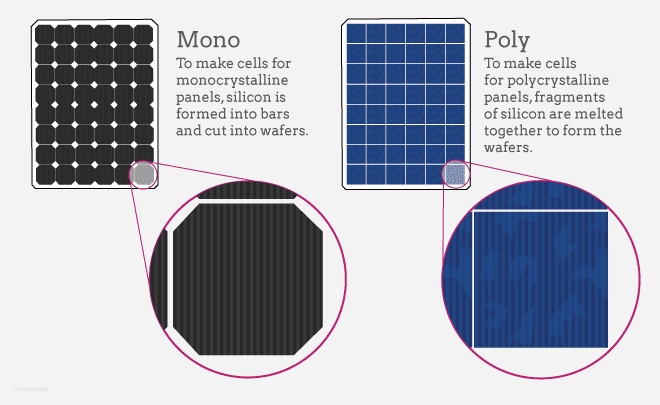
Cell production | Silicon ingots and wafers | For monocrystalline cells, grow a single-crystal ingot and slice it into wafers. Texture, dope and coat the surfaces, then add metal contacts. |
Cell connection | Solar cells and solder-coated copper ribbons | Test and sort the cells, then connect them into strings. |
Protective assembly | Glass, encapsulant and a backsheet or rear glass | Arrange the cell strings between protective layers, then bond the stack using controlled heat and pressure. |
Finishing and testing | Aluminium frame, junction box and cables | Fit the frame and electrical components, then check appearance, insulation and electrical performance. |
Rated output is measured under standard test conditions: irradiance of 1,000 W/m², a cell temperature of 25°C and an AM1.5 reference spectrum. Electroluminescence imaging can also reveal defects such as microcracks that may be difficult to see.
Are All Solar Panels Made From the Same Materials
Not quite. Crystalline silicon remains dominant, but semiconductor materials and cell structures vary between panel types. The July 2026 Fraunhofer ISE Photovoltaics Report reports that silicon wafer-based technology accounted for about 98% of global production in 2025, with monocrystalline n-type TOPCon now the dominant technology.
Monocrystalline and Polycrystalline Silicon Panels
Monocrystalline cells are cut from a single crystal, generally giving them a uniform dark appearance and higher solar panel efficiency. Polycrystalline cells come from cast silicon containing multiple crystals, traditionally producing a speckled blue appearance and lower efficiency. Both use crystalline silicon, but monocrystalline technology now dominates production.
Cell architectures also differ. TOPCon adds a thin tunnel oxide and passivating contact structure to reduce electrical losses; PERC uses rear-surface passivation. Both have strong Australian research links: UNSW identifies early TOPCon work in 1981 and the invention of PERC in 1983. These cell technologies describe the electrical design of the cell, rather than whether the finished module uses a rigid frame or flexible protective layers.
Thin Film Solar Panels
Thin-film panels are built by depositing semiconductor layers on a supporting surface rather than slicing cells from a crystalline-silicon ingot. Materials include cadmium telluride (CdTe), copper indium gallium diselenide (CIGS) and amorphous silicon. Their construction can therefore differ from conventional crystalline-silicon modules, although they still need protective layers and electrical connections. 'Flexible' describes a module’s construction, not its semiconductor technology; flexible panels can also use crystalline-silicon cells.
How Do Materials Affect Performance and Durability
The materials inside a solar panel affect how it converts sunlight, withstands exposure and retains its shape. Each part contributes differently to performance and durability:
Solar cells: The semiconductor material and cell design influence conversion efficiency and how electrical output responds to temperature.
Protective layers: Glass, polymer films and encapsulants transmit light and help protect the cells from physical damage and moisture. Their effectiveness depends on the complete protective structure, including its seals.
Frames and reinforcement: Aluminium frames provide stiffness and mounting points, while composite reinforcement can support lighter, flexible construction. These choices affect weight, shape and handling requirements.
EcoFlow’s panels illustrate how these material choices translate into practical considerations. The 400W Rigid Solar Panel has a power temperature coefficient of −0.38%/°C, compared with −0.39%/°C for the 100W Flexible Solar Panel. These describe approximate relative changes in maximum power per 1°C change in cell temperature from the 25°C reference, with other conditions held constant.
Both panels have an IP68 rating tested under IEC 60529 at a maximum water depth of 1 m for up to 72 hours. This describes laboratory-tested resistance to dust and water ingress; it does not establish impact resistance or the protection of every connector in an installed system. Correct mounting, support and ventilation remain important when choosing where to use either construction.
EcoFlow 400W Rigid Solar Panel
The EcoFlow 400W Rigid Solar Panel uses a conventional glass-fronted, aluminium-framed construction around its monocrystalline cells. The frame supports the finished module and provides mounting points, while the rigid construction gives the panel a fixed shape. This format is worth considering for fixed off-grid installations with a suitable supporting structure. When choosing a panel, consider how its outer materials protect the cells and contribute to the complete module’s weight, then check the available mounting area and structural support.
EcoFlow 100W Flexible Solar Panel
Monocrystalline-silicon cells can also be incorporated into flexible modules. The EcoFlow 100W Flexible Solar Panel uses laminated composite protection to create a conformable panel for suitably supported curved surfaces. This format is relevant where surface shape and added weight matter, such as a campervan roof. Its silicon cells still require careful handling, so assess the finished module’s protective construction and follow the manufacturer’s handling, support and ventilation instructions when deciding where to use it.
Choosing Between EcoFlow Rigid and Flexible Solar Panels
What Matters for Your Setup | EcoFlow 400W Rigid Solar Panel | EcoFlow 100W Flexible Solar Panel |
Suitable application | Fixed installations with enough space and structural support | Weight-sensitive applications with suitably supported curved surfaces, such as campervan roofs |
Material and structure | Glass cover and aluminium frame provide a stiff, fixed shape | ETFE protective film and glass-fibre composite construction allow the panel to follow suitable curves |
Rated output and weight | 400W and approximately 21.8 kg per panel | 100W and approximately 2.3 kg per panel |
Choose it when… | You need higher rated output per panel and can accommodate its dimensions and weight | Lower added weight and conformity to the mounting surface are priorities |
Mounting considerations | Confirm compatible brackets, fixings and structural support | Follow the manufacturer’s bending, support and ventilation requirements |
Package and mounting note: The Australian 400W rigid-panel pack contains two 400W panels, while the 100W flexible-panel package contains one 100W panel. Rigid-panel mounting feet are sold separately, with two sets required for two panels. Confirm compatible brackets, fixings or adhesive requirements before ordering, and follow the installation instructions for support and ventilation.
Can Solar Panel Materials Be Recycled in Australia
Glass, aluminium, copper and silicon can be recovered from solar panels, although recovery methods and material quality vary. Before arranging disposal, ask your installer or council which local facilities accept panels, whether collection is available and what fees apply. Check that a service specifically accepts solar panels rather than assuming every e-waste drop-off point does.
The Australian Government’s solar panel recycling guidance notes that some states and territories ban panels from landfill. For fixed rooftop systems, arrange removal by a licensed electrician and confirm the collection route before work begins. A panel’s recyclable content does not guarantee that all its materials will be recovered.
Conclusion
Knowing the answer to “What are solar panels made of?” helps you compare the cells and the protection around them. Rigid and flexible designs can share the same silicon technology while using different outer materials, weights and forms. Match that construction to the intended use, check the model’s electrical and mounting requirements, and plan an accepted reuse or recycling route when replacing older panels.
FAQs
What is the lifespan of a solar panel?
For solar panels in rooftop systems, the Australian Government gives an average lifespan of 20–30 years. A product warranty covers specified defects; A performance warranty describes permitted output degradation. These are different promises. Check the particular model’s terms rather than assuming every panel has the same warranty or guaranteed output after 25 years.
Why are people getting rid of their solar panels?
Some owners replace damaged or underperforming panels, while others upgrade to increase system capacity or make better use of limited roof space. Removal does not always mean a panel has stopped generating. Before replacing an array, ask an installer to diagnose the system: a fault may be in the inverter or another component. Safe, serviceable panels may have reuse options; unsuitable panels need an appropriate recycling route.
Is it true that solar panels are bad for the environment?
Solar panels have environmental impacts from mining, manufacturing, transport and disposal. They also generate electricity without burning fuel during operation and can repay the energy used to manufacture them over their working life. The overall impact depends on manufacturing methods, installation and service life. Keeping functioning panels in use and arranging responsible end-of-life recovery helps reduce waste and recover useful materials.
What will happen to solar panels after 25 years?
They do not automatically stop working at 25 years. Output generally declines with age, and some panels can remain useful beyond a performance-warranty period. Whether to keep them depends on safety, condition and useful energy production. Have an installer assess cracking, damaged connections or unusual performance losses rather than replacing panels solely because they have reached a particular birthday.
Are rigid and flexible solar panels made from the same materials?
Many rigid and flexible panels use crystalline-silicon cells, but their protective construction differs. Rigid modules commonly use glass and an aluminium frame, while flexible modules can use polymer films and composite reinforcement. The semiconductor material alone therefore does not determine whether a panel is rigid or flexible. Follow the model’s handling and mounting instructions, including its requirements for support and ventilation.
Do solar panels contain rare-earth metals?
Standard crystalline-silicon panels do not generally rely on rare-earth elements. Their main electrical materials include silicon, copper, silver and aluminium. Thin-film technologies may use tellurium, indium or gallium, which are not rare-earth elements. “Critical mineral” and “rare earth” are different categories; a material can be important to solar manufacturing without belonging to the rare-earth group.