Ultimate Guide to Dual Battery Systems for 4x4s & Campers
Power has become essential for modern off-road travel and camping. Whether you drive a 4WD, RV, or Campervan, you need stable power. Long trips and overnight camping require reliable electricity. Onboard devices also need continuous power.
To prevent insufficient vehicle power and main battery over-discharging, the Dual Battery System has become an ideal solution.
This article explains how a dual battery system works. It also shows when you may need one. You will learn how smart energy storage makes vehicle power easier and safer to use.
Dual Battery System Basics & Components
What Is a Dual Battery System
A dual battery system uses two batteries in single vehicle to separate power roles. The starter battery is reserved for engine ignition and essential vehicle functions, while the auxiliary battery supplies power to accessories such as a fridge, lights, and charging devices. This ensures reliable starting while providing stable off-grid power for touring and camping.
Key Components
Starter Battery – Dedicated to cranking the engine and running factory electronics; it remains protected from accessory loads to avoid a flat start battery.
Auxiliary Battery – Stores energy for fridges, lighting, inverters, and device charging, supporting extended off-grid use without affecting vehicle start-up.
DC-DC Charger – Regulates charging from the alternator, delivering the correct charge profile and ensuring the auxiliary battery reaches full capacity while driving.
Battery Isolator – Automatically separates the two batteries when the engine is off, preventing accessory use from draining the starter battery.
Fuses & Wiring – Sized to handle current safely, protecting the system from short circuits and voltage drop, which is critical in high-load 4WD setups.
Battery Monitor – Provides real-time voltage and state-of-charge data, helping users manage power consumption and avoid over-discharge.
How a Dual Battery System Works
With a clear understanding of a dual battery system and its core components, we can now explore how it operates in practice.
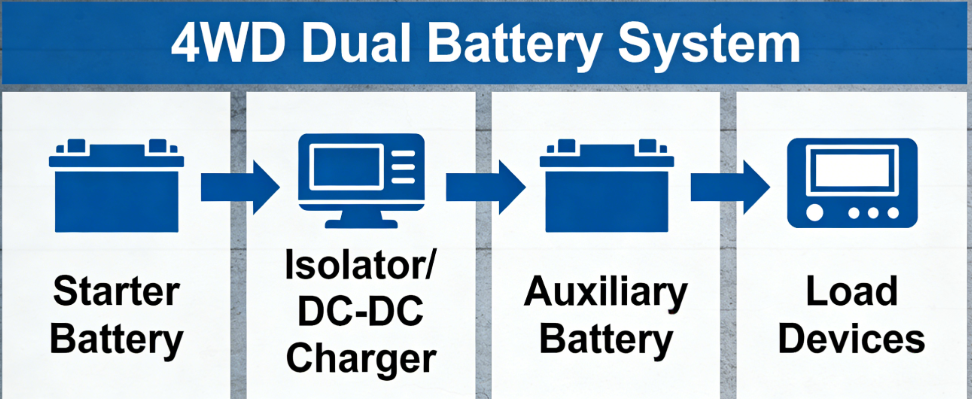
1. Starter Battery – Engine & Essentials
The starter battery connects directly to the vehicle’s ignition and essential electronics, ensuring the engine always starts.
2. Charging Path – Isolator / DC-DC Charger
A battery isolator or DC-DC charger links the starter battery to the auxiliary battery, safely managing charging while the engine is running.
3. Auxiliary Battery – Power for Accessories
Power flows from the auxiliary battery to onboard devices such as fridges, lights, chargers, and other camping or touring gear.
4. Vehicle Off – Independent Operation
When the vehicle is turned off, the isolator prevents auxiliary loads from draining the starter battery, allowing the auxiliary battery to operate independently and keep your devices running.
Short Wiring Route Diagram
Why a Dual Battery System Matters
For Australians exploring the outback, remote coastlines, or national parks, a single starter battery simply can’t keep up with modern touring and camping demands.
Starter Battery Protection – Camping gear like fridges, lights, pumps, and inverters draws power from the auxiliary battery, ensuring your starter battery stays fully charged for morning engine starts.
Consistent Power for Devices – A dedicated deep-cycle or lithium auxiliary battery provides stable voltage, so your fridge, lights, and electronics run reliably without interruptions.
Longer Battery Life – By keeping heavy loads off the starter battery, both batteries last longer, and the auxiliary battery is built to handle many charge cycles, reducing replacement frequency.
Off-Grid Flexibility – You can easily add solar panels, extra outlets, or an inverter, giving peace of mind that your vehicle has a safe, managed 12 V power supply while exploring remote areas.
How to Choose the Right Dual Battery System
The key to choosing a suitable dual battery system is to judge based on your actual travel needs and electricity consumption habits:
1. Types of Electrical Equipment
Low-power devices: Medium-capacity batteries like the EcoFlow DELTA 3 Plus+1000W Alternator Charger a dual battery system that can be recharged while driving on weekend trips or short off-road camping. While the vehicle is running, the alternator helps replenish the system, maintaining auxiliary power without affecting vehicle startups.
High-power devices: Larger-capacity batteries such as the EcoFlow DELTA 2 Max + 800W Alternator Charger can be quickly topped up during long drives, keeping high-demand systems charged and ready. Whether on multi-day outback trips or extended RV journeys, the alternator maintains independent auxiliary power, so you can focus on driving and camping without worrying about depleting your main battery.
2. Travel Frequency & Duration
Short or occasional use only requires a medium-capacity system that can handle daily lighting, fridge, and device charging. For example, a compact plug-and-play package with moderate power is ideal.
Frequent or long-duration use demands higher capacity to support multiple devices and longer runtimes. A larger system with high output ensures safe, independent auxiliary power for extended operation.
This also helps estimate the generator size you need if adding solar or extra charging sources.
3. Intelligent Management & Expansion
Systems with intelligent monitoring or APP control make it easier to track battery level and load.
For future expansion, such as adding solar panels or additional devices, choosing an expandable system provides more flexibility.
4. Installation & Operational Convenience
Plug-and-play systems simplify setup and reduce maintenance.
Traditional isolator + secondary battery setups are also an option for experienced users, but they require regular inspection and maintenance.
Where to Install a Second Battery
The auxiliary battery can be installed in several locations depending on vehicle type and available space:
Under the Bonnet – Convenient for wiring to the starter battery, common in many 4WDs.
In the Tray or Cargo Area – Ideal for dual-cab utes or campervans, keeps heat away from the battery and allows for larger capacity units.
Inside a Custom Battery Box – Often used in caravans or overland rigs to protect the battery and integrate fuses, isolators, and monitors.
Conclusion
In off-road, camping, and RV travel, traditional dual battery systems can provide basic protection, but installation is complex and lacks intelligent management.
The intelligent dual battery system solution meets different travel scenarios through energy storage management, APP monitoring, and solar compatibility. These features make off-road, camping, and RV travel safer, more flexible, and convenient.
FAQs
Are dual battery systems worth it?
If you frequently travel off-road, camping, or in an RV, the secondary battery can provide continuous power to protect the main battery from starting. At the same time, with the EcoFlow energy storage solution, it is more convenient and flexible, making travel more reassuring.
Can you run two batteries with one alternator?
Traditional systems require isolators or DC-DC chargers for safe charging, while the EcoFlow 800W/1000W Alternator Charger can automatically charge, with simple operation, worry free and safe.
What is the benefit of a dual battery?
The auxiliary battery can extend the power consumption time, protect the main battery from starting, and support multiple devices to use power simultaneously. When used with EcoFlow batteries and solar panels, it becomes cleaner and more flexible.
How to arrange the dual battery system wiring diagram?
Connect the main battery to an isolator or DC-DC charger, and then connect the auxiliary battery and load equipment. The EcoFlow solution does not require complex wiring and can be easily operated by C-end users.
Which cars are suitable for installing a Dual Battery System?
4WD, 4x4, and Campervan models are all suitable. The secondary battery can provide stable power during camping or off-road, making the journey more reassuring and the equipment more durable.